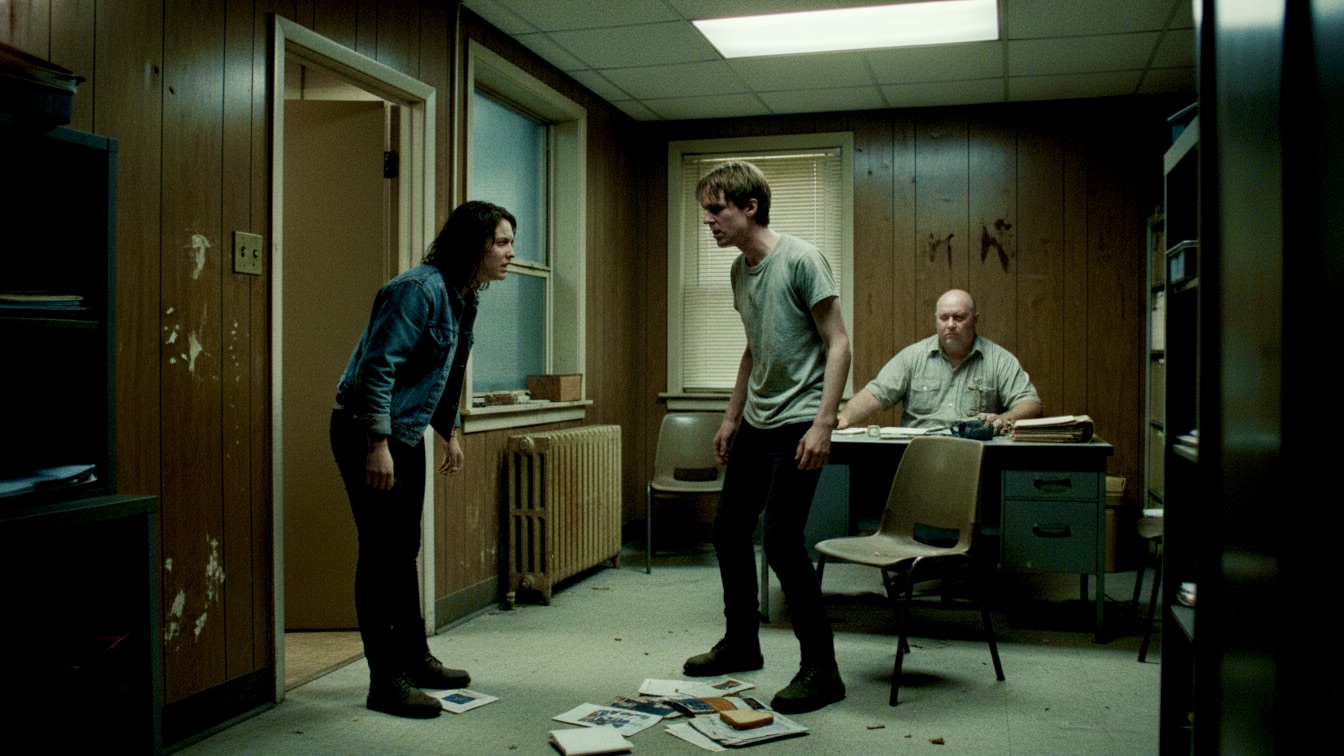
The oppressive quiet of a failing art gallery in the dead of winter, where the cold seeps through the floorboards and dust motes dance in the weak afternoon light. The air is thick with the scent of turpentine and brewing failure. Later, the scene shifts to a cramped, dingy recruitment office that smells of stale smoke, cheap coffee, and desperation.
The silence in the gallery was a physical weight. After Jack had gone, leaving the rolled-up blueprints on her desk like an unexploded ordinance, Debbie had tried to work. She’d tried to answer emails, update the inventory spreadsheet, and pretend the yawning emptiness of the space wasn't swallowing her whole. But every tap of the keyboard echoed. The drip from the ceiling into the bucket near the east wall sounded like a ticking clock, counting down the seconds to her inevitable failure. Her own breathing was too loud, a ragged counterpoint to the gallery’s funereal quiet.
She pushed back from her desk, the chair’s wheels screeching on the warped floorboards. She paced. From the frosty front windows to the back storage room, a ten-step circuit of her own cage. Her thoughts were a frantic, looping reel of Claire’s warnings, Evan’s smarmy proposals, and now Jack’s quiet, wounded intensity. He’d tried to give her something—a warning, a piece of a puzzle—and she’d thrown it back in his face. Not because she didn't believe him, not really. But because his problem was messy and vast and bled into the city’s deep-seated rot, and she was already drowning in her own small, contained disaster. She didn’t have the bandwidth for anyone else’s apocalypse.
But the cylinder of paper on her desk mocked her. It was a tangible representation of her refusal to see beyond her own walls. She stopped her pacing and stared at it. It was just a roll of paper. Technical drawings. Lines and numbers. It couldn't hurt her. Yet she felt a profound reluctance to touch it, as if it would burn her fingers. It was his problem. Not hers. She had enough liabilities.
Frustration boiled over into a sudden, kinetic need for order. If she couldn't fix the gallery, she could at least clean her desk. She swept a pile of invoices into a drawer, slammed it shut. She stacked a teetering column of art magazines, their glossy covers showcasing artists who were successful, solvent, somewhere else. Underneath them was a half-eaten protein bar and a stained coffee mug. She grabbed the mug and the wrapper, marching to the small kitchenette in the back. As she scrubbed the mug with a stiff, worn brush, she saw her reflection in the dark, unlit window over the sink: a pale, pinched face, dark circles under her eyes. She looked brittle. She looked like she was about to snap.
Returning to the desk, she found her manufactured fury had dissipated, leaving only a hollow exhaustion. The blueprints were the last thing left. The only piece of clutter remaining. With a sigh that felt like it came from the soles of her feet, she picked them up. The paper was heavy, expensive. Not the flimsy stuff you got from a copy shop. She slid off the rubber band holding them rolled. It snapped against her wrist, a tiny, stinging punishment.
She spread the sheets across the clear space on her desk, weighting the curling corners with her stapler, her phone, the heavy tape dispenser. The first sheet was a site plan. A grid of streets she recognized, a familiar slice of the warehouse district. The lines were sharp, blue on white, precise and emotionless. Her eyes scanned the technical jargon in the margins, the neatly printed legends. Zoning codes, material specifications, electrical grids. It was a language she didn't speak, but she could read the map. She traced a street with her finger. Logan Avenue. Then another, intersecting it. Princess Street. The corner where the old textile mill had burned down two months ago.
Her breath caught. That was a coincidence. Just a coincidence.
She moved to the next sheet. It was a floor plan for a new structure. A multi-level building labeled ‘NORTH STREAM HOLDINGS – PROPOSED RETAIL/CONDO DEVELOPMENT 04B’. The name meant nothing to her, but the shape of the building’s footprint was familiar. It perfectly filled the lot where the textile mill used to be. She flipped back to the site plan. There was the lot, outlined in a faint dotted line, marked for demolition. The date in the bottom corner of the drawing was from six months ago. They had plans for the land long before the fire.
Okay. That was… unsettling. Developers were vultures. Everyone knew that. They circled dying properties. It didn’t prove anything. It was just ugly business.
But Jack’s face swam in her memory. The earnestness in his eyes. They’re not random. He had said it with such certainty. She had dismissed it as paranoia, the lonely musings of a night-shift clerk with too much time on his hands.
She unrolled the third sheet. It was another new development. Same company, North Stream Holdings. This one was larger, a sweeping L-shaped building that was slated for a different block, a few streets over. She knew the area. It was a collection of derelict warehouses, a fish processor that had been shuttered for years, and a small brick building that housed a co-op of woodworkers. A fire had gutted the fish processor just last week. She’d seen the smoke from her apartment window, a greasy black plume against the grey winter sky. She remembered feeling a brief, detached sadness for the city before turning back to her own problems.
Her heart started to beat a little faster. The cold in the gallery seemed to intensify, seeping into her bones. This was more than a coincidence. This was a pattern. A blueprint for gentrification, written in fire and ash. The city saw urban blight; North Stream Holdings saw a portfolio of acquisitions, cleared and ready for development. The fires weren't just clearing buildings; they were clearing the way.
And Jack had seen it. He, who worked a dead-end job and spent his nights watching the city through the plate-glass window of a convenience store, had seen the pattern that had eluded everyone else. The city planners, the fire marshals, the journalists. He’d seen it, and he’d tried to show her. He’d brought the evidence to her gallery, a place supposedly dedicated to seeing the world differently, and she had shown him the door.
Guilt hit her like a physical blow, a nauseating wave that made her sit down hard in her chair. She felt small. Petty. Her financial anxieties, which had felt so monumental moments before, now seemed like a spoiled child’s tantrum in the face of this cold, calculated destruction. She had been so wrapped up in the potential death of her little gallery that she hadn’t been able to see the very real death of her city, happening right outside her door. She remembered the condescending tone of her voice, the impatience in her posture as she’d brushed him off. The memory made her skin crawl with shame.
She had to find him. She had to apologize. It wasn’t just about being right or wrong anymore. It was about acknowledging that she had been so lost in her own fear that she had failed to see someone else’s truth. Someone who was trying to do the right thing, in his own quiet, fumbling way.
She grabbed her coat, not bothering to straighten the blueprints. They lay open on her desk, a stark, geometric confession. She didn’t even lock the gallery door behind her, just pulled it shut. The cold hit her instantly, a brutal shock. The wind howled down the street, whipping her hair across her face and making her eyes water. She pulled her scarf up over her nose and mouth, the wool scratching her chin, and started walking, leaning into the wind, her boots crunching on the salt-strewn pavement. The Stop-N-Go. He would be there. It was his world. She walked faster, the urgency a fire in her chest, a desperate need to undo the damage, to tell him that he wasn't crazy. To tell him she finally saw it too.
*
The walk from the alley had been a blur of shivering and shame. Each crunch of Jack’s boots on the snow was a reminder of the guard’s dismissal, the ease with which he had been neutralized. He wasn't a threat. He was a joke. A kid digging in the dirt. Humiliation was a physical coating on his skin, colder than the wind. He kept his head down, his hands shoved deep in his pockets, fingers curled around the useless weight of the silver lighter. It wasn't a clue. It was a souvenir of his own impotence.
He didn't walk home. His apartment, with its thin walls and the ghost of his father in every corner, was the last place he wanted to be. He just walked. He let the grid of the city pull him along, past darkened storefronts and bus shelters plastered with peeling ads. The city felt alien, a hostile landscape he had completely misunderstood. He’d thought he knew its secrets, its rhythms. He’d thought by watching, by paying attention, he was a part of it. But he was just a spectator, and he’d gotten too close to the stage. The guard had been a stagehand, efficiently and impersonally shoving him back into the audience.
This one is heavy. It will break your back. Ahmed’s words. He had been so arrogant to think he could carry it. His father had tried to carry it, and it had crushed him. Who was Jack to think he was any stronger?
He passed a community bulletin board outside a laundromat, its cork surface layered with years of ripped flyers. A brightly colored poster, garish against the grimy snow, caught his eye. It showed a stylized drawing of a massive pine tree and a man in a hard hat, smiling. ‘FIND YOUR FUTURE IN THE NORTH WOODS!’ the headline screamed in bold, friendly letters. ‘MANITOBA LOGGING CONSORTIUM – HIRING NOW! NO EXPERIENCE NECESSARY. TRANSPORTATION AND LODGING PROVIDED.’ Below, an address for a local recruitment office and a phone number.
He stopped. He stared at the smiling man on the poster. The man looked strong, capable. His work was simple: cut down a tree. There was no ambiguity, no hidden blueprints or corporate assassins. There was just the tree, the saw, and the honest exhaustion at the end of the day. It was the complete opposite of his own life, a life spent deciphering whispers and connecting invisible dots that led nowhere but to a snowy alley and a shove in the back.
An idea, cold and sharp as an icicle, formed in his mind. Leaving. Not just his apartment, not just his job. Leaving the city. Erasing himself from the equation. North Stream Holdings, the fires, his father’s memory—they couldn’t break his back if he wasn't here to carry them. It was a coward’s solution, and he knew it. But the relief it offered was seductive, a powerful narcotic. To be somewhere else, to be someone else. Someone whose only job was to swing an axe. Someone who was too tired at the end of the day to think.
He pulled out his phone, his fingers stiff and clumsy with cold, and typed the address from the flyer into his map app. It wasn't far. A fifteen-minute walk. He didn't hesitate. He just turned and started walking again, this time with a destination. Each step felt both like a surrender and a liberation. He was giving up. He was also, finally, doing something. He was taking the one piece of himself he had any control over—his physical presence—and removing it from the board entirely. He was becoming a liability to no one.
The recruitment office was on the second floor of a tired-looking brick building sandwiched between a payday loan office and a boarded-up vape shop. The stairwell smelled of wet wool and stale cigarette smoke. The door at the top of the stairs was unmarked except for a piece of paper taped to it, the same flyer from the bulletin board, its colors already fading.
He pushed the door open. The room was small and suffocatingly hot, the ancient radiator in the corner hissing and clanking like it was about to explode. The air was thick with the smell of burnt coffee and printer toner. A single desk was pushed against the far wall, behind which sat a man who looked as worn out as the furniture. He had a grey, sagging face, a coffee-stained tie loosened at his thick neck, and the profoundly bored eyes of someone who had heard every hard-luck story in the book.
“Help you?” the man asked, his voice a gravelly monotone. He didn't look up from the crossword puzzle he was doing.
“The… the logging job,” Jack mumbled, his voice sounding thin in the stuffy room. He felt suddenly foolish, like a kid playing dress-up. His parka felt too thin, his problems too vague and urban for a place that promised the rugged simplicity of the north woods.
The recruiter finally looked up. His eyes did a quick, dismissive scan of Jack’s frame. He seemed to take in the slender build, the worn-out jeans, the nervous energy humming off him. He grunted. “You ever run a chainsaw for ten hours in twenty-below?”
“No,” Jack admitted.
“You ever buck logs till your arms feel like they’re gonna fall off?”
“No.”
“You like mosquitos? Black flies? Living in a bunkhouse with twenty other guys who haven’t showered in a week?”
“I don’t know,” Jack said, feeling his resolve start to crumble under the man’s weary cynicism.
The recruiter sighed, a long, rattling exhalation. He gestured with a thumb towards a hard plastic chair against the wall. “Sit down.” He pulled a sheaf of papers from a messy stack and slid it across the desk along with a cheap blue ballpoint pen, the cap already chewed to shreds. “Read that. It’s the contract. Pay’s in there. Rules are in there. Everything you need to know. You sign on for a minimum six-month term. You quit before that, you pay your own way back from wherever we stick you. Which, I guarantee, is the middle of nowhere. You still interested, you sign the last page. Bus leaves Sunday morning, five a.m.”
He dropped his eyes back to his crossword puzzle, the interview apparently concluded. Jack picked up the papers. The cheap paper was warm from sitting near the radiator. He sat in the designated chair. It wobbled under his weight. He started to read. The language was dense, legalistic. Clauses about workplace safety, grounds for dismissal, liability waivers. It was a contract designed to protect the company, not him. It was a document that turned a person into a unit of labor, a pair of hands to be used up and, if necessary, discarded.
It was perfect.
He read through the details. The pay was decent, more than he made at the Stop-N-Go. The work was described in stark, unappealing terms. It sounded brutal. Mind-numbingly physical. He thought of the security guard, the effortless way he’d been handled. The man had a physical authority Jack completely lacked. Maybe this was how you got it. By breaking your body against the world until it became hard. By trading thoughts for muscle, anxiety for exhaustion.
This was penance. It wasn’t just an escape; it was a punishment. A punishment for his weakness, for his failure to protect his father’s memory, for his inability to do anything with the truth except get himself thrown in the snow. He deserved this. He deserved to be shipped to the middle of nowhere, to freeze and ache and work until he was too tired to dream. He deserved to be just a body, because his mind had failed him at every turn.
He flipped to the last page. There was a line for his printed name, a line for his address, and a line for his signature. He stared at the empty space. Signature. A single motion of his hand that would change everything. He clicked the pen. The sound was unnaturally loud in the silent office. He leaned over the arm of the chair, using his thigh as a makeshift desk, and filled in his name and address in shaky block letters. All that was left was the signature.
He held the pen over the line. The blue plastic felt slick in his sweating fingers. He could feel his heart thudding against his ribs. This was it. The point of no return. He could sign, and vanish. Or he could walk out, back into the city that was trying to erase him, back to the life that was crushing him.
The smiling man on the poster had seemed to promise a future. But Jack knew what this was. It was an abdication of one. He pressed the tip of the pen to the paper. The ink was a tiny, dark pinprick on the page, the beginning of a decision.
*
The automatic door of the Stop-N-Go hissed open, letting in a swirl of frigid air and Debbie’s frantic energy. The place was exactly as she remembered it: too bright, too quiet, smelling of stale coffee and disinfectant. The slushie machine gurgled in the corner, its lurid colors a stark contrast to the grey world outside.
Miles was behind the counter, leaning on his elbows, staring at his phone with a slack-jawed intensity. He didn't look up when she came in.
“Is Jack here?” she asked, her voice sharp with urgency. She walked right up to the counter, her hands braced on the sticky surface.
Miles finished whatever he was watching on his phone before slowly raising his head. His eyes were flat, disinterested. “Nope.”
“Is he on break? In the back?” she pressed, annoyance rising in her chest. She didn't have time for this.
“Called in sick,” Miles said with a shrug, his gaze already drifting back to his phone. “Said he wouldn’t be in tonight. Or maybe ever. Sounded weird.”
“What do you mean, ‘weird’?” The word sent a jolt of alarm through her. It wasn’t like Jack to call in sick. He was infuriatingly reliable.
Miles shrugged again, a gesture that managed to convey a universe of apathy. “I dunno. Just… quiet. Said he had to take care of something. Something personal. Whatever. Means I’m stuck here for a double.” He finally pocketed his phone and began to half-heartedly wipe down the counter with a damp, grey rag, pushing smeared grime around in circles.
“Did he say where he was going?” Debbie asked, her voice rising in pitch. Panic was beginning to claw at the edges of her guilt. She had a sudden, horrible vision of Jack going back to that alley, confronting the security guard, getting himself seriously hurt.
“Look, lady, I’m not his secretary,” Miles drawled, his tone dripping with resentment at having to engage in a prolonged conversation. “He called, he said he’s out, that’s it. End of story. You want a Taquito?” He gestured with his head toward the greasy roller grill where withered-looking sausages sweated under a heat lamp.
The casual disinterest was infuriating. She felt like screaming. She wanted to grab him by his stained uniform and shake him. But it wouldn’t do any good. He didn’t know anything. And he wouldn’t care if he did.
“No,” she said through gritted teeth. “I don’t want a Taquito.”
She turned and stormed out, the door hissing shut behind her. Back on the street, the wind felt even colder. Called in sick. Or maybe ever. Miles’s words echoed in her head. This was wrong. This was all wrong. He wasn't sick. He was running. And it was her fault. She had been the last person he’d reached out to, and she had pushed him away. She had made him feel crazy, isolated. And now he was gone.
But where would he go? He didn’t have a car. His whole life, as far as she knew, was contained within a few blocks of this neighborhood. He wouldn’t just disappear. He had to be somewhere.
She stood on the sidewalk, indecisive, a plume of her own breath fogging in front of her face. She felt a desperate, clawing helplessness. How do you find someone who doesn’t want to be found, in a city that’s indifferent to his existence? She thought about calling the police, but what would she say? That a guy she barely knew, who she’d been rude to, had called in sick to his job? They would laugh at her.
She started walking again, aimlessly this time, her mind racing through possibilities. His apartment? She didn't know where he lived. Ahmed, the musician on the corner? Maybe he would know something. But he wasn’t at his usual spot; the cold had likely driven him indoors.
She was walking past a row of struggling businesses, their windows dusty and their signs faded. A tax preparer. A laundromat. A recruitment office for something called the ‘Manitoba Logging Consortium.’ A flyer was taped to the glass door, the smiling, hard-hatted man promising a new future. It was so out of place, so absurdly optimistic amidst the urban decay, that she almost laughed.
And then a thought, a wild, improbable leap of logic, struck her. A memory of something Jack had said to her once, weeks ago, when she’d been complaining about a leaky pipe in the gallery. Sometimes I just want to burn it all down and go work in the woods. Be a lumberjack. At least you know what you’re hitting. He’d said it as a joke, a piece of self-deprecating humor. But what if it wasn't? What if, pushed to the absolute edge, that was his escape plan? A place where things were simple, physical, and you didn't have to think.
It was insane. A total shot in the dark. But it was the only thing she had. Every other option was a dead end. This was a single, flickering possibility.
She looked at the door to the recruitment office. It was a flimsy, glass-paned door on the second floor of a decrepit building. Taking a deep breath, the frigid air burning her lungs, she started moving. First walking, then jogging, then breaking into a dead run. She sprinted up the grimy concrete steps of the stairwell, her boots echoing in the narrow space. She didn't know what she would do if he was in there. She didn't know what she would say. All she knew was that she had to get there. For the first time in a long time, she was chasing after someone, running toward a problem instead of waiting for it to come to her. She burst through the door at the top of the stairs, gasping for breath, her heart pounding a frantic, desperate rhythm against her ribs.
The room was small, hot, and smelled like despair. And there, sitting in a wobbly plastic chair, hunched over a sheaf of papers with a cheap pen in his hand, was Jack.
He looked up, startled by her sudden entrance. His face was pale, his eyes wide and haunted. The recruiter behind the desk glanced at her over his crossword puzzle, his expression one of mild annoyance at the interruption.
For a moment, nobody spoke. The only sound was the hissing of the radiator and Debbie's ragged breathing. Jack’s eyes met hers, and in them she saw a flicker of something she couldn’t name—relief, maybe, or shame, or maybe just pure, astonished shock. The pen was still in his hand, hovering just inches above the paper. A signature line waited, empty and expectant.
“Jack?” she finally managed to get out, her voice a harsh croak.
He just stared at her, as if she were an apparition. The pen in his hand trembled slightly.
“What are you doing?” she asked, taking a step into the room. Her gaze flickered from his face to the contract on his lap, to the ridiculously cheerful poster on the wall. She understood instantly. The wild guess had been right. The sheer, insane reality of it hit her.
“What does it look like I’m doing?” he said, his voice low and raw. He finally broke eye contact, looking down at the papers in his lap. He sounded defensive, cornered.
“You’re leaving,” she said. It wasn’t a question. “You’re just… running away.”
“It’s a job, Debbie,” he shot back, his voice hardening. “It’s called getting a job. Something to do besides getting pushed around in alleys.”
The barb hit its mark. He knew. He knew she knew about the blueprints, about the fires. He knew why she was here. This wasn't a friendly check-in. This was an intervention.
The recruiter cleared his throat, a loud, phlegmy sound. “Hey, look, if you two need a minute…” he started, already losing interest and turning back to his puzzle.
“We don’t,” Jack snapped, not looking at him. He looked back at Debbie, his eyes dark with a simmering anger. “You shouldn’t be here.”
“You called in sick to your job,” she said, ignoring his dismissal. She took another step closer. The heat in the room was making her feel dizzy. “Miles said you might not be coming back. You were just going to disappear? Without telling anyone?”
“Who is there to tell?” he asked, and the genuine desolation in the question stopped her cold. He gestured vaguely with the pen. “There’s no one. It doesn’t matter. This is better. I’m useless here.”
“Useless?” The word was so wrong, so completely the opposite of the truth she had just discovered, that it came out as a half-laugh, sharp and incredulous. “Are you kidding me, Jack? Useless? You’re the only person in this whole goddamn city who wasn't blind. You’re the only one who saw it.”
“And what good did it do?” he retorted, his voice rising. His grip on the pen tightened, his knuckles turning white. “What good did seeing it do? I saw it, I tried to tell someone, and I got thrown in the dirt for my trouble! I got a threat from some corporate goon, and a lecture from you about how you’ve got your own problems. Seeing it doesn’t mean anything if you can’t do anything about it. It just makes you a target. A liability.”
He was right. He was completely right. She had been part of the problem. Her dismissal had been the final push. The shame she’d felt in the gallery came flooding back, hot and acidic. But this wasn't the time for apologies. Apologies were weak. He needed to hear the truth.
“So you run,” she said, her voice dropping, becoming hard. “That’s your big plan. Some monster is eating the city, and your solution is to pack a bag and let it happen?”
“It’s not my fight!” he yelled, finally getting to his feet. The contract papers slid from his lap and scattered across the dirty linoleum floor. The recruiter looked up again, his expression now one of genuine irritation. “I can’t win it. My dad tried. Look where it got him. It’s too big. This,” he kicked at one of the scattered pages, “this is something I can do. I can cut down a tree. I can get paid. I can be too tired to care about anything else. It makes sense.”
“No, it doesn’t!” she insisted, her voice rising to match his. “It’s the most cowardly thing I’ve ever heard. You have the truth. You have those blueprints. That’s not nothing, Jack. That’s everything. And you’re just going to throw it away to go swing an axe in the middle of nowhere because you’re scared?”
“Of course I’m scared!” he shouted, his face contorted with anger and pain. “You’re not? You saw the plans. You know what these people are doing. They burn buildings down. They have men who follow you into alleys. Yeah, I’m scared. And I’m tired. I’m so tired of being the guy who sees things nobody else does. I just want to be blind for a while. I just want to not know anything.”
He was breathing heavily, his chest rising and falling. The confession, ripped out of him, seemed to leave him exposed, vulnerable. She saw past the anger to the deep, aching exhaustion underneath it. He wasn’t just running from North Stream Holdings; he was running from the burden of his own perception, from the legacy of his father’s unanswered questions.
This was not a reconciliation. This was a fight. A brutal, messy collision of his despair and her guilt. She had come here to apologize, but found herself in a battle for his future, a future he was actively trying to incinerate. She took a breath, trying to find the right words, the thing that would break through his wall of resigned fury.
“You don’t get to be blind,” she said, her voice quiet but intense. “That’s not your right. Not anymore. You know. And because you know, you have to do something. Running away isn’t doing something. It’s just letting them win.”
He stared at her, his jaw tight. The anger in his eyes was warring with something else—a flicker of the old weariness, the crushing weight she was asking him to pick back up. He had been so close to letting it go. He had the pen in his hand. He had been seconds away from a kind of peace, even if it was the peace of total surrender.
And she had ripped it away from him.
“I didn’t sign it,” he said, his voice a low, venomous growl. The pen was still clutched in his fist. He opened his hand and let it drop. It clattered on the floor, rolling under the desk.
She felt a wave of relief so profound it almost buckled her knees. He wasn't leaving. She had stopped him.
But as he looked at her, his eyes were not grateful. They were full of a cold, hard rage. “Get out,” he said, the words clipped and sharp.
“Jack…”
“I said, get out,” he repeated, taking a menacing step towards her. “You wanted me to stay? Fine. I’m staying. But you don’t get to tell me what to do with it. Now get out of here. I need to pick up my mess.”
He bent down and began gathering the scattered pages of the contract with jerky, angry movements. He wouldn't look at her. The conversation was over. She had won the battle, but the victory felt sour, toxic. She had stopped him from leaving, but she had also tethered him to a fight he never wanted, and he hated her for it. She turned and walked out of the hot, stuffy office, leaving him alone on the floor with the pieces of the life he had almost escaped.
“She had stopped him from leaving, but she had also tethered him to a fight he never wanted, and he hated her for it.”