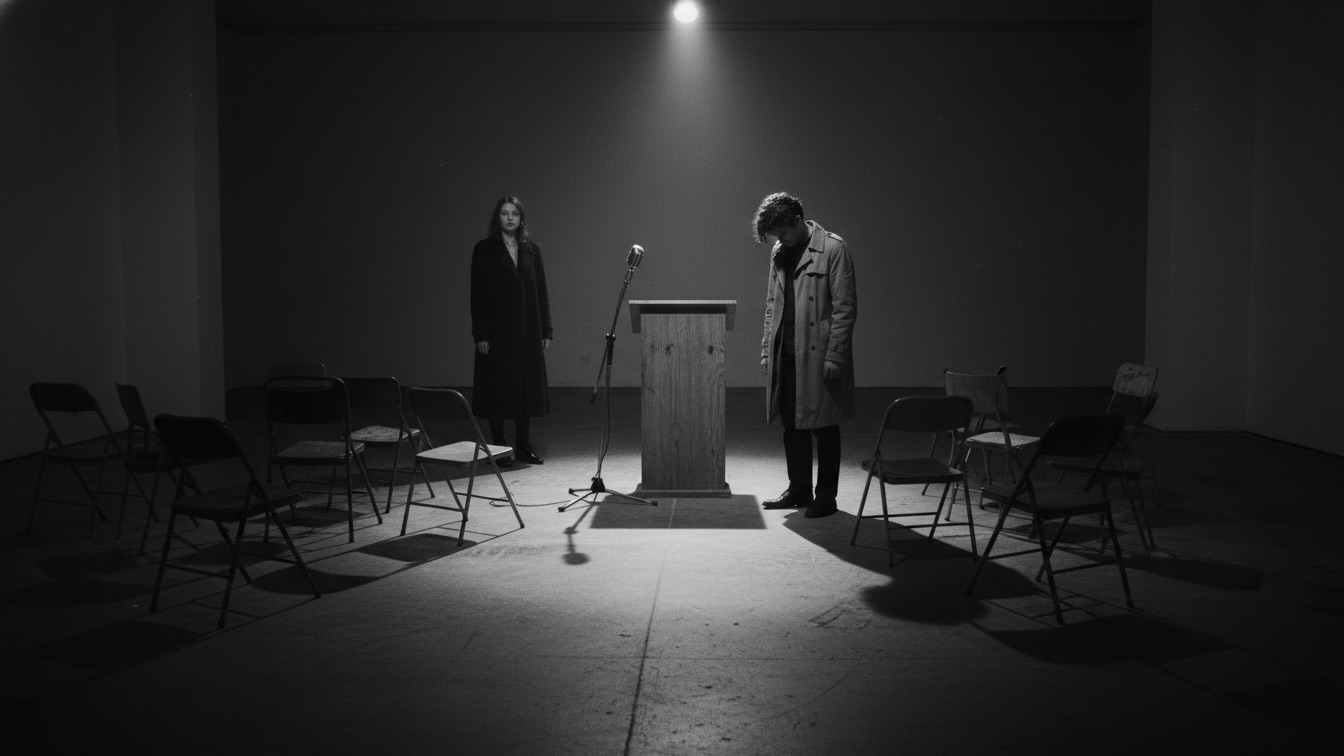
Inside the cold, cavernous space of the Canvas & Rust Gallery, mismatched chairs face an unstable podium. The air is thick with the scent of wet wool and nervous anticipation, underscored by the low buzz of a faulty amplifier as a community meeting teeters on the edge of collapse.
The hot ceramic of the mug did nothing to warm Jack’s hands. The heat was a surface-level lie, a thin veneer over bones that felt permanently chilled from hours spent scraping frozen paint off brick in the soul-crushing wind. He sat on a rickety stool in the gallery’s back room, a space that served as an office, storage, and kitchenette all at once. The kettle clicked off, its steam clouding the single-paned window that looked out onto a snow-choked alley. He stared at his own reflection in the dark glass, a pale, hollow-eyed ghost he didn't recognize.
Across the small table, Debbie cradled her own mug, her knuckles white. She wasn’t drinking, just holding it, as if the warmth was a concept she was trying to understand. The silence in the room was louder than the earlier scraping sounds from outside. It was a heavy, exhausted silence, filled with the unsaid things that had festered out there in the cold. They hadn't brought them together. It had just made the distance between them more obvious, a frozen chasm.
“It’s not enough,” she said, her voice flat. She wasn't looking at him. She was looking at the wall, at a stack of unsold canvases leaning against it. “Cleaning the wall. It’s performative. It’s what they want. They want us to waste our time fixing the small problems while they bulldoze the big one.”
Jack took a sip of the tea. It was bitter. He hadn't bothered with sugar. “What else are we supposed to do? We got the compliance notice.”
“We fight back,” she said, finally turning to look at him. There was a raw, frantic energy in her eyes, the look of an animal chewing its own leg off to get out of a trap. “Not with spray paint and not with scrapers. With people. With facts.”
He watched her, saying nothing. He knew that look. It was the precursor to an idea that would inevitably involve him, an idea that would require effort and exposure and the kind of faith he hadn't possessed in years.
“A town hall,” she said, the words coming faster now, gaining momentum. “Right here. In the gallery. We’ll print flyers. Post on social media. We’ll get everyone from the neighborhood—the bakery, the bookstore, the other shops. We lay out everything. The shell corporations, the rezoning applications filed on a holiday weekend, the history of fires at their other properties.”
She was standing now, pacing the small space between the table and a stack of bubble-wrapped frames. The energy was radiating off her, a stark contrast to the profound weariness that had settled deep in his marrow.
“We can’t just let them pick us off one by one,” she continued, her hands gesturing, carving plans out of the air. “They’re counting on us being isolated. Tired. They think we’ll just roll over. But if we all stand together, if we show them we’re a community, not just a collection of storefronts… they’ll have to listen. The city council will have to listen.”
Jack felt a familiar, sinking feeling in his stomach. The kind he got when the bus was late and the snow was turning to sleet. It was the feeling of inevitable misery. “Debbie…”
“It’ll work, Jack. It has to.” She stopped pacing and leaned on the table, her face close to his. “I’ll put together a presentation. Slides. I’ll get a projector. We’ll need a sound system. A microphone.”
The word ‘microphone’ landed in the pit of his stomach like a stone. He thought of stages, of spotlights, of eyes. Hundreds of eyes. All looking. All waiting for him to speak, to fail.
“I’ll present the financial data,” she said, her mind already racing ahead. “The evidence of corporate malfeasance. But we need a human element. We need someone to talk about what this neighborhood means. What it feels like to be pushed out.” She paused, her gaze locking onto his. “We need you to speak.”
Jack flinched. The air went out of his lungs. “Me? No. No, I can’t do that.”
“Why not? You’re perfect. Your family has been here for generations. Your father…” She stopped, but the name hung in the air between them. “You’re the heart of this. People know you. They know your story.”
“They know nothing,” he mumbled, looking down into his mug. The distorted reflection of his face rippled on the surface of the tea. “And I’m not… I don’t do public speaking. I can’t.”
“It’s not public speaking, it’s just talking. To our neighbors. You just have to tell them what you told me. About the Stop-N-Go, about the feeling of being erased.”
“That was different,” he said, his voice tight. “That was… I can’t just get up in front of a crowd and… and talk.” The thought alone made his palms sweat. The room suddenly felt smaller, the air thicker.
“Jack, I can’t do this alone,” she said, her voice softening, but it was a calculated softness. It was a tool. “I have the data. The charts. The proof. But that’s all head stuff. We need the heart. That’s you.”
He wanted to say no. A thousand different versions of no. No, I’ll screw it up. No, I’ll freeze. No, I’ll make things worse. No, please don’t ask me to be seen. But he looked at her face, at the desperate hope warring with the exhaustion, and he saw a mirror of his own feeling of being trapped. She was trapped by debt and a failing business. He was trapped by fear and a dead-end life. For a split second, their prisons looked exactly the same.
He swallowed. The word felt like sandpaper in his throat. “Okay.”
It was a whisper. He wasn’t even sure he’d said it aloud. But she heard it. A wave of relief washed over her features, so profound it was almost painful to watch. “Thank you,” she breathed. “It’s going to work, Jack. I promise.”
He just nodded, staring into his cold tea. He didn't believe her. He didn’t believe in promises, or plans, or the power of community. He had just agreed to stand on a stage in the middle of his own recurring nightmare, and all he could think was that the scraping had been the easy part.
The next forty-eight hours were a blur of manic activity, powered entirely by Debbie’s will. The gallery ceased to be a place for art and became a campaign headquarters. Jack felt like a conscripted soldier in an army of one. Debbie was the general, the strategist, and the entire infantry. Claire, the gallery assistant, was a conscientious objector, her disapproval a silent, oppressive force in the room.
“The scuff marks on the floor, Deborah,” Claire said on the morning of the event, pointing a manicured finger at a black streak left by a folding chair. “These are Brazilian cherrywood. They don’t just buff out.”
“It’s fine, Claire. We’ll deal with it later,” Debbie said without looking up from a stack of flyers she was stapling with furious speed. Staple. Slap. Staple. Slap. The rhythm was aggressive, a percussive counterpoint to her mounting anxiety.
Jack was tasked with setting up the fifty folding chairs they’d borrowed from a nearby church basement. They were metal and cold, each one unfolding with a groan of protest. He arranged them in neat rows, the obsessive alignment a small act of control in a situation that felt utterly out of his hands. Every scrape of metal on wood sent a fresh wave of disapproval from Claire’s corner, where she was ostensibly organizing invoices but was actually cataloging every new scratch and potential violation of the rental agreement.
The space felt wrong. The high ceilings that made paintings feel grand and imposing now made the small gathering of chairs look pathetic. The track lighting, usually focused on canvases, now created harsh, interrogative pools of light on the empty floor. In the corner, the bucket continued its slow, steady work. Drip. Drip. Drip. A water clock counting down to his humiliation.
His main task, the one he’d been dreading, was the sound system. It was a pathetic little setup Debbie had borrowed from a musician friend. A small amplifier with a frayed power cord and a microphone stand that seemed to have a death wish. The main shaft was a telescoping pole, and the locking mechanism was stripped. No matter how hard he twisted the plastic collar, the top half would slowly, inexorably, slide down.
He spent twenty minutes trying to fix it. He tried wrapping duct tape around the joint, but the cold made the adhesive weak. It peeled away with a pathetic sigh. He tried jamming a small wedge of folded cardboard into the collar. It held for a minute, then the cardboard crushed and the microphone drooped again, like a wilted flower.
“How’s it going with that?” Debbie asked, breezing past with an armful of clipboards.
“It’s…it’s broken,” Jack said, frustration tightening his voice. “The stand won’t stay up.”
Debbie glanced at it, her brow furrowed with impatience. “Just tighten it as much as you can. It’ll be fine. People will be sitting, it doesn’t need to be that high.”
She didn’t see it. To her, it was a minor logistical hiccup. To Jack, it was an omen. A physical manifestation of his own inability to stand up, to hold his ground. He wrestled with the stand again, his fingers numb and clumsy. He finally got it to a point where it only sank an inch every thirty seconds. It would have to do.
Then he had to test the microphone. He plugged the cord into the amplifier and flipped the power switch. A low, menacing hum filled the gallery. He tapped the top of the mic. Thump-thump. The sound echoed in the empty space, unnaturally loud.
“Testing,” he mumbled, his voice feeling foreign and foolish. “One, two…”
A piercing shriek of feedback ripped through the air, so sudden and violent it felt like a physical blow. Jack recoiled, dropping the mic. It hit the floor with a loud crackle and the feedback intensified, a sustained, electronic scream. Claire clapped her hands over her ears. Debbie spun around, her face a mask of alarm.
“Turn it off!” she yelled.
Jack fumbled with the amplifier, his heart hammering against his ribs. He couldn't find the power switch. The screaming continued. He finally yanked the plug from the wall socket. The silence that followed was deafening, broken only by the steady dripping in the corner.
“Jesus, Jack,” Debbie said, her voice frayed. “Be careful.”
“Sorry,” he muttered, his face burning. “I was just… it’s really sensitive.”
“Just… put it on the podium. And don’t stand too close to the amp when you talk,” she instructed, already turning her attention back to her checklists. She was compartmentalizing, pushing past the problem. But Jack couldn’t. The shriek of the feedback was still ringing in his ears. It sounded like panic. It sounded exactly like the inside of his own head.
By six o’clock, people started to arrive. Not a flood, but a trickle. Old Mrs. Gable from the bookstore, her face a permanent etching of worry. The two brothers who ran the bakery, smelling faintly of yeast and sugar, their aprons still dusted with flour. A few artists Jack recognized from the neighborhood, their clothes spattered with paint, their expressions cynical but curious. They came in stamping snow from their boots, their hushed conversations swallowed by the gallery’s high ceiling. They looked small and uncertain, huddled together in the mismatched chairs like survivors of a shipwreck.
Jack stood near the back, trying to make himself invisible. He watched Debbie greet people at the door. She was electric, forcing a bright, confident smile, shaking hands, handing out the informational packets she’d spent all night printing. She was playing the part of the confident community organizer, but he could see the tension in her shoulders, the way her smile didn’t quite reach her eyes.
Then a different sort of person started to arrive. They came in groups of two or three. They wore better coats, their shoes weren't worn at the heels. They didn’t know anyone, didn’t talk to their neighbors. They just took seats near the back and the sides, their faces illuminated by the glow of their phones. They scanned the room with a kind of detached appraisal, like they were assessing a property, not joining a community. They were the developer’s people. Jack knew it in his gut. They were here to watch, to report, maybe to disrupt.
The draft from the front door brought a fresh wave of frigid air, and with it, Evan. Debbie’s brother moved into the room with an unearned familiarity, a politician working a crowd of strangers. He clapped one of the bakery brothers on the shoulder, flashed a brilliant white smile at Mrs. Gable, and acted as if the whole event was his idea.
“Debbie, this is fantastic!” he boomed, kissing her on the cheek. She stiffened at his touch. “Look at this turnout. You’ve really got something going here.”
“Evan. I didn’t know you were coming,” she said, her voice tight.
“Wouldn’t miss it for the world. Gotta support my sis.” He winked, then his eyes found Jack lurking in the shadows. He gave a little nod, a dismissive, patronizing acknowledgment. Jack felt a hot prickle of anger. Evan was a parasite, and this was his host.
Debbie moved to the front of the room, stepping behind the small wooden podium she’d borrowed from the same church. She tapped the microphone, and the amplifier hummed ominously, but thankfully didn't squeal. The shuffling of chairs and quiet murmuring died down. Fifty pairs of eyes, maybe more, all focused on her.
“Thank you all for coming,” she began, her voice a little shaky at first, but gaining strength. She launched into her prepared speech, her words precise and backed by the data she’d painstakingly compiled. She spoke of zoning laws, of tax loopholes, of the anonymous LLCs that hid the true ownership of the development company.
Jack watched her, a knot tightening in his stomach. He saw her adjust the microphone stand. It had already started its slow descent. She’d push it up, tighten the collar with a quick, frustrated twist, and continue. Two minutes later, she’d have to do it again. The small, repetitive failure was a constant distraction. He saw a few people in the audience exchange glances. He saw one of the well-dressed men smirk.
Debbie was losing them. The facts and figures were too abstract. People started to fidget. A phone buzzed. Someone coughed loudly. She was presenting evidence, but she wasn’t telling a story. She was showing them the monster’s blueprint, but she wasn’t making them feel its teeth.
“...and the environmental impact report was clearly rushed, failing to account for the watershed contamination from the proposed underground parking…”
She was talking to a room that was no longer listening. Her careful plan, her meticulous organization, it was all failing to connect. Jack felt a surge of sympathetic panic. He could see the desperation in her eyes as she rushed through her slides, trying to find the one fact that would make them care, that would galvanize them.
Then, it was his turn. “And now,” Debbie said, her voice strained, “I want to introduce someone who can speak to the human cost of this. Someone whose family has been a part of this community for three generations. Jack.”
Every head in the room turned toward him. The collective weight of their gaze was a physical force. He felt his legs turn to lead. He pushed himself away from the wall and started the long walk to the podium. The wooden floorboards seemed to groan under his feet. Each step was an eternity. The pools of light from the overhead lamps were blinding. He could feel his heart trying to beat its way out of his chest. He could hear the blood roaring in his ears, a sound that almost drowned out the shuffling of the audience.
He reached the podium and gripped its edges. His knuckles were white. His hands were slick with sweat. He looked out at the crowd, but their faces were just a blur, a sea of indistinct shapes and shadows. He saw Debbie give him a small, encouraging nod, but it was like seeing it through water. Far away and distorted.
He leaned toward the microphone. He remembered the feedback. Don’t get too close. He opened his mouth to speak, to say his name, to start the story he’d half-rehearsed in his head a hundred times while stocking shelves at the Stop-N-Go.
What came out was a strangled croak. He cleared his throat and tried again. And that’s when it happened. The amplifier, as if sensing his terror, unleashed a deafening shriek of feedback. It was a physical assault. A high-pitched, brain-drilling scream that filled every corner of the gallery. Jack physically jerked back from the podium, his hands flying up to cover his ears. The audience groaned, people wincing and shielding their own ears. The sound was a living thing, a manifestation of all the tension and failure in the room.
Debbie rushed forward and fiddled with the knobs on the amp. The sound died with a final, ugly pop. A wave of nervous laughter rippled through the crowd. His face was on fire. He felt a hundred years old and five years old at the same time.
“Sorry about that,” Debbie said into the silence, her voice brittle. “Technical difficulties.”
Jack took a deep breath, trying to steady himself. He leaned toward the mic again, more cautiously this time. The feedback was gone, but the internal panic was still screaming. He looked down at his notes, but the words swam before his eyes. They were just meaningless black marks on a white page.
“My… my name is Jack,” he began, and his own voice sounded like it belonged to a stranger. It was thin, reedy. He could hear the tremor in it. “I… I work at the Stop-N-Go. Down… down the block.”
His stutter, the old enemy he thought he’d mostly beaten back into a dark corner of his mind, was re-emerging. It was a snake coiling in his throat.
“This neighborhood…” he stammered. “It’s… it’s n-not just buildings.” He was losing the thread. The carefully constructed thoughts he’d had were gone, scattered by the feedback and the fear. He was just a guy, standing in a bright light, failing.
From the back of the room, a voice called out, sharp and impatient. “What’s your point? We can’t hear you!” It was one of the men in the nice coats. His voice was a blade that cut right through Jack’s fragile composure.
Jack’s mouth went dry. He gripped the podium harder. “The p-p-point is… the point…” He couldn't find the word. It was right there, but his brain refused to deliver it to his mouth. He was trapped in the awful, silent space between breaths.
Another voice, from the side this time. “Is this a joke? Did you bring us all out here for this?”
The heckling was a spark on dry tinder. Suddenly, the restlessness in the room had a voice. An old man in the front row grumbled, “I can’t follow any of this.” People started whispering to each other. The fragile sense of unity, of a shared purpose, was shattering.
Jack looked desperately at Debbie. She looked horrified. She had trusted him. She had called him the heart of the operation, and his heart had seized. He had failed her. He had failed everyone.
He tried one last time, pushing the words out with sheer force of will. “My f-father… he b-believed in this p-p-place…”
But it was too late. He sounded weak. Pleading. Pathetic.
And that’s when Evan stood up. He didn’t shout. He spoke in a calm, reasonable tone that cut through the rising murmur of the crowd. He held his hands up in a placating gesture.
“Okay, okay, everybody, let’s just take a breath,” he said, his voice smooth as oil. He smiled a warm, disarming smile that didn't reach his eyes. “I think we can all see this is getting a little out of hand.”
He turned his gaze toward Debbie, and the smile became something else. Something condescending. “My sister, Debbie, she gets very passionate about these things. We all know that.” He chuckled, as if sharing an inside joke with the entire room. “Sometimes she gets a little carried away. Maybe even a little… hysterical.”
The word hung in the air. Hysterical. It was a dismissal. A weapon. It reframed her entire effort—her research, her passion, her fear—as a moment of feminine irrationality. It was a public execution, delivered with a smile.
Debbie’s face went pale. Jack could see the exact moment the word landed, the way the fight just drained out of her. It was a more violent blow than any punch.
A surge of pure, white-hot rage burned through Jack’s fear. He forgot the microphone. He forgot the crowd. He took a step forward, away from the podium, pointing a trembling finger at Evan.
“Don’t you call her that,” he said. The stutter was gone, replaced by a raw fury. “She’s not… She’s the only one here who’s actually trying to do something!” But his voice cracked on the last word. The anger had burned out as quickly as it had ignited, leaving behind only the shaky, impotent shell of a man who couldn't even speak in complete sentences.
He looked weak. He knew it. The men in the nice coats were openly laughing now. The sound was sharp and cruel. The bakery brothers were looking at the floor, embarrassed for him. Mrs. Gable was already putting on her coat.
The meeting was over. It dissolved not with a bang, but with a chaotic, defeated murmur. People started getting up, their chairs scraping loudly against the wood floor. The sound was a grating, final verdict on their failure. Small arguments broke out between neighbors and the developer’s plants. The carefully arranged rows of chairs became a chaotic obstacle course. The packets of information lay discarded on the floor and seats, unread.
Debbie stood frozen by the projector, watching the room empty, watching her plan disintegrate into noise and motion. Her organizational skills, her lists and her data, couldn’t control people. She had built a structure, and the unruly, messy, human element had simply knocked it down. Her face was a blank mask of shock. She had gambled everything on this, and she had lost.
Jack was still standing at the front, rooted to the spot. The last of the crowd pushed past him, eager to get back out into the cold, away from the awkwardness and the failure. Evan walked past, pausing to pat Jack on the shoulder. “Nice try, champ,” he said, his voice dripping with false sympathy. Then he was gone.
Soon, they were alone. Jack and Debbie, standing in the wreckage of her town hall. The gallery was a mess of abandoned chairs, discarded flyers, and the lingering hum of the amplifier they had forgotten to turn off. The microphone stand had finally given up, its top half sliding all the way down with a quiet, metallic sigh. The dripping in the corner was the only other sound. Drip. Drip. Drip. It was the sound of everything coming apart, one drop at a time. They hadn’t rallied the community. They had just given everyone a front-row seat to their own humiliation. The cold of the room felt absolute now, a penetrating chill that had nothing to do with the winter outside. It was the cold of a total, undeniable defeat.
“It was the cold of a total, undeniable defeat.”