The chapter "Liability" opens with Debbie in her struggling art gallery, consumed by anxiety over its imminent failure, intensified by the silent presence of Jack's rolled-up blueprints on her desk. Initially dismissive of Jack's earlier warnings and burdened by her own "small disaster," she eventually succumbs to a kinetic need for order, leading her to finally examine the blueprints. To her horror, they reveal a chilling pattern: proposed developments by "NORTH STREAM HOLDINGS" on sites recently destroyed by fires, confirming Jack's theory of calculated gentrification. Overwhelmed by guilt for her prior dismissal of Jack and the scale of the corruption, Debbie rushes to find him.
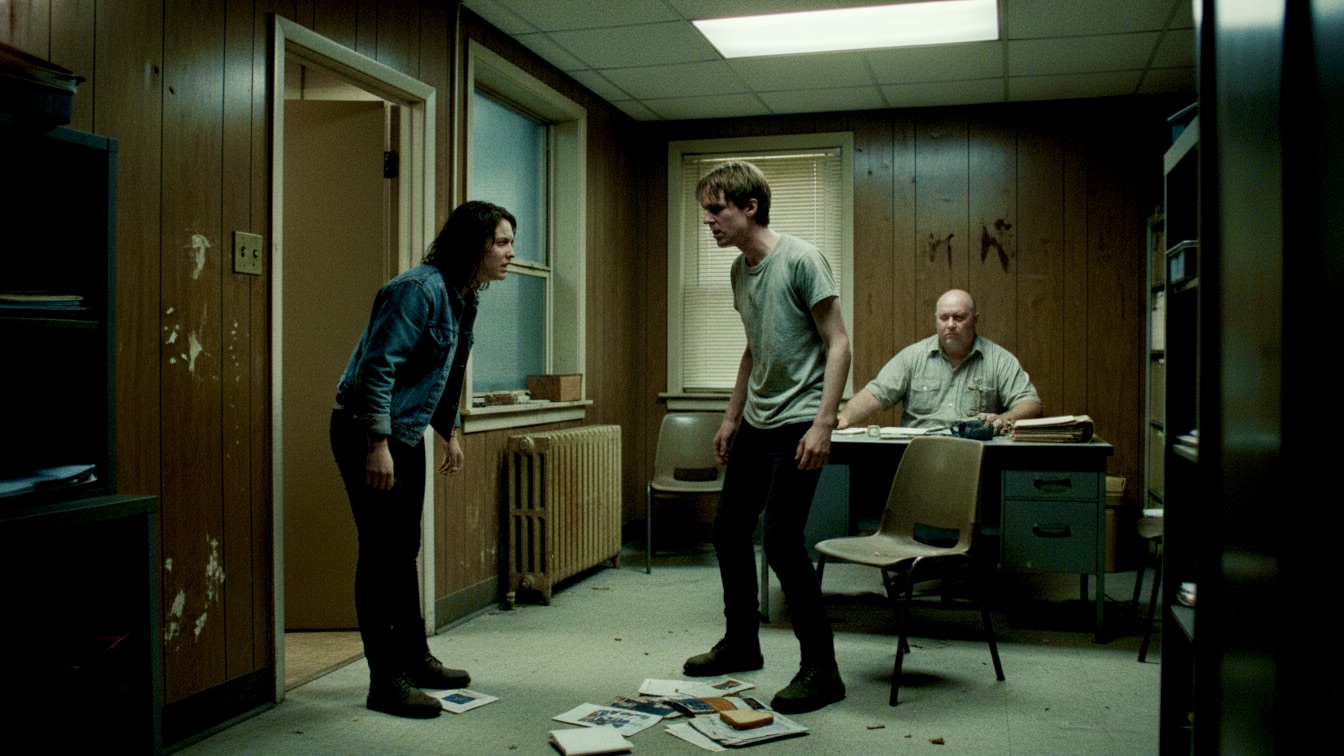
Meanwhile, Jack, reeling from humiliation after being rebuffed by a security guard and then by Debbie, is at a logging recruitment office, contemplating escape. Burdened by his father's legacy and the immense weight of the truth he uncovered, he sees the brutal simplicity of a logger's life as a means to abdicate responsibility and become "blind for a while." Debbie, driven by a desperate, intuitive guess, tracks him to the office and confronts him just as he is about to sign the contract. A fierce argument ensues, where Debbie forces Jack to acknowledge his unique sight and the moral imperative to act, despite his fear and exhaustion. Jack, enraged but ultimately swayed, refrains from signing, choosing to stay and confront the "mess," yet he dismisses Debbie with cold fury, leaving their connection fraught with unresolved tension and resentment.
The chapter "Liability" delves deeply into the themes of responsibility, perception versus blindness, and the complex interplay between individual struggle and systemic corruption. The title itself becomes a central motif, shifting from Debbie's initial perception of her gallery's financial woes as her primary "liability" to the profound moral burden of knowing about the city's calculated destruction. This evolution highlights how personal anxieties can overshadow larger societal truths, only to be redefined when the scope of injustice becomes undeniable. Both characters grapple with the weight of what they know, with Jack seeking to shed this "liability" through escape, while Debbie ultimately embraces it as a call to action.
The theme of blindness versus sight is powerfully explored through both protagonists. Jack possesses a unique, almost obsessive "sight," enabling him to discern patterns of corruption that elude city officials and journalists. His burden is the isolation and powerlessness that comes with this unwelcome clarity. Debbie, initially "blind" due to her self-absorption and the overwhelming nature of her own problems, experiences a stark awakening. Her journey from dismissive ignorance to horrified understanding underscores the human tendency to avoid uncomfortable truths, but also the transformative power of confronting them. Jack's desperate desire to "be blind for a while" encapsulates the immense psychological toll of bearing witness to injustice.
Escapism and confrontation form another pivotal thematic axis. Jack's decision to pursue a logging job represents a profound act of escapism, a retreat into a physically arduous but mentally simple existence to avoid the "messy and vast" problem of urban corruption. It is a "coward's solution" he acknowledges, yet it offers seductive relief from the crushing burden of knowledge. Debbie, conversely, moves from passive avoidance of her problems to active, desperate confrontation. Her dramatic pursuit of Jack and their heated argument signify her embrace of confrontation, not just with Jack, but with the larger injustice, recognizing that turning away allows the "monster" to win. This contrast highlights different coping mechanisms when faced with overwhelming threats.
Finally, the chapter subtly explores the insidious nature of urban decay and gentrification. The "blueprint for gentrification, written in fire and ash" is revealed not as random misfortune, but as a deliberate, cynical strategy by North Stream Holdings. This systemic corruption, disguised as "urban blight," exposes how vulnerable communities and historical sites are sacrificed for profit. The fires are not just clearing buildings, but "clearing the way" for a new, economically driven landscape, underscoring the destructive power of unchecked corporate ambition and the vulnerability of those who stand in its path.
Debbie's character undergoes a significant psychological transformation within this chapter, moving from a state of profound self-absorption and anxiety to one of fierce determination and moral clarity. Initially, her internal landscape is dominated by the "yawning emptiness" of her failing gallery and the "funereal quiet" that mirrors her despair. Her thoughts are a "frantic, looping reel" of personal worries, making her dismissive of external problems, particularly Jack's "messy and vast" concerns. She is depicted as "brittle," on the verge of snapping under the weight of her own "small, contained disaster." This initial state highlights the psychological trap of individual struggle, where the perceived magnitude of personal problems eclipses collective suffering.
Her motivations are initially driven by self-preservation and a desperate need for control over her immediate environment, as evidenced by her "kinetic need for order" by cleaning her desk. However, the discovery of the blueprints acts as a powerful catalyst, shattering her myopic focus. Overwhelming guilt and shame flood her as she realizes the true scale of the city's corruption and her own complicity in dismissing Jack. This profound shift ignites a new, urgent motivation: to undo the damage of her dismissal, to acknowledge Jack's truth, and to confront the injustice. She transforms from someone paralyzed by her own fear into an active agent, "running toward a problem instead of waiting for it to come to her."
Debbie's primary internal conflict lies between her initial, overwhelming personal anxieties and the moral imperative to address a larger societal injustice. This conflict is externalized in her heated confrontation with Jack, where she fights not just for him, but for the principle of not surrendering to fear and apathy. Her final act of leaving Jack in his anger, having achieved her goal of preventing his escape, suggests a complex victory. She has tethered him to a fight he resents, but in doing so, she has also tethered herself to a larger purpose, moving beyond her individual "liability" to embrace a collective responsibility.
Jack is presented as a deeply wounded and exhausted individual, burdened by the weight of his unique perception and a family legacy of failed resistance. His initial state is one of profound humiliation and defeat, stemming from his earlier encounter with the security guard and Debbie's dismissive reaction. He feels like a "joke," his efforts to expose corruption rendered "useless," and his silver lighter, once a potential clue, now a "souvenir of his own impotence." The city, once a landscape he felt he understood, now appears "alien, a hostile landscape he had completely misunderstood." This sense of alienation and powerlessness is compounded by the ghost of his father, whose failure to carry the same "heavy" burden looms large in Jack's mind.
His primary motivation in this chapter is a desperate need for escape and abdication. He seeks a "coward's solution," a powerful narcotic of relief found in the imagined simplicity of a logger's life. This desire is not merely to flee physical danger, but to escape the mental burden of his own perception, to "be blind for a while," and to trade anxiety for exhaustion. It is a form of self-punishment, a penance for his perceived weakness and failure to protect his father's memory. He longs to become "a body" rather than a mind, to be "a liability to no one."
Jack's central internal conflict is between his acute awareness of injustice and his profound psychological exhaustion and fear. He knows the truth, but the futility of his efforts and the personal cost of "seeing" have pushed him to the brink of surrender. His external conflict with Debbie is a raw, emotional battle for his future. He resents her for pulling him back from the precipice of escape, for forcing him to confront the very burden he desperately sought to shed. His final, venomous rage and dismissal of Debbie, despite not signing the contract, reveal the profound anger and resentment born from having his escape route blocked. He remains, but his commitment to the fight is now tinged with bitterness and a deep, personal cost.
The narrative in "Liability" employs a third-person limited perspective, alternating between Debbie and Jack, which provides intimate access to their distinct internal monologues and emotional states. This allows the reader to experience Debbie's initial suffocating anxiety and subsequent surge of guilt and determination, as well as Jack's deep humiliation, despair, and yearning for escape. The shifting perspective effectively highlights their individual isolation, even as their paths are inextricably linked by the central conflict.
The pacing of the chapter is meticulously controlled, mirroring the characters' emotional arcs. It begins with a slow, oppressive rhythm, reflecting Debbie's internal paralysis and the "physical weight" of silence in her gallery. The pace quickens dramatically as she uncovers the truth in the blueprints, building to a frantic urgency during her search for Jack. Jack's sections, in contrast, initially carry a resigned, heavy pace, reflecting his exhaustion and sense of defeat, before accelerating with his decision to flee. The climax, the confrontation in the recruitment office, is marked by rapid-fire dialogue and heightened tension, creating a sense of immediate, high-stakes conflict.
The tone of the chapter undergoes significant shifts, from the initial oppressive anxiety in Debbie's gallery, to a revelatory shock and moral urgency, then to the bleak despair and cynical resignation found in Jack's journey to the recruitment office. The recruiter's brief appearance introduces a mundane, weary cynicism that contrasts sharply with the protagonists' intense emotional states, grounding the extraordinary events in a gritty realism. The final confrontation is imbued with a raw, confrontational tone, laden with anger, pain, and a bitter form of victory.
Rich sensory details and vivid imagery enhance the narrative's psychological depth. The "drip from the ceiling into the bucket" sounding like a "ticking clock" effectively externalizes Debbie's internal countdown to failure. The blueprints are described as an "unexploded ordinance" and later, a "blueprint for gentrification, written in fire and ash," transforming inanimate objects into symbols of impending danger and systemic destruction. Jack's humiliation is a "physical coating on his skin, colder than the wind," while Debbie's guilt hits her "like a physical blow, a nauseating wave." These details, along with descriptions of "frosty front windows," "greasy black plume" of smoke, and the "smell of wet wool and stale cigarette smoke" in the recruitment office, immerse the reader in the characters' experiences and the grim urban landscape, making their psychological burdens tangible. Metaphors like developers being "vultures" further contribute to the vivid and impactful storytelling.