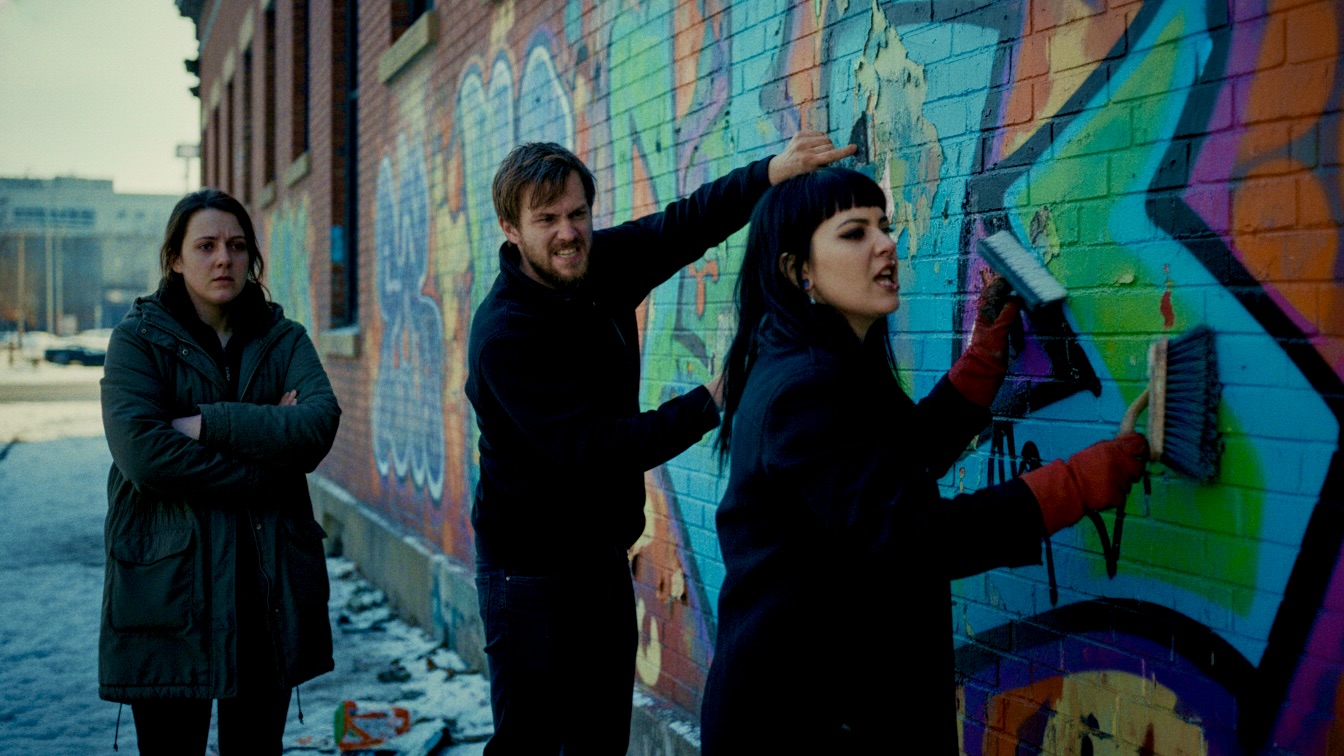
The biting pre-dawn cold of a Winnipeg winter morning outside the Canvas & Rust gallery. The air is sharp and still, smelling of frozen pavement and exhaust. A massive, shockingly vibrant mural covers one entire brick wall, its fresh paint clashing with the old, weathered facade. The silence is broken only by the distant hum of the city waking up.
The cold was the first thing to greet her. Not the gentle, creeping cold of a drafty building, but a solid wall of it that hit her the moment she stepped out of her car. It was that specific Winnipeg cold, the kind that felt personal, a predator that stole the breath from your lungs and replaced it with tiny, sharp needles of ice. Debbie pulled her thin coat tighter, a useless gesture, and fumbled with the keys to the gallery. Her fingers were already stiff and stupid. The lock was always stubborn in this weather, the metal contracting until the key barely fit.
She was about to shove her shoulder into the heavy door when something caught her eye. A slash of color where there should have been none. It was jarring against the monochrome palette of the winter morning—the grey sky, the dirty white of the snowbanks, the muted red of the old brick. She paused, key halfway into the lock, and turned her head.
And then she saw it.
The entire east-facing wall of Canvas & Rust, the long, unbroken expanse of brick that faced the empty lot, was gone. In its place was a sprawling, incandescent mural. It was a chaotic masterpiece, a riot of color and form that seemed to thrum with a furious energy, even in the frozen air. A colossal, stylized raven with wings made of tangled electrical wires and broken circuit boards dominated the center. In its beak, it held a single, glowing red heart, dripping what looked like binary code onto a landscape of collapsing buildings and grasping, skeletal hands. The detail was staggering. Look closer, and the feathers were individual spray-painted lines, precise and sharp. The crumbling city was made of QR codes and forgotten logos. It was beautiful. It was breathtaking. And it was a goddamn catastrophe.
For a full minute, Debbie just stood there, her keys forgotten in her hand, her mouth slightly agape. A strange, dual emotion warred within her. The artist in her, the part that had led her to sink every penny she had into this failing gallery, was in awe. The technique was masterful, the composition dynamic, the message… potent. It was a raw, angry scream about technology, decay, and fragile humanity. It was the kind of art she dreamed of showing.
Then the gallery owner in her took over, and a cold dread, far more chilling than the wind, washed through her. This was vandalism. A massive, billboard-sized act of vandalism on a historic building. The city would have a field day. The fines. The cleanup costs. She could already hear Claire’s precise, judgmental voice. She could already picture Evan’s smug, I-told-you-so expression.
She walked closer, her boots crunching on the salted, icy pavement. The paint was fresh. She could smell the aerosol fumes, a sharp chemical tang hanging in the frigid air. Whoever had done this had worked through the night, in this soul-crushing cold. They had to have used ladders, maybe even some kind of scaffolding. This wasn't some teenage tagger. This was a professional. A dedicated, talented, and completely infuriating professional.
She reached out a gloved finger and touched the beak of the raven. The paint was dry, but still felt new, a thin, rough skin over the cold brick. She traced one of the dripping lines of code. It felt like a personal insult, a deliberate targeting. Why her building? Why now, when she was already dangling by a financial thread?
It took her another ten minutes to finally get the door open. Inside, the gallery was even colder than it was outside. The air was stale and still. The bucket in the corner had a thin layer of ice over the collected water. She didn't bother turning on the main lights, just the small lamp on her desk. The darkness felt appropriate. She sank into her squeaky office chair, the springs groaning in protest, and stared at the stack of bills held down by a clay paperweight she’d made in college. A relic from a time when art was about creation, not survival.
She didn’t call the police. Not yet. Calling them would make it official, start a clock she wasn't ready to face. Instead, she made coffee, her movements slow and robotic. She watched the dark liquid drip into the pot, the machine hissing and sputtering. The familiar ritual did nothing to calm the frantic hummingbird of panic in her chest. She had survived the leak in the roof, the furnace quitting in November, the abysmal sales of the last show. She had even survived the return of her brother. But this felt different. This felt like a finishing move.
She was on her second cup of coffee, the bitter heat doing little to warm her, when the official-looking car pulled up. It wasn't a police car. It was a pristine white sedan with the city’s crest on the door. A man in a thick, city-issued parka got out, holding a clipboard. He had the brisk, unimpressed air of a man who dealt with other people’s problems all day and had long ago run out of sympathy.
He didn't knock. He just stood outside, looking from his clipboard to the mural and back again, his breath pluming in the air. Debbie watched him through the frosted glass of the front window. She knew, with a sinking certainty, what was on that clipboard. She pushed her chair back, the sound scraping loudly in the quiet gallery, and went to face the music.
“Debbie Stenner?” he asked, not as a question, but as a confirmation. He didn't offer a name.
“Yes.” Her voice was tight.
He gestured with his pen at the wall. “You’re aware of this?”
“I just saw it this morning.”
“It’s a violation of city by-law 113/2008, section 4, regarding unauthorized alterations to a building facade in a designated heritage zone. Not to mention standard vandalism statutes.” He recited it like a line from a play he’d performed a thousand times. He peeled a sheet of paper from his clipboard. It was stiff with cold. “This is a remediation order. You have seventy-two hours to have it removed completely. If it’s not gone by then, the city will contract a service to do it and bill you for the cost, plus administrative fees.”
“Seventy-two hours? That’s impossible. It’s a huge wall. It’s freezing out.”
The man just shrugged, a slight lift of his padded shoulders. “The by-law doesn't make exceptions for the weather.” He handed her the paper. “And this is the initial fine.”
She took the slip of paper. Her fingers were numb. She looked down at the number printed in stark black ink. It was four figures. Four figures that she absolutely did not have. It was enough to cover two months of heat. It was enough to finally fix the leak in the roof. It was enough to bankrupt her.
“This is… this is insane,” she stammered. “I didn’t do this. I’m the victim here.”
“The by-law applies to the property owner, ma’am. You’re responsible for the condition of your property.” He clicked his pen. “I’d suggest you get started. Seventy-two hours isn’t a lot of time in this cold. Have a good day.”
He turned and walked back to his warm car without another word. Debbie stood there, the remediation order in one hand, the fine in the other, the wind whipping her hair across her face. The papers fluttered, threatening to fly away. She was the victim, and she was being punished for it. The injustice of it was a bitter pill, lodged in her throat. She looked back at the magnificent, terrible mural. The raven’s eye, a perfect circle of white and black, seemed to be mocking her.
An hour later, Evan found her in the exact same spot. She was still holding the papers, staring blankly at the brick wall, a universe of impossible calculations running through her head. She hadn’t even registered the sound of his car.
“Wow,” he said, his voice a low whistle. He stood beside her, hands shoved in the pockets of his stylish, expensive-looking coat. He wasn't looking at her; he was looking at the mural. “Gotta admit, that’s impressive. For a felony.”
“They fined me, Evan.” Her voice was flat, devoid of emotion. “Seventy-two hours to get it off, or they’ll fine me again and charge me for the cleanup.”
He finally looked at her, his expression shifting from detached amusement to practiced concern. It was a look she knew well, the one he used before he asked for money or tried to sell you something you didn’t need. “Deb, that’s awful. How much?”
She showed him the paper. He winced theatrically. “Ouch. Okay. That’s… that’s not good.”
“No, it’s not.”
They were silent for a moment, the only sound the distant traffic and the rustle of the papers in her hand. Evan sighed, a cloud of white vapor. “Look, Deb. I know the timing is terrible. But maybe this is a sign.”
“A sign? A sign of what? That the universe enjoys a good cosmic joke at my expense?”
“A sign that it’s time,” he said, his voice softening, becoming reasonable, persuasive. The sales pitch. “This is the final straw. You can’t afford this fine. You can’t afford the cleanup. You can’t afford to keep bleeding money into this place. It’s killing you.”
“We’re not having this conversation again.” She started to walk back toward the gallery door.
He moved to block her path, putting a gentle hand on her arm. “Just listen. Please. Helena’s offer is still on the table. It’s a good offer. It’s more than fair. You sell, you walk away from all this. The debt, the leaks, the fines. You pay me back what you owe me, and you still have enough to start over. A clean slate. Think about it. No more waking up wondering if the furnace is going to make it through the night. No more stress.”
“It’s not just a building, Evan. It’s Dad’s legacy. It’s my… it’s everything.”
“Dad’s legacy was being a great artist, not a lousy businessman,” Evan said, his voice still smooth but with a new, harder edge. “He would hate seeing you run yourself into the ground like this. This isn’t honoring him, Deb, it’s martyrdom. And for what? So a handful of people can come in once a month and look at art that doesn’t sell?” The words were a series of calculated blows, each one designed to find a weakness.
She flinched. “That’s not fair.”
“Is it not? Look at this!” He gestured wide, at the mural, at the crumbling mortar, at the whole struggling enterprise. “The world is sending you a message. A big, bright, spray-painted message. It’s over. Let it go. Sell to Helena. She has the capital to deal with this kind of thing. She’ll probably keep the mural, call it a PR stunt. For you, it’s a bankruptcy notice. For her, it’s a tax write-off. That’s the difference. That’s the game.”
He was right. That was the most infuriating part. Every logical point he made was correct. She was drowning, and he was offering her a lifeboat. A lifeboat that required her to abandon the one thing that gave her life meaning. The fine in her hand felt heavier, colder. The numbers seemed to mock her, validating every word he said.
“I have to think,” she said, pulling her arm away from him. She felt cornered.
“Think about what? The math? I’ve already done the math for you. There’s no way out of this one, sis. Not on your own.” He looked at her, his eyes full of that infuriating, pitying sympathy. “I’ll call Helena. I’ll tell her you’re ready to talk. We can have the papers drawn up by tomorrow. This whole mess could be her problem by the end of the week.”
He was making it so easy. Too easy. The path of least resistance. Just sign the papers. Give up. The thought was seductive, a siren song of relief. For a second, she let herself imagine it. No more bills. No more stress. Just… emptiness.
The image of Jack’s face from the night before flashed in her mind. His rage, his despair, his decision to stay and fight a battle he didn't want. You don’t get to be blind. Not anymore. She had forced him to face his fight. How could she turn and run from hers? The hypocrisy was sickening.
Something inside her hardened. A tiny, stubborn coal of defiance glowing in the pit of her stomach.
“No,” she said. The word was quiet, but it cut through Evan’s smooth patter like a shard of glass.
He blinked. “No? What do you mean, no?”
“I mean no. I’m not selling. Not today.”
“Deb, be serious. This is not the time for pride. This is a financial emergency.”
“I will handle it,” she said, the words tasting like a lie, but she said them anyway. She had to.
“Handle it? How? Are you going to go out there with a bucket and a sponge yourself? It’s ten below zero! You need a professional crew, chemical solvents, probably a pressure washer. That costs thousands. Thousands you don’t have!” His voice was rising, the smooth facade cracking to reveal the frustration beneath.
“I said I’ll handle it.” She pushed past him and finally made it to the gallery door, shoving the key in the lock. “Go home, Evan.”
“You’re being irrational! You’re letting emotion cloud your judgment!” he called after her. “This is the dumbest, most self-destructive thing you have ever done!”
She slammed the door behind her, the sound echoing in the empty gallery. She leaned against the cold wood, her heart hammering against her ribs. She had no plan. She had no money. She had just made the most irrational, illogical, and possibly stupidest decision of her life. And for the first time all morning, she felt a flicker of something that wasn't despair. It was a wild, desperate, terrifying resolve.
She walked back to her desk and stared at the fine. She had seventy-two hours. First things first. She needed to find the artist. She looked back out the window at the mural. The style was distinctive. Aggressive, graphic, somewhere between a comic book and a blueprint. She’d seen it before. Smaller pieces, on dumpsters in back alleys, on boarded-up windows of derelict buildings. A signature tag, always tucked into a corner. A stylized ‘L’ that looked like a lightning bolt.
She knew who to ask. Ahmed. He saw everything that happened on these streets. She pulled on her gloves, grabbed her purse, and walked back out into the cold, leaving Evan’s toxic logic behind her.
Finding Ahmed was easy. He was in his usual spot, huddled over a small brazier, his guitar case open at his feet. A few coins lay on the worn red velvet lining. He was playing a slow, melancholic tune, his fingers, wrapped in cutoff gloves, moving stiffly over the strings. The melody was a perfect soundtrack to the bleak morning.
“Ahmed,” she said, her breath misting.
He looked up, his weathered face breaking into a slight smile. He stopped playing. “Debbie. Cold day to be selling pictures.”
“Cold day to be doing much of anything,” she agreed, dropping a five-dollar bill into his case. “I need your help. I’m looking for someone. An artist.”
She described the mural, the raven, the signature. Ahmed listened, nodding slowly, his eyes fixed on the middle distance as if searching a vast internal library of street knowledge.
“Lightning bolt L,” he mused, his voice a low rasp. “Yeah. I know the work. Kid’s got a ghost in the machine. Angry. Talented.”
“You know who it is?”
“Name’s Lena. Doesn’t like to be found. Moves around. But… she’s got a weakness for good coffee. The strong stuff. There’s a place over on Sargent, ‘The Daily Grind.’ She’s there most mornings, warming up. Sits in the back corner, sketchbook open. Keeps to herself.”
“The Daily Grind. Thank you, Ahmed. I owe you.”
“Just bring me a coffee sometime,” he said, and started playing again, the mournful notes swallowed by the city’s noise.
Twenty minutes later, Debbie pushed open the door to The Daily Grind. The blast of warm, coffee-scented air was a physical relief. The place was small, crowded, and steamy. And in the back corner, just as Ahmed had said, sat a young woman hunched over a sketchbook. She had a shock of dyed-black hair, shaved on one side, and was wearing a paint-splattered army jacket. Even from across the room, Debbie could see the ferocious concentration on her face as her pen flew across the page. She was nursing a large black coffee. It had to be her.
Debbie bought a coffee she didn’t want and walked over to the table. She stood there for a moment, waiting to be acknowledged. The girl, Lena, didn’t look up. Her pen kept moving.
“Lena?” Debbie said.
Finally, the pen stopped. Lena looked up, her eyes narrowed with suspicion. They were dark, intense, and hostile. “Who’s asking?” Her voice was loud, confrontational.
“My name is Debbie Stenner. I own the Canvas & Rust gallery.”
A flicker of something—recognition? amusement?—passed over Lena’s face. She leaned back in her chair, crossing her arms over her chest. The army jacket fell open, revealing a t-shirt with a faded anarchist symbol. “Oh yeah? The brick box with the leaky roof. Nice pre-war detailing on the cornices, by the way. Most people don’t appreciate good masonry anymore.” She took a deliberate, slow sip of her coffee. “So what? You gonna call the cops? Sue me? Go for it. Can’t get blood from a stone, lady.”
Debbie was taken aback, both by the casual admission and the comment about the masonry. She pulled out the other chair and sat down, uninvited. “I’m not going to call the cops.”
Lena raised a skeptical eyebrow. “Right. So you tracked me down to… what? Congratulate me? Give me a stern lecture on property rights?”
“The city fined me,” Debbie said, sliding the ticket across the table. “And they gave me seventy-two hours to remove your masterpiece.”
Lena glanced at the fine, a smirk playing on her lips. “Sucks to be you.” She pushed it back. “Not my problem.”
“It is now.” Debbie leaned forward, her voice low and intense. She had no script, no plan. She was running on pure, desperate instinct. “I can’t afford this fine. And I definitely can’t afford to hire a crew to clean that wall in two days. So here’s the deal. You’re going to help me clean it.”
Lena burst out laughing. It was a loud, sharp bark of a laugh that made a few people at nearby tables look over. “You’re kidding, right? You want me to help you destroy my own work? Lady, you’re certifiable.”
“I’m serious,” Debbie pressed on, ignoring the stares. “We’ll get some solvents, some brushes, and we’ll scrub that wall until it’s clean. And in exchange for your help…” She took a deep breath. This was the crazy part. This was either the smartest or the dumbest thing she would ever say. “In exchange, I’ll give you a show.”
Lena’s laughter died in her throat. She stared at Debbie, her mouth hanging open slightly. The smirk was gone, replaced by a look of utter disbelief. “A… a show? Like, in your gallery? With my stuff on the walls?”
“A solo show,” Debbie confirmed, her own heart pounding at the audacity of her offer. “The whole space. For a month. We’ll call it ‘Vandalism.’ We’ll print postcards. We’ll have an opening. You can paint whatever you want. On canvas, this time. We’ll even sell it, and you’ll get sixty percent. But first, you have to help me clean that wall.”
The silence stretched. Lena was searching Debbie’s face for the punchline, for the trick. She saw only a desperate, sleep-deprived sincerity. This wasn’t a joke.
“Why?” Lena finally asked, her voice barely a whisper. “Why would you do that?”
“Because what you did to my building is a disaster that might bankrupt me,” Debbie said, her voice raw with honesty. “But it’s also the most exciting piece of art I’ve seen in this city in five years. I’m a gallery owner. I’m supposed to take risks. This is a risk. So, what do you say? Do we have a deal?”
Lena stared at her, then down at her own sketchbook, then back at Debbie. She was a creature of chaos, a disruptor. The offer was a paradox she couldn’t compute. An establishment figure wasn’t just forgiving her; she was inviting her in, offering her the keys to the kingdom on the condition that she first help tear down the flag she had just planted. It was insane. It was illogical. And it was the most interesting thing that had happened to her in a very long time.
“You’re gonna need more than just a couple of brushes,” Lena said, a slow, calculating smile spreading across her face. “And I’m gonna need that in writing.”
Debbie felt a wave of relief so profound it almost made her dizzy. “Fine. One more thing. I need more help. There’s no way the two of us can do it alone.” There was only one person she could ask. One person who owed her, in a twisted way. One person who needed to hit something as much as she did.
Her next stop was the Stop-N-Go. The little bell above the door jingled, announcing her arrival. The place smelled of stale coffee and disinfectant. Jack was behind the counter, staring blankly at the security monitor, his shoulders slumped. He looked like he hadn’t slept. When he saw her, his face tightened, the open wound of their last conversation still fresh between them.
“What do you want?” he asked, his voice low and flat.
“I need your help,” she said, no preamble, no apology. There wasn’t time.
He gave a short, bitter laugh. “My help? You’ve gotta be kidding me. After last night? I think I’ve helped you enough. I’m still here, aren’t I? Trapped. Just like you wanted.”
“This isn’t about that. Not really.” She explained the mural, the fine, the seventy-two-hour deadline. She didn’t tell him about her deal with Lena. She just framed it as a crisis. An impossible, back-breaking job that needed to be done.
“And you want me to… what? Come scrub your wall for you? For free?” His tone was laced with disbelief and resentment.
“I’ll pay you,” she said quickly. “Not much, but whatever I can.”
“I don’t want your money, Debbie,” he snapped. Then he sighed, running a hand over his tired face. He looked at her, and for a second, the anger in his eyes was replaced by that familiar, crushing weariness. “Why me? Go ask your brother. I’m sure he’d be thrilled to help.”
“Because you’re angry,” she said simply. “So am I. And I’ve got a giant brick wall that needs to be punished. It’s a lot cheaper than therapy. It’s just… physical work. Hard, mindless, physical work. I thought you might… I don’t know. I thought you might need that right now.”
He stared at her, his jaw working. She had offered him exactly what he didn't know he needed: an outlet. A target for the furious, helpless energy buzzing under his skin. A way to translate his internal chaos into external exhaustion. He hated that she knew him that well. He hated that she was right. He hated her for getting him into this mess, but the idea of scrubbing a wall until his arms gave out, of focusing all his rage on frozen paint, was undeniably appealing.
“When?” he asked, the single word a grudging admission of defeat.
“Now,” she said. “As soon as your shift is over.”
And so, two hours later, the three of them stood in the shadow of the gallery, a miserable and unlikely trio united by desperation and resentment. Debbie, the beleaguered owner. Lena, the vandal-turned-indentured-servant. And Jack, the unwilling conscript. The wind howled down the alley, whipping at their faces. It was even colder than it had been at dawn.
Debbie had spent the last of her emergency cash on the supplies: industrial-grade solvent that smelled like a chemical fire, stiff-bristled brushes, thick rubber gloves, and a stack of flimsy plastic scrapers. Lena had looked at the supplies with disdain. “This is amateur hour,” she’d declared. “The cold is gonna turn that solvent to slush. And these brushes? They’ll be useless in twenty minutes.” But she took them anyway.
They started at the bottom corner of the mural, a section of crumbling cityscape. The work was brutal from the first moment. The solvent, a thick, gel-like substance, was difficult to apply. It wanted to freeze the second it hit the brick. The brushes were stiff, the bristles already freezing together.
“You gotta use more pressure,” Lena instructed, her voice sharp and impatient. She was scrubbing a small patch with a ferocious energy, her whole body thrown into the motion. “You can’t be gentle. You’re not trying to persuade it. You’re trying to kill it.”
Jack said nothing. He found a spot a few feet away from the two women and started scrubbing. He poured all his frustration into the repetitive motion. Back and forth, back and forth. His shoulder screamed in protest. The scraping sound of the brush against the brick was a grating, rhythmic punctuation to the howling wind. He focused on a single, stubborn patch of black paint. He was going to erase it. He was going to scrub it out of existence. The anger from the night before, the feeling of being trapped by Debbie’s ultimatum, the years of stagnation—it all fueled the movement of his arm. Scrape. Scrape. Scrape.
Debbie worked between them, a frantic, desperate energy to her movements. Every patch of paint that refused to budge was the fine she couldn't pay, Evan’s condescending voice, the weight of her own impending failure. The chemical sting of the paint thinner mixed with the freezing air, making her eyes water. Or maybe it wasn’t just the thinner. She scrubbed harder, her knuckles white inside her gloves.
They worked in silence for what felt like an hour, but the sun had barely moved in the sky. They had managed to clear a pathetic, smeared patch of brick about the size of a welcome mat. The paint didn't so much come off as it turned into a gummy, frozen sludge that then had to be chipped away with the plastic scrapers, which kept snapping in the cold.
“This is pointless,” Jack finally grunted, stopping to blow on his hands. His face was red with cold and exertion. “It’s like trying to scrub a glacier with a toothbrush.”
“Quitting so soon, slugger?” Lena shot back without pausing her own relentless scrubbing. “I figured you for a guy with stamina. Guess I was wrong.”
Jack’s head snapped up. “What did you call me?”
“You heard me. You’ve been moping over here like someone kicked your puppy. It’s just a wall. What’s your problem?” Lena’s prodding was deliberate, a poker stirring a fire.
“My problem is that I don’t particularly enjoy freezing to death while cleaning up a mess I didn’t make,” Jack snarled, his voice tight with anger. He was tired of being pushed, first by Debbie, now by this stranger.
“Oh, I get it,” Lena said, finally stopping to look at him, a mocking grin on her face. “You’re one of those guys. The world owes you something, right? Things should be easy. Fair. Well, spoiler alert, champ. Nothing is fair. You either make your mark, or you get erased. Right now, you’re just helping with the erasing.”
“And what are you doing?” Jack shot back, taking a step toward her. “Making a mark? You think spray-painting someone’s property is some brave artistic statement? It’s just noise. You’re a glorified teenager throwing a tantrum on a wall because you want attention.”
Lena’s grin vanished. Her eyes went cold. “You don’t know the first thing about me or what I do.”
“I know you caused this problem. And now we’re the ones paying for it.”
“Guys, stop it,” Debbie said, her voice sharp. “Fighting isn’t going to get this paint off.”
“He started it,” Lena said, pointing a scraper at Jack.
“I’m finishing it,” Jack muttered, turning his back on them and attacking the wall with renewed fury. He switched from the brush to a scraper, chipping away at the frozen paint with vicious, jerky motions. Each chip of paint that flew off was a word he couldn't say, a punch he couldn't throw. The repetitive impact of the scraper against the brick vibrated up his arm, a dull, satisfying shock. He was channeling all his rage, all his resentment for Debbie, for his father, for his own inertia, into this one small, destructive act of cleaning.
Lena watched him for a moment, then shrugged and went back to her own section. But her movements were different now. Less frantic, more methodical. She paused, running a gloved hand over the brick, her eyes tracing the lines of mortar. “Flemish bond,” she said, to no one in particular. “Double-stretcher. It’s good work. Solid. The idiots who built that glass condo down the street used a running bond with a cheap facade. It’ll be leaking in five years. This… this has good bones.”
Debbie stared at her. It was the last thing she expected to hear. A flicker of the artist beneath the abrasive exterior, an appreciation for the very structure she had desecrated. It was a strange, disorienting moment of connection in the midst of the freezing, miserable conflict.
But the moment passed. The wind picked up again, a brutal gust that felt like it was slicing right through their layers of clothing. Jack kept chipping. Lena kept scrubbing. Debbie felt a tear freeze on her cheek. They were three islands of misery, working side-by-side but a million miles apart. They had seventy-one hours left. It felt like a life sentence. And as she watched the two of them, locked in their own private wars against the wall, she realized her desperate gamble hadn't brought them together. It had just found a new, colder, and more public arena for them all to fall apart in. The thin, high-pitched whine of the wind sounded like laughter. She picked up her brush, the bristles stiff with frozen paint, and went back to work. She couldn't feel her fingers anymore. All she could feel was the scraping. The endless, hopeless scraping. It was the only thing in the world.
“All she could feel was the scraping. The endless, hopeless scraping. It was the only thing in the world.”