

Are transboundary or Indigenous groups with overlapping claims-related issues being excluded, ignored or overlooked? What are other Indigenous commenters and groups saying?
Executive Summary: The Revell Site Deep Geological Repository (DGR) project, proposed by the Nuclear Waste Management Organization (NWMO), faces significant opposition from Indigenous Nations and transboundary groups. Analysis of the public registry indicates that the proponent’s current engagement framework is perceived as exclusionary, particularly regarding the scoping of transportation risks and the recognition of traditional governance structures. Indigenous groups, notably the Grand Council Treaty #3 (GCT3), assert that the project ignores their inherent jurisdiction and legal frameworks, such as Manito Aki Inaakonigewin (MAI), while failing to meet the standards of the United Nations Declaration on the Rights of Indigenous Peoples (UNDRIP).
Detailed Analysis
The core of the opposition from Indigenous groups, including GCT3 and the Mississaugas of Scugog Island First Nation (MSIFN), centers on the proponent’s attempt to fragment the project scope. By designating the transportation of used nuclear fuel as an ‘incidental activity’ outside the federal Impact Assessment (IA), the NWMO is accused of avoiding scrutiny of the risks posed to lands and waters within Treaty #3 territory [Comment Ref: 705, 660, 627]. Furthermore, the designation of the Township of Ignace as the sole ‘host community’ is contested, as the site is located in unorganized territory within the Kenora District, where Ignace lacks municipal jurisdiction [Comment Ref: 660].
Evidence from Public Registry
- Grand Council Treaty #3 (GCT3): Explicitly opposed, citing the disregard for Anishinaabe laws (MAI) and the failure to harmonize these with the Impact Assessment Act. They argue the NWMO has ignored the Nation’s role and protocols since 2011 [Comment Ref: 660].
- Manitoba Métis Federation (MMF): Opposed, rejecting the ‘pan-Indigenous’ approach to consultation. They demand distinction-based engagement and a Project-specific Red River Métis Knowledge and Land Use Study [Comment Ref: 517].
- Nishnawbe Aski Nation (NAN): Opposed, arguing that the exclusion of the 50-year transportation phase from the Initial Project Description (IPD) prevents impacted Nations from understanding the risks within their territories [Comment Ref: 485].
- Passamaquoddy Recognition Group (PRGI): Opposed, labeling the transportation of waste across Indigenous lands as ‘environmental racism’ and highlighting the failure to obtain Free, Prior, and Informed Consent (FPIC) [Comment Ref: 655].
Technical Deficiencies & Gaps
Internal analysis indicates that the proponent’s reliance on ‘straight-line’ distance measurements to define ‘proximity’ is a significant technical and social gap [Analysis: Section C]. By ignoring the functional connectivity of watersheds and transportation corridors, the NWMO fails to account for the actual impact zone. Furthermore, the proponent’s reliance on ‘confidential’ hosting agreements creates a transparency vacuum that prevents neighboring Indigenous and non-Indigenous communities from verifying safety and socio-economic safeguards [Analysis: Section 19.2.3.13].
Recommendations & Mandates
We strongly recommend that the NWMO establish a formal ‘Jurisdictional Harmonization Agreement’ that explicitly maps how Indigenous regulatory processes (such as WLON’s RAAP) are integrated into the federal IA process. This is necessary to prevent legal gridlock. Additionally, we strongly recommend that the proponent conduct a comprehensive ‘Transboundary Cumulative Effects Assessment’ that includes all transportation corridors, not just the immediate site vicinity. This assessment must be co-developed with Indigenous Knowledge holders to ensure that traditional land use and spiritual values are not marginalized by Western scientific metrics.
Conclusion
The current regulatory approach is failing to secure the necessary social license. The exclusion of transportation from the project scope and the perceived disregard for Indigenous legal orders are creating significant legal and reputational risks. A shift toward a co-management model, where Indigenous Nations have a formal role in monitoring and decision-making, is the only viable path forward.
About the Deep Geological Repository (DGR) for Canada’s Used Nuclear Fuel Project
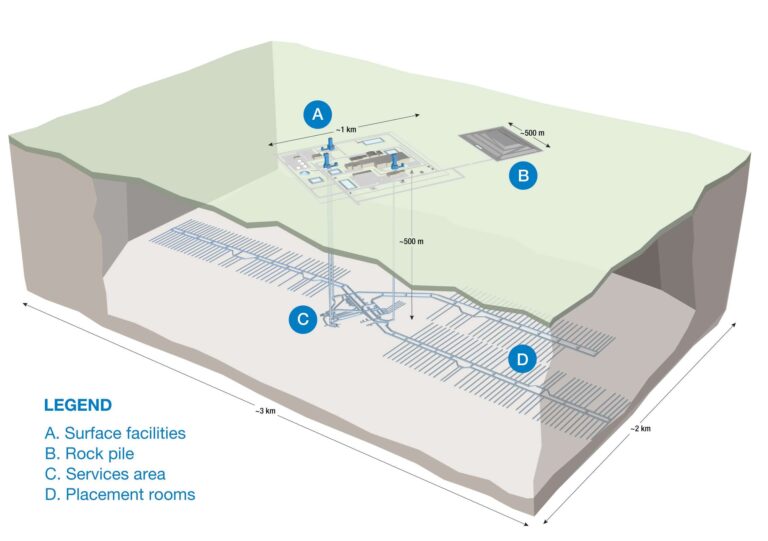
The Nuclear Waste Management Organization (the NWMO) is proposing a new underground deep geological repository system designed to safely contain and isolate used nuclear fuel. Wabigoon Lake Ojibway Nation (WLON) and the Township of Ignace have been selected as the host communities for the proposed project, which is located 21 kilometres southeast of the WLON and 43 kilometres northwest of the Town of Ignace, Ontario along Highway 17. As proposed, the Deep Geological Repository (DGR) for Canada’s Used Nuclear Fuel Project would provide permanent storage for approximately 5.9 million bundles of used nuclear fuel. The project is expected to span approximately 160 years, encompassing site preparation, construction, operation and closure monitoring. The project assessment is being conducted in collaboration with the Canadian Nuclear Safety Commission.
Learn more about the Integrated Impact Assessment process which is led by the Impact Assessment Agency of Canada and Canadian Nuclear Safety Commission.
- Read the Summary of Issues (February 16, 2026)
- Read the Summary of the Initial Project Description (January 5, 2026)
- Read the Initial Project Description (January 5, 2026)
- Learn More about the Melgund Integrated Nuclear Impact Assessment (MINIA) Project
- Learn More about the Nuclear Waste Management Organization (NWMO)
About the Author