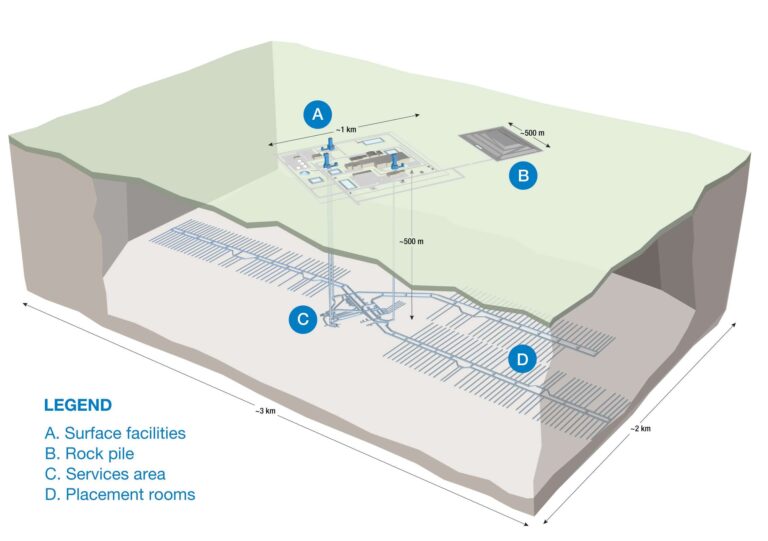

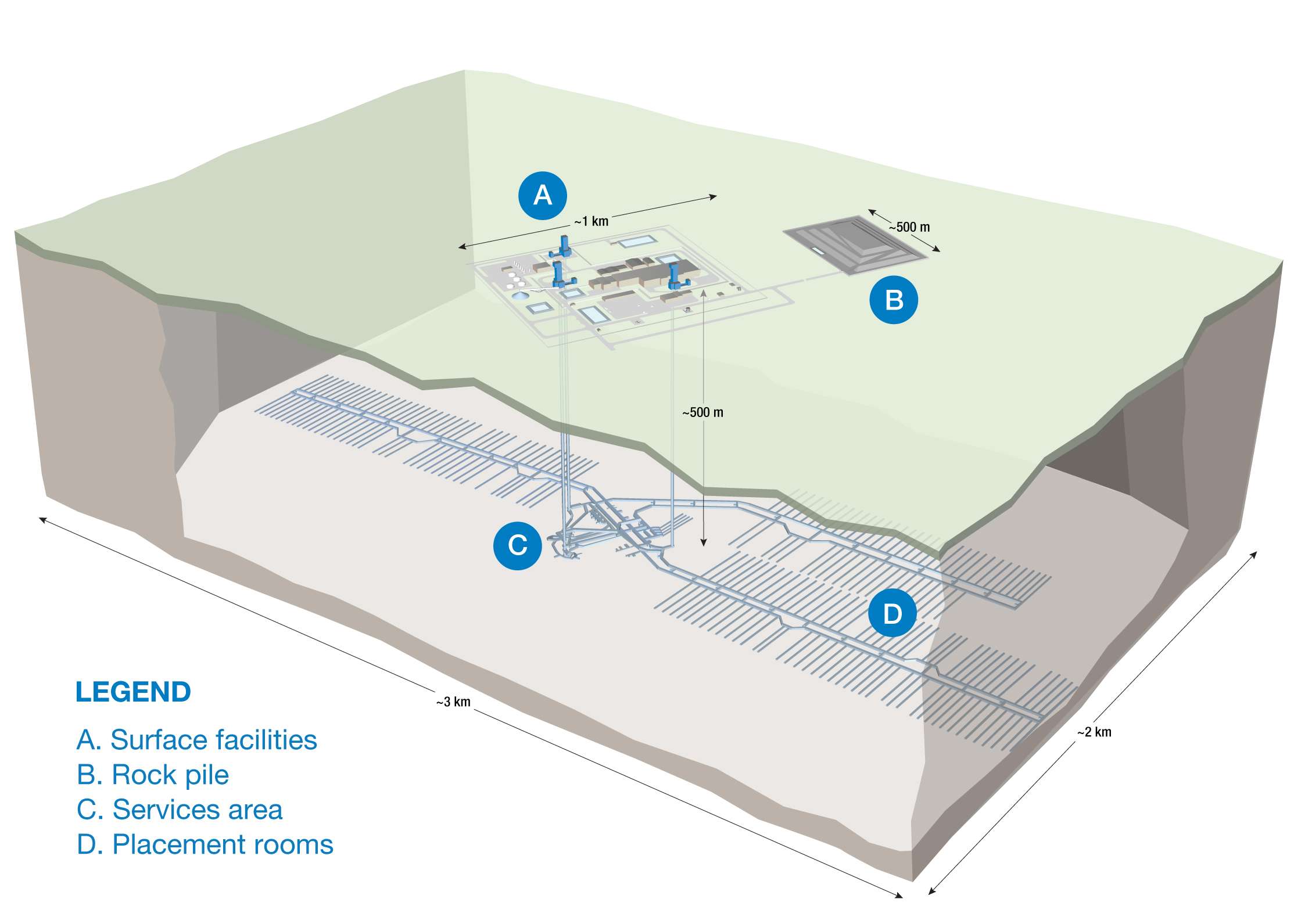
This photo is a rendering of the proposed Deep Geological Repository (DGR) at the Revell Site, designed to safely store nuclear waste deep underground for long-term environmental protection.
Introduction
This report presents a meta-analysis of public comments submitted to the Impact Assessment Agency of Canada (IAAC) regarding the Initial Project Description for the proposed Revell Site Deep Geological Repository (DGR). The analysis is based on a dataset of 37 individual comment assessments as of January 14, 2026.
The objective of this review was to synthesize the prevailing public sentiment, categorize substantive concerns, and identify constructive alternatives proposed by stakeholders who submitted public comments to the Government of Canada. The scope of this report is strictly limited to content of the provided comments, offering a neutral academic overview of the feedback received regarding the Nuclear Waste Management Organization’s (NWMO) proposal.
Public Feedback Open: Comments on the Initial Project Description are accepted until February 4, 2026. Submissions help shape the formal impact assessment guidelines. Click here to make a submission to the IAAC.
Learn more about our project at: https://melgundrecreation.ca/nuclear
Consolidated Overview
Quantitative Summary: The dataset reveals an overwhelming trend of opposition to the proposed project. Of the 37 public comments reviewed, approximately 81% (30 comments) expressed explicit opposition. Only one comment (approx. 3%) expressed support for the project. The remaining comments (16%) were classified as Neutral, Unclear, or Procedural, often serving as cover notes, requests for information, or critiques of the consultation timeline rather than the project itself.
Qualitative Sentiment: The tone of the opposition is characterized by high levels of anxiety, distrust, and urgency. Commenters frequently utilize strong emotional language, describing the project as a “threat,” “ecocide,” and a “travesty.” There is a pervasive sense of skepticism regarding the integrity of the regulatory process and the technology involved.
Conversely, the single supporting comment adopted a technical and pragmatic tone, framing the project as a necessary component of climate leadership and praising the engineering safety of rail transport.
Prevailing Themes: The discourse is dominated by three major pillars of concern: the risks of long-distance transportation, the potential for irreversible environmental contamination of watersheds, and the perceived illegitimacy of the consent process (governance). A recurring theme is the “Proximity Principle,” where a significant number of respondents argue that waste should remain near its point of generation rather than being transported to Northwestern Ontario.
Key Issues Analysis
Transportation and Logistics
Transportation represents the most frequently cited technical concern within the dataset. Respondents expressed profound alarm regarding the logistics of moving high-level radioactive waste over distances exceeding 1,600 kilometers from Southern Ontario to the Revell Site. Specific fears center on the condition and safety record of Highways 11 and 17, particularly during winter months. Commenters characterized these routes as dangerous, citing high accident rates, poor infrastructure, and the presence of inexperienced commercial drivers. There is also a specific technical concern regarding the physical integrity of spent fuel bundles; respondents fear that the vibrations and stresses of long-haul transport could damage the fuel, leading to radioactive emissions or rendering the bundles unsafe for manipulation upon arrival.
A critical procedural grievance related to transportation is the perceived exclusion of transport risks from the scope of the Impact Assessment. Multiple commenters argued that the transport phase is integral to the project and that excluding it violates the Impact Assessment Act. They contend that the risks of spills, collisions, and security incidents along the route must be assessed with the same rigor as the repository site itself. In contrast, the sole supporting comment argued that rail transport offers a superior safety profile compared to road haulage and fossil fuel transport, citing the robustness of steel transport casks.
Environmental and Watershed Integrity
The potential for long-term environmental degradation is a primary driver of opposition. Stakeholders expressed deep anxiety regarding the placement of the repository at the headwaters of major watersheds, specifically the Wabigoon and Turtle-Rainy River systems, which eventually drain into Lake Winnipeg. The fear of radionuclide migration via groundwater is prevalent, with commenters questioning the ability of engineered barriers (clay and metal) to contain waste for the required timeframe of up to one million years. The “pristine” nature of the Canadian Shield is frequently contrasted with the industrial nature of Southern Ontario, with residents arguing that the region’s ecological value for tourism and recreation outweighs the benefits of hosting the waste.
Furthermore, respondents raised concerns regarding the intersection of geological timescales and climate change. Questions were posed regarding how the facility would withstand seismic activity, future glaciation, and extreme weather events over centuries. The irreversibility of the project was highlighted as a major ethical and environmental risk, with commenters describing the repository as an “experiment” with unproven technology, citing the lack of operational track records for similar facilities globally (specifically referencing the Finnish Onkalo model as not yet fully proven).
Governance, Consent, and Social License
A significant portion of the feedback challenges the legitimacy of the decision-making process, raising serious red flags regarding consent manufacturing and regulatory capture. Commenters explicitly criticized the financial relationship between the NWMO and potential host communities. The payments offered to communities like Ignace were described by some as “alluring inducements” designed to buy consent, thereby compromising the objectivity of local councils. There is a strong sentiment that the NWMO is “prejudiced” and that the process lacks democratic accountability.
The definition of a “willing host” is heavily contested. Respondents argue that consent is being defined too narrowly, granting decision-making power to the small township of Ignace while excluding downstream communities, First Nations, and those along the transportation corridor who bear the risk. This has led to accusations of an “authoritarian approach” to site selection. Additionally, procedural fairness was questioned regarding the consultation timeline; stakeholders argued that a 30-day window to review over 1,000 pages of technical documentation is “patently unfair” and insufficient for meaningful public engagement.
Indigenous Rights and Environmental Justice
Opposition based on Indigenous rights is prominent and specific. Commenters referenced the United Nations Declaration on the Rights of Indigenous Peoples (UNDRIP), asserting that the project violates the requirement for free, prior, and informed consent. Specific territorial disputes were raised, notably by the Eagle Lake First Nation, which asserts the project is within their territory and is proceeding without their consent. The historical context of environmental racism was also invoked, particularly regarding the Grassy Narrows First Nation; commenters argued that placing nuclear waste near a community already suffering from historical mercury poisoning constitutes a “criminal” compounding of trauma.
Socio-Economic and Intergenerational Ethics
Socio-economic concerns focus on the potential stigmatization of Northwestern Ontario as a “nuclear waste dump,” which residents fear will deter tourism and damage the regional brand. Economically, skeptics argued that the cost of the DGR and the associated transportation is prohibitive and that these costs will ultimately be passed to consumers via higher hydro bills. Ethically, the project is viewed by many as a violation of intergenerational equity. Commenters argued that burying waste transfers the burden of risk and management to future generations who received no benefit from the energy generated, characterizing the act as irresponsible stewardship.
Community Suggestions and Alternatives
While the majority of comments were critical, they contained several consistent suggestions for alternative approaches to nuclear waste management:
- The Proximity Principle: The most frequently proposed alternative is to store the waste at or near the point of generation (e.g., the Bruce site in Southern Ontario). Proponents of this view argue it eliminates transportation risks, reduces costs, and places the burden of waste on the beneficiaries of the energy produced.
- Hardened On-Site Storage: Rather than deep geological burial, several commenters advocated for robust, monitored surface or near-surface storage at current reactor sites. This allows for constant monitoring and retrievability should technology improve in the future.
- Expanded Democratic Mandate: To address the “democratic deficit,” commenters suggested a province-wide referendum on the transportation of nuclear waste. They argue that all citizens along the Trans-Canada Highway should have a vote, not just the host municipality.
- Independent Oversight: There were calls for oversight bodies completely independent of the NWMO and the nuclear industry to review safety claims, as trust in the current proponent is low.
- Nuclear Phase-Out: A subset of commenters suggested that the only true solution to the waste problem is the cessation of nuclear power generation to prevent the accumulation of further waste.
The Melgund Integrated Nuclear Impact Assessment Project
The Impact Assessment Agency of Canada (IAAC) is reviewing the Nuclear Waste Management Organization’s (NWMO) proposed Deep Geological Repository (DGR) at the Revell Site, located near Ignace and Wabigoon Lake Ojibway Nation in Northwestern Ontario.
This major nuclear infrastructure project is undergoing a joint federal review by the IAAC and the Canadian Nuclear Safety Commission (CNSC) to evaluate environmental, health, social, and Indigenous rights impacts over its projected 160-year lifecycle.
Public Feedback Open: Comments on the Initial Project Description are accepted until February 4, 2026. Submissions help shape the formal impact assessment guidelines. Click here to make a submission to the IAAC.
About the Author