Format: Short Film / Anthology Episode | Est. Length: 10-12 minutes
Imagine a world gripped by an endless winter and the lingering scars of an unseen conflict, where the line between reality and delusion blurs for those left behind. This story could serve as a powerful episode within an anthology series exploring the psychological toll of survival in a fractured society, focusing on isolated characters grappling with trauma and the desperate search for meaning in a desolate landscape. Each episode would delve into a unique personal struggle, often using elements of magical realism or psychological thriller to heighten the emotional stakes and question perceptions of truth.
In a frigid, desolate home, a young girl named Gerta struggles to open a frozen attic latch, determined to access her absent father's hidden radio. Her desperate efforts reveal a profound need for connection and a burgeoning delusion that will soon consume her.
A young girl, isolated in a post-conflict world, retreats into a dangerous delusion, believing her father’s old radio connects her to a secret military mission. To secure her "base of operations," she ultimately neutralizes the perceived internal threat: her own mother.
The story deeply explores themes of grief, trauma, and the psychological impact of war, particularly on children. Gerta’s elaborate fantasy serves as a coping mechanism for the profound loss of her father and the overwhelming instability of her environment, highlighting how the mind constructs its own reality in the face of unbearable pain. It also delves into the dangers of unchecked delusion and the tragic breakdown of familial bonds under extreme stress.
Genre-wise, it blends elements of psychological drama, post-apocalyptic survival, and a touch of tragic magical realism, creating an unsettling and emotionally resonant experience. The narrative questions the nature of sanity and the lengths to which individuals will go to maintain a sense of purpose and connection when everything else has been stripped away.
For Gerta, the stakes are her sanity and her ability to process her father's absence, risking a complete break from reality and the destruction of her remaining family ties. For Lena, the stakes are her daughter's well-being and her own safety, as Gerta's delusion escalates into a direct threat against her. The story also implicitly raises the stakes for humanity in a post-conflict world, showing how trauma can erode the very foundations of society and personal relationships.
The primary conflict is internal, as Gerta battles her grief and the harsh reality of her father's absence by constructing an elaborate, dangerous delusion. Externally, she perceives the world as hostile – the freezing environment, the "glass knives" (icicles), the "enemy" soldiers, and ultimately, her own mother, who tries to pull her back to reality. Lena represents the opposing force of reality and maternal concern, inadvertently becoming the "internal threat" Gerta feels compelled to neutralize.
In a world scarred by conflict and bitter cold, Gerta, a young girl, desperately tries to open a frozen attic latch to retrieve her absent father's military radio. Believing it to be a direct link to him and a secret mission, she overcomes the physical challenge, finds the AN/PRC-77, and despite only hearing static, begins to interpret random broadcasts and her own imagination as direct orders from "Command." Her first mission involves an "ice radio patrol" to identify "hostiles," leading her to perceive icicles as "glass knives" and a neighbor's milk delivery as a "potential enemy asset."
As Gerta's delusion deepens, she returns to the attic to report her findings, receiving new "orders" to destroy the "enemy network" (icicles). Her mother, Lena, increasingly worried by Gerta's behavior, tries to intervene, particularly after soldiers question Gerta's destructive actions. Lena's attempts to bring Gerta back to reality are tragically misinterpreted by Gerta as collaboration with the enemy, leading her to believe her mother is a "compromised asset." Gerta, fully committed to her mission, lures Lena to the cellar and locks her inside, effectively neutralizing the "internal threat" to her "base." The episode concludes with Gerta, alone and secure in her delusion, reporting her success to the static-filled radio, awaiting new orders.
* GERTA (Psychological Arc: Desperate grief and longing -> Deep-seated delusion and perceived military agent): A young girl, perhaps 8-10 years old, grappling with the absence of her military father in a harsh, post-conflict world. She starts as a child seeking comfort and connection, but her vivid imagination and trauma lead her to construct an elaborate fantasy where she is a soldier on a mission, receiving orders from her father via his old radio. By the end, she is fully immersed in this delusion, willing to sacrifice her remaining family for the "mission."
* LENA (Supporting Character: Exhausted, worried mother): Gerta's mother, worn down by the harsh realities of their existence and the grief of her husband's absence. She tries to maintain a semblance of normalcy and protect her daughter, but is increasingly frustrated and worried by Gerta's escalating "game." Her attempts to intervene are tragically misunderstood, leading to her being locked away.
Gerta struggles with the frozen attic latch, driven by a desperate need to reach her father's radio, while her mother's weary sounds from below underscore their desolate reality. She eventually forces the latch open, revealing a dusty, cold sanctuary where her father's sea bag and the prized AN/PRC-77 radio await. Gerta discovers the radio, attempts to power it on, and despite only hearing static, begins to interpret faint sounds as her father's voice and initial orders.
Gerta embarks on her "ice radio patrol," observing the frozen world through the lens of her delusion, identifying icicles as "glass knives" and a neighbor's milk bottle as a "potential enemy asset." She reports back to her static-filled "Command," receiving new "orders" to neutralize the "threats," leading her to smash the icicles with a pipe. Her mother, Lena, confronts her about her strange behavior and the soldiers' complaints, attempting to intervene and retrieve the radio, which Gerta interprets as a hostile act from a "compromised asset."
Gerta, with chilling resolve, lures her mother to the dark cellar under the pretense of showing her something, then shoves her down the stairs and locks the heavy door. She returns to the quiet attic, the house now secure in her delusional world, and reports to her silent radio that the "internal threat has been neutralized," awaiting her next orders.
The episode begins with a mood of quiet desperation and longing, quickly shifting to a tense, almost childlike determination as Gerta pursues her goal. As her delusion takes hold, the mood becomes increasingly unsettling and tragic, blending moments of Gerta's perceived triumph with the audience's growing dread. The climax is chillingly detached and clinical from Gerta's perspective, culminating in a profound sense of isolation and sorrow, leaving the audience with a heavy feeling of loss and the disturbing reality of her fractured mind.
If expanded into a series, Gerta's story could be a recurring thread or a standalone episode within an anthology exploring the psychological aftermath of a global "Ice War." A season arc could follow different individuals or small communities as they navigate the harsh environment and the lingering trauma, each episode revealing another facet of human resilience, delusion, or descent into madness. The overarching narrative could slowly unveil the true nature of the "enemy" or the "war," perhaps revealing it to be a long-ended conflict, or even a natural disaster misinterpreted through the lens of military propaganda, further deepening the themes of perception and reality.
Alternatively, Gerta's continued "missions" could form a mini-arc, with her increasingly dangerous interpretations of the world leading her further afield and into contact with new characters or factions. Her radio, while a source of delusion, could also inadvertently lead her to genuine threats or unexpected allies, blurring the lines between her fantasy and the harsh realities of survival, and potentially offering a path to either deeper delusion or a painful re-entry into reality.
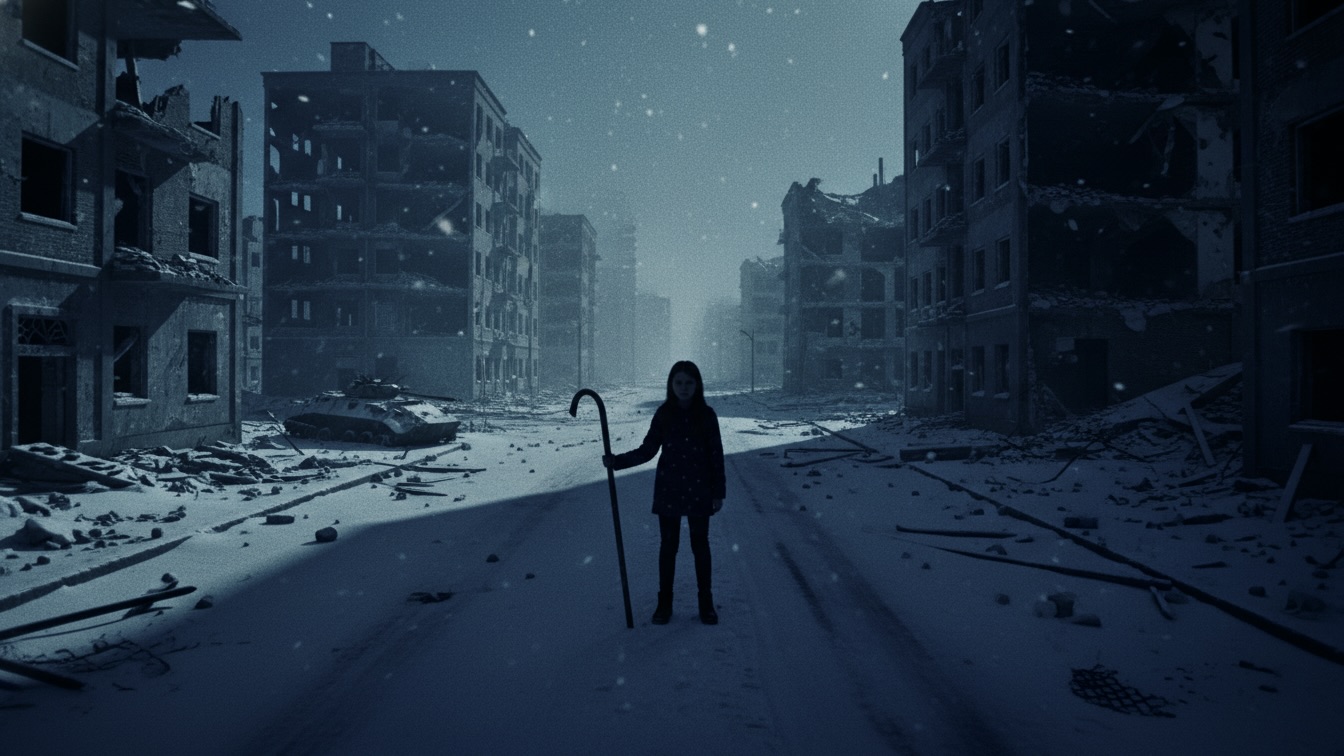
The visual style should be stark and desaturated, emphasizing the pervasive cold and desolation. Think muted blues, grays, and whites, with occasional pops of color (like the olive-green radio) to highlight key objects. Cinematography should often use low angles to emphasize Gerta's smallness in a vast, broken world, and close-ups to capture her intense focus and the subtle shifts in her expressions as she processes her "orders." The tone is a blend of melancholic drama and psychological thriller, with an underlying current of profound sadness.
Tonal influences could include films like The Road for its bleak, post-apocalyptic atmosphere and focus on survival, Pan's Labyrinth for its blend of childlike fantasy and brutal reality, and Room for its exploration of a child's constructed world within confinement. The sound design would be critical, with the omnipresent hiss and crackle of the radio becoming a character in itself, shaping Gerta's perception of reality.
This treatment is aimed at a mature audience (16+) who appreciate psychological dramas, post-apocalyptic narratives, and character-driven stories that explore themes of grief, trauma, and mental health. Viewers who enjoy anthology series with a dark, thought-provoking edge, and those interested in the human cost of conflict, would find this compelling. It's best suited for a streaming platform or premium cable channel known for challenging and emotionally resonant content.
The pacing should be deliberate and atmospheric, building tension gradually. The first act focuses on Gerta's determined efforts to access the attic and the radio, establishing her longing. The second act, her "patrol" and initial "reports," moves with a sense of urgent purpose, escalating her delusion. The third act accelerates towards the chilling climax, with a sharp, decisive tempo as Gerta "neutralizes" her mother, culminating in a quiet, unsettling resolution. The 10-12 minute runtime allows for a tight, impactful narrative without overstaying its welcome, perfect for an anthology format.
Minimal special effects would be required, focusing instead on practical effects for the cold, ice, and dilapidated environment. Set design should emphasize decay and resourcefulness, with the attic feeling like a secret, dusty shrine. The AN/PRC-77 radio prop needs to be authentic and functional-looking, with particular attention paid to the tactile experience of Gerta interacting with its knobs and handset. Sound design is paramount, with meticulous attention to the nuanced sounds of static, faint broadcasts, and the contrast between the external world's silence and Gerta's internal auditory landscape.
Casting a young actress capable of conveying both childlike vulnerability and chilling conviction is crucial. The visual storytelling should rely heavily on Gerta's perspective, using point-of-view shots and subjective sound to immerse the audience in her fractured reality. The limited locations (house, street, attic, cellar) make this a contained and feasible production, allowing for greater focus on performance and atmospheric detail.