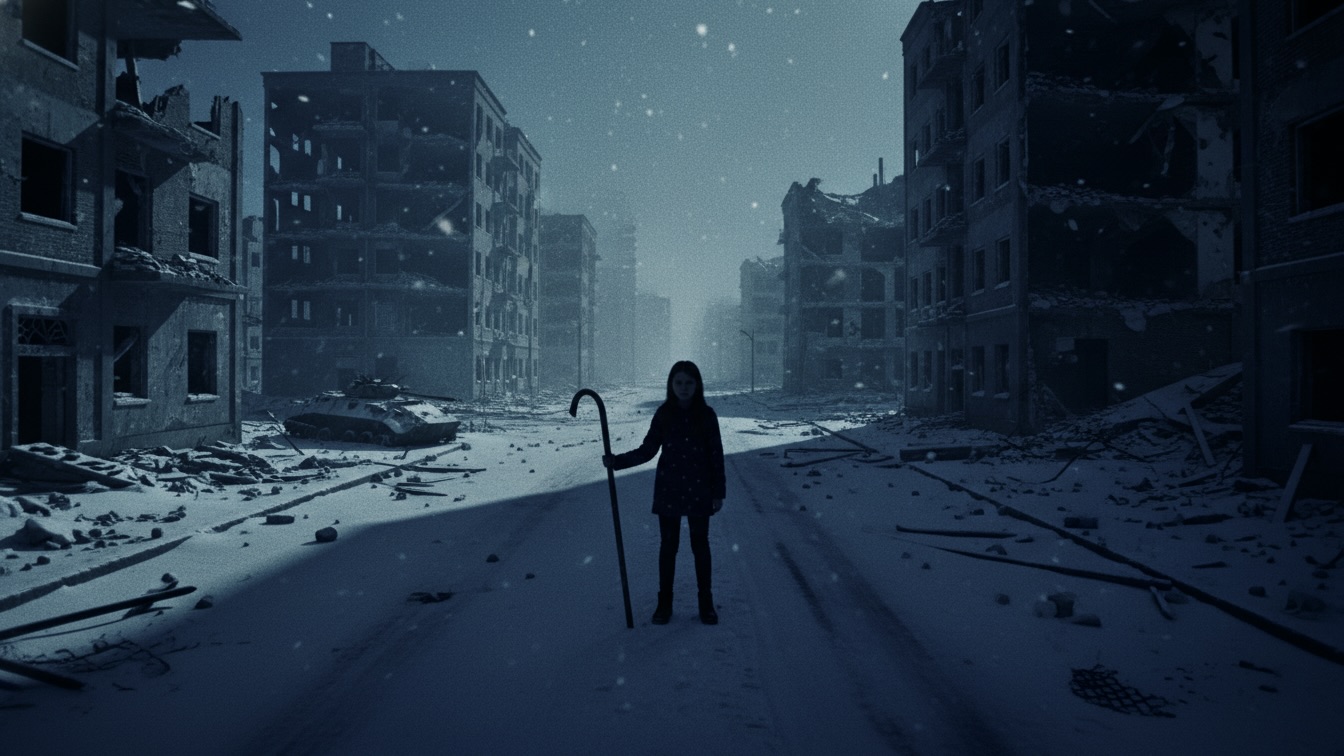
The chapter introduces Gerta, a young girl living in a cold, war-torn environment, fixated on accessing her attic. After a struggle, she retrieves her deceased father's military radio from a canvas bag, along with other survival items. She attempts to operate the radio, interpreting static and fleeting sounds as coded messages from "Command," which she believes is her father. Driven by these perceived orders, Gerta embarks on an "Ice Radio Patrol," identifying icicles as "glass knives" and a neighbor's milk bottle as a "potential enemy asset." Her mother, Lena, increasingly concerned by Gerta's behavior, tries to intervene, leading Gerta to label her as a "compromised asset" due to her communication with actual soldiers and her attempts to stop Gerta's mission. Ultimately, Gerta lures Lena into the cellar and locks her in, neutralizing the perceived "internal threat" to her mission, and reports her success to the silent radio, awaiting new orders.
The narrative powerfully explores themes of grief, delusion, and the psychological impact of war on a child. Gerta's elaborate "mission" serves as a profound coping mechanism for the overwhelming loss of her father and the chaotic, dangerous world around her. She transforms her grief into a structured, militaristic fantasy, where the father's radio becomes a direct conduit to his enduring presence and authority, providing her with purpose and a distorted sense of control in an otherwise uncontrollable reality.
This delusion starkly contrasts with the harsh external reality, highlighting the fragile boundary between childhood imagination and psychological breakdown. Gerta's interpretation of everyday objects and interactions—icicles as "glass knives," her mother's concern as "compromised"—reveals the extent to which her trauma has warped her perception. The story thus becomes a tragic exploration of how a child attempts to process incomprehensible loss and chaos by imposing a self-created, albeit dangerous, order.
Another central theme is the breakdown of communication and the profound isolation Gerta experiences. Her mother, Lena, attempts to connect with her, to ground her in reality, but Gerta's internal world has become impenetrable. The static from the radio, a symbol of emptiness and absence, is paradoxically interpreted by Gerta as a rich language of orders and affirmations, further isolating her from human connection and reinforcing her delusion. This severing of true communication culminates in her extreme act against her mother, solidifying her solitary descent into her self-made reality.
The story also subtly examines the nature of authority and control. In a world where Gerta is powerless, she creates an elaborate system where she is an agent of "Command," giving her a sense of agency and importance. Her father, even in absence, provides the framework for this authority, his military training becoming the blueprint for her "mission." This need for control, born from helplessness, ultimately leads her to exert absolute, destructive control over her immediate environment, including her mother.
Gerta's internal state is a complex tapestry woven from grief, fear, and a desperate need for meaning. She is profoundly traumatized by the absence of her father, likely a casualty of the ongoing conflict, and struggles to reconcile this loss with the grim reality of her surroundings. Her mind constructs an elaborate, militaristic delusion, where she is a soldier on a vital mission, directly connected to her father through his radio. This fantasy provides her with a framework to understand and interact with a world that has become terrifying and unpredictable.
Her motivations are rooted in a deep longing for connection to her father and a yearning for order amidst chaos. By adopting the persona of a soldier, she feels a sense of purpose and control that is otherwise missing from her young life. The "mission" allows her to channel her grief and anxiety into tangible actions, no matter how misguided. She desperately seeks validation and guidance, projecting these needs onto the static-filled radio, believing it to be her father's voice and orders.
Gerta's primary conflict is internal, a battle between her nascent understanding of reality and the powerful, comforting delusion she has constructed. While a part of her acknowledges the radio is "just a box," her emotional need to believe in its power to connect her to her father is overwhelming. Externally, she is in conflict with her mother, Lena, who represents the encroaching reality that threatens to dismantle her carefully built fantasy. The external world, with its cold, ruined buildings and patrolling soldiers, only reinforces her distorted worldview, solidifying her belief in pervasive threats.
Lena's internal state is characterized by profound worry, exhaustion, and a desperate effort to protect her daughter and maintain some semblance of normalcy. She is undoubtedly grieving her husband's absence, but her immediate focus is on Gerta's increasingly erratic and dangerous behavior. She is a figure of maternal concern, trying to ground her daughter in reality and shield her from both the external dangers of their world and the internal dangers of her own mind.
Her motivations are purely protective and nurturing. She seeks to bring Gerta back from her delusion, to ensure her safety, and to restore a healthy relationship with her daughter. She attempts to intervene gently at first, then with increasing frustration and urgency, as Gerta's actions become more extreme. Lena wants Gerta to understand the real dangers, rather than fabricating imaginary ones.
Lena's main conflict is external, struggling against Gerta's powerful delusion and the practical implications of her daughter's "mission." She is pitted against Gerta's unwavering belief in her "orders," which prevents any meaningful communication or resolution. Her attempts to discipline or reason with Gerta are met with hostility and suspicion, ultimately leading to her tragic neutralization as a "compromised asset" in Gerta's warped reality.
The chapter employs a stark, sensory-rich narrative voice that plunges the reader directly into Gerta's subjective experience, making her fractured reality intensely palpable. The third-person limited perspective, closely adhering to Gerta's point of view, is crucial; it allows the reader to witness the world through her eyes, experiencing her interpretations of static as "orders" and icicles as "weapons," thereby enhancing the psychological depth and tragic irony. The prose is precise, often using short, impactful sentences that reflect Gerta's focused, almost military-like determination.
Pacing in the chapter is masterfully controlled, starting with a slow, deliberate build-up as Gerta struggles with the attic latch, mirroring her internal struggle and the weight of her mission. It accelerates subtly during her "patrol," her observations detailed and quick, before intensifying dramatically during the confrontations with Lena. The final, chilling act of locking Lena in the cellar is executed with swift, unadorned prose, creating a powerful and shocking conclusion that underscores Gerta's complete descent into her delusion.
Sensory details are meticulously woven throughout the narrative, painting a vivid picture of both the external, war-torn environment and Gerta's internal world. Tactile sensations like the "cold of the house," "numb at the tips" fingers, and the "achingly cold" milk bottle emphasize the harsh physical reality. Auditory details are particularly significant, from the "clink of a spoon" representing Lena's mundane reality to the omnipresent "hiss" and "static" of the radio, which Gerta transforms into a language of command. Olfactory details, such as the attic's smell of "old paper and dead things" and the blanket's scent of "cold air and faint machine oil," serve as potent links to memory and loss. Visually, the "skeletons of buildings" and "glass knives" of ice create a bleak, dangerous landscape, mirroring Gerta's internal paranoia.
The tone shifts from one of determined resolve to a chilling, almost clinical detachment as Gerta fully embraces her role as an agent. Initially, there's a sense of desperate hope and longing in her attempts to reach her father. However, as her delusion solidifies, the tone becomes increasingly devoid of typical childish emotion, replaced by a cold, unwavering commitment to her "mission." This shift highlights the tragic transformation of Gerta from a grieving child into a psychologically compromised "soldier," culminating in the chilling final report to "Command."