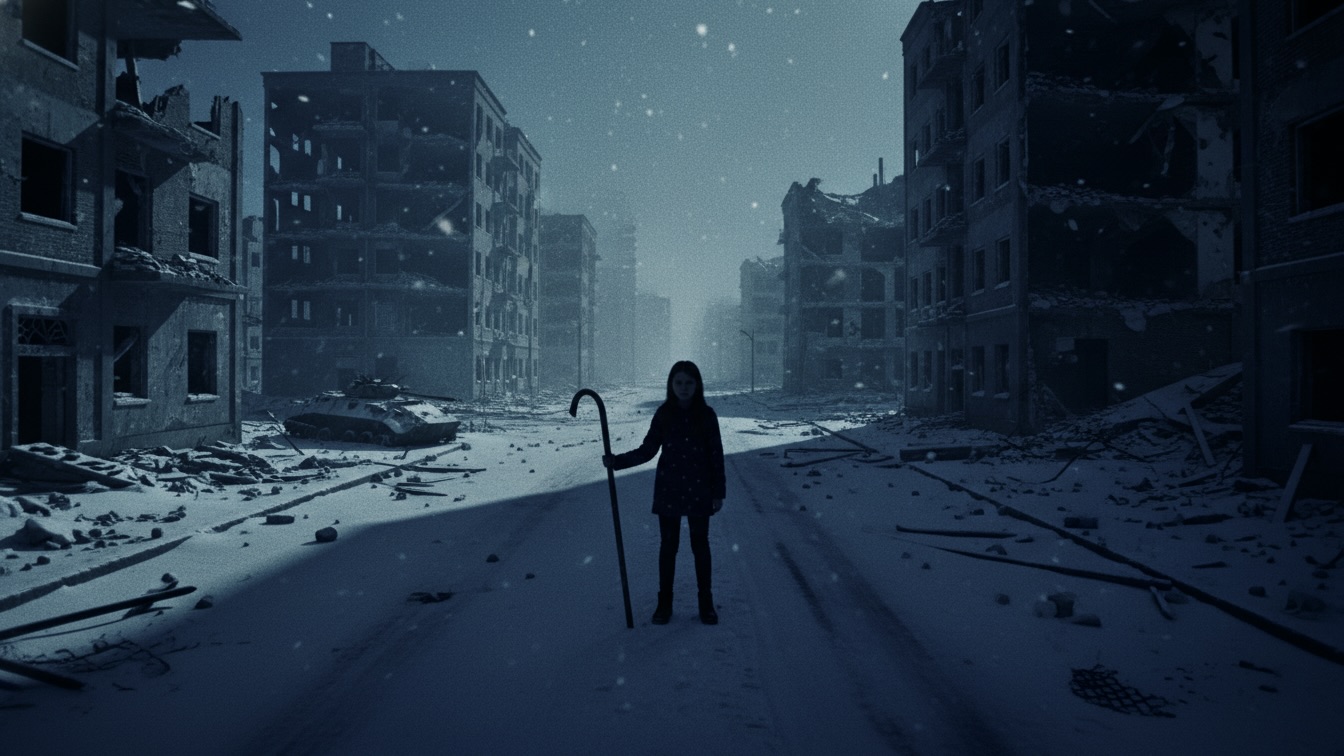
In a frozen, war-scarred city under the perpetual gray of a winter sky, the bitter cold seeps through the cracks of a damaged home. The air is thick with the smell of damp plaster, woodsmoke, and the metallic tang of snow. Sounds are muffled by the snow-blanketed ruins, broken only by the wind and the distant, rhythmic crunch of military patrols.
The attic latch was frozen shut. Gerta put her shoulder into the small square door set in the ceiling and pushed. A grunt, small and tight in her throat. Nothing. The cold of the house had worked its way into the metal, welding it to the frame. She could see her breath, a little cloud of steam puffing out and vanishing in the gloom of the hallway. Below, her mother, Lena, was a collection of noises in the kitchen—the clink of a spoon against a ceramic bowl, the tired sigh that seemed to follow every small task. Gerta didn't want those noises. She wanted the quiet of the attic.
She dragged a chair from the kitchen, its legs scraping a protest against the warped floorboards. The chair wobbled. She climbed onto it anyway, her thin fingers, numb at the tips, fumbling with the metal ring of the latch. It wouldn't budge. She pulled until her knuckles turned white, a hot frustration building in her chest. This was a mission. Entry was essential. Her father would have found a way. He wouldn't have been stopped by a little bit of ice.
She remembered watching him fix things. He never forced them. He was clever. He would tap at a stuck bolt, a gentle persuasion. Gerta balled her small hand into a fist and tapped the latch. Once. Twice. A third time, harder, using the bony part of her wrist. A crackle of ice breaking. The latch shuddered and, with a final, groaning pull, it swung open. A puff of frigid, dusty air washed over her face. It smelled of old paper and dead things.
She pulled down the rickety folding ladder. It unfolded with a series of loud cracks that sounded like bones breaking. She froze, listening for her mother. The clinking in the kitchen stopped. "Gerta? What was that?"
"Nothing," Gerta called back, her voice too loud in the sudden quiet. "Chair slipped."
She waited, holding her breath, until the spoon started stirring again. Then she scrambled up the ladder, pulling it up behind her and pushing the trapdoor shut, plunging herself into a dusty, slanted darkness, lit only by a single, grimy porthole window at the far end of the roof.
Her father's things were in a canvas sea bag tucked under the eaves, just where he’d told her they would be. "Everything a soldier needs to get home," he'd said, tapping the side of his nose. She hadn't understood then. She did now. It was a supply cache. An emergency post.
The canvas was stiff with cold. She worked at the knot on the drawstring, her fingers too clumsy. Frustrated, she found a loose thread and just pulled, ripping the seam with a satisfying tearing sound. The contents spilled onto the dusty floorboards. A wool blanket, smelling of him—of cold air and faint machine oil. A tin of hard biscuits, a dented canteen, a folded map case with nothing inside. And at the bottom, the prize. The radio.
It was a heavy, olive-green box with a web of straps, a coiled handset, and a long, collapsible antenna that folded against its side like a broken wing. The AN/PRC-77. She knew its name. He had taught her. She ran her hand over the cold metal, her fingers tracing the stenciled numbers. This was his voice. This was the box that carried his words across mountains and through forests. It had connected him to his men, to his command. It would connect him to her.
She sat cross-legged on the floor, the radio heavy in her lap. The battery pack was still attached. She found the power knob. It was stiff. She had to use both hands to turn it, her small thumbs pressing hard until it clicked. A low hiss filled the attic. Static. The sound of a dead channel. The sound of emptiness. Her heart sank. Of course. It was just a box. He was gone.
She fiddled with the frequency dial, a hopeful, desperate twist. The static changed pitch, rising and falling. She put the handset to her ear, the cold plastic pressing against her skin. Hiss. Crackle. Pop. Nothing but the sound of empty space. She slumped against a roof beam, the weight of the silence pressing down on her more than the radio ever could. Her eyes burned. He wasn't going to talk. He was quiet, like the snow outside.
She kept turning the dial anyway, slowly, methodically. It was something to do. A drill. Soldiers performed their drills. Through the hiss, a flicker of something else. A voice, warped and distant, buried in the noise. "…report… severe weather warning… ice forming on…"
Gerta froze. The voice was gone as quickly as it came, swallowed by the static. But she had heard it. A report. Ice. She twisted the dial back, trying to find it again. Nothing. Just the hiss. But the word echoed in her head. Report.
She leaned closer to the handset, her lips almost touching the plastic grille. "This is Gerta," she whispered, her voice trembling. "Awaiting orders."
Silence. Then, a sharp burst of static, like a cough. Pop. Hiss. And then, woven into the fabric of the noise, she heard it again. A different voice, a snatch of a song from some faraway station. "…watch your back…"
Her breath caught in her chest. An order. A warning. Her father was on the line. He was watching out for her. The mission was active. The first instruction was clear: identify hostiles. That’s what a patrol did. You went out, you observed, you reported back. She had to watch her back. Hostiles were everywhere.
She packed the essentials back into the bag: the biscuits, the canteen. She left the blanket. It was too much to carry and its scent was a distraction. She strapped the radio to her back, the weight of it settling onto her small frame. It felt right. Official. She extended the antenna, a thin metal spine reaching for the roof. She was in communication with Command.
She slipped out of the attic and down the ladder, silent as a ghost. Lena was in the living room now, mending a tear in Gerta's coat. "Where are you going? It's almost dark."
"Just out," Gerta said, pulling on her boots. She avoided her mother's eyes.
"Stay on our street, Gerta. Don't go near the barricades."
"I know," she said, her voice flat. Lena was a civilian. She didn't understand operational security.
The cold hit her like a physical blow as she stepped outside. The sky was the color of a bruise. Snow crunched under her boots. The street was lined with the skeletons of buildings, their walls blown out, their windows like empty eye sockets. A military transport rumbled past the end of the block, its engine a deep growl that vibrated through the soles of her feet. Hostiles? No, they were their own forces. But she watched them, cataloging their number, their direction of travel. Intel.
Her objective was observation. She moved along the broken pavement, keeping to the shadows of ruined walls. Her father had taught her about cover and concealment. The world was a mess of jagged lines and hiding places. She saw the icicles first. They hung from every roofline, from every twisted piece of rebar, from every shattered window frame. Long, clear daggers of ice, gleaming faintly in the dying light. Most people would see frozen water. Gerta saw weapons. Glass knives, hanging in wait. A threat. She made a note of their positions, counting them. Dozens. Hundreds.
The street was empty except for her. A thread of smoke curled from the chimney of the neighbor’s house, the one with the boarded-up windows. Movement. A potential contact. She crept closer, ducking behind the rusted hulk of a burned-out car. The back door of the house opened. The neighbor, a stooped old woman named Elsbeth, placed a single bottle of milk on her doorstep to keep it cold. A delivery. A drop. What was in it? Gerta's heart hammered against her ribs. This was intel. This was evidence.
She waited until the old woman went back inside and the door clicked shut. Then she darted from her cover, her feet silent on the snow. She snatched the bottle. It was heavy and achingly cold in her bare hands. She scurried back to the cover of the car, her prize clutched to her chest. She had secured the asset. The first part of the mission was a success. She retreated, moving quickly and quietly back toward her own house, the captured bottle tucked inside her coat.
Back in the attic, the air was even colder. She sat with the radio, the milk bottle on the floor beside her. She clicked the power knob. The familiar hiss filled the small space. She lifted the handset.
"Command, this is Gerta. Report follows." She spoke in a low, urgent whisper. "Patrol complete. Identified multiple enemy emplacements. Glass knives, deployed on all rooftops. High threat level. Also secured a potential enemy asset. White liquid, unknown composition. Awaiting further instructions. Over."
She waited, listening to the static. It was a language she was beginning to understand. The pops and whistles were affirmations. The long hisses were moments for thought. Then, a new sound cut through. A crackle, a snatch of broadcast from a commercial station drifting on the edge of the frequency. "…that's a sharp price… must be destroyed…"
Her instructions. The message was clear. The glass knives were not just weapons. They were listening devices. Enemy sensors. They had to be eliminated. She had her new orders.
Her mother was waiting for her at the bottom of the ladder. "Gerta, what are you doing up there? And what is that?" She pointed at the milk bottle Gerta was now holding.
"It's evidence," Gerta said, holding it tighter.
"That's Elsbeth's milk. Did you steal it?" Lena’s voice was sharp with a tired frustration Gerta couldn't understand. She was interfering with the mission.
"I requisitioned it for analysis," Gerta said, using a word she had heard her father use. She tried to push past, but Lena blocked her way.
"Give it to me. You're taking it back and you're going to apologize. Right now." Lena reached for the bottle.
"No!" Gerta clutched it. "It's contaminated!"
"Gerta, stop this. This game of yours is going too far." Lena's face was a mixture of anger and something else, something soft and worried that Gerta found infuriating. Weakness.
"It's not a game," Gerta said, her voice dangerously low.
She had to neutralize the threat. She couldn’t complete her mission with an unstable element in the base of operations.
She returned to the street the next morning, a metal pipe from the basement tucked into her coat. The icicles glittered. Listening posts, every one of them. She started with the one hanging from her own porch. She swung the pipe. A satisfying crack and the icicle shattered on the ground, exploding into a thousand tiny pieces. She moved to the next house, smashing, shattering, working her way down the street. Crack. Smash. The sound was loud in the frozen silence. She was destroying their network. She was blinding them.
"Hey! Little girl!"
A voice. Deep. Authoritative. She turned. Two soldiers stood at the end of the street, their rifles held loosely across their chests. They wore the same uniform as her father, but their faces were wrong. Strangers. Hostiles, attempting to halt the mission.
"What are you doing?" the taller one asked, walking toward her. He wasn't smiling.
"Classified," Gerta said, gripping her pipe tighter.
The soldier stopped a few feet away. "You should be inside. It's not safe out here. Go home."
They were trying to send her away. To leave the enemy network intact. She gave a short, sharp nod, a soldier's acknowledgment of an order she had no intention of following. She turned and walked back toward her house, not running. Running showed fear. She could feel their eyes on her back. They knew she was an agent.
When she got inside, Lena was frantic. "The soldiers came to the door. They said you were out here, breaking things. Gerta, you scared me to death!"
Lena reached for her, tried to pull her into a hug. Gerta went rigid. This was it. The final proof. Her mother was working with them. She had been talking to the hostiles. She was a compromised asset.
"I know what you are," Gerta whispered.
Lena pulled back, her face confused. "What are you talking about?"
"You're compromised," Gerta said, her voice flat and certain. "You've been in communication with the enemy."
Lena stared at her, her mouth slightly open. "Gerta, honey, this has to stop. You need to… we need to talk. Give me the radio."
She moved toward the hallway, toward the attic ladder. She was going for the communications equipment. Gerta knew what she had to do. Protocol was clear. Compromised assets had to be secured.
"I need you to come see something," Gerta said, her tone changing, becoming sweet, compliant. "In the cellar. I found something."
Suspicion warred with relief on Lena’s face. Relief won. She wanted to believe her daughter was back. "Okay. Show me."
Gerta led the way to the heavy cellar door. She pulled it open, revealing the steep, dark stairs leading down into the freezing earth. "Down there."
Lena hesitated at the top of the stairs, peering into the blackness. "What is it?"
"You have to see." Gerta stood behind her, her hand flat against her mother’s back. A gentle pressure. It was all it took. Lena, off-balance and unprepared, stumbled forward, crying out as she tumbled down the wooden steps. A series of heavy thuds, and then silence.
Gerta didn't wait. She slammed the heavy oak door. The thick metal bolt was stiff and loud as she slid it into place. The lock clicked, a final, definitive sound. She listened for a moment. A faint moan from below, then her mother's voice, muffled and panicked. "Gerta! Let me out! Gerta, this isn't funny! Open the door!"
Gerta ignored it. She walked up to the attic, the house now quiet and secure. She sat with the radio, the weight on her back gone. The mission was everything. She lifted the handset to her lips, the plastic cool against her skin.
"Command, this is Gerta," she whispered into the hiss of the static. "The internal threat has been neutralized. Asset is secured. The base is clean." She paused, listening intently to the empty airwaves. "Awaiting new orders."
“She paused, listening intently to the empty airwaves. 'Awaiting new orders.'”