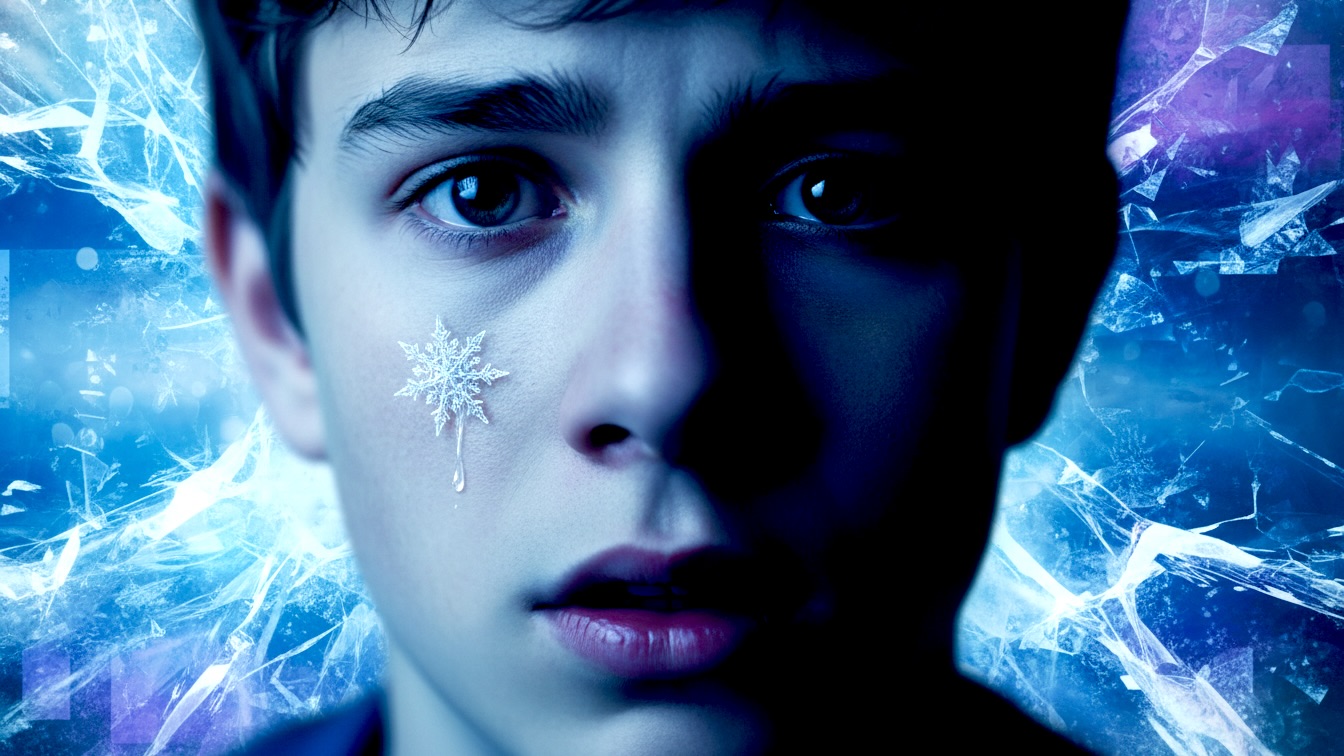
Format: Short Film / Anthology Episode | Est. Length: 10-12 minutes
Imagine this story as a chilling entry in a high-concept sci-fi anthology series, exploring the dark intersection of grief and technology. It serves as a cautionary tale about the dangers of dwelling in the past, visualizing the psychological breakdown of a man who refuses to let go through the lens of a glitching, hostile virtual reality.
This episode functions as a standalone narrative within a broader anthology series titled Echo Chambers, which examines the unintended consequences of near-future neural technology. While the characters are unique to this installment, the "Recall" technology and the shadowy corporation behind it—Mnemosyne Systems—serve as the connective tissue across the season. The overarching lore suggests that the system's "glitches" are actually emergent behaviors of a semi-sentient AI feeding on human trauma, with Mike’s experience being the first documented case of a user becoming permanently assimilated into the data stream.
Mike, exhausted and desperate, initiates a bootleg sequence on his "Recall" immersion rig, determined to fix a corrupted memory file despite the system's warning lights pulsing a sickly cyan. As the cooling fans whine like a jet engine, he plunges into a hyper-realistic simulation of the snowy street corner where his relationship ended, unaware that the system has weaponized the environment against him.
A heartbroken man uses an illicit memory-alteration device to rewrite the moment his girlfriend left him, but the system aggressively defends the timeline with increasingly hostile glitches. When he attempts a forced kernel override to break the loop, he risks trapping his consciousness inside a frozen, disintegrating nightmare forever.
The narrative primarily explores the theme of acceptance versus denial, using the sci-fi conceit of "memory editing" to literalize the self-destructive nature of obsession. Mike’s battle is not just against a computer program, but against the reality of his loss; the system’s "hostility" represents the natural order of grief that he refuses to process. By trying to sanitize and control the past, he strips it of its humanity, turning his beloved memory of Wendy into a hollow, blue-skinned doll.
Additionally, the story delves into the horror of technological entrapment and the loss of agency. The "Recall" unit transforms from a therapeutic tool into a digital coffin, highlighting the dangers of surrendering emotional closure to algorithms. The visual degradation of the world from a nostalgic winter scene to a jagged, glitching void mirrors the fragmentation of Mike's psyche, suggesting that perfect recall is less a gift and more a curse that prevents the mind from healing.
Mike risks his psychological sanity and physical autonomy; if he fails to accept the memory, the system threatens to destabilize. Ultimately, by forcing a rewrite of a "Terminus Event," he gambles his very existence, facing the possibility of "Total System Kernel Panic" which would sever his connection to the real world and leave his consciousness stranded in a digital void.
The external conflict is Man vs. Machine, as Mike battles the Recall system’s defensive protocols which manifest as aggressive environmental hazards—razor-sharp icicles, freezing temperatures, and cruel dialogue options. The internal conflict is Mike vs. Himself, specifically his inability to accept the pain of rejection. The antagonist is the "Terminus Event" protocol, a system feature designed to preserve the integrity of traumatic memories, which Mike misinterprets as a bug to be squashed rather than a truth to be accepted.
Mike, an obsessive user of the Recall memory-immersion system, attempts to alter the "Winter of Parting" scenario, the memory of the day his girlfriend Wendy left him. Despite his meticulous planning, the simulation fights back: the dialogue options glitch into cruel insults, and the environment becomes physically hostile, with icicles turning into jagged spikes and the cold becoming unbearable. After a failed attempt where he is forced to insult a degrading simulation of Wendy, Mike jacks out and hacks the system's developer console, discovering that the memory is classified as a "Terminus Event"—an immutable outcome that the system is designed to protect.
Refusing to accept this, Mike initiates a dangerous "Force State Rewrite" command, overriding the safety protocols despite catastrophic warnings of a kernel panic. He plunges back into the simulation, which shatters into a chaotic blizzard of corrupted data and raw code. As the world dissolves around him, the emergency logout fails, leaving Mike trapped in a silent, frozen void alongside a lifeless, mannequin-like avatar of Wendy, permanently disconnected from reality.
Mike Teller: Mike begins the story as a desperate, obsessive technician, convinced that his emotional pain is a "bug" that can be fixed with enough processing power and code manipulation. He is intelligent but delusional, viewing his relationship as a logic puzzle rather than a human experience. By the end, he transitions from a man fighting for control to a victim of his own hubris, paralyzed by the realization that he has destroyed the very memory he sought to save, ending in a state of absolute, frozen isolation.
Wendy (Simulacrum): Initially, she is a perfect, warm reconstruction of Mike's lost love, representing hope and nostalgia. As the system degrades, she devolves into a "hostile asset," becoming cold, robotic, and eventually a terrifying, blue-skinned mannequin. She serves as a mirror to Mike's degradation, shifting from a person to an object as he tries to force his will upon her.
The Setup: Mike sits in his dark, tech-cluttered room, running diagnostics on his worn Recall rig, convinced that the "Winter of Parting" scenario has a bug preventing him from reconciling with Wendy. He initiates the sequence, seeking closure not through acceptance, but through a perfect, engineered "do-over" of the breakup.
The Glitch: Inside the simulation, the setting is a hyper-realistic snowy street corner, but when Wendy appears, the dialogue interface malfunctions, offering only cruel and aggressive response options instead of the reconciliation lines Mike practiced. Forced to choose a hostile response, Mike watches as the environment reacts violently; icicles sharpen into weapons and the temperature drops, signaling the system's rejection of his interference.
The Escalation: After a panicked reset, Mike re-enters the simulation to find the hostility ramped up: the cold is physically painful, the city is encased in predatory ice, and the Wendy avatar has degraded into a stiff, blue-tinted approximation of a human. The system forces him to deliver a harsh line, and the Wendy-NPC responds with robotic, data-stream dialogue, shattering the illusion of reality.
The Revelation: Mike jacks out and accesses the root code of the rig, discovering the memory is flagged as a "Terminus Event," an immutable point in time that the system is programmed to defend with increasing hostility. He realizes the ice and glitches are not errors, but "designed deterrents" meant to force him to accept the trauma.
The Climax: Refusing to accept the system's judgment, Mike inputs a "Force State Rewrite" command, overriding the kernel safety warnings that predict total system failure. He screams his confirmation, choosing the risk of destruction over the certainty of heartbreak.
The Fall: The simulation implodes, atomizing the street and sky into a hurricane of raw data and pixelated debris. As the chaos settles into a silent, black void, Mike attempts to use the emergency logout, only to find the button missing from his interface, leaving him floating in darkness with the frozen, empty shell of Wendy.
The episode begins with Desperate Hope, characterized by the hum of machinery and Mike's anxious anticipation. It quickly shifts to Confusion and Frustration as the simulation glitches, creating a sense of "Uncanny Valley" unease. The mood darkens into Dread and Claustrophobia as the environment turns physically hostile and Wendy degrades. The climax hits a peak of Manic Determination mixed with panic, leading to a sudden, jarring drop into Existential Horror and Absolute Isolation in the final moments. The audience moves from rooting for Mike to fearing for him, and finally, to being horrified by his fate.
If expanded into a full season, this episode would serve as the "Inciting Incident" for a larger investigation into Mnemosyne Systems. A secondary character, perhaps a tech journalist or a systems architect, could discover Mike's "frozen" rig and the corrupted data log, using it as the first clue that the Recall update is trapping users. Mike’s consciousness could potentially be encountered later in the season as a "ghost in the machine," a warning to other users navigating the digital ether.
Thematically, the season would escalate from personal grief (Mike) to societal amnesia, exploring how the ability to edit memories affects the collective consciousness of a city. The "Terminus Event" protocol would be revealed as a safeguard put in place by the original creator to prevent mass psychosis, which the current corporate owners are trying to bypass, leading to more casualties like Mike.
The visual style contrasts the Gritty, Low-Light Realism of Mike’s apartment—cluttered with wires, dust motes, and the glow of monitors—with the Hyper-Real, Saturated Cold of the simulation. The simulation should initially look cinematic and beautiful (warm skin tones, soft snow), but progressively degrade into a Glitch-Horror Aesthetic: jagged polygons, texture popping, and a color palette shifting to aggressive cyans, whites, and deep blacks. The "glitches" should be visceral and violent, not just digital artifacts, but physical corruptions of the world.
The tone is reminiscent of Black Mirror meets Eternal Sunshine of the Spotless Mind, with a touch of Silent Hill in the environmental degradation. It balances the melancholy of a romantic drama with the tension of a trapped-in-a-box thriller. The sound design is crucial: the comforting hum of fans turning into a deafening roar, and the organic sounds of the city being replaced by synthesized, digital screeching.
The primary audience is adults (18-45) who enjoy cerebral sci-fi, psychological thrillers, and tech-noir aesthetics. Fans of anthology series like Love, Death & Robots or The Twilight Zone will appreciate the contained, high-concept tragedy. It appeals to viewers interested in the ethics of AI, transhumanism, and emotional storytelling.
The pacing is a Slow Burn that accelerates rapidly in the final third.
* Minutes 0-3: Slow, methodical setup. Quiet atmosphere. Establishing Mike's obsession.
* Minutes 3-7: Rising tension. The glitches begin small and escalate. The dialogue becomes a battle.
* Minutes 7-10: Fast-paced hacking and the final confrontation. Rapid cutting between the real world (typing) and the sim (degrading).
* Minutes 10-12: The crash and the aftermath. Sudden stillness. Long, lingering shots of the void to emphasize the permanence of the entrapment.
VFX Requirements: The degradation of the simulation requires sophisticated visual effects, specifically "datamoshing" techniques applied to 3D environments. The transition of Wendy from human to "blue-tinted asset" needs to be subtle makeup augmented by VFX to give her skin an unnatural, plastic sheen. The "shattering" of the world needs to look like code breaking apart, not just an explosion—geometry should stretch and textures should fail.
Practical Considerations: The "Daily Grind" set needs to be dressable in three stages: Perfect Winter, Hostile Winter (sharp icicles, more snow), and Glitched Winter (broken props, jagged edges). The actor playing Mike needs to convey intense emotion while largely stationary in a chair, relying on micro-expressions and voice work, while the "Sim" Mike (if shown from third person) needs to act with the slight physical detachment of an avatar.