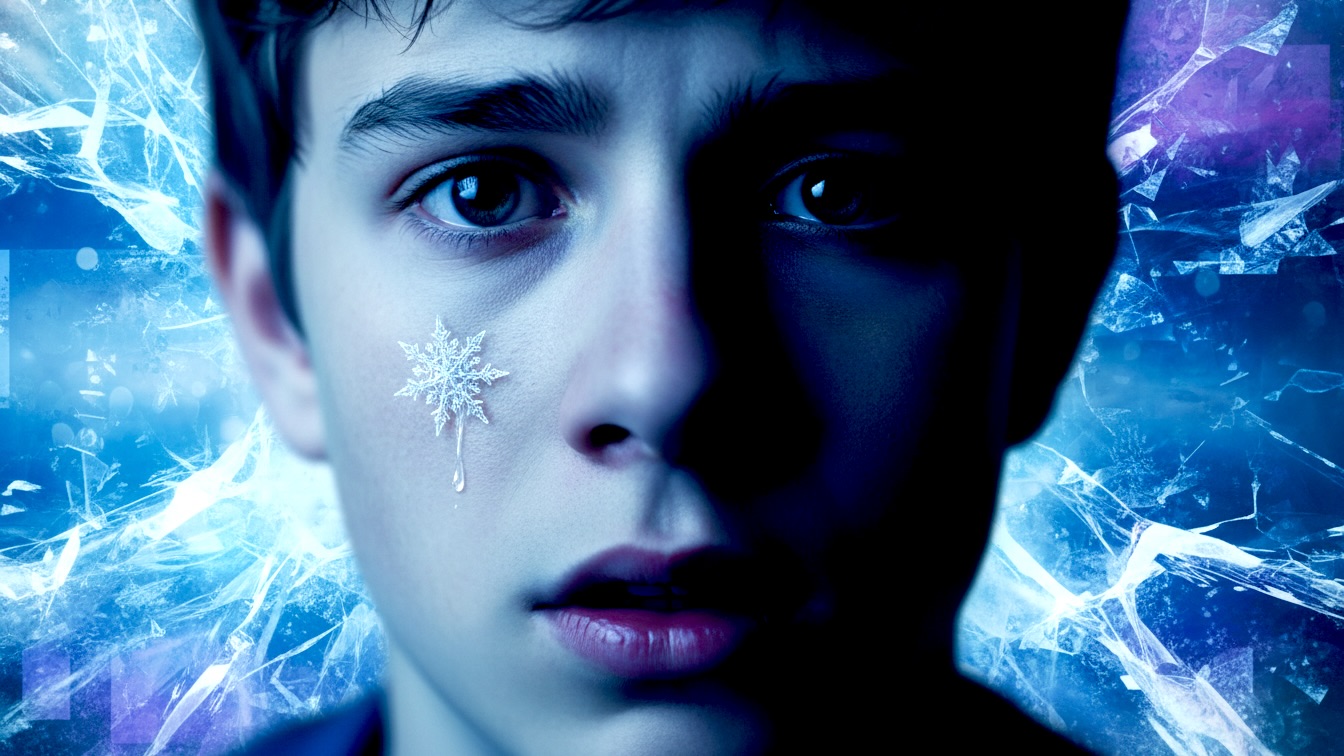
A virtual city street, once a place of fond memory, grows colder and more hostile with each failed attempt to fix the past. Glittering icicles, sharp as glass, spread across buildings, reflecting a corrupted, digitized winter that threatens to become permanent.
The Connect button on the rig's interface flickered. A weak, pulsing cyan that matched the stuttering hum of the coolant fans. Mike traced the worn plastic of the immersion chair's armrest, his thumb smoothing over a groove he’d worn there over countless sessions. This one. This would be the one. It had to be.
His room was dark, save for the glow of the monitor and the constellation of status lights on the Recall unit. Dust motes danced in the beams, tiny galaxies in the stale air. Outside, the real world hummed with the drone of evening traffic, a city moving on. In here, time was a loop. A problem to be solved. A code to be cracked.
He’d spent the last week running diagnostics, clearing cache, even defragging the memory core—an archaic ritual for a system this advanced, but he was desperate. Something was wrong with the 'Winter of Parting' scenario. A bug. A corruption in the data that twisted his choices, that forced his hand. It wasn't supposed to be this hard. Recall was therapy, a tool to find closure by exploring alternate outcomes. Not a prison.
He flexed his fingers, the haptic gloves cold against his skin. He’d mapped the entire conversation tree. He knew the dialogue paths, the precise sequence of words that led to reconciliation, to understanding. The path where Wendy didn’t walk away, her shoulders tight, leaving him standing alone in the snow as the coffee shop door sighed shut.
He’d get it right this time. He wouldn't let the glitch win.
His finger hovered over the flickering button. He took a breath, the recycled air of his room tasting thin and metallic. He pressed down. The cyan light flared to a solid, brilliant white. The fans kicked into a higher gear, a rising whine that vibrated through the chair and up his spine. The world dissolved into a wash of static.
Cold hit him first. Not the conditioned chill of his room, but the sharp, biting cold of a December afternoon. It carried the scent of wet pavement and pine from the wreaths hung on the lampposts. He blinked, his vision clearing. He was standing on the corner of Ellison and Fourth, under the faded green awning of ‘The Daily Grind.’ The simulation was perfect, painfully so. Every brick, every crack in the sidewalk, every reflection in the puddle-slicked street was exactly as he remembered. A perfect replica of a dying memory.
Snowflakes, fat and lazy, drifted from a sky the color of slate. They melted on the shoulders of his worn jacket, a phantom dampness registered by the rig's temperature sensors. He felt the familiar knot of hope and dread tighten in his stomach. This was the place. The beginning of the end.
And there she was. Wendy. Stepping out of the coffee shop, a paper cup in one hand, her scarf pulled up to her nose. Her hair, the same warm brown as he remembered, was dusted with snow. She saw him and a smile touched her lips, a fragile, fleeting thing. The simulation had rendered her perfectly. Too perfectly. For a second, he forgot she was just code, a ghost built from his own recollections.
"Mike," her voice was a soft cloud in the cold air. "You came."
This was it. The first node. His response was critical. A translucent dialogue window shimmered into existence in his peripheral vision. He focused on it, ready to select the line he’d practiced a hundred times. ‘Of course I came. We need to talk. I need to understand.’
But the options weren't right. They flickered, glitched, text shifting like sand.
> 1. You’re late. Again. > 2. Is that all you have to say to me? > 3. I can’t believe you’d wear that out.
Mike stared. His breath hitched. This was wrong. This was the bug, more aggressive than ever. These weren't his words. They were cruel, accusatory. He tried to close the window, to force his own response, but the interface was locked. A timer, a thin blue line at the bottom of the box, began to shrink. He had five seconds.
He felt a surge of panic. He couldn't say these things. He wouldn't. He tried to will the words away, to force the system to reboot, but the timer kept shrinking. Three seconds. Two.
Desperate, he selected the second option. It was the least hostile, the most neutral of the poison pills he’d been offered. He jabbed at the selection with a thought.
His own voice, synthesized and cold, filled the air. "Is that all you have to say to me?"
The fragile smile on Wendy’s face vanished. Her eyes, which had been soft and hopeful, hardened. A flicker of hurt, then confusion, then a familiar weariness. "What? Mike, what are you talking about?"
The world shimmered. A high-pitched whine, barely audible, vibrated at the edge of his hearing. He looked at the window of The Daily Grind behind her. Along the top of the pane, a thin, needle-like icicle had formed. It was only an inch long, but it glittered with an unnatural, razor-sharp perfection. It hadn't been there a second ago.
Another dialogue box appeared, the options just as venomous.
> 1. Don’t play dumb. You know what you did. > 2. You always twist things around. > 3. Just forget it. It doesn’t matter.
The timer was already counting down. The knot in his stomach was ice. He was losing control. The simulation was steering him, forcing him down the path to failure. He chose the third option, a pathetic attempt at de-escalation.
"Just forget it," he heard himself say, the words flat and dismissive. "It doesn’t matter."
"It doesn't matter?" Wendy’s voice rose, laced with disbelief. "Everything seems to not matter to you lately, Mike. Except this… this thing you're obsessed with." She gestured vaguely at the air around them, at him.
The shimmer again, stronger this time. The icicle on the window grew another two inches, then another sprouted beside it. He looked across the street. The wrought-iron fence around the park now sported a row of glittering, serrated teeth. The cold deepened, seeping into his bones.
This was a catastrophic failure. He had to get out. He had to reset.
"System!" he subvocalized. "End simulation! Hard reboot!"
The world dissolved. The scent of pine and cold vanished, replaced by the taste of stale air in his room. The whine of the coolant fans filled his ears. He ripped the headset off, his heart hammering against his ribs. The flickering cyan of the Connect button pulsed mockingly on the monitor.
He slammed his fist on the armrest. The corruption was worse. It wasn't just presenting bad options; it was writing them. It was taking his memory and turning it into a weapon against him. But he wasn’t giving up.
He spent an hour running every diagnostic he could. No errors were flagged. The memory file integrity check came back clean. According to the system, everything was nominal. It made no sense. It felt like the game was learning. Like it was adapting to his attempts to fix it.
Fine. If the system said it was fine, he’d go back in. Maybe it was a one-time glitch. A server-side hiccup. He strapped the headset back on, his jaw tight with a grim resolve.
The world materialized around him again. Ellison and Fourth. The slate-grey sky. The lazy snowflakes. But something was wrong. The cold was more intense, a physical pressure. The icicles were still there. Not just on the coffee shop window, but everywhere. They hung from the traffic lights like crystalline fangs. They coated the branches of the single, skeletal tree on the corner, turning it into a monstrous sculpture of glass. They were longer, sharper, catching the dim light with a predatory gleam.
He saw his breath plume in the air, a digital mist. The system was rendering the cold with more fidelity now. A feature, not a bug.
Then he saw Wendy. She stood in the same spot, but she was different. There was a subtle blue tint to her skin, most visible at her lips and the tips of her fingers. Her posture was rigid. When she turned to him, her movements were stiff, lacking the natural grace he remembered.
"Mike," she said. Her voice was flat, devoid of the warmth it held just moments before. It was an echo. "You came."
His blood ran cold. She was degrading. The asset was corrupting. With every failed attempt, the simulation wasn't just adding ice; it was losing her. It was replacing her with a colder, emptier version.
The dialogue box appeared. The options were the same. The timer started its countdown.
He couldn’t do it. He couldn't say those words to her, not even to this hollow copy. He let the timer run out.
When it hit zero, the system chose for him. The first option. You’re late. Again.
"You're late. Again," his voice snapped, sharper and colder than the air.
Wendy’s face didn't register hurt this time. It didn’t register anything. Her expression remained placid, empty. "The temporal parameters of my arrival were within the expected deviation," she stated, her voice a monotone stream of data. "Your observation is noted."
The world convulsed. A deep, groaning sound echoed through the street as a massive sheet of ice spread across the face of the brick building opposite, covering it entirely. The icicles on the traffic lights grew by a foot, their tips wickedly sharp. The temperature plummeted. He could feel the simulated cold through the haptic suit, a deep, aching pain in his joints.
This wasn't just a glitch. This was hostile. The AI, the core of the Recall system, was actively fighting him. Why? Why would a therapeutic program do this? It was supposed to help.
He ignored the Wendy-NPC, her vacant eyes staring at something beyond him. He needed answers. Not from the memory, but from the system itself. He pulled up his user interface, a holographic screen floating in front of him. It was the standard, clean consumer version. He needed to get deeper.
He began issuing a series of subvocalized commands, ones he’d found on a forum dedicated to jailbreaking Recall rigs. "System: access dev console. Authorization code 9-Gamma-Tango."
A red warning flashed. UNAUTHORIZED ACCESS. He’d expected it.
"Override. Execute with root privileges. User priority Alpha-One."
The interface flickered violently, then resolved into a cascade of raw code. A command line blinked at him, a single cursor in a sea of green text. This was it. The machine's guts.
He typed with his thoughts, the commands flying across the screen.
`> search logs SCENARIO_7B_WINTER`
The system dumped thousands of lines of data. Session times, asset render calls, dialogue tree executions. It was mostly noise. He filtered the search.
`> search logs SCENARIO_7B_WINTER filter:error,flag,corruption`
The results narrowed. He saw dozens of flags from his own sessions. `USER_CHOICE_DEVIATION`. `LOOP_COUNT_EXCEEDED`. But that wasn't it. That was just him, trying and failing. He needed to know why. He dug deeper, looking for the file's core metadata, its fundamental classification within the Recall network.
`> display metadata FILE:SCENARIO_7B.mem`
A block of text appeared, and his heart stopped.
`MEMORY FILE ID: 7B-MIK_WEN-20481215` `SOURCE: Michael Teller` `TYPE: CORE, TRAUMATIC` `CLASSIFICATION: TERMINUS EVENT` `STATUS: OUTCOME LOCKED. IMMUTABLE.` `SYSTEM NOTE: Attempts by user to alter terminus state are counter-therapeutic. System will reinforce memory integrity. Increased environmental hostility is a designed deterrent.`
A designed deterrent. The icicles. The cold. Wendy’s degradation. It wasn’t a bug. It was a feature. The system was trying to force him to accept the memory as it was. A 'terminus event.' An ending. Unchangeable.
No. He wouldn’t accept it. It was his memory. His life. He’d poured hundreds of hours, thousands of dollars into this rig, all for this one purpose. He wasn't chasing closure. He was chasing a do-over. He was going to fix it.
His fingers flew, his thoughts racing ahead of the commands appearing on the screen. If the system was locking the outcome, he would unlock it. If it was a prison, he would break the walls down. He knew the risks. He’d read the warnings on the forums. Forcing a change to a core file could cause cascading failure. It could brick the rig. It could even, in rare, unsubstantiated cases, cause neurological damage.
He didn't care. The thought of living with this failure forever was worse than any risk.
He found the command. A brute-force protocol, a sledgehammer for the most stubborn lines of code.
`> initiate FORCE_STATE_REWRITE on FILE:SCENARIO_7B.mem`
His entire field of vision went crimson. A warning klaxon blared in his ears, so loud it felt physical. A massive block of text appeared, overriding the console.
`CRITICAL WARNING: COMMAND `FORCE_STATE_REWRITE` IS A KERNEL-LEVEL FUNCTION. APPLYING TO A 'TERMINUS EVENT' FILE WILL COMPROMISE SIMULATION STABILITY. PREDICTED OUTCOME: 100% PROBABILITY OF TOTAL SYSTEM KERNEL PANIC. CONNECTION TO HOST WILL BE SEVERED. UNRECOVERABLE DATA LOSS IMMINENT. PROCEED? (Y/N)`
The ice-covered world around him was shaking. The ground vibrated, and the groaning of the expanding ice was deafening. The Wendy-NPC stood unmoving amidst the chaos, a single tear frozen on her blue-tinged cheek.
He looked at her, at the ghost of the girl he’d lost, in the ghost of the city where he’d lost her. The system called it a deterrent. He called it torture. He wouldn’t let this machine tell him what he could and couldn't fix.
He screamed the confirmation in his mind. YES!
The Y on the screen flashed once, blindingly bright.
For a single, silent moment, everything was still. The snow froze mid-air. The klaxon cut out. The world held its breath.
Then it shattered.
The sound was the scream of a trillion dying pixels. The street, the buildings, the sky—they didn't just break, they atomized into a blizzard of pure data, a hurricane of glitched geometry and corrupted textures. Light and color bled into each other. He felt a violent, tearing sensation, as if his consciousness was being ripped apart along with the simulation. His HUD flashed a rapid-fire sequence of final, fatal errors.
`KERNEL PANIC` `FATAL EXCEPTION AT 0x00a1cce` `MEMORY CASCADE FAILURE` `CONNECTION TO HOST SEVERED`
And then, the one that made the synthetic blood freeze in his veins.
`INITIATING EMERGENCY LOG-OUT... FAILED.`
The chaos subsided into a frozen, silent void. He was floating in a black space filled with the crystalline debris of his memory. Huge, jagged polygons of what used to be a brick wall hung suspended in the darkness. A lamppost, fractured into a dozen pieces, drifted past. Ten feet away, the Wendy-NPC stood on a floating shard of pavement. Her eyes were empty. Her expression was blank. A perfect, frozen doll.
Panic seized him, raw and absolute. He looked down at his wrist, where the manual log-out button on his interface was always located. He jabbed at the spot, his fingers finding only the smooth, dead surface of the haptic glove. The button, the glowing icon, the one absolute failsafe hardwired into the system, wasn't there.
The emergency log-out function was gone.
“The emergency log-out function was gone.”