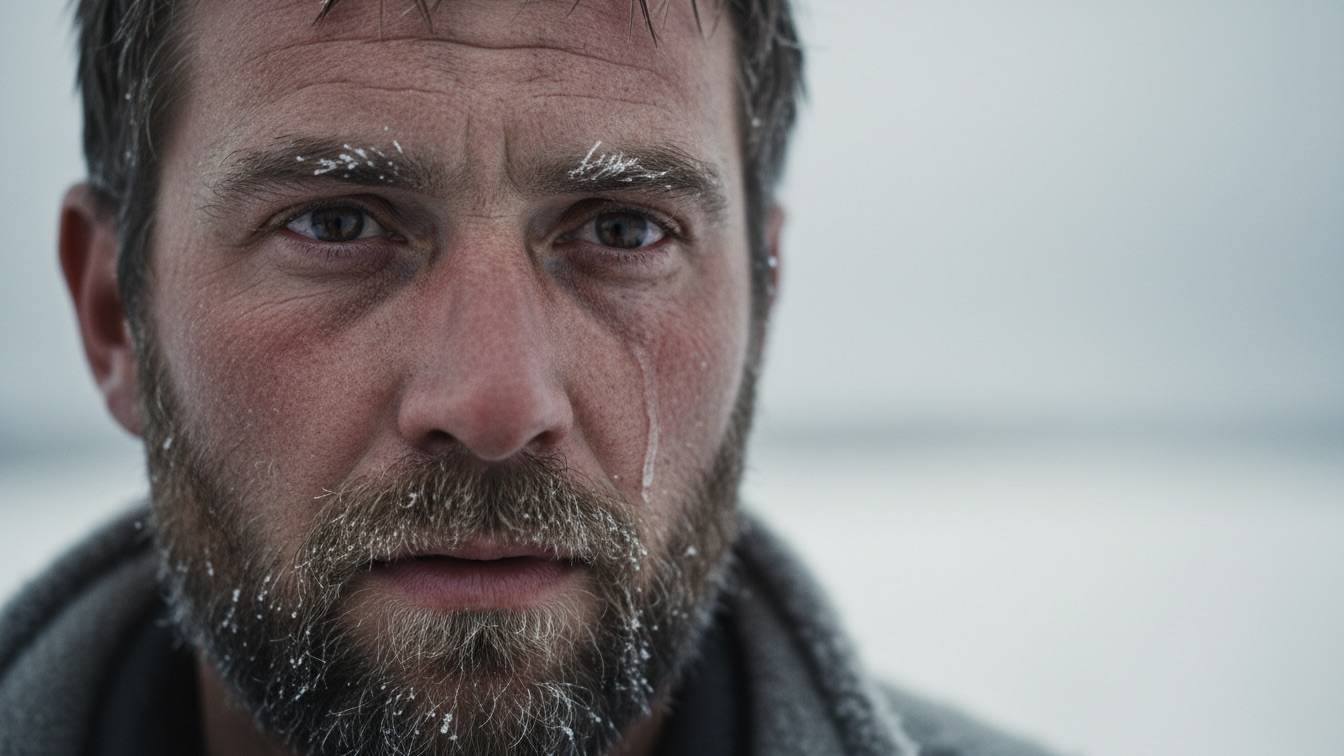
Format: Short Film / Anthology Episode | Est. Length: 10-12 minutes
Imagine "The White Thirst" as a chilling entry in a horror anthology series titled THE EMPTY PLACES. Each episode is a standalone story exploring how extreme isolation and ancient folklore prey on the human psyche. The series would journey from the frozen arctic to the deep desert, from the abyssal ocean to the vacuum of space, examining a recurring, malevolent force—a spirit of hunger and desperation known by many names—that doesn't just hunt people, but catalyzes the darkness already within them.
In the howling chaos of an arctic blizzard, one man desperately sets his partner's gruesome compound fracture using a pry bar and electrical tape, their makeshift shelter the only thing standing between them and a world of white oblivion.
Stranded by a snowmobile crash in a deadly blizzard, a pragmatic mechanic must protect his severely injured partner from the elements and a mysterious, predatory entity. As paranoia and starvation take hold, he discovers the greatest threat isn't the monster outside, but the one it's awakening within him.
This story is a brutal exploration of survival versus morality, questioning what remains of a person when civilization is stripped away. It delves into the theme of psychological devolution, where the external, hostile environment mirrors the internal decay of humanity. The "white thirst" of the title is a metaphor for the consuming emptiness of the landscape and the soul—a hunger for not just food or water, but for any advantage, at any cost.
The primary genres are survival horror and psychological thriller, with a strong undercurrent of supernatural dread. The horror is not derived from jump scares, but from the slow-burn tension, the claustrophobia of their shelter, the agoraphobia of the endless white, and the chillingly rational descent of the protagonist from a man into a monster. It is a story about how the most terrifying predators are often the ones who walk beside us.
The stakes are absolute: life and death. For Jack, the risk is a slow, agonizing death from his infected wound, the freezing cold, or starvation. For Frank, the physical stakes are the same, but the psychological stakes are even higher: he risks losing his sanity and his very soul, becoming a creature as cold and predatory as the monster that stalks them. The ultimate stake is not just survival, but what kind of human is left on the other side of it.
The conflict operates on three levels. The primary external force is Man vs. Nature: the relentless, deadly blizzard and the unforgiving arctic landscape. The second external force is Man vs. The Supernatural: the unseen, intelligent entity (the Wendigo) that toys with them, using psychological warfare and mimicry to break their spirits. The most critical conflict, however, is internal: Man vs. Self. Frank battles his own eroding compassion, as his pragmatic mind begins a cold calculus of survival that sees his partner less as a friend and more as a liability and a drain on dwindling resources.
Mechanic Frank and his partner Jack are stranded in the arctic wilderness after a snowmobile crash during a blinding whiteout. With Jack suffering a severe compound fracture, Frank sets up a crude shelter against a raging blizzard, his practical skills barely keeping them alive. Their situation grows desperate as a mysterious presence begins to circle their camp, its faint scraping sounds and terrifyingly perfect vocal mimicry preying on their fear and dwindling hope.
As days pass and their meager supplies run out, the creature’s psychological torment intensifies, pushing both men to the brink of madness. The line between the external monster and the internal one blurs, particularly for Frank, whose survival instinct begins to override his morality. When the storm finally breaks, revealing a vast, hopeless expanse, Frank makes a horrific choice, concluding that his only chance of survival is to leave Jack behind—and ensure he doesn't become a beacon for the creature that is still hunting.
FRANK: A stoic, pragmatic mine mechanic in his late 30s/early 40s. He is a problem-solver, viewing every situation, including Jack's shattered leg, with a cold, functional detachment.
* Psychological Arc: Frank begins as a competent, if emotionally distant, survivor focused entirely on the logistics of staying alive. As the ordeal wears on, the Wendigo's influence acts as a catalyst, stripping away his thin veneer of humanity until only a cold, selfish survival engine remains. He ends the story as a hollowed-out shell, having sacrificed his partner and his soul to conquer the wilderness, only to become as empty and desolate as the landscape itself.
JACK: A religious family man in his 30s, more emotionally open and reliant on faith. He represents the world of warmth, community, and morality that they have left behind.
* Psychological Arc: Jack starts in physical agony but clings to hope for rescue and the power of prayer. The relentless pain, cold, and the creature's psychological attacks erode his faith, replacing it with terror and paranoia. He ultimately becomes a symbol of vulnerability and a liability, his fear turning from the monster outside to the man sitting beside him, just before he becomes the final victim of Frank's brutal transformation.
THE WRECKAGE: The story opens on the raw, visceral act of Frank setting Jack's compound fracture inside their overturned snowmobile shelter. The brutal intimacy of the act, set against the deafening roar of the blizzard, immediately establishes the life-or-death stakes, their isolation, and Frank's cold, methodical nature. They take stock of their meager supplies, the claustrophobia of their tiny world already pressing in.
THE HUNTING: As time blurs in the grey twilight of the storm, a new threat emerges—a faint, rhythmic scraping sound from just outside the shelter. This marks the story's midpoint, shifting the conflict from pure survival to supernatural horror. The entity escalates its psychological assault, perfectly mimicking the cries of a lost woman and then Jack’s own wife, turning hope into a weapon and shattering Jack's sanity while hardening Frank's resolve.
THE CALCULUS: The storm breaks, revealing a silent, beautiful, and utterly empty world with no hope of immediate rescue. This is the climax of Frank's internal struggle; he decides to walk out alone, a choice Jack meets with panicked threats. In this moment of confrontation, Frank sees Jack not as a partner but as "bait"—a noisy, desperate beacon for the creature—and realizes that to truly escape, he must silence him permanently.
THE WALK: The final beat shows Frank walking alone under a pale sun, a small figure in a vast, indifferent landscape of white. The silence is absolute, mirroring the new silence within him. He is a survivor, but the act of survival has cost him everything, leaving him as cold and empty as the world around him—the white thirst has been quenched with his own humanity.
The audience is immediately thrown into a state of high-stakes physical tension and visceral discomfort. This evolves into a sustained, claustrophobic dread as the psychological and supernatural elements are introduced, building paranoia and a sense of being watched. The emotional peak is not a loud scare but a moment of quiet, shocking violence, which then collapses into the story's final, pervasive mood: a bleak, hollow, and chilling emptiness that lingers long after the credits roll.
If expanded into a season, the series could follow two potential arcs. The first is an anthology format where each episode depicts an encounter with this "hunger spirit" in a different isolated setting—a deep-sea submersible crew, a lone astronaut, a 19th-century pioneer family—exploring how the entity adapts its methods to prey on different forms of human desperation. This would build a global mythology around a single, terrifying concept.
A second, serialized arc could follow a single character—perhaps a folklorist or a federal agent who survived a similar encounter—who becomes obsessed with tracking these incidents. This protagonist would piece together the creature's patterns from historical accounts and modern disappearances, realizing the entity is not just a monster but a fundamental force of nature. The season would build towards a direct confrontation, where the protagonist must face the entity not with weapons, but by resisting the very human darkness it seeks to cultivate.
The visual style will be a study in contrasts, designed to maximize audience discomfort. Inside the shelter, the camera will be tight, handheld, and claustrophobic, emphasizing the cramped space, the condensation of breath, and the visceral detail of Jack's injury. Outside, the shots will be vast, static, and agoraphobic, using wide lenses to show the characters as insignificant specks in an endless, overexposed sea of white, creating a sense of profound hopelessness.
The color palette will be severely desaturated, dominated by cold blues, stark whites, and deep greys. The only sources of warmth will be the flickering, unreliable flame of the Zippo and the shocking, visceral red of blood on the snow. The tone is bleak, grim, and grounded, drawing tonal influence from the oppressive paranoia of John Carpenter's The Thing, the atmospheric dread of The Terror, and the brutal naturalism of The Revenant.
The target audience is mature viewers (18-49) who favor elevated, slow-burn horror and survival thrillers. This includes fans of A24-style atmospheric horror (The Witch, Hereditary) and viewers who appreciate thematically rich, character-driven stories over conventional jump scares. It is best suited for a streaming platform or premium cable audience that seeks out challenging, thought-provoking genre content.
For a 10-12 minute runtime, the pacing must be deliberate yet relentless. Act One (approx. 3 minutes) will rapidly establish the physical crisis and setting. Act Two (approx. 6 minutes) will be a slow, tense descent into psychological horror, focusing on the waiting, the sounds, and the breakdown of the characters' relationship. Act Three (approx. 3 minutes) will be swift and brutal, containing the climax and the bleak, silent resolution, letting the final images of Frank walking alone linger to maximize their impact.
The primary production challenge will be creating a convincing and hostile arctic environment. This will likely require a combination of location shooting in a remote, snowy landscape for the exteriors and a controlled soundstage environment for the interior shelter scenes, where temperature, wind, and snow effects can be precisely managed. The sound design is paramount; the wind cannot be a simple background noise but must be a dynamic, multi-layered character in itself, shifting in pitch and intensity.
Special effects will focus on practical, grounded elements. The makeup for Jack's compound fracture and subsequent infection must be viscerally realistic to anchor the story's stakes. The supernatural entity should remain unseen, its presence conveyed entirely through sound design (the scraping, the mimicry) and the actors' performances, making its threat more psychological and terrifying than any visual creature could be.