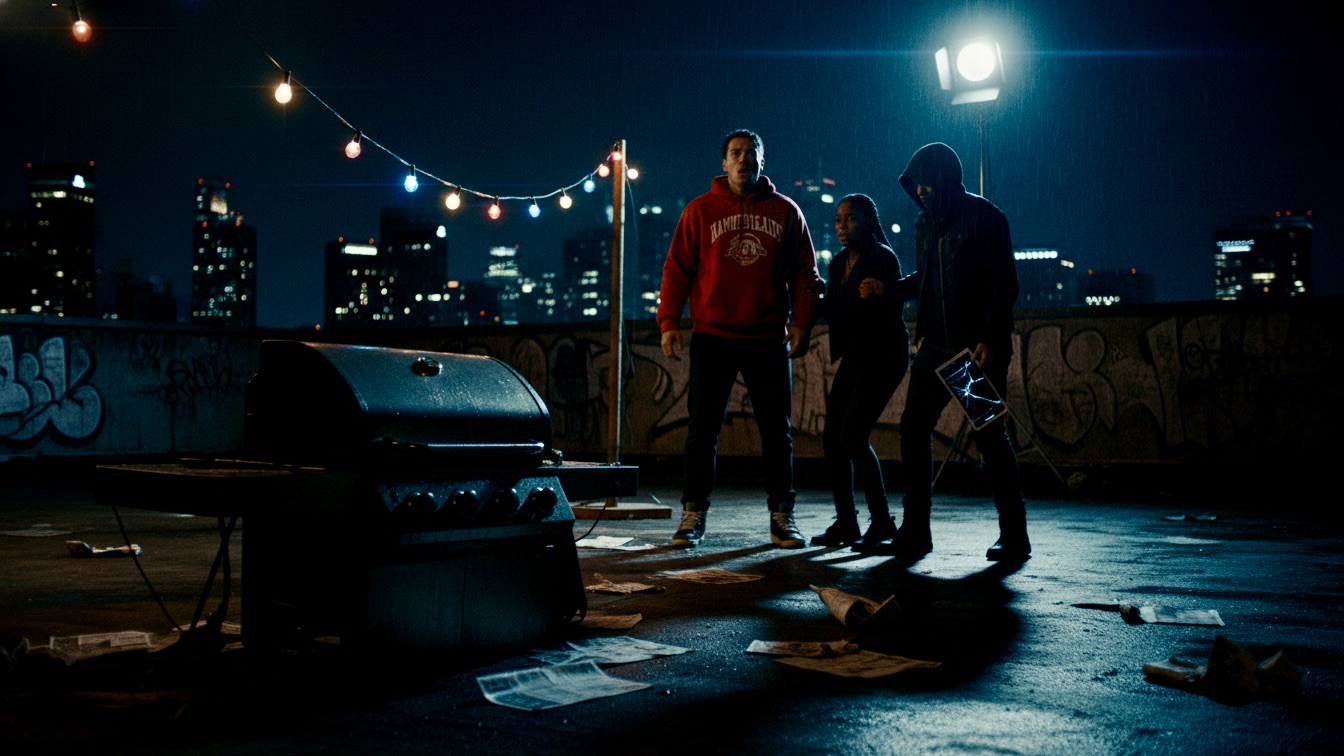
The rooftop is cold, lit by cheap string lights under a hazy, starless sky. The air smells of weed, cheap beer, and urban exhaust. Music thumps from a single Bluetooth speaker, competing with the distant drone of downtown traffic and the occasional siren.
The service door was stuck. Of course it was. The metal handle, slick with condensation, refused to turn. Sasha put her shoulder into the steel plate, once, twice, and on the third grunt-fueled shove, the latch gave with a percussive crack that echoed in the narrow concrete stairwell. The sudden release sent her stumbling forward, out of the stale, stuffy dark and into the cold night air.
Noise hit her first. A wave of bass-heavy music, the indistinct chatter of two dozen conversations mashed together, and the high, thin laughter of someone who’d had too much of whatever was in the red plastic cups. She blinked, her eyes adjusting from the stairwell’s single bare bulb to the dim, festive glow of string lights crisscrossing the rooftop. They cast long, dancing shadows that made the whole scene feel unsteady, provisional. Below, the city was a grid of orange and white light, a silent, sprawling circuit board.
This was it. Garry Street. The apex of whatever passed for a scene in this town. She clutched the strap of her messenger bag, the second-hand camera inside a heavy, reassuring weight against her hip. The zine needed this. ‘Urban Etudes,’ she was calling the photo series. A pretentious name for a collection of pictures of kids drinking on rooftops, but it sounded important. It sounded like journalism. Her phone was in her jacket pocket, a more discreet tool if the big camera felt too aggressive. For now, she was just an observer, gathering atmosphere.
She moved along the perimeter, keeping her back to the low parapet wall. A few people nodded at her, faces vaguely familiar from school hallways, but no one spoke. She was a known quantity: Sasha, the girl with the camera, the one who ran that weird, photocopied zine that nobody really read but everyone pretended to respect. Her neutrality was her armor. She wasn’t here to party; she was on assignment. A self-assigned assignment, but an assignment nonetheless.
The air was a chemical soup of cheap perfume, cigarette smoke, and the sweet, skunky smell of weed. A guy with a bad haircut and a worse mustache tried to explain the stock market to a girl who was staring intently at her own shoes. Two others were in a heated debate over whether a hot dog was a sandwich. Standard. Unusable. This was texture, not text. She needed a focal point, a story. A moment that said something about being young and bored and trapped in the dead center of the country.
And then she saw it. A node of tension in the otherwise fluid party dynamic. By the far railing, away from the central huddle of people, stood Mark. Even from across the roof, his posture was a broadcast of aggression. Shoulders squared, neck thick, his body a solid block of muscle packed into a faded hockey team hoodie. He had one of those faces that seemed perpetually flushed, perpetually on the verge of either a laugh or a punch. Tonight, it wasn’t leaning toward laughter.
His focus was Thandi. She stood her ground, but she looked small in front of him, clutching a stack of folded paper pamphlets to her chest like a shield. Thandi was always on a mission. Save the wetlands, ban the plastic straws, register to vote. Sasha had seen her a dozen times in the cafeteria, trying to get signatures, her voice earnest and unwavering. Here, under the party lights, that earnestness looked fragile.
Sasha drifted closer, using a cluster of people near a massive, stainless-steel BBQ as cover. The thing was a monster, a suburban dad’s dream plopped onto a patch of urban grit, its chrome gleam reflecting the party lights in distorted streaks. From here, she could hear them.
“—just trying to have a good time, man,” Mark was saying, his voice a low growl that still managed to cut through the music. He gestured vaguely with his cup, sloshing beer onto the tar-paper floor. “Nobody wants your guilt-trip papers here.”
“It’s not a guilt trip, it’s just information,” Thandi said. Her voice was tight, controlled. “It’s about the zoning bylaw for the North End. It affects people, real people. Maybe even people you know.”
“I know I’m trying to have a beer with my friends,” he shot back, taking a half-step closer. He was intentionally crowding her, using his size to shrink her world down to the space between them and the railing. Classic intimidation tactic. Sasha’s journalistic brain cataloged it automatically. “Take your politics and go canvass a library or something.”
A few people nearby had noticed. The conversation around the BBQ faltered. Heads turned. The invisible energy of the rooftop was changing, re-centering on this one small point of conflict. This was it. The moment. The story wasn’t bored kids drinking; it was this. The friction between apathy and activism, played out on a rooftop stage.
Sasha’s hand went to her pocket, her fingers finding the cool, smooth glass of her phone. The big camera was too much, too official. It would change the dynamic, make everyone self-conscious. But a phone… everyone had a phone. It was practically invisible. She stayed behind the BBQ, peering around its considerable bulk. She thumbed the screen on, opened the camera app. The angle was bad, half-obscured by some guy’s shoulder and the corner of the grill.
She needed to move. Not closer, necessarily. Just… better. A better angle. The documentarian’s imperative. She shuffled to her left, circling the small crowd that was now openly watching the confrontation. She found a gap, a space next to a cooler where she could get a clean shot. She raised the phone, framing them both. Mark’s back, broad and tense. Thandi’s face, pale in the phone’s sensor, her jaw set.
The red dot appeared in the corner of her screen. REC. She was recording.
The air felt different now. Colder. Thicker. Her own presence felt different. She wasn’t just an observer anymore. The act of recording had changed her role. She was a lens, and a lens can be a mirror, or a magnifying glass.
Mark must have felt the shift, the weight of a dozen pairs of eyes suddenly on him. He glanced over his shoulder, his eyes scanning the new audience. They slid past Sasha, then snapped back, locking onto the phone in her hand. For a second, his angry expression dissolved into confusion. Then it hardened into something uglier. He felt cornered.
“What’s this?” he snarled, gesturing with his head toward Sasha. “You brought your own cheering section? Got a reporter on the scene?” The sarcasm was thick and sour.
Thandi glanced at Sasha, her expression flickering with annoyance. This wasn't helping. “I don’t know her,” she said, her voice wavering for the first time. “This is between you and me. Just take a pamphlet, or don’t. I don’t care.” She tried to step around him.
Mark blocked her, planting his feet. He was playing to the crowd now. To the camera. His face was dark red under the yellowy lights. “No, no. Suddenly everyone’s interested. Let’s give the people what they want.” His eyes were fixed on Sasha’s phone. The tiny red light was a beacon, a challenge. He felt the need to perform, to resolve this situation in a way that asserted his dominance.
Everything seemed to slow down. Sasha could feel her own heartbeat, a dull thud against her ribs. Her thumb hovered over the screen. She should stop. She should put the phone away, say something, de-escalate. That’s what a person would do. But a journalist records. The thought was cold, clear, and absolute. She kept the phone steady.
“Just leave me alone,” Thandi said, her voice barely a whisper.
“Fine,” Mark spit out the word. And he shoved her. It wasn’t a haymaker, not a dramatic, movie-style punch. It was a short, brutal, dismissive push with the heel of his hand, right into her shoulder. An punctuation mark to end the conversation.
Thandi stumbled backward, her balance gone. One of her heels caught on the leg of the oversized BBQ. For a moment, she was suspended, her arms pinwheeling. Then she fell against the grill with a hollow, metallic boom.
The massive stainless-steel appliance, so solid and permanent a moment before, rocked on its wheels. It tilted, balanced on two legs for an impossible second, and then crashed over onto the deck. The sound was deafening. A thunderclap of metal on wood, the shriek of scraping chrome, and the heavy, resonant clang of the propane tank hitting the rooftop. The music was gone, lost in the noise. The party was gone. There was only the ringing silence that followed the crash.
Thandi was on the ground, tangled in the legs of the overturned grill, pamphlets scattered around her like fallen leaves. Mark stood frozen, his hand still half-extended, a look of stupid shock on his face.
The service door burst open again, this time with real force. A guy Sasha didn’t know, older, maybe twenty-five, with a landlord’s scowl, stormed out. The host. His eyes took in the scene in one furious sweep: the toppled monument to outdoor cooking, Thandi on the floor, Mark looking guilty, and Sasha, standing there with her phone still held up, the red light blinking.
His finger shot out, pointing, shaking. “Out,” he yelled, his voice cracking with rage. “All of you. Now.” He didn’t care who started it. He pointed at Mark. “You.” He pointed at Thandi, who was now being helped up by a friend. “You.”
Then his eyes landed on Sasha, and his expression curdled even further. “And you. Especially you. Get the hell off my roof.”
Sasha’s thumb finally found the stop button. The recording saved. The screen went dark. She lowered the phone, the plastic suddenly feeling cheap and greasy in her hand. She had it all on video. The story. The perfect, unfiltered evidence of a moment of ugly, stupid violence. But the weight in her stomach wasn’t triumph. It was a cold, heavy stone of complicity. She hadn’t just recorded the story. She had become part of its ugly machinery. Her presence, her lens, had been the catalyst that turned words into a shove, and a shove into a wreck. She backed away toward the stairwell, the host's glare following her every step. She had her footage, but she wasn’t sure if she was the reporter anymore, or just another piece of the evidence.
“She had her footage, but she wasn’t sure if she was the reporter anymore, or just another piece of the evidence.”