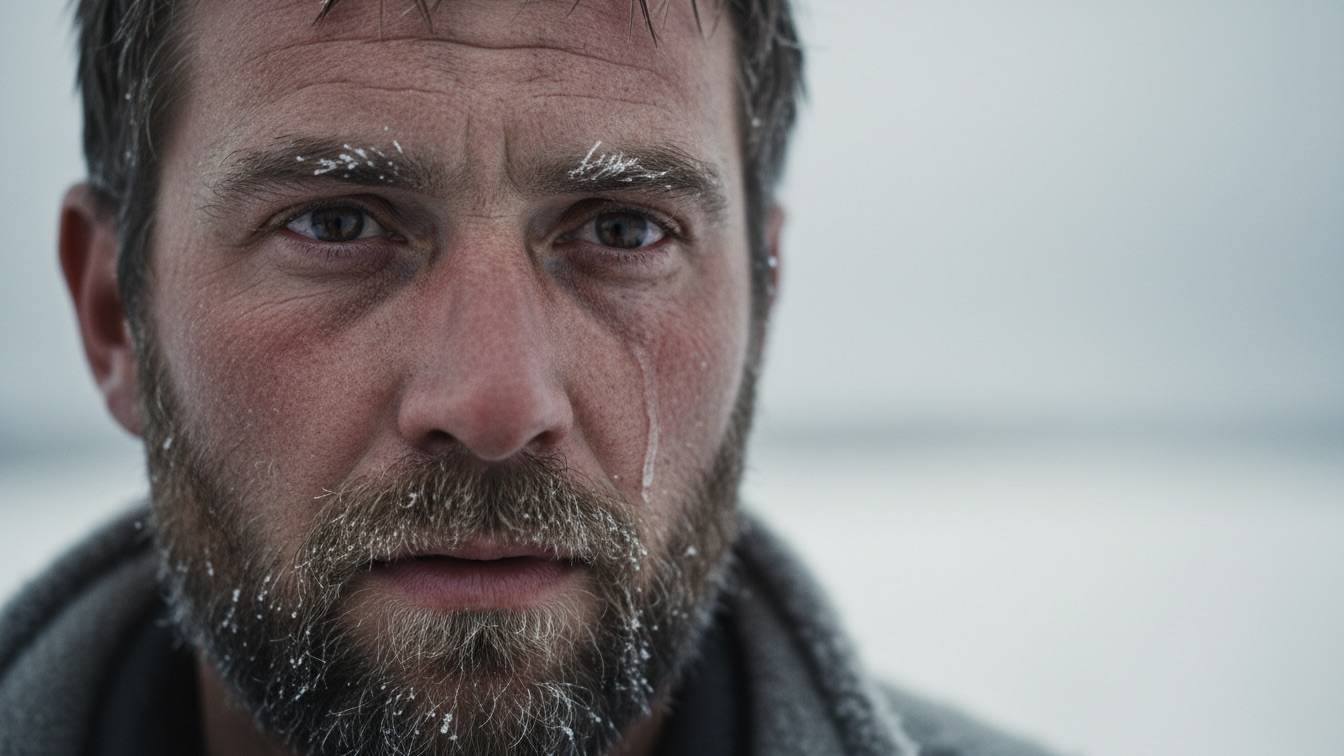
The torque of a bolt is a precise, unfeeling calculation, a binary state of tension and release that cares nothing for the material it binds. It demands a rigid alignment, a forcing of disparate parts into a singular, functioning unity regardless of the screaming protest of metal or bone. In this frozen equation, the human element is merely a source of friction, a soft and messy variable that must be stripped away to reveal the cold, hard logic of survival. When the world is reduced to simple mechanics, the only noise that matters is the snap of a connection made or broken, and the silence that inevitably follows.
The narrative operates within the grim intersection of survival horror and psychological realism, utilizing the bleak backdrop of a blizzard to strip away the veneer of civilization. The central theme revolves around the "White Thirst," which functions less as a physical craving for water and more as a metaphysical consumption of the soul by the void. The story interrogates the fragility of human morality when subjected to the absolute zero of existential threat. By juxtaposing the mechanical pragmatism of the narrator against the emotional disintegration of his companion, the text explores the terrifying efficiency of survivalism. It suggests that to survive the inhuman cold, one must shed their humanity and become analogous to the environment itself—indifferent, relentless, and empty.
The narrative voice is chillingly distinct, filtered through Frank’s perspective as a mechanic who views the world as a series of broken systems requiring repair or abandonment. His perception is limited by this utilitarian worldview, creating a profound dissonance between the reader’s horror and the narrator’s calm. Frank details the setting of a bone with the same detached technicality he would apply to a diesel engine, revealing a psyche that has already begun to freeze over. The narrative reliability is compromised not by deceit, but by a fundamental lack of empathy; Frank sees only the "cold math" of the situation. He interprets Jack’s pleas and the potential supernatural threat through a lens of resource management, leaving the reader to wonder if the Wendigo is a literal monster or a manifestation of Frank’s own predatory selfishness.
Ethically, the story posits a disturbing question about the cost of life. It challenges the romantic notion of camaraderie in the face of death, replacing it with a Darwinian calculation where the weak are not just liabilities, but fuel for the strong. The "Wendigo" legend serves as the cultural framework for this transformation, representing the spirit of greed and consumption that overtakes a starving man. However, the true horror lies in the ambiguity of whether the spirit possessed Frank, or if Frank simply accessed a dormant, reptilian part of his own nature. The storm acts as the catalyst, eroding the social contract until the only law remaining is the physics of energy conservation, where murder is recontextualized as a necessary engineering solution.
Psychological State:
Frank exhibits a profound dissociation from his own humanity, retreating into a state of hyper-rationality as a defense mechanism against the trauma of the crash and the impending threat of death. His mind organizes chaos into mechanical problems; a broken leg is a structural failure, and a dying companion is an inefficiency. The cold environment accelerates this detachment, mirroring his internal emotional temperature. He does not panic, which is his greatest strength and his most terrifying flaw. As the story progresses, his psychological state shifts from that of a survivor to that of a predator, accepting the "emptiness" of the landscape into his own psyche.
Mental Health Assessment:
Frank displays traits consistent with high-functioning sociopathy or severe schizoid personality disorder, exacerbated by acute survival stress. His inability to connect with Jack on an emotional level, viewing him instead as "broken machinery," suggests a pre-existing deficit in empathy that the storm fully exposes. He lacks the capacity for guilt, viewing his actions through a utilitarian lens rather than a moral one. His resilience is high, but it is a brittle, maladaptive resilience that relies on the total suppression of emotional affect. He is not mentally "healthy" in a human sense; he has become a functioning automaton, effectively cauterizing his conscience to ensure his biological persistence.
Motivations & Drivers:
His primary motivation is the preservation of his own life, driven by a biological imperative that overrides all social conditioning. In the initial stages, he attempts to save Jack, but this motivation is rooted in the "job" of fixing things rather than altruism. As resources dwindle, his driver shifts to the elimination of variables that threaten his survival probability. The "silence" becomes a secondary motivation; he craves the cessation of Jack’s noise—the pain, the fear, the humanity—because it interferes with the "cold math" he relies upon. He seeks to align himself with the indifference of the storm rather than fight it.
Hopes & Fears:
Frank fears the chaotic "noise" of suffering and the loss of control more than he fears death itself. He dreads the "messiness" of Jack’s slow demise, which represents a disorderly, unmanaged failure. Conversely, he does not hope for rescue in the traditional sense, as he lacks the faith to believe in miracles. His hope is singular and concrete: to reach the mine, to complete the "walk," and to solve the equation of his survival. He hopes to become invulnerable to the cold by becoming part of it, fearing only that his "fuel" (physical and mental) will run out before the calculation is complete.
Psychological State:
Jack is in a state of rapid psychological decomposition, fueled by physical agony, sepsis, and terror. Unlike Frank, he cannot compartmentalize the horror of their situation. He is deeply deeply rooted in his emotional and spiritual connections—his wife, his daughter, his God—which makes his isolation in the "ice-dusted hell" unbearable. The fever from his infection blurs the line between reality and hallucination, making him susceptible to the auditory pareidolia of the storm. He is the embodiment of human vulnerability, feeling the full weight of the tragedy rather than repressing it.
Mental Health Assessment:
Jack is suffering from acute delirium and likely septic shock, which induces paranoia and hallucinations. His mental health was seemingly robust prior to the accident, grounded in community and faith, but these support structures are useless in the vacuum of the whiteout. He lacks the psychological callousness required for this specific brand of survival. His regression to a child-like state and his hysterical blindness to the reality of Frank’s intentions indicate a total breakdown of his coping mechanisms. He is mentally fragile, clinging to a reality that no longer exists.
Motivations & Drivers:
Jack is driven by a desperate need for connection and salvation. He is motivated by the hope of seeing his family again, a desire that the "creature" exploits with its mimicry. He seeks reassurance and protection from Frank, looking to his partner as a savior figure even as Frank transforms into his executioner. Jack is driven by the human imperative to not die alone, to share the burden of fear, which stands in direct conflict with Frank’s drive for solitary efficiency.
Hopes & Fears:
Jack hopes for divine intervention or a miraculous rescue, placing his faith in external forces rather than internal resolve. He fears the physical pain of his injury, but even more so, he fears the "thing" outside—the Wendigo. He represents the primal fear of being eaten, both literally by a monster and metaphorically by the indifference of the wild. Ultimately, his deepest fear is realized not from the outside, but from within the shelter: the realization that his partner has abandoned the moral contract of humanity. He fears the loss of Frank’s loyalty more than the storm, and that fear is tragically validated.
The emotional trajectory of the chapter moves from a frantic, shared anxiety to a chilling, singular detachment. Initially, the tension is claustrophobic, contained within the "coffin of steel and canvas." The shared struggle creates a tenuous bond, but as the temperature drops, so does the emotional warmth. The author constructs a sense of dread not through fast-paced action, but through the slow attrition of hope. The dwindling resources—the jerky, the lighter fluid—act as a countdown timer for empathy. As the physical supplies vanish, the emotional capacity of the narrator evaporates, replacing the heat of panic with the cold stability of murderous logic.
This transfer of emotion is unidirectional: Jack becomes increasingly hysterical and emotive, effectively carrying the emotional burden for both men, while Frank becomes a void. The "White Thirst" manifests as an emotional draining; the more Jack feels, the less Frank does. The external storm mirrors this internal dynamic. The wind's scream and the creature's mimicry serve to heighten Jack's terror, which in turn accelerates Frank's dissociation. Frank’s eventual violence is not an act of passion but an act of silencing the emotional noise that Jack generates. The climax of the murder is terrifyingly quiet, an extinguishing of a flame that was already flickering, leaving the reader with a profound sense of hollowness rather than resolution.
The atmosphere is built on sensory deprivation and sensory overload simultaneously. The blinding white and the deafening roar create a paradox where the characters are overstimulated yet starved of meaningful input. This sensory environment distorts empathy. In a world of static, human connection feels like a glitch, an error to be corrected. The reader is forced to inhabit Frank’s perspective, creating a disturbing complicity. We understand the logic of the "cold math" even as we are repulsed by it. The story manipulates the reader’s desire for survival, making us question how much of our own humanity is contingent upon warmth and safety.
The setting of the overturned snowmobile acts as a crucible for the psychological transformation of the characters. The space is described as "impossibly small," forcing a physical intimacy that contrasts violently with the growing emotional chasm between the two men. This confined space creates a pressure cooker effect; there is nowhere for the fear to dissipate, so it recycles and intensifies. The tarp acts as a flimsy membrane between the known world of the shelter and the unknown chaos of the storm. It is a boundary that is constantly tested—physically by the wind and the creature, and psychologically by the auditory hallucinations.
Outside the shelter, the environment is defined by its lack of features—a "churning vortex of white." This lack of visual reference points mirrors the loss of moral landmarks. In a whiteout, there is no up or down, no north or south, just as in extreme survival, there is no right or wrong, only living or dying. The landscape is an active antagonist, "erasing tracks, erasing hope." It is not a passive backdrop but a "patient predator" that waits for the characters to exhaust themselves. The cold is described as an invasive force that sinks into the marrow, blurring the boundaries between the internal body and the external freeze. Frank’s final walk into the "blank page" signifies his total absorption into this environment; he has become indistinguishable from the landscape that consumed his partner.
The prose style mirrors the stark, brutal reality of the characters' situation. The author employs short, truncated sentences that mimic the shallow, painful breaths of someone in freezing air. "The bone grated." "White bone, red muscle, dark blood." This staccato rhythm strips away linguistic flourish just as the cold strips away warmth, leaving only the essential nouns and verbs required to convey action. The diction is mechanical and industrial—"torque," "hydraulics," "diesel," "alignment"—reinforcing Frank’s worldview where biology is subservient to engineering. The absence of flowery language enhances the sense of emotional barrenness; the text itself feels cold to the touch.
Symbolism is heavily relied upon to convey the thematic progression. The pry bar is the central artifact of transformation: it begins as a tool for healing (a splint) and ends as an instrument of death, perfectly encapsulating the perversion of utility in the face of survival. The Zippo lighter represents the dwindling spark of civilization and hope; when Frank abandons it, he is abandoning the last vestige of the "fire" that makes him human. The color white is inverted from a symbol of purity to one of consumption and oblivion—the "White Thirst." It represents the void that demands to be filled, first with Jack’s life, and then with Frank’s humanity.
The auditory imagery is particularly potent. The wind is given a voice, a personality, while the creature mimics human cries. This auditory assault blurs the line between the natural and the supernatural. The "scraping sound" serves as a leitmotif for the encroaching horror, a rhythmic reminder of the inevitability of death. Contrastingly, silence is presented as the ultimate goal and the ultimate horror. Frank seeks the silence of the machine, but in achieving it through murder, he enters a silence that is absolute and dehumanizing. The "static" of the storm becomes the static of his own mind, a white noise that drowns out the moral implications of his actions.
The story draws heavily from the Algonquian folklore of the Wendigo, a malevolent spirit associated with winter, famine, and cannibalism. Traditionally, the Wendigo possesses humans who resort to cannibalism or greed, transforming them into insatiable monsters with hearts of ice. In this narrative, the Wendigo is modernized and internalized. While there is a suggestion of a physical creature, the true "Wendigo" is the spirit of selfishness that overtakes Frank. He consumes Jack’s life—not for food, but for the resources (water, silence, chance) required to survive. This psychological interpretation aligns with contemporary horror trends that locate the monster within the human psyche, suggesting that the supernatural is merely a metaphor for our darkest impulses.
The narrative also echoes the naturalist tradition of Jack London, particularly "To Build a Fire," where the indifference of nature is the primary antagonist. Like London’s protagonist, Frank is a man of limited imagination who relies on facts and mechanics. However, unlike London’s character who dies due to his lack of instinct, Frank survives by embracing a darker, more primal instinct. The story subverts the "man vs. nature" trope by suggesting that to defeat nature, man must become nature—cold, unfeeling, and predatory. There are also shades of the Dyatlov Pass incident in the imagery of the tent/tarp slashed or abandoned and the paradoxical undressing or freezing of the victims, adding a layer of historical unease to the fiction.
Furthermore, the story engages with the "lifeboat ethics" dilemma, a philosophical thought experiment concerning resource distribution in survival scenarios. Frank’s "cold math" is a brutal application of utilitarian ethics, where the few are sacrificed for the survival of the one. The story critiques this philosophy by showing the spiritual cost of such logic. By stripping the scenario of any romantic heroism found in typical survival stories, the text reveals the terrifying proximity between rationality and sociopathy. It suggests that civilization is a thin thermal layer, easily torn away by the first sharp wind of true adversity.
The most haunting aspect of "The White Thirst" is not the violence itself, but the tranquility with which it is executed. The reader is left with the uncomfortable realization that Frank’s logic, while morally repugnant, is mathematically sound. We are forced to confront the shadow self that exists within the imperative to survive. The story denies us the comfort of a clear villain; Frank is not evil in a chaotic sense, he is simply empty. This emptiness is more terrifying than malice because it is recognizable. It is the part of the human mind that shuts down empathy when overwhelmed, the part that looks away from suffering to protect itself.
The imagery of the "white thirst" lingers as a potent metaphor for a specific kind of spiritual desolation. It suggests that there is a fate worse than death: the survival of the body at the total expense of the soul. The ending, with Frank walking into the endless white, does not feel like a victory. It feels like a erasure. He has not escaped the storm; he has been metabolized by it. The reader is left with the sensory memory of the cold—the "gasp of ice," the "grating bone"—and the chilling silence that follows the scream.
Questions regarding the reality of the creature remain deliberately unanswered, forcing the reader to adjudicate reality. Was there a monster mimicking Jack’s wife, or was it the wind filtering through Frank’s crumbling sanity? If the monster was real, did it leave because it was satisfied by Frank’s act of murder? The implication that the Wendigo "didn't need to kill us... it just had to wait for us to kill each other" reframes the supernatural element as a catalyst rather than a cause. This ambiguity ensures that the horror remains internal, echoing in the reader's mind long after the story concludes.
The footprints Frank leaves in the snow are temporary things, shallow indentations in a crust of ice that the wind will scour smooth within the hour. They are the only evidence that a man walked here, that a choice was made, and that a life was extinguished for the sake of an equation. But as the snow fills them in, erasing the history of the struggle, one cannot help but feel that the man who walks away is less substantial than the corpse left behind. Jack, in his terror and his death, remained human to the end. Frank, in his survival, has become a ghost haunting his own body, a hollow vessel carrying nothing but the cold.
Ultimately, the white thirst is not a craving that can be sated; it is a permanent condition of the landscape that has infected the traveler. The sun may glitter like diamonds, and the sky may be a perfect, hard blue, but these are the aesthetics of a void. Frank has solved the engineering problem of his existence, but in doing so, he has dismantled the machinery of his soul. He moves forward not because he has hope, but because he has momentum—a machine made of meat, ticking down the miles in a silence that will never again be broken by the sound of a friend’s voice.