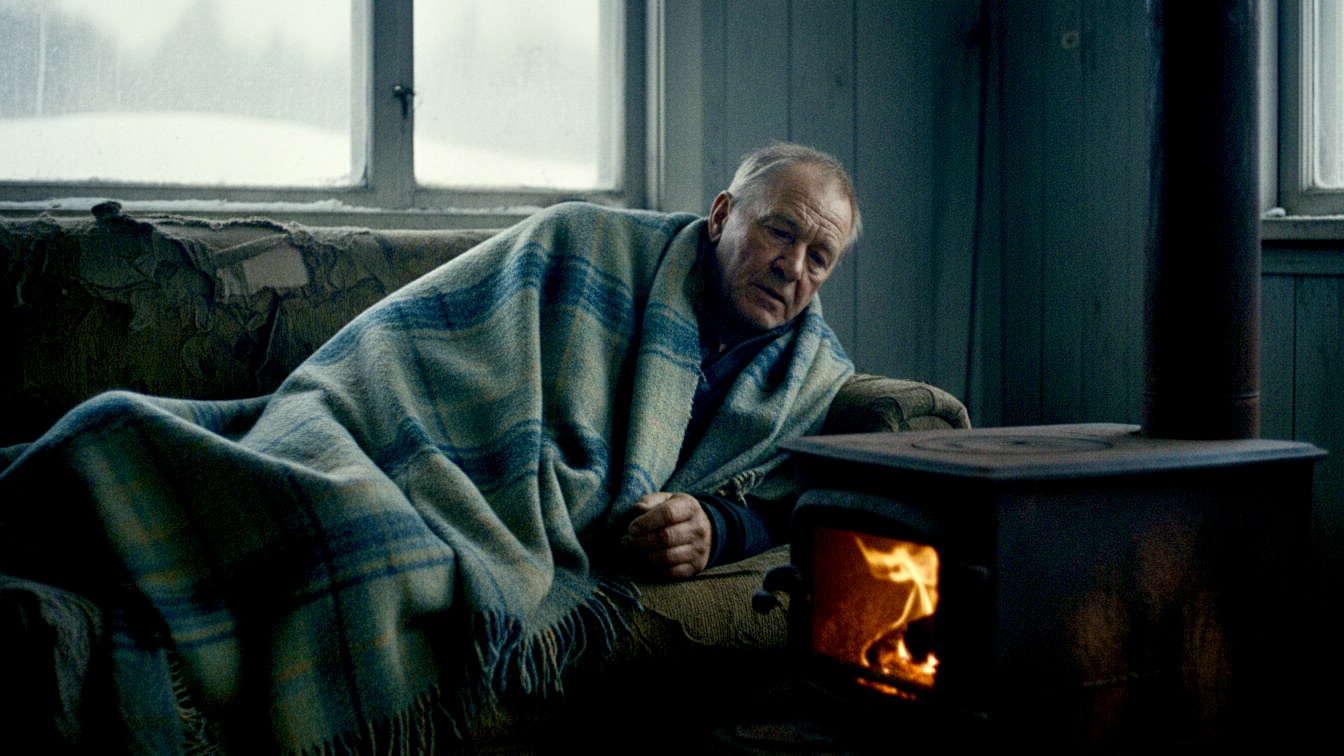
The air held a brittle quiet after the blizzard, a stark, profound silence where only the faint groan of settling ice and the metallic tang of extreme cold permeated. Inside, the house was a tomb of chilled air, smelling of old wood and the creeping damp.
The wind had ceased its mournful howl sometime before dawn. Morris didn’t need a clock to know; the absence of the constant shriek against the windowpanes was a silence so profound it vibrated in his skull. He shifted in the bed, the old springs groaning in protest. Evelyn beside him was a still, warm lump under the heavy quilt, her breathing a shallow, even rhythm. He could hear it, the faint inhale, exhale, now that the storm had truly gone.
The bedroom was cold. Not just cool, but a deep, bone-seeping cold that made his breath visible in faint tendrils as he pushed back the covers. His bare feet hit the floorboards, the shock of the frigid wood a sudden, sharp pain that quickly faded to a dull ache. He fumbled for his robe draped over the armchair, the thick flannel stiff and icy against his skin. The air in the room felt heavy, metallic, smelling of old dust and something else, something subtly damp.
He pulled on the robe, cinching the tie around his waist. The darkness of the room was absolute, the power having gone out sometime in the night. No glowing red numbers on the alarm clock, no soft hum from the humidifier. Just the thick, impenetrable dark. He navigated by memory, hand trailing along the wall, past the dresser, toward the bedroom door. The doorknob was a disc of pure ice under his palm. He twisted it, the old brass squeaking. The sound seemed to echo in the pre-dawn quiet.
Out in the hall, the cold was even more assertive. He shuffled toward the kitchen, his slippers scraping softly on the hardwood. His bladder, old and unreliable, had been his first alarm. He could feel the familiar ache in his lower back, a constant companion these last few years. The kitchen was a black pit. He moved to the counter, his fingers searching for the familiar smoothness of the battery-powered lantern they kept there. Found it. Flipped the switch. A weak, yellow beam cut through the darkness, pushing back the oppressive gloom by a few feet.
He made his way to the bathroom, the light bouncing off the chipped porcelain of the sink. The toilet flushed with a gurgle, the water sounding unnaturally loud in the silence. As he washed his hands, the cold water from the tap bit at his skin. He leaned closer to the mirror, his reflection a blurry figure in the lantern’s dim light. His face looked older than he felt, lines etched deep around his eyes, hair thinned and stark white.
Returning to the kitchen, he paused. There it was. A faint, irregular drip. Drip. Pause. Drip. Drip. It was coming from somewhere. His brow furrowed. He held the lantern higher, sweeping the beam across the ceiling. Nothing immediately visible. But the smell was stronger here, a musty, wet scent underlying the cold. He moved slowly, deliberately, towards the basement door, his heart beginning a slow, heavy thump against his ribs.
The basement stairs, old and creaky, groaned under his weight. Each step was a commitment. The air grew colder, heavier, with each descent. The drip became clearer, a maddeningly persistent rhythm. He reached the bottom, the beam of the lantern cutting through cobwebs and dust motes. The concrete floor felt clammy under his slippers. His gaze landed on the far wall, near the old washing machine. A dark, spreading stain bloomed on the drywall, already larger than his hand. And beneath it, a puddle, reflecting the lantern’s weak glow like a disturbed eye.
“Damn it,” he muttered, the words thick with exhaustion and a familiar sense of dread. He knelt, his knees protesting, and touched the water. It was icy. His fingers traced the path up the wall, the paint soft and peeling. Up, up, into the ceiling tiles. An ice dam, he thought, or a burst pipe from the extreme cold. It was always something.
He stood, grimacing at the ache in his knees. This was not how he wanted to start the day. He needed a bucket. He needed towels. He needed light. He needed the power to come back on. He knew, with a sinking certainty, that this was only the beginning. The cold had been too prolonged, too intense. Something had to give. And it looked like it was their old house, again.
He found an old bucket, a red plastic one that usually held cleaning supplies. He placed it under the drip, the plink of water hitting plastic a hollow, lonely sound. He then went to wake Evelyn. Her eyes fluttered open as he gently touched her shoulder. “Evelyn. We’ve got a problem. Basement.”
She blinked, her eyes adjusting, then sat up slowly. “What is it?” she asked, her voice raspy with sleep and the cold. She didn't need to ask for details. Her expression was already tightening with the same weary resignation he felt.
“Water. Near the laundry. Looks like a pipe, or an ice dam.” He hated the sound of his own voice, so flat, so tired. It was a familiar refrain, the chorus of aging homeownership in a climate that refused to be tamed.
She swung her legs out of bed, her feet finding her own slippers. “I’ll get some towels. And the bigger bucket.” Her voice was clipped, efficient. She didn’t complain, not out loud anyway. That was their way. They just did what needed to be done. It was the quiet, shared understanding that sometimes felt more binding than any spoken promise.
They worked in the dim light of the lantern, their shadows dancing on the cold, damp walls. Morris pushed aside the damp laundry bins, his muscles stiff. Evelyn laid down old bath towels to soak up the spreading puddle. The air grew thick with the smell of wet drywall and mildew. He could hear her short, sharp breaths, a small sniffle escaping occasionally. The cold was pervasive. He felt it in his bones, a deep tremor that no amount of thick clothing seemed to alleviate.
“It’s coming from above,” he said, looking up at the stained ceiling. “Got to be an ice dam, unless a pipe burst in the wall.” He prodded the ceiling tile with the handle of a broom. It was soft, saturated. More water dripped onto the broom. “This whole section will need replacing.”
Evelyn sighed, a sound that seemed to carry the weight of decades. “Of course, it will. Just when we finally got the kitchen settled.” Her voice was low, almost a murmur, but he heard the bitterness in it. They had just replaced the kitchen counter. Another unexpected expense, last summer.
They spent the better part of an hour trying to contain the water, moving things away from the wall, emptying the buckets into the laundry sink. The power remained off, the house a silent, frigid hulk around them. When they were finished, for now, the basement still dripped, but the immediate threat of a major flood was averted. For now.
“Coffee,” Evelyn said, her voice a little brighter, as they climbed back up the stairs. “I’ll get the percolator on the propane burner.” It was their emergency ritual, one practiced far too often in recent years. The old camping stove, hauled out of the garage, sputtering to life on the kitchen counter.
While Evelyn fussed with the coffee, Morris pulled on his heavy winter coat, gloves, and hat. He needed to check outside. The garage, the fence, the roof, everything. The world outside the kitchen window was a dazzling white. The sun, finally up, glared off the pristine snow, hurting his eyes. He fumbled for his sunglasses, found them on the hook by the back door.
The backyard was a landscape transformed. Snow drifts piled high against the back fence, sculpted by the wind into graceful, deceptive curves. The old apple tree, usually a gnarled sentinel, was now a ghostly white sculpture, each branch encased in a thick layer of ice. He squinted against the glare, walking carefully on the packed snow.
Then he saw it. Near the compost bin. A section of their cedar fence, three panels, ripped clean from the posts. They lay half-buried in a drift, splintered wood jutting out like broken bones. “Damn it to hell,” he muttered again, the words tasting like frost on his tongue. That fence had been there for forty years. Forty years of winters, and this one finally took it.
He knelt beside the broken panels, his gloved fingers tracing the splintered edge. The wood was wet, heavy, already starting to rot at the points of fracture. He pushed a hand into the snow beside it, feeling the underlying ice crust. Everything was frozen solid. No repairs today.
He continued his circuit, checking the eaves for more ice dams, though he couldn't see the roof properly from the ground. The garage door, stiff with ice, refused to budge more than a few inches. The car, an old sedan, was entombed in a drift, a white mound with hints of metal beneath. This was a monumental task. More than just a nuisance.
When he came back inside, Evelyn had two steaming mugs of coffee ready. The faint smell of propane mixed with the rich aroma of the brew. “Fence is down,” he said, shrugging off his coat. “Three panels. Probably more. The garage is frozen shut.”
She didn’t look up from stirring her coffee. “I figured. Always something.” Her voice was flat, devoid of emotion. He knew that tone. It was the quiet acceptance of an onslaught they had no control over. The city, this climate, it chipped away at them, year after year.
They sat at the kitchen table, sipping their coffee in silence. The house slowly, imperceptibly, began to warm from their small propane burner. The drip in the basement was a constant reminder. After a while, Evelyn reached for her phone. The screen lit up, showing no service bars. “Still nothing,” she said, more to herself than to him. “Can’t call anyone.”
“They’ll be overloaded anyway,” Morris said, trying to sound pragmatic. He knew the drill. After a big storm like this, the insurance companies, the repair services, they all got swamped. Their turn would come, eventually. But it felt like they were always at the back of the queue.
Later that morning, the power flickered on, then off, then on again, staying. The house hummed back to life, the furnace kicking on with a deep thrum. A small victory. Morris went straight to the basement, to see the damage in proper light. It was worse than he thought. The water stain covered a larger area, spreading like a malignant growth. The ceiling tiles were sagging, softened by the absorbed moisture. He touched one. It was cold, slimy. He could feel the rot already setting in.
He pulled out his phone, the signal bars now full. He found the number for their insurance provider. He paced the kitchen floor, the phone pressed to his ear, listening to the incessant hold music. Twenty minutes. Thirty minutes. Finally, a human voice, cheerful and unburdened. He explained, his voice flat, detailing the ice dam, the water damage, the fence. He heard the click of keys on the other end, the practiced questions. “Have you taken pictures? Can you estimate the extent of the damage?”
He felt a wave of impotent frustration wash over him. “It’s extensive,” he said, his voice tightening. “Rotting ceiling, damaged drywall, potential structural issues. Three fence panels ripped out by the wind. Garage door frozen solid.” He heard a pause. A different tone in the representative’s voice. More hesitant.
“Sir, our basic policy for storm damage has a rather high deductible for water damage originating from ice dams. And for wind damage to detached structures, like fences, we often see… limitations.” The words hit him like a physical blow. Limitations. He knew what that meant. They wouldn’t cover it all. Not even close. Not with the rising costs of repairs, the inflated prices for materials.
“How much?” he asked, his throat tight. He braced himself. He could almost hear the numbers forming in her mouth. The representative cleared her throat. “For a repair of that nature, with current material and labor costs, and your deductible, you’d likely be looking at a significant out-of-pocket expense.” She wouldn’t give a number, of course. Just the vague, ominous implications.
He hung up, the dial tone a rude buzz in his ear. He looked at Evelyn, who had been watching him, her face a mask of quiet expectation. He shook his head slowly. “Limitations,” he mumbled. “Fencing… ‘detached structure’.” He could taste the bitterness. “And the water damage… high deductible. ‘Climate-driven extremes,’ she said.” The phrase hung in the air, a meaningless corporate buzzword for their mounting misery.
Evelyn simply nodded. She didn’t need an explanation. They had been through this before. The last time, after the hail storm, they had emptied their savings for a new roof, only for the insurance to cover a fraction of it. This was their new normal. Always patching, always paying more than they had, always just staying afloat.
“We’ll get the snow cleared,” she said, her voice surprisingly firm. “And then we’ll figure out the fence. One thing at a time.” Her resilience, he thought, was a force of nature in itself. She was the one who always found the way forward, even when the path was obscured by doubt and debt. He looked at her, at the small lines etched around her eyes, at the determined set of her jaw. She was tired, but not broken.
Morris spent the afternoon shovelling. The snow was heavy, wet, and the sun, though bright, did little to warm the biting wind. His back ached, his shoulders burned. He felt every one of his sixty-eight years. He cleared a path to the garage, then chipped away at the ice around the doorframe with an old crowbar. Each swing sent a jarring vibration up his arms. It was slow, painstaking work. He felt like Sisyphus, pushing against an immovable, icy wall.
By evening, he had managed to get the garage door open just enough to squeeze through. The car, still encased, remained a monument to the storm. He retreated inside, exhausted, his body stiff with cold and exertion. Evelyn had started a fire in the wood stove in the living room. The small stove, a relic from the 70s, cast a warm, orange glow, filling the room with the comforting smell of burning birch and oak.
They sat on the old couch, wrapped in blankets, sipping hot tea. The warmth from the stove slowly seeped into their bones, chasing away the deep chill. He watched the flames dance behind the glass, mesmerized by their hypnotic rhythm. It was a good fire, a steady burn. It reminded him of simpler times, of camping trips with their children, Clara and David, when they were small. Of evenings spent huddled around a campfire, telling stories.
“Remember that time David tried to toast a marshmallow on a twig that caught fire?” Evelyn chuckled softly, a rare, genuine sound. “He dropped it right in the dirt, all gooey and black.”
Morris smiled faintly. “And Clara, she swore she saw a bear in the woods. Cried for an hour until we convinced her it was just a shadow.” He remembered the feel of her small hand in his, clammy with fear. They were good memories, sharp and vivid, a stark contrast to the grim reality of the present.
His phone buzzed. He looked at the screen. Clara. A text message. Hey Dad, heard about the storm. Everything okay? Crazy weather out there. He stared at the screen for a moment, the simple words feeling hollow. Everything okay? No, Clara, everything was not okay. The house was slowly falling apart. Their savings were dwindling. And they were getting too old for this.
He typed back, a brief, censored reply. Rough storm. Power's back. Some damage. We'll manage. He didn’t mention the fence, the basement, the insurance. He didn’t want to burden her. She had her own life, her own pressures. A demanding job in Toronto, two young kids, a mortgage that dwarfed theirs. He knew she meant well, but there wasn't much she could do from a thousand miles away, beyond offering empty platitudes.
Evelyn looked at him expectantly. “Clara?” He nodded. “Just checking in.” He didn’t elaborate. They had an unspoken agreement to protect their children from the full weight of their struggles. It was a burden they carried, stoically, privately. He knew Evelyn felt the same. They didn’t want to be a source of guilt or obligation.
“It’s good they’re safe,” Evelyn said, her voice softer now, her gaze fixed on the dancing flames. “They have their own lives to live.” It was a truth, spoken without resentment, but with an underlying current of loneliness he recognized. They had raised their children to be independent, to fly far. And they had. Sometimes, too far.
Morris watched the flames, the warmth spreading through his chest, a fleeting comfort against the pervasive cold of the house, of the world outside. The wood stove was their anchor, their small, defiant act against the winter's cruelty. He knew what tomorrow would bring: more shovelling, more assessment, more calls to contractors who would charge exorbitant rates for emergency repairs. More calls to insurance, more polite denials.
He leaned his head back against the cushion, closing his eyes. The rhythmic crackle of the fire filled the silence. He thought about the basement, the wet, rotting ceiling. He thought about the fence, lying in splintered ruin under the snow. He thought about the rising cost of everything, the relentless march of the seasons, each one bringing a new challenge. They were in a constant battle, a never-ending siege against the elements, against time itself. He felt the familiar ache in his lower back, a dull throb that had intensified with the day's work. The house, their home for over forty years, felt less like a sanctuary and more like a besieged fortress, slowly crumbling around them. He opened his eyes, staring into the heart of the fire, the orange glow reflecting in his tired eyes. He heard a faint creak from the floorboards above, a sound that wasn't the house settling, but something else, something new and unnerving, a slow, deliberate splintering that seemed to come from the deepest part of the ceiling, directly above the very section of the basement where the water had seeped in all night, and he realized with a sickening lurch that the ice dam hadn't just caused cosmetic damage, but was pulling the very structure of the house apart, piece by agonizing piece, threatening to bring it all down around them.
“He heard a faint creak from the floorboards above, a sound that wasn't the house settling, but something else, something new and unnerving, a slow, deliberate splintering that seemed to come from the deepest part of the ceiling, directly above the very section of the basement where the water had seeped in all night, and he realized with a sickening lurch that the ice dam hadn't just caused cosmetic damage, but was pulling the very structure of the house apart, piece by agonizing piece, threatening to bring it all down around them.”