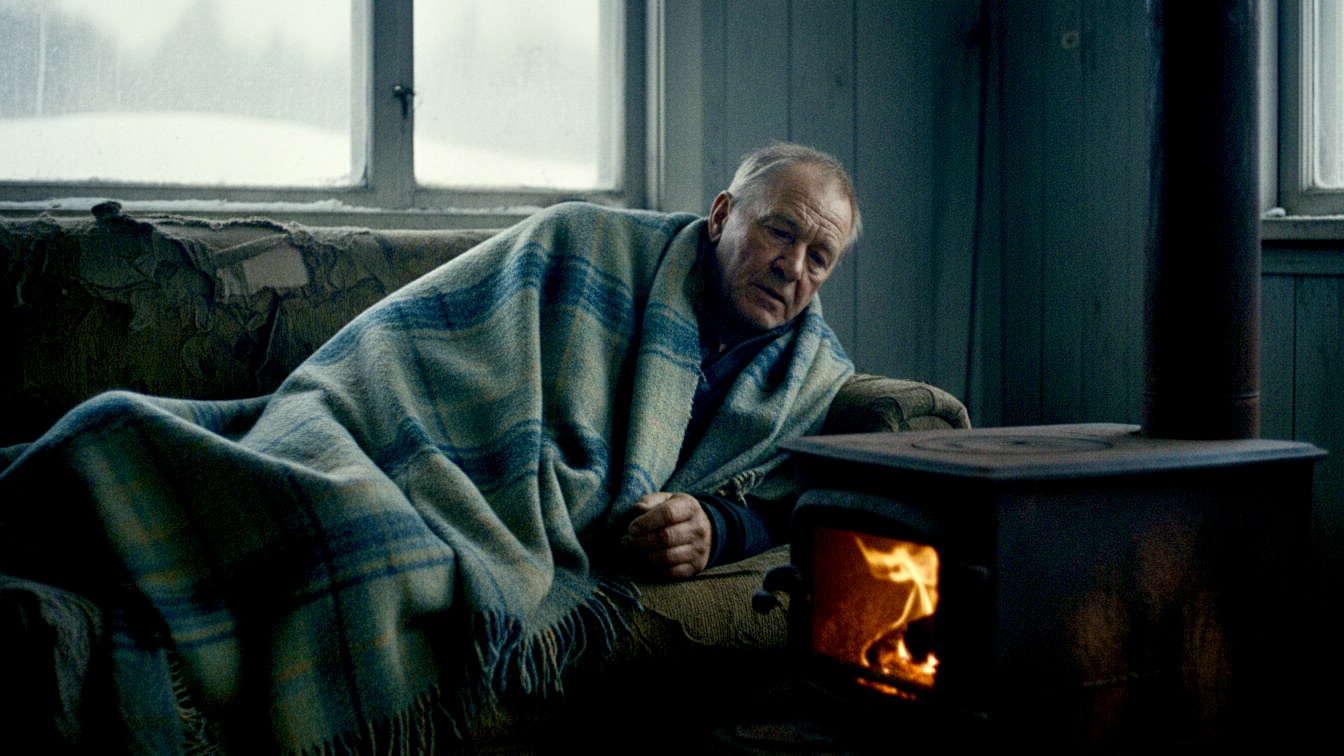
The chapter "Thaw and Tremor" opens with Morris waking in the profound silence after a severe winter storm, immediately noting the bone-seeping cold and the pervasive darkness caused by a power outage. His pre-dawn routine is interrupted by the discovery of a persistent drip in the basement, leading him to find a significant water leak and spreading stain on the drywall, likely from an ice dam or burst pipe. He wakes his wife, Evelyn, and together they embark on the familiar, weary task of containing the damage. Morris then ventures outside, only to discover a section of their forty-year-old cedar fence ripped apart by the wind and the garage door frozen shut. Upon attempting to contact their insurance company, they are met with discouraging news about high deductibles and limitations for "climate-driven extremes." The evening brings a brief respite by the wood stove, offering nostalgic memories, but a text from their daughter, Clara, highlights their unspoken burden to protect their children from their struggles. The chapter concludes with Morris's unsettling realization that the structural integrity of their home is compromised, implying a deeper, more catastrophic damage than initially perceived.
The chapter profoundly explores the theme of aging and decline, both in the human body and in the physical structures around us. Morris's aches and pains, his "old and unreliable" bladder, and the sheer exhaustion he feels are directly mirrored by the "old springs groaning," the "old brass squeaking," and the "old house" itself, which is slowly succumbing to the relentless elements. This parallel between personal and architectural decay underscores the inevitable erosion of strength and stability over time, creating a palpable sense of vulnerability.
Resilience versus exhaustion emerges as a central conflict. Morris and Evelyn display remarkable, almost mechanical, resilience in their immediate response to each new disaster, "just doing what needed to be done." However, this is consistently undercut by their weariness, flat voices, and "familiar sense of dread." Their stoicism is a coping mechanism, a quiet defiance against an onslaught they cannot control, yet the underlying current of fatigue suggests this resilience is finite and costly.
The relentless force of nature acts as a primary antagonist, embodying the broader implications of climate change. The "extreme cold," "prolonged" and "intense," is not just a backdrop but an active destructive agent, causing ice dams, burst pipes, and wind damage. The insurance company's phrase, "climate-driven extremes," dehumanizes their struggle, highlighting the impersonal and overwhelming scale of environmental challenges that disproportionately affect the aging and less financially secure.
Financial strain and economic precarity are woven into the fabric of the narrative. The repeated "unexpected expense," the "dwindling savings," and the disheartening news from the insurance company about "high deductibles" and "limitations" paint a grim picture of their financial vulnerability. The house, rather than an asset, becomes a constant drain, forcing them into a cycle of "always patching, always paying more than they had, always just staying afloat," revealing a pervasive anxiety about their future.
Finally, the theme of intergenerational dynamics and the burden of parenthood is subtly portrayed. Morris and Evelyn consciously choose to shield their children, Clara and David, from the full extent of their struggles, communicating only "censored" realities. This act of protection, while loving, also creates a sense of isolation for the elderly couple, highlighting the quiet sacrifices parents often make, even as their children have moved on to their own demanding lives.
Morris is presented as a man grappling with the physical and emotional toll of aging and persistent hardship. His internal state is dominated by a pervasive weariness and a "familiar sense of dread" that manifests in his repeated muttered curses and his "flat, so tired" voice. He is keenly aware of his body's limitations, feeling "every one of his sixty-eight years" through aches and stiffness, which intensify with physical exertion like shovelling. His pragmatism compels him to act, to physically confront the problems, but his spirit is frequently overwhelmed by "impotent frustration" when faced with insurmountable obstacles like insurance limitations.
His motivations are deeply rooted in his role as a protector of his home and Evelyn, and as a parent. He strives to manage the crises, seeking to restore order and mitigate damage, even as he knows it is a losing battle. A significant motivation is also to shield his children from the burden of his struggles, editing his communications to present a sanitized version of reality. Morris's central conflict lies in his internal battle against despair and the physical decline of his own body, pitted against the relentless external forces of nature and financial strain that threaten to dismantle his home and peace of mind. The ominous final creak suggests a deeper, more profound structural collapse, mirroring his own deepening sense of helplessness and the breaking point of his endurance.
Evelyn emerges as a figure of quiet, stoic resilience, contrasting with Morris's more outwardly expressed frustrations. Her internal state is characterized by "weary resignation" and a calm, efficient approach to crisis. She doesn't complain "out loud anyway," choosing instead to channel her emotional energy into practical action, her voice becoming "clipped, efficient" in moments of need. While she shares Morris's underlying exhaustion, her strength lies in her ability to look forward and "find the way forward," even when the path is obscured by doubt and debt.
Her motivations are primarily to support Morris and to maintain the stability of their home, acting as a steadfast partner in their shared struggles. She is the anchor, offering practical solutions like the "bigger bucket" and the "percolator on the propane burner," demonstrating a consistent ability to adapt and cope. Evelyn's conflicts are largely internal, as she processes her bitterness and weariness without overt expression, maintaining a strong front for both herself and Morris. Her unwavering determination, even when faced with overwhelming odds, is a testament to her enduring strength, though it comes with a quiet undercurrent of loneliness, particularly regarding their independent children.
The narrative employs a third-person limited perspective, primarily immersing the reader in Morris's internal experience. This choice allows for deep empathy, as his thoughts, physical sensations, and emotional responses drive the story. The narrative voice is direct and unadorned, reflecting the harsh realities faced by the characters and lending authenticity to their struggle against the elements and financial strain.
The pacing of the chapter is deliberate and builds tension incrementally. It begins slowly, with Morris's sensory observations of the post-storm silence and cold, gradually accelerating with each discovery of damage—the drip, the spreading stain, the broken fence, the insurance news. This pattern of discovery and weary reaction creates a rhythmic, almost relentless forward momentum, mirroring the couple's feeling of being constantly besieged. The brief respite by the wood stove offers a temporary deceleration, only for the final, unsettling creak to deliver a sharp, jarring conclusion, leaving the reader with a profound sense of foreboding.
The story is rich with sensory details that vividly bring the cold, the damp, and the decay to life. Auditory details are particularly prominent, from the "mournful howl" of the wind giving way to a "profound silence" that "vibrated in his skull," to the "groaning springs," "squeaking brass," "gurgle" of the toilet, and the maddening "drip. Pause. Drip. Drip." The "plink" of water into the bucket and the final "slow, deliberate splintering" of the house itself are powerful soundscapes that underscore the escalating damage.
Visual details paint a stark picture: "faint tendrils of breath," "impenetrable dark," the "weak, yellow beam" of the lantern, the "dark, spreading stain" blooming "like a malignant growth," and the "puddle, reflecting the lantern’s weak glow like a disturbed eye." The transformed "dazzling white" landscape outside, with the apple tree as a "ghostly white sculpture," contrasts sharply with the "splintered wood jutting out like broken bones." Tactile and thermal sensations are omnipresent, emphasizing the pervasive cold: "bone-seeping cold," "frigid wood," "stiff and icy flannel," "disc of pure ice," "clammy concrete," "icy water," and the "deep tremor" Morris feels in his bones. These details contribute significantly to the tone of weary realism, dread, and ultimately, profound despair, effectively immersing the reader in the characters' harsh environment and their internal struggles.