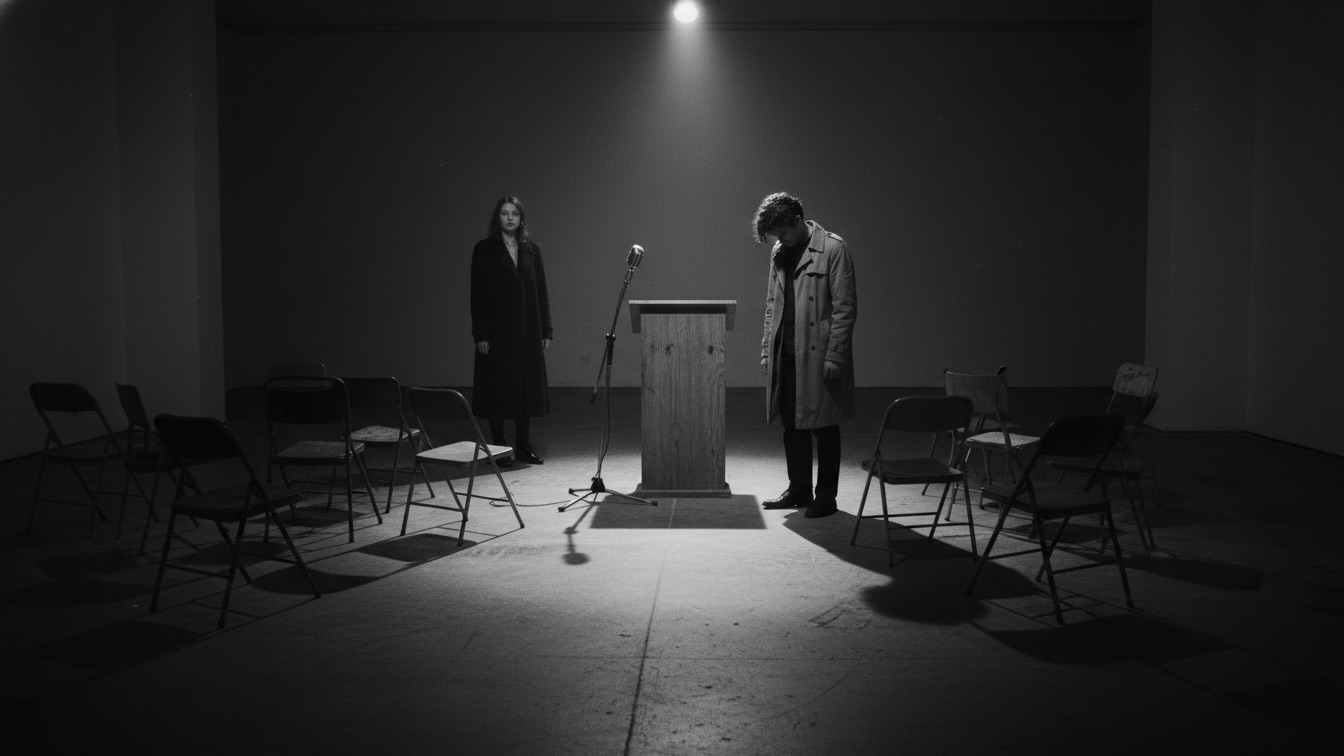
The chapter, "The Setup," plunges into the bleak atmosphere surrounding Jack and Debbie, who are struggling to save their neighborhood gallery and community from an encroaching developer. Jack, a man perpetually chilled and consumed by anxiety, reluctantly aids Debbie in preparing for a town hall meeting intended to rally their neighbors. Debbie, fueled by a desperate hope and fierce determination, meticulously plans the event, while Jack grapples with his profound fear of public speaking and the faulty equipment, particularly a recalcitrant microphone stand. As the community trickles in, alongside suspicious individuals linked to the developer, Debbie's brother Evan arrives, bringing with him an air of condescending familiarity. Debbie's fact-laden presentation fails to connect with the audience, setting the stage for Jack's disastrous attempt to speak. Plagued by extreme stage fright, a re-emerging stutter, and a catastrophic microphone feedback incident, Jack's speech collapses, leading to heckling and the meeting's rapid dissolution. Evan seizes the moment to publicly humiliate Debbie, dismissing her efforts as "hysterical." The chapter concludes with Jack and Debbie standing in the wreckage of their failed endeavor, utterly defeated and isolated, as the gallery echoes with the sounds of their collective failure.
The chapter deeply explores the pervasive theme of fear versus resilience, particularly through Jack's internal battle. His debilitating anxiety and fear of exposure stand in stark contrast to Debbie's desperate, albeit ultimately futile, resilience. This internal conflict is mirrored by the external threat of the developer, symbolizing a larger, impersonal force that preys on individual and communal weaknesses. The narrative emphasizes how fear, both personal and collective, can paralyze action and undermine even the most well-intentioned efforts, highlighting the immense psychological toll of facing overwhelming odds.
Another central theme is the fragility of community in the face of corporate power. The developer's strategy, as Debbie articulates, is to "pick us off one by one," exploiting isolation and weariness. The town hall meeting is an attempt to forge unity, but the gathering itself, filled with "small and uncertain" individuals and infiltrated by the developer's agents, underscores the difficulty of organizing a cohesive front. The ultimate failure of the meeting demonstrates how easily a nascent community can be fractured by external manipulation and internal disunity, leaving individuals feeling more isolated than before.
The narrative also examines the theme of failure and public humiliation. From the outset, there's an ominous sense of impending failure, manifested in Jack's dread and the malfunctioning equipment. The repeated feedback from the microphone becomes a powerful symbol of things breaking down, culminating in Jack's public stutter and the audience's heckling. Evan's calculated dismissal of Debbie as "hysterical" represents the ultimate public humiliation, not just of her ideas but of her very being. This theme underscores the psychological impact of perceived personal and collective failure, demonstrating its capacity to crush hope and initiative.
Finally, the chapter touches upon the power and limitations of different forms of communication and influence. Debbie's reliance on "facts" and "data" proves insufficient to galvanize an emotionally disengaged audience. She understands the need for a "human element," for "heart," which she assigns to Jack's personal story. However, Jack's inability to articulate this story due to his fear highlights the critical gap between intention and execution. The chapter suggests that while data can inform, emotional connection is often necessary to inspire, but even that can be sabotaged by fear and manipulative rhetoric, as seen with Evan's smooth, disarming, yet devastating speech.
Jack is presented as a deeply anxious and emotionally withdrawn individual, whose physical and mental states are inextricably linked to his environment. The opening description of his "permanently chilled bones" and his reflection as a "pale, hollow-eyed ghost" immediately establishes his profound weariness and sense of detachment from himself. His internal landscape is dominated by a paralyzing fear of public exposure and failure, manifesting physically through sweating palms, a dry mouth, and the re-emergence of his stutter. This anxiety is not merely superficial; it is a "recurring nightmare," suggesting a past trauma or deep-seated insecurity that renders him profoundly vulnerable.
His motivations are complex, driven less by active conviction and more by a reluctant obligation and a mirror-like empathy for Debbie's desperation. He agrees to speak not out of belief in the plan, but because he sees a reflection of his own entrapment in Debbie's plight. Jack exhibits classic signs of social anxiety disorder, where anticipation of performance triggers intense physiological and psychological distress, leading to avoidance or, when forced, a catastrophic performance. His brief, impotent surge of anger at Evan's insult, quickly extinguished, reveals a flicker of protective instinct and moral integrity beneath his fear, yet underscores his perceived powerlessness.
Jack's primary conflict is internal, an agonizing struggle against his own debilitating fears and self-doubt. He projects his internal state onto external objects, seeing the faulty microphone stand as an "omen," a "physical manifestation of his own inability to stand up, to hold his ground." This externalization of his fear intensifies his dread and provides concrete symbols for his anticipated failure. His ultimate collapse on stage is not merely a failure of public speaking but a vivid portrayal of his psychological defenses crumbling under pressure, leaving him exposed and humiliated.
Debbie is portrayed as a woman of fierce determination and desperate hope, driven to the brink by the threat to her livelihood and community. She is the engine of the resistance, characterized by "raw, frantic energy" and meticulous organization, believing firmly in the power of facts and collective action. Her initial composure, despite her "knuckles white" grip on her mug, suggests a woman who compartmentalizes her anxiety to focus on the task at hand. She is a planner, a strategist, and a doer, channeling her fear into manic activity and detailed preparation.
Her motivations are clear: to fight back against corporate malfeasance and save her neighborhood. She views the situation in terms of justice and survival, believing that presenting "facts" and fostering "community" will compel change. Debbie's psychological coping mechanisms involve intense focus and control, evident in her "furious speed" stapling flyers and her ability to "compartmentalize" problems. She places immense faith in logic and evidence, which ultimately becomes her downfall when faced with an emotionally disengaged audience and manipulative rhetoric.
Debbie's central conflict lies in the clash between her rational, data-driven approach and the messy, unpredictable reality of human emotions and political maneuvering. She struggles with the weariness and isolation of her neighbors, and critically, fails to anticipate the psychological warfare waged by her own brother, Evan. Her profound shock and the draining of her "fight" upon hearing Evan's "hysterical" comment reveal the devastating impact of such a gendered, dismissive attack, which invalidates not just her efforts but her very passion and intellect. Her defeat is not just logistical but deeply personal, as her carefully constructed plans disintegrate into chaos and noise.
Evan is presented as a smoothly manipulative and self-serving antagonist, a stark contrast to his sister's earnest efforts. He moves with "unearned familiarity," exuding a calculated charm that belies his true intentions. His "brilliant white smile" that "didn't reach his eyes" immediately signals his insincerity and predatory nature. He is a master of superficial social interaction, able to work a crowd while maintaining a detached, condescending stance toward Jack and Debbie.
Evan's primary motivation appears to be to assert dominance and undermine his sister, possibly to protect his own interests or simply out of a deep-seated contempt. His actions are deliberate and strategically timed, designed to dismantle Debbie's credibility and efforts publicly. He represents a form of psychological violence, using words as weapons to achieve his ends.
His conflict with Debbie is one of ideological and personal opposition, where he leverages her vulnerability and the audience's restlessness to his advantage. Psychologically, Evan exhibits traits of a cynical opportunist, possibly with narcissistic tendencies, deriving satisfaction from others' discomfort and control. His use of the word "hysterical" is a particularly insidious psychological tactic, designed to dismiss Debbie's passion as irrational feminine overreaction, thereby discrediting her entirely and ensuring the failure of the town hall.
The chapter employs a bleak and anxious tone that permeates the narrative from the very first sentence. Descriptions like "permanently chilled bones," "soul-crushing wind," and "hollow-eyed ghost" immediately establish a sense of profound weariness and internal coldness. This tone is consistently maintained, even during moments of frantic activity, through Jack's perspective, which is saturated with dread and a pervasive sense of impending doom. The atmosphere is heavy with unspoken fears and the weight of an impossible task, creating a palpable sense of futility that foreshadows the ultimate failure.
Sensory details are meticulously woven throughout the text, immersing the reader in Jack's subjective experience. Tactile sensations of cold are prominent, from the "hot ceramic" that fails to warm Jack's hands to the "cold metal" of the chairs and the "penetrating chill" of defeat. Auditory details are particularly striking, with sounds often signifying anxiety or breakdown: the "loud scraping" of paint, the "rickety stool," the "groan of protest" from chairs, and especially the recurring "drip. drip. drip." of water, which acts as a relentless, ominous countdown. The "piercing shriek of feedback" from the microphone is a brutal auditory assault that perfectly externalizes Jack's internal panic, echoing "exactly like the inside of his own head."
The pacing of the chapter is carefully controlled, starting slow and heavy with Jack's internal monologue and the oppressive quiet of the back room. It accelerates into a frantic blur as Debbie's "manic activity" takes over, conveying her desperate energy. The tension steadily mounts during the setup and the arrival of the attendees, reaching a peak during Jack's failed attempt to speak. The climax is abrupt and chaotic, marked by the violent feedback and the rapid dissolution of the meeting. The ending then slows to a desolate, lingering pace, emphasizing the quiet, absolute nature of their defeat and the wreckage left behind.
The narrative voice is primarily third-person limited, deeply anchored in Jack's internal world. This perspective allows for intimate access to his anxieties, fears, and physical sensations, fostering strong reader empathy for his struggle. The language is often metaphorical, drawing connections between the external environment and internal states: the "frozen chasm" between Jack and Debbie, the microphone landing "like a stone" in his stomach, and the stutter re-emerging as a "snake coiling in his throat." This rich, evocative language elevates the emotional stakes, making Jack's internal landscape as vivid and impactful as the external events unfolding around him. The subtle shifts in focus to observe Debbie's actions and expressions provide a broader, yet still intimate, view of their shared predicament.