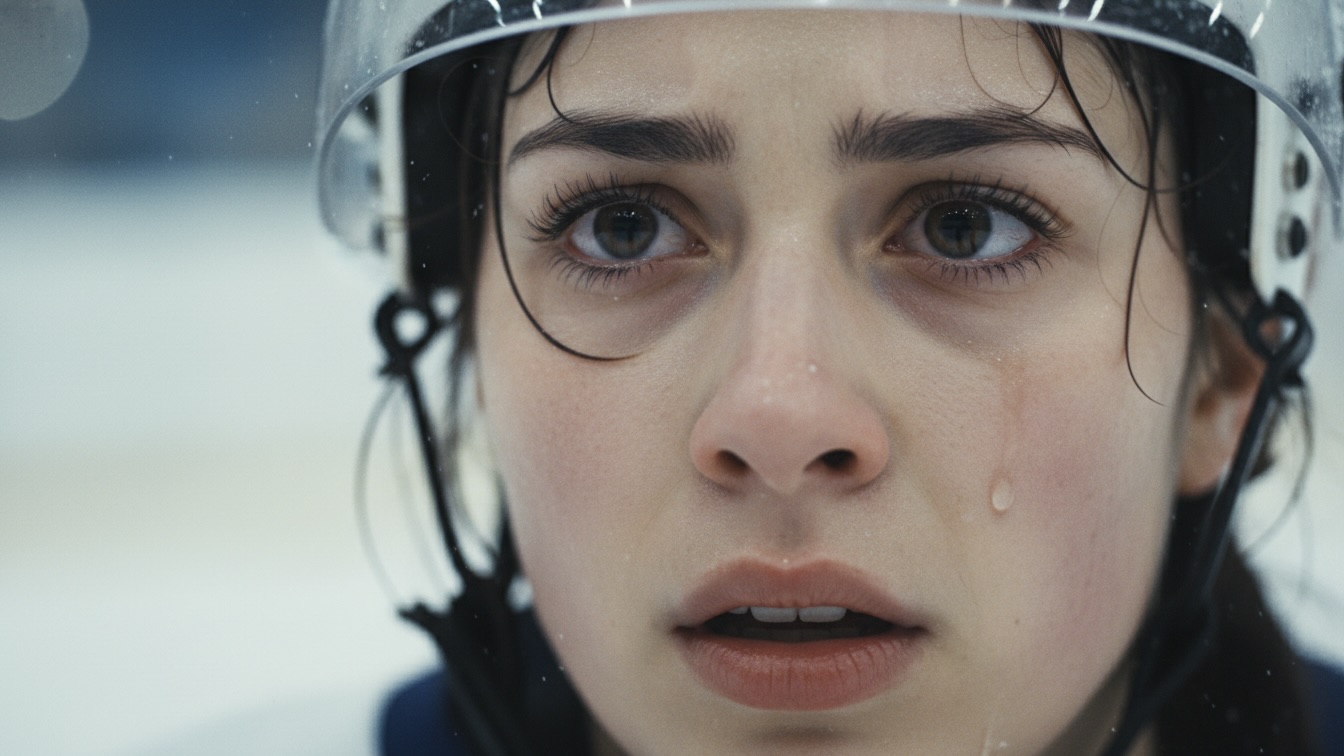
The narrative follows a recovering hockey player who, driven by frustration and longing, defies medical restrictions to skate on a closed outdoor rink. Despite having undergone four months of grueling physical therapy for a previous knee injury, he ignores the locked gate and the warning signs of his own body to access the ice. Initially, the experience is euphoric; he feels a restoration of his power and identity, convincing himself that the doctors were wrong and that he is fully healed.
However, this delusion leads him to attempt a high-intensity maneuver known as the "Kenning Pivot." The sun-softened ice catches his blade during the turn, resulting in a catastrophic re-injury. The story concludes with the protagonist lying on the ice in agony, facing the devastating, absolute realization that his career is permanently over.
The central theme of the story is the destructive nature of hubris and the psychological mechanism of denial. The protagonist constructs a false reality where his will is stronger than his physiology. He frames his rehabilitation not as a healing process, but as "psychological torture" and a "life sentence," viewing the medical advice as an obstacle to his identity rather than a safeguard for his future. This denial is reinforced by the setting; the "perfect, stupidly blue sky" and the "omen" of the beautiful day act as false validators for his reckless decision-making. He interprets the weather as a divine promise rather than a meteorological condition that softens the ice, illustrating how desire can warp perception.
Furthermore, the narrative explores the conflict between the idealized self and the physical self. The protagonist cannot reconcile who he is—a star athlete capable of the "Kenning Pivot"—with who he has become—a patient doing exercises a "toddler could do." The ice represents the arena of his idealized self, the only place where he feels "real." By stepping onto the ice, he attempts to bridge the gap between these two selves through sheer force of will. The tragedy lies in the fact that the physical reality is immutable; the body has limits that no amount of psychological reframing can overcome.
Finally, the story touches upon the indifference of nature. The environment is personified throughout the text, from the sun that "had teeth" to the ice that "betrayed" him. However, the ending reveals the fallacy of this personification. The sky remains "perfect" and "indifferent" as he lies ruined. The tragedy is entirely human; the world continues its natural cycle, unmoved by the end of his career. This underscores the isolation of the protagonist's suffering, trapping him in a private hell while the rest of the world remains bright and cold.
The protagonist is a study in the psychology of the injured athlete, struggling to maintain his self-worth in the absence of his primary coping mechanism. He is defined entirely by his physical capability; without hockey, he views himself with contempt. His internal monologue reveals a deep-seated arrogance, referring to the rehabilitation plan as being for "cowards" and "people who were actually injured." This distinction implies that he views himself as a superhuman entity, exempt from the biological rules that govern others. He projects his insecurities onto Dr. Evans, dismissing her expertise because it contradicts his desperate need for agency.
His motivation is not merely the joy of skating, but the reclamation of dominance. He describes the sensation of skating as "effortless power" and needing to "prove you deserve it." This need for validation drives him to ignore the "familiar ghost" of pain in his knee. He intellectualizes the pain as "memory" and "scar tissue talking," a classic dissociation technique used to suppress physical warning signals. He is fighting a war against his own vulnerability, and the enemy is his own body's fragility.
The decision to attempt the "Kenning Pivot" is the ultimate manifestation of his ego. It is a signature move, the specific action that defined his success and secured his scholarship. By attempting it, he is trying to prove that the past four months of vulnerability never happened. When the injury occurs, the shift in his psyche is instantaneous. The arrogance evaporates, replaced by a "calm, cold thought." In the end, he is stripped of his delusions. The tragedy forces him to confront the reality he fled from, transitioning from a state of manic denial to a depressive, absolute certainty of loss.
The narrative voice is immediate, visceral, and deeply subjective, firmly rooting the reader in the protagonist's sensory experience. The author utilizes a first-person perspective that oscillates between lyrical appreciation of the sport and jagged, aggressive denial. Early in the chapter, the prose is fluid and romantic, describing the air that "kissed" and the "rhythm settled in my bones." This establishes the seduction of the ice, allowing the reader to understand why the protagonist would take such a risk. The sensory details—the smell of old coffee, the scrape of the blades—create an intimate atmosphere that mimics the hyper-focus of an athlete entering "the zone."
Pacing is used effectively to mirror the protagonist's physical state. The story begins with a slow, observational pace as he climbs the fence and laces his skates. As he hits the ice, the sentences become rhythmic: "Scrape. Glide. Scrape. Glide." As he builds speed, the syntax accelerates, becoming more breathless and driven. This crescendo halts abruptly with the onomatopoeic "POP," which serves as a violent structural break. Following the injury, the pacing slows to a crawl ("Time stretched"), simulating the phenomenon of temporal distortion often experienced during traumatic events.
The imagery employed is violent and elemental, foreshadowing the disaster. The sun has "teeth," the leg lifts are "pathetic," and the eventual injury is described not as a tear, but a "detonation" and a "supernova." This hyperbolic language elevates a sports injury to the level of a cosmic event for the protagonist, emphasizing that for him, this is indeed the end of his world. The contrast between the "silent air" and the internal "roaring ocean" of pain creates a powerful juxtaposition, highlighting the internal nature of his suffering against the backdrop of a quiet, sunny winter day.