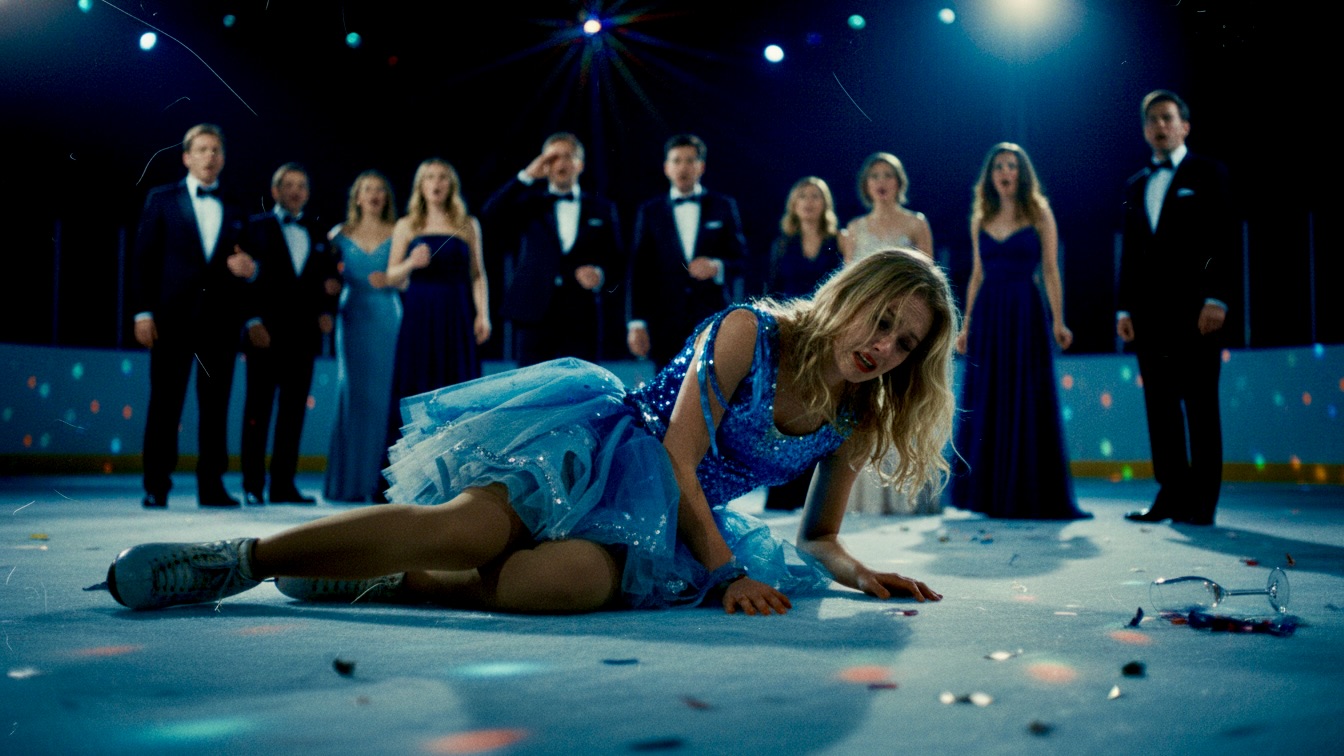
At a winter club gala meant to celebrate her victory, the air is thick with false smiles and unspoken pressure. Crystal glasses clink over the low hum of conversation, but the sterile, cold atmosphere of the party's private ice rink reflects the skater's inner turmoil.
The clasp of the medal bit into the skin on the back of my neck. A tiny, insistent pressure, a little sawtooth edge of gold-plated metal and grosgrain ribbon that had been digging into me for two hours. It was meant to be a mark of triumph, this heavy, ornate disc lying against the velvet of my dress, but it felt like a millstone. A down payment. People swirled around me, their faces soft and indistinct with champagne and congratulations, their words a syrupy tide that threatened to drown. They saw the medal, not the girl wearing it. They saw the result, not the cost.
The Winter Club’s ballroom was suffocating. A cavern of crystal chandeliers weeping light onto waxed floors, the air thick with the scent of pine garlands and expensive perfume. I was supposed to be smiling. I was supposed to be gracious. I was supposed to feel something other than the raw chafe of the ribbon and the echoing emptiness where the thrill of victory should have been.
Then my father appeared, parting the sea of well-wishers with the sharp prow of his ambition. Richard’s smile never reached his eyes. It was a facial arrangement, a tool he used for sponsors and judges. He held two glasses of sparkling cider, handing one to me. The bubbles fizzed aggressively against the crystal.
“Your spirals were magnificent,” he began, a rare morsel of praise that I knew was only bait. I waited. “But the entry on the triple Salchow was sluggish. A quarter-second off. You were lucky Judge Moreau was feeling generous.”
I stared into my glass, watching a single bubble cling stubbornly to the side. “I won, Dad.”
“You won today,” he corrected, his voice a low, precise instrument of dissection. “Against this field. But the Russians won’t give you that quarter-second. They will eat you alive. We need to rework your stamina drills. Starting Monday. Six a.m.”
He wasn’t my father, not here. He was my coach, my strategist, my architect. And I was his grand design, a project with a single, glaring flaw he was determined to sand down. He tapped his glass against mine, a gesture that was supposed to look like a toast but felt like a summons. “Don’t look so morose, Genevieve. It’s unbecoming of a champion.” He turned and was swallowed back into the crowd, leaving me with the cold glass and the colder truth of his words.
My victory was already an old accomplishment, a data point for him to analyze. The medal around my neck felt heavier, the ribbon digging deeper. I drifted away from the warmth of the ballroom, drawn toward the cool, blue-white light of the party rink. The club had opened its small, private ice sheet for the celebration, a glittering square of perfect ice under the stars, enclosed by glass walls. A few couples were skating, laughing, their movements clumsy and joyful. It was everything skating was supposed to be, and everything it had never been for me.
And there was Alexei. My partner. He was holding court near the boards, not with words, but with motion. He laughed, a bright, easy sound that carried across the ice, and pushed off. He wasn’t in costume, just tailored black trousers and a cashmere sweater, but he moved with a liquid grace that made the air around him seem to bend. He glided backward, carving a long, clean arc into the virgin ice left by the Zamboni.
The crowd’s attention shifted to him. A murmur went through the guests who had gathered by the glass. He was performing, but it felt different from our routines. This was pure, unburdened flight. For him, the ice was a playground. For me, it was a proving ground.
With a flick of his wrists and a predatory dip, he launched himself into the air. One, two, three rotations, tight as a corkscrew. He landed the triple toe loop with a whisper of steel and a puff of ice-dust, arms flaring out for a second before he relaxed into a cocky, charming grin. The applause was instant, a percussive clap that echoed in the cold night. People whistled. Someone shouted his name. He bowed, a theatrical sweep of his arm, soaking it in.
The jealousy left a hot taste in my mouth. It coiled in my gut, a bitter, furious thing. He had done it so easily. Stolen my moment with a single, effortless jump. He hadn't endured the lecture, the dissection of his victory. He just… was. And everyone loved him for it.
My father was watching, too. I saw him near the glass, and he wasn't looking at Alexei with critique. He was nodding, a flicker of appreciation in his eyes. Acknowledging the power, the natural talent. A talent he was always telling me I had to compensate for with relentless, brutal work.
Something inside me snapped. A wire pulled too tight for too long. The need to wipe the smug look off Alexei’s face, to snatch back the spotlight, to show my father what real power looked like—it was a roar in my ears, drowning out the music and the polite clapping. I put my cider glass down on a vacant table with a sharp click. I would not be a footnote at my own celebration.
I walked through the gate and onto the ice. The cold hit me through the thin soles of my velvet party shoes. I wasn't wearing my skates. It didn't matter. I saw a pair of rental skates sitting on a bench, their blades dull, their leather stiff. I shoved my feet into them, not bothering to tuck in the hem of my dress. I pulled the laces tight, the rough fibers digging into my fingers. There was no warm-up. No stretching. Just the cold, hard knot of spite in my stomach.
I pushed onto the ice. The blades felt wrong, foreign. The balance was off. Alexei saw me and his smile faltered, a question in his eyes. The other skaters drifted toward the boards, sensing a shift in the atmosphere. The air grew still. All eyes were on me.
I ignored them. I ignored the restrictive fabric of my dress bunching at my knees. I ignored the dull ache in my arches from the unfamiliar boots. I had to do something bigger than his triple toe. Something that would leave no doubt. A triple Lutz. My most difficult jump. The one my father said was still inconsistent.
I skated a wide, preparatory circle, building speed. The wind felt thin and sharp against my heated face. I could feel my father’s stare like a physical weight on my back. This is for you, I thought, a vicious, silent snarl. This will be good enough.
I picked my entry point, drove the toe pick into the ice to launch. For a single, terrifying second in the air, I knew I had miscalculated. The rotation felt slow, loose. My axis was tilted, my body fighting itself. The velvet of my dress seemed to catch the air like a sail, pulling me off-center. I was not flying; I was plummeting.
Instead of the clean slice of a blade hitting ice, there was a sickening crunch. My ankle folded, a shriek of bone and tendon that I felt more than heard. The impact knocked the wind out of my lungs, my body slamming onto the unforgiving surface. I slid for a few feet, a tangle of velvet and flailing limbs, and came to a stop in the center of the rink. The music, a gentle waltz, played on for three more bars before someone had the sense to cut it off.
Silence. A thick, absolute silence that was louder than any applause. The only sound was a high-pitched ringing in my own ears. A white-hot, electric pain shot up my leg from my ankle. It was a blinding, nauseating agony. But it was nothing—nothing—compared to the humiliation.
I pushed myself up onto my elbows. The whole party was staring. Frozen silhouettes against the glass, their faces pale masks of shock. Alexei was skating toward me, his face stripped of its earlier bravado. But I didn't look at him. My eyes searched the crowd and found my father. He stood at the edge of the ice, perfectly still. His face was not filled with worry or compassion. It was a mask of cold, unadulterated fury. He didn't move toward me; he just stared, and in his eyes, I saw the true cost of my fall.
“He didn't move toward me; he just stared, and in his eyes, I saw the true cost of my fall.”