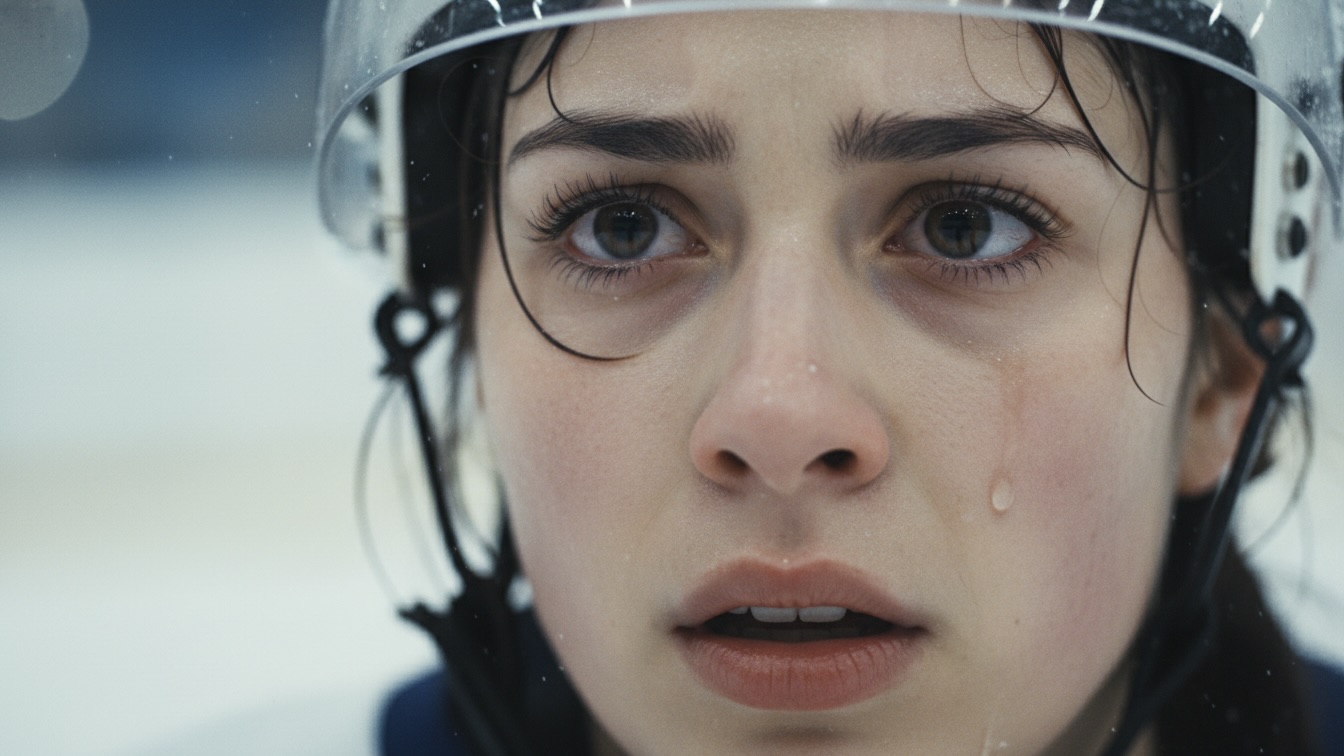
Format: Short Film / Anthology Episode | Est. Length: 10-12 minutes
Imagine this story as an episode in an anthology series titled THE ECHO, where each installment explores a single, life-altering decision and its irreversible consequences. The series examines moments of hubris, desperation, or defiance, showing how one choice can create an echo that reshapes a person's entire existence. Set in a grounded, contemporary world, the overarching narrative of the series is a mosaic of human fallibility, linking disparate lives through the universal theme of choices that cannot be unmade.
A gifted young hockey player, four months into a grueling recovery from a knee injury, stands before a locked outdoor rink. The pristine, untouched ice inside calls to him, a perfect vision of the life he's desperate to reclaim, forcing him to choose between his doctor's stern warning and the overwhelming urge to feel whole again.
A promising hockey player, driven by denial and a desperate need to reclaim his identity, defies his doctor's orders for one perfect skate on a forbidden rink. His defiant act of hubris culminates in a catastrophic, career-ending injury, forcing him to confront the devastating reality he tried to outrun.
The primary theme is the fragile nature of identity, particularly when it is fused to a single physical talent. The story explores the psychological prison of recovery, where the protagonist’s sense of self-worth is so tied to being a hockey player that he cannot envision a life without it. This obsession fuels a powerful denial, leading him to reject medical reality in favor of a self-constructed narrative of invincibility.
A secondary theme is hubris and the tragedy of ignoring limitations. The protagonist views his injury not as a physical reality to be respected, but as a personal failure to be conquered through sheer force of will. The beautiful, treacherous day serves as a metaphor for this delusion—a perfect surface hiding a fatal weakness, mirroring his own body and his tragic refusal to accept its new fragility.
The stakes are absolute and existential for the protagonist. On a practical level, his athletic scholarship, his future career, and his physical mobility are all on the line. Psychologically, the stakes are even higher: his entire identity, his social standing, and his sense of purpose are tied to his ability on the ice. By stepping onto that rink, he is gambling the rest of his life on the belief that he is the exception to the rule.
The central conflict is internal: the protagonist versus his own impatience and denial. He is at war with the cautious, rational voice in his head (personified by the absent Dr. Evans) and the physical reality of his healing body. The external antagonistic force is the ice itself—a passive, indifferent element that appears perfect but contains a hidden flaw that ultimately serves as the instrument of his downfall, punishing his arrogance with brutal finality.
Frustrated by four months of tedious physical therapy for a torn ligament, a promising young hockey player feels his life has been reduced to a series of pathetic exercises. On a crisp, deceptively beautiful winter day, he finds the local outdoor rink locked but sees the ice is in perfect condition. Believing this to be a sign, he ignores his doctor’s strict orders to "stay off it," climbs the fence, and steps onto the ice, determined to prove he is healed.
The initial tentative glides quickly give way to a feeling of exhilarating freedom and power he hasn't felt since before his injury. Convinced that his body is fully recovered and that the doctors were wrong, he decides to perform his signature, high-torque pivot move to seal his comeback. But as he plants his skate at full speed, the blade digs into a soft patch of sun-melted ice, and his knee detonates with a sickening pop, twisting his body in an unnatural arc and sending him crashing down in a supernova of pain, forced to face the absolute and permanent end of his career.
LEO (18): A fiercely talented and ambitious hockey player whose entire identity is built on his athletic prowess. Psychological Arc: Leo begins in a state of deep frustration and denial, viewing his slow, medically-supervised recovery as an insult to his inherent strength. He chooses to believe in his own exceptionalism over medical science, leading him to a state of euphoric hubris on the ice, where he feels invincible. He ends in a state of broken, silent horror, stripped of his delusion and forced into a devastating moment of clarity where he understands his life as he knew it is over forever.
DR. EVANS (off-screen): The voice of reason, caution, and medical science. Though never seen, her warning—"Just stay off it"—haunts Leo as an internal monologue he actively fights against. She represents the safe, patient path to recovery that Leo’s pride and desperation will not allow him to take.
BEAT 1: THE TEMPTATION: Leo arrives at the locked outdoor rink, a physical barrier symbolizing his exclusion from the world he loves. Despite the 'CLOSED' sign and the memory of Dr. Evans's warning, the sight of the pristine ice acts as an irresistible siren call, promising a return to his former self. He makes the fateful decision to climb the fence, dismissing a warning twinge in his knee as a mere ghost of the past.
BEAT 2: THE RECLAMATION (MIDPOINT): On the ice, Leo’s initial caution gives way to exhilarating freedom as he glides, the stiffness in his knee seemingly melting away into fluid strength. The rhythmic scrape of his blades becomes a hypnotic reassurance, silencing the voice of doubt and making him feel powerful and whole for the first time in months. This false victory solidifies his dangerous belief that he is healed and that the doctor's cautious plan was for someone weaker.
BEAT 3: THE HUBRIS (CLIMAX): High on adrenaline and a renewed sense of invincibility, Leo decides to prove he is fully back by executing his signature, high-risk pivot move—the very kind of action he was forbidden from attempting. He builds incredible speed, the world narrowing to a single point on the ice, his mind replaying past glories in a final, defiant act. The camera tracks him tightly, capturing the raw power and speed that precedes his catastrophic miscalculation.
BEAT 4: THE FALL: At the peak of his motion, Leo plants his skate, but the deceptively soft ice gives way, causing his blade to catch instead of glide. The sickening POP of his knee detonating echoes across the rink as, in a moment of surreal, slow-motion horror, his body twists unnaturally around his anchored leg. He crashes to the ice not in triumph, but in a silent, agonizing heap of broken potential.
BEAT 5: THE RECKONING: Lying shattered on the ice, the initial shock gives way to a white-hot supernova of pain. As he stares at the indifferent blue sky, his leg bent at an impossible angle, a cold, calm certainty cuts through the agony. He understands with devastating finality that this injury is not one he can recover from, marking the true and permanent end of his life as a hockey player.
The episode begins with a mood of quiet frustration and longing, which slowly builds into cautious hope as Leo steps onto the ice. This feeling swells into a crescendo of pure, kinetic euphoria and defiant freedom during his skate, making the audience believe with him that he has succeeded. This peak is shattered by an abrupt, visceral moment of body horror and sickening shock, before plunging into a sustained, silent aftermath of profound despair and tragic finality.
This episode could serve as the inciting incident for a season-long character study of Leo. The subsequent episodes would abandon the sports genre entirely, instead becoming a raw drama about his life after the fall. The season arc would follow his painful physical and psychological rehabilitation, his struggle with a new identity, and his battle with depression and potential painkiller addiction as he confronts a future he never imagined.
This arc would explore his fractured relationships with family who don't know how to help him and his former teammates who represent a world he can no longer access. The overarching story would be a poignant exploration of grief for a living self, as Leo is forced to kill the "hockey player" inside him to discover if anyone else is left. His journey could intersect with other characters from the anthology, creating a thematic web of people living in the echo of their own life-altering choices.
The visual style will be grounded and subjective, using a shallow depth of field to isolate Leo in his world. Early scenes will feature claustrophobic, static shots within the physical therapy office, contrasted sharply by the wide, sweeping, and fluid camera movements on the open ice. The color palette will shift from the dull, clinical tones of his recovery to the piercing, high-contrast blues and whites of the perfect winter day, making the rink feel like a dreamscape.
The tone is one of intimate, creeping dread masquerading as a story of triumph. It will feel like a character-driven drama that abruptly pivots into body horror. Tonal comparables include the obsessive, single-minded focus of Whiplash combined with the stark, lonely atmosphere and sudden, brutal violence of Foxcatcher.
The target audience is adults 18-49 who appreciate character-driven psychological dramas and high-impact, contained narratives. It will appeal to fans of anthology series like Black Mirror and Room 104, as well as viewers of intense, character-focused films that explore the dark side of ambition and identity.
The 10-12 minute runtime will be deliberately paced to maximize emotional investment and impact. Act One will be a slow, methodical build-up of Leo's internal frustration. Act Two will be a fluid, almost musical sequence of him skating, accelerating in tempo and energy to a euphoric peak. The climax and Act Three will be brutally swift—the pivot, the snap, and the fall occurring in a matter of seconds—followed by a long, static, and uncomfortably quiet final shot, forcing the audience to sit in the chilling aftermath of his decision.
The central injury sequence is the production's most critical challenge. It will require a skilled stunt performer (an experienced hockey player) to perform the high-speed pivot. The moment of the knee's destruction will be achieved through a seamless blend of practical effects, clever camera angles hiding the performer's actual movement, and subtle digital manipulation to create the unnatural twist of the lower leg.
Sound design is paramount. The sequence will be built around the contrast between the rhythmic scraping of the skates and the final, gut-wrenching POP. This sound should be sharp, wet, and mixed to be felt viscerally by the audience, briefly cutting out all other audio to emphasize the shock. The use of a high-speed camera for the brief shot of the leg twisting will capture the event in grotesque detail, heightening the horror before snapping back to real-time for the brutal impact with the ice.