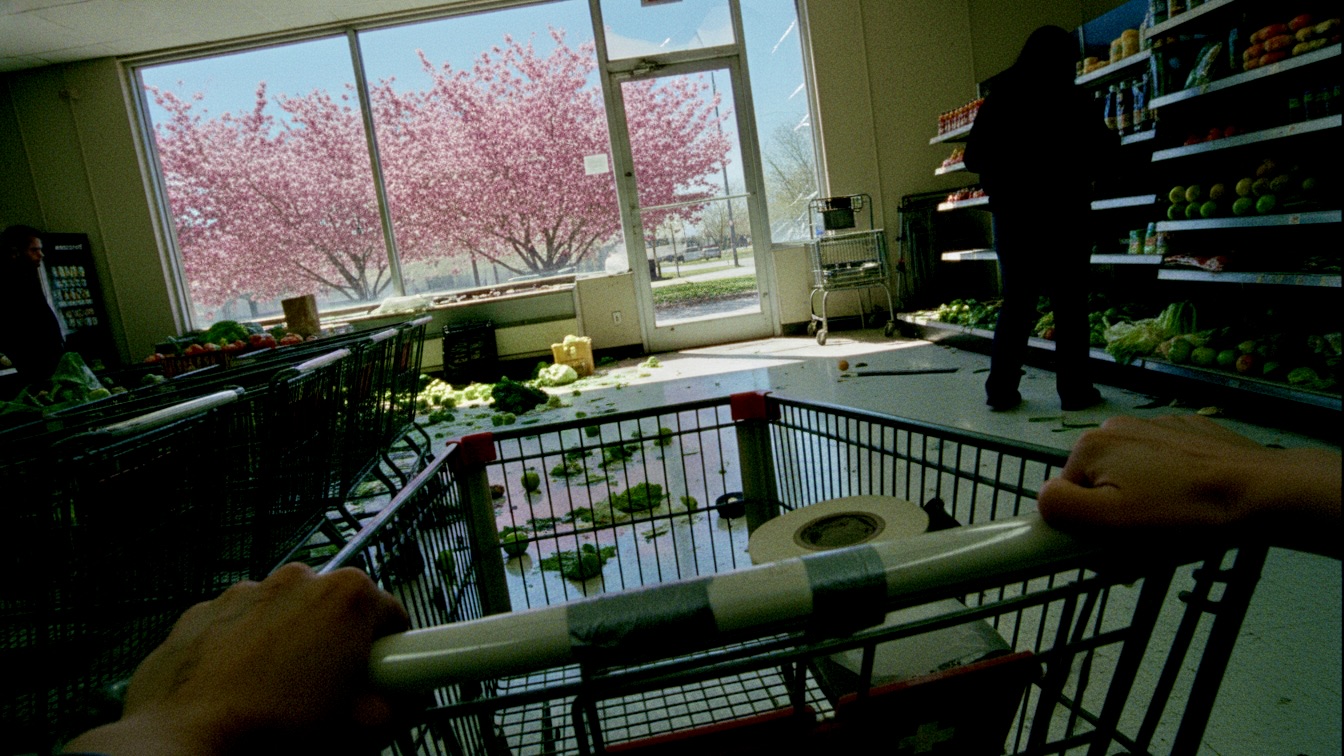
When the digital currency fails, Annette builds a sanctuary out of shopping carts and sheer will in a grocery riot.
The card reader made a sound like a dying bird. It wasn't the usual chirpy 'transaction approved' beep. It was a flat, digital rasp. The woman in front of me, wearing a yoga set that probably cost more than my last three car payments, tapped her phone against the terminal again. Her face was scrunched up.
"It’s not working," she said. She didn't look at the cashier. She looked at the screen as if she could shame it into compliance.
"Try it again, ma'am," the cashier said. He was a kid, maybe nineteen, with acne scars and a name tag that read 'Terry.' He looked like he wanted to be anywhere else. Outside, the spring sun was hitting the parking lot hard, turning the asphalt into a shimmering lake of heat.
"I am trying," she snapped. "It says 'Service Unavailable.' This is a Fed-Coin wallet. It doesn't just... not work."
I looked at my own phone. The little bars in the corner were full, but the digital currency app was just spinning a white circle on a black background. A cold ripple started at the base of my spine. I’d seen this look before, not on a phone screen, but on a heart monitor right before it flatlined. It was the look of a system that had simply given up.
Behind me, a man with a cart full of bottled water and canned tuna groaned. "Come on, lady. Some of us have lives."
"It’s the system!" she yelled, turning around. "Look!"
She held up her phone. All down the line of registers, the sound began. Rasp. Rasp. Rasp. It was a chorus of failure. People started checking their phones. The low hum of a Saturday morning grocery run shifted. The frequency changed. It went from the white noise of consumerism to the jagged edge of a panic attack.
"System's down," Terry said, his voice cracking. He looked at the line of twenty people behind me. "I can't... I can't take cash. We’re a cashless store. Policy."
"Policy?" the man behind me barked. He pushed his cart forward, the metal frame clunking against my hip. "My kids need to eat. Open the damn register."
"There is no register!" Terry shouted back, his hands shaking. "It's all in the cloud!"
Then the lights flickered. Not a full blackout, just a brownout that made the industrial hum of the freezers groan and die. In the sudden silence, the sound of a glass jar shattering three aisles over sounded like a gunshot.
"I’m taking this," the yoga woman said. She grabbed her paper bags of organic kale and almond milk.
"Ma'am, you can't—" Terry started.
She didn't listen. She walked. And that was the crack in the dam. The man behind me didn't even say anything; he just shouldered past me, his cart a battering ram. I stepped back, my heels catching on a display of Easter candy. My heart was slamming against my ribs. I knew this rhythm. It was the rhythm of an ER waiting room when the power goes out and the backup generator fails. It was the sound of the world losing its mind.
"Terry, get behind the counter!" I yelled.
He didn't move. He was frozen. I grabbed his vest and hauled him back just as a swarm of people from the back of the store realized the exits weren't being guarded. The front windows were floor-to-ceiling glass, letting in that beautiful, mocking spring light. A man in a business suit tripped over a display of potted tulips, and three people stepped on him to get to the bread aisle.
"Move!" I shoved Terry toward the little office cubicle behind the tobacco cage. "Get down!"
I ducked behind a stack of soda crates. The air was already getting thick. The smell of broken vinegar bottles and spilled bleach rose up. Someone screamed—a real, high-pitched sound of physical pain. I looked out. A kid, maybe six years old, was huddled under a magazine rack while the crowd surged past him.
I didn't think. I never really do when the blood starts. I crawled out, my knees scraping the grit on the floor. I grabbed the kid by his shirt and pulled him into the gap between the crates. He was shaking so hard his teeth were clicking.
"Stay here," I said. I used my 'nurse voice.' Low. Flat. No room for argument. "Don't move until I come back."
I needed a station. I needed a way to stop the bleeding. I saw a shopping cart overturned near the pharmacy. I ran for it, staying low. My shoulder hit a woman who was trying to carry a whole crate of eggs; she went down, and the yellow slime coated the floor, making it a skating rink. I grabbed the cart, flipped it, and shoved it into the corner by the 'Natural Foods' section. It provided a small V-shaped fortress.
I reached into my bag. I always carry a kit. Force of habit. I found the silver duct tape I kept for quick fixes. I taped the cart to the heavy shelving unit. It wasn't much, but it was a barrier.
"Terry!" I shouted. The kid peeked his head out from the office. "Get me every towel you can find! And the first aid kits from the wall!"
"They're looting them!" he cried.
"Then fight for them!" I yelled back.
He disappeared. A minute later, a man came stumbling toward my makeshift corner. His forehead was split open, a flap of skin hanging over his eye. Blood, bright and arterial, sprayed the white linoleum.
"Sit," I said, grabbing his arm and forcing him down behind the cart.
"I just wanted... I just needed milk," he wheezed.
I ripped a strip of duct tape and used a clean dish towel Terry had managed to toss me. I pressed it hard against the man's head. "Hold this. Don't let go. If you let go, you bleed out. Understand?"
He nodded, his eyes wide and glazed.
I looked toward the back of the store. The pharmacy was a raised platform with a plexiglass barrier. A man—tall, gaunt, wearing a dirty hoodie—was hammering at the glass with a heavy fire extinguisher.
"Hey!" I screamed, but the noise in the store was a roar now. It was the sound of a hundred people realizing the money in their pockets was just numbers on a dead screen.
I left my triage station and headed for the pharmacy. I had to dodge a flying jar of pickles. The smell was overwhelming—sour, metallic, and the faint, sweet scent of the spring flowers being crushed underfoot.
I reached the pharmacy steps. The guy with the fire extinguisher was about to swing again.
"Stop!" I grabbed his arm. It was like grabbing a bundle of dry sticks. He was vibrating with adrenaline.
"Move, lady! My daughter's a Type 1! The fridge is off! If I don't get the insulin, she’s dead by Tuesday!"
"I'm a nurse!" I yelled in his face. "You break that glass, you’re going to cut your hands to ribbons and contaminate everything in there. You won't find what you need in the dark!"
He paused, the heavy red tank trembling in his grip. "They locked the gate. The pharmacist ran out the back."
"I know where they keep the cold storage," I lied. I didn't, but I knew the layout of these chain stores. "Help me get this gate up. If we do it clean, we can get the meds out for everyone who needs them. You want to be a thief or a provider?"
He looked at me. His eyes were bloodshot. Outside, the sky was a perfect, cruel blue. "I just need the Humalog."
"Then help me."
We pulled. The metal gate groaned. It was a rolling shutter, locked at the bottom. I saw a heavy pair of bolt cutters in the tool aisle earlier. "Terry!" I scanned the chaos. Terry was cowering near the triage cart, helping the man with the head wound.
"The bolt cutters! Aisle seven!"
Terry looked terrified, but he ran. He actually ran. He dove through a gap in the crowd and came back thirty seconds later, sliding on the spilled egg slime like a baseball player. He handed me the cutters.
I snapped the lock. The gate rolled up with a sound like thunder.
I jumped over the counter. It was dark back there. I grabbed a flashlight from the 'Emergency Preparedness' endcap. The fridge was in the back corner. The little green light on the temperature gauge was out.
"Here," I said, grabbing the vials. I handed them to the man in the hoodie. "Keep these cold. Wrap them in frozen peas if you have to. Go."
He didn't thank me. He just took them and vanished into the fray.
"Annette!" Terry was screaming now.
I looked toward the front. The loading dock doors at the back of the store were vibrating. Someone was hitting them from the outside with something heavy. A truck. They were trying to ram their way in. The front glass was already shattered in three places. The structural pillars of the store—the cheap steel beams—seemed to hum with the tension of the mob.
"The roof," Terry gasped, pointing up. A crack was spreading across the acoustic ceiling tiles. The weight of the people on the loading dock overhang was too much.
"We have to get out," I said. I looked at my triage station. I had four people there now. The man with the head wound, an elderly woman clutching her chest, the kid from the magazine rack, and a teenager with a broken arm.
"We can't go out the front," Terry said. "They're fighting over the cars out there. It’s worse."
I looked at the shopping carts. There were dozens of them, abandoned and tangled.
"Line them up!" I commanded. "Terry, get that side. You, kid, get in the middle. Hold onto the woman's hand."
We created a phalanx. Two rows of carts, side-by-side, pushed by the strongest of us. We used them as shields, a metal cage to move through the madness. I stood at the front, my hands white-knuckled on the handle.
"Move!" I shouted.
We pushed. The carts ground against the floor, clearing a path through the looters. Someone tried to grab a bag from the elderly woman, and I shoved the front of my cart into his shins. He yelped and fell back.
We reached the loading dock just as the big metal door buckled inward. The sound was a deafening screech of tearing steel. A flood of sunlight poured in, blinding us.
"Keep moving!" I yelled.
We burst out into the spring air. It was so quiet outside compared to the roar of the store. The birds were singing in the trees near the edge of the parking lot. It was surreal. The world was ending, but the cherry blossoms were still blooming.
We kept the carts together, a little island of broken people in a sea of chaos. I looked back at the store. The 'Big-Box' logo was crooked. A plume of dust rose as the ceiling finally gave way.
I looked at Terry. He was covered in egg yolk and blood, but he was standing straight. I looked at the man with the duct-taped head. He was still holding the towel.
"What do we do now?" Terry asked. His phone was still in his hand, a useless piece of glass.
I looked down the street. People were standing on their porches, looking at their own phones, the same confusion turning into the same fear. The system was gone. The digital ghosts had vanished.
"We walk," I said. "And we stay together. It’s the only thing they can’t take away."
I felt a hand on mine. It was the kid. He wasn't shaking anymore. He just held on tight.
We started walking away from the store, away from the smoke and the screaming. The smell of fresh grass was thick in the air, a scent of renewal that felt like a lie and a promise all at once.
Then, from the distance, I heard the first siren, but it wasn't coming toward us.
“The sirens weren't coming to help; they were screaming in the opposite direction, toward the city center where the black smoke was just beginning to rise.”


