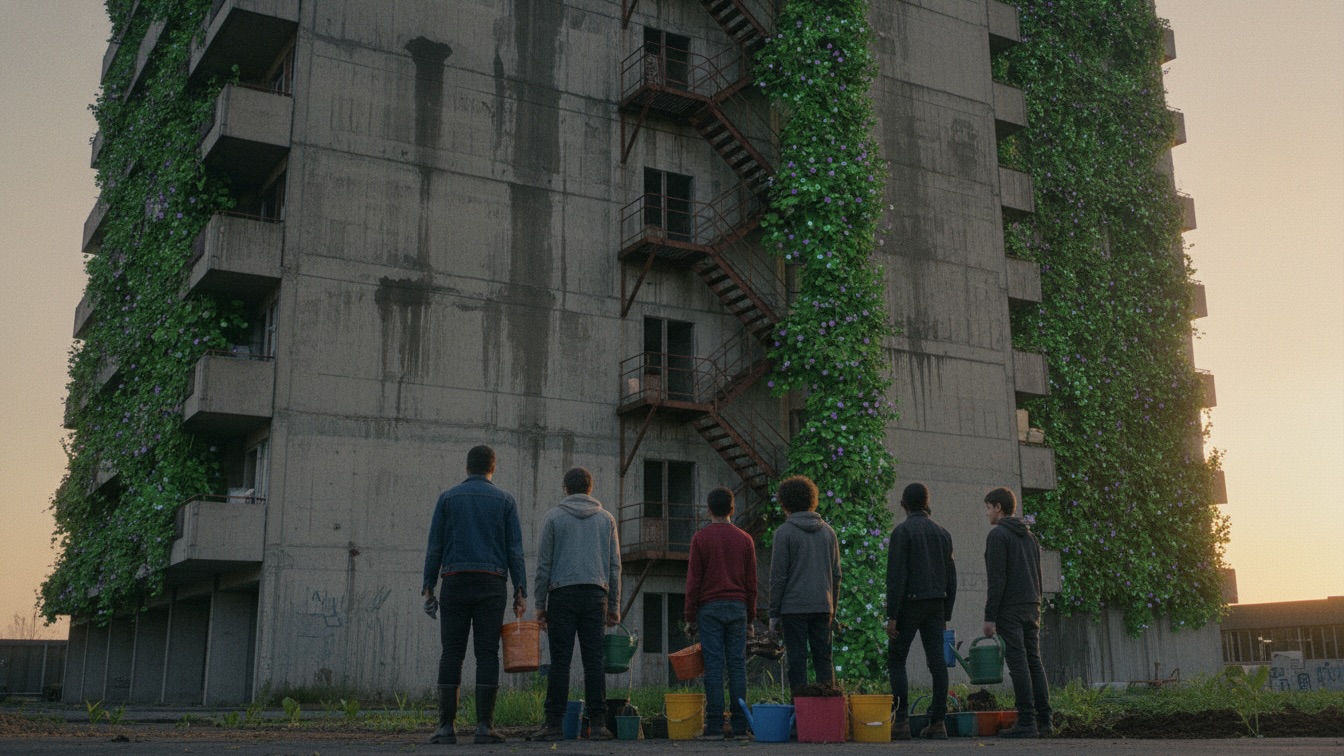
Wendy fights the concrete heat and high-rise apathy to grow a garden in a place designed for gray decay.
"You’re actually doing it. You’re putting stickers on a dumpster fire," Matt said. He was leaning over his third-floor railing, a lukewarm protein shake in one hand. He looked like he hadn't slept since 2024. His eyes were bloodshot, tracking Wendy as she scaled the side of the Sector 4 housing block.
"It’s not a sticker, Matt. It’s bio-scaffolding. There’s a difference," Wendy yelled back. She adjusted her haptic gloves. The sensors hummed against her palms, translating the structural integrity of the rotting concrete into a series of vibrating pulses. She was thirty feet up, hanging by a dual-point harness that felt about as secure as a pinky swear.
"Looks like expensive moss to me," Matt shouted. "The City Council is gonna have your head on a spike by Tuesday. You know they don't want us having nice things. It ruins the aesthetic of 'crushing poverty'."
Wendy ignored him. She tapped her wrist-comm, pulling up the decentralized ledger. The funding was there—micro-donations from three thousand people who were tired of breathing recycled AC exhaust. The permit she’d 'secured' was technically a maintenance work order for 'surface stabilization,' a loophole she’d exploited with the grace of a digital ghost. If Councilman Barnes found out the 'stabilization' was actually a living, breathing vertical forest, she’d be blacklisted from the architecture guild before sunset.
"The scaffolding is modular," Wendy muttered to herself, snapping a carbon-fiber joint into place. "It’s self-repairing. It’s the future."
"It’s a salad on a skyscraper," Matt countered. He hadn't moved. He was the building’s unofficial watchdog, a twenty-something who had seen three 'urban renewal' projects fail before they even broke ground. Sector 4 was where dreams went to get repurposed for scrap metal.
Wendy reached the first irrigation node. The bio-printed seedlings were already tucked into the mesh, tiny sparks of emerald against the soot-stained walls. It was early April, the start of Spring, but the air felt heavy. The sun was a dull copper coin hanging in a hazy sky.
"The sensors are green," Wendy said, her voice cracking. She hadn't drank water in four hours. "Matt, if this works, the ambient temperature in your kitchen drops five degrees. You can stop living in a toaster."
"I like my toaster," Matt said, but his voice lacked conviction. He watched her work. Wendy was fast. She had to be. The city’s automated drones patrolled every six hours, and she needed the primary grid locked in before the next sweep.
By noon, the scaffolding covered the lower five floors. It looked like a giant green ribcage hugging the building. The residents were starting to notice. Faces pressed against cracked windows. A few kids on the sidewalk pointed and laughed. To them, nature was something you saw on a screen, or behind the high-security fences of the North District where the tech-elites lived.
Then the heat hit.
It wasn't a gradual climb. It was a spike. The temperature readout on Wendy’s HUD jumped from seventy-five to ninety-two in twenty minutes. The 'Urban Heat Island' effect was kicking into overdrive. The concrete of Sector 4 began to radiate heat like an oven element.
"Wendy!" Matt called out. He wasn't leaning anymore. He was standing straight. "The leaves. They’re curling."
Wendy looked down. The seedlings—her beautiful, bio-engineered moss and ivy—were turning a sickly shade of yellow. The automated irrigation system was supposed to be live, but the local water pressure was bottoming out. The building’s pipes were old, clogged with decades of calcium and neglect.
"The pump's not engaging," Wendy hissed, frantically swiping at her wrist-comm. "There’s a block in the main line. It’s not pulling from the greywater tanks."
"Of course there’s a block," Matt said, vaulting over his railing onto the fire escape. He clattered down the metal stairs toward her. "Everything in this building is blocked. The plumbing, the people, the politics. It’s all junk."
"I can't let them die, Matt. If they die now, the Council wins. They’ll say green-tech is a waste of resources for 'low-priority zones'." Wendy swung herself closer to the wall, her boots scraping against the brick. She reached for a manual override valve, but it was fused shut with rust.
"The drones are coming in thirty," Matt said, checking his own phone. "And the sun is cooking your plants. You got a Plan B?"
Wendy looked at the withered stems. Her stomach turned over. This wasn't just about plants. It was about proving that the people in Sector 4 deserved to breathe real air. She looked at Matt. He looked back, his cynical mask finally slipping. He saw the desperation in her eyes.
"Plan B is manual," Wendy said. "We need water. Now."
"From where? The taps are barely dripping."
"The greywater tanks in the basement are full. They’re just not pumping up. We need a bucket brigade."
Matt laughed, a sharp, dry sound. "A bucket brigade? In 2026? Wendy, nobody here talks to each other unless it’s to complain about the Wi-Fi lag."
"Then make them talk!" Wendy screamed, the heat making her vision swim. "Tell them their apartments are going to be ten degrees hotter if this fails. Tell them the North District is betting on them to fail!"
Matt hesitated. He looked at the dying green, then at the gray horizon. He let out a breath that sounded like a tire deflating. "Fine. But if I get a hernia, I’m suing your non-profit."
He disappeared into the building. Wendy stayed on the wall, shielding a patch of ferns with her own body, her shadow the only thing keeping them from scorching. Minutes felt like hours. The heat was a physical weight, pressing her against the hot stone.
Then, a door slammed. Then another.
Matt appeared on the first-floor landing with a plastic storage bin. Behind him was an older woman Wendy didn't recognize, carrying a mop bucket. Then a teenager with a gym bag full of water bottles.
"Pass it up!" Matt shouted.
It was chaotic. It was inefficient. It was the most beautiful thing Wendy had ever seen. People who had lived in the same hallway for years without exchanging a word were now forming a jagged line. They hauled water from the basement tanks, passing containers hand-to-hand up the fire escape.
Matt reached the third floor and leaned out, handing a heavy bucket of lukewarm, recycled laundry water to Wendy. She grabbed it, the weight nearly pulling her off her harness. She poured it into the central reservoir of the scaffold.
"Again!" she yelled.
They worked through the peak of the heat. The 'clink' of buckets and the rhythmic shouting of the residents replaced the usual dull roar of distant traffic. The water hit the dry soil, and the bio-scaffold hummed. It was designed to react to hydration. The mesh expanded, the tiny pumps within the fiber optics finally catching the prime.
By four PM, the seedlings weren't just surviving. They were thriving. The bio-accelerants in the water—nutrients Wendy had pre-loaded into the soil—began to kick in.
"Look," someone shouted from the street.
Wendy wiped sweat from her eyes. The sun was beginning its descent, hitting the building at an angle that usually turned the concrete into a blinding, gray slab. But today, it hit the green.
Across the five floors, the first blooms began to open. They weren't 'ethereal' or 'majestic.' they were small, hardy purple flowers and thick, waxy leaves that looked like they could survive a nuclear winter. But as the sunset turned the sky a bruised orange, the building began to glow. The bio-scaffolding had a phosphorescent tint, designed to store light during the day.
Sector 4 was no longer a gray block. It was a beacon.
"Wendy, look up," Matt said. He was sitting on the fire escape, drenched in greywater and soot, but he was smiling.
A sleek, black hover-car was descending from the upper levels of the city. It bore the seal of the City Council. Councilman Barnes was here.
Wendy unclipped her harness and dropped the last few feet to the pavement. Her legs felt like jelly. She watched as the hover-car touched down, its silent engines kicking up a swirl of dust. Barnes stepped out, his suit worth more than the entire block’s annual rent. He looked at the vertical garden, then at the crowd of residents who were still holding their buckets.
"This is a violation of city code 402-B," Barnes said, his voice amplified by a small lapel mic. "Unsanctioned structural modifications. Wendy, you’ve outdone yourself this time. This comes down tonight."
Matt stepped forward, still holding a cracked plastic pitcher. "It’s not a modification, Councilman. It’s a landmark."
"A landmark?" Barnes sneered. "It’s a fire hazard. It’s a weed."
"The sensor data is already live on the public ledger," Wendy said, her voice steady despite the adrenaline. "The ambient temperature on this block just dropped four degrees. The air quality sensors are showing a twenty percent decrease in particulate matter. Three thousand people are watching this stream right now. You want to be the guy who tears down the only clean air in Sector 4? In an election year?"
Barnes looked at the residents. They weren't shrinking away. They were standing together, a wall of tired, sweaty, defiant people. He looked at the glowing green wall. The contrast was undeniable. The building looked alive. The rest of the sector looked dead.
"It’s efficient," Wendy added, twisting the knife. "Lower cooling costs for the city. Less strain on the grid. It’s a win for the budget, Councilman."
Barnes narrowed his eyes. He knew he’d been played. But he also knew a PR win when he saw one. He smoothed his suit.
"We will... evaluate the data," Barnes said stiffly. "If the metrics hold, we may consider this a pilot program for the Green Initiative. For now, it stays."
He turned and climbed back into his car. As the vehicle rose back toward the clouds, a cheer broke out. It wasn't a loud, cinematic roar. It was a tired, relieved sound.
Matt walked over to Wendy. He looked at the purple flowers nearest to him. "I still think it looks like a salad," he muttered.
"Yeah, well," Wendy said, leaning against the now-cool concrete of the building. "It’s our salad."
She looked up at the vertical spring. For the first time in her life, the air in Sector 4 didn't taste like dust. It tasted like growth. It tasted like they had finally found a way to breathe.
But as the residents began to head back inside, Wendy’s comm chimed. A red alert flashed on her wrist. The decentralized ledger was being pinged by an unknown source—a heavy-duty encryption she didn't recognize.
Someone was trying to delete the project's data from the inside.
“The decentralized ledger was being pinged by an unknown source—a heavy-duty encryption she didn't recognize; someone was trying to delete the project's data from the inside.”


