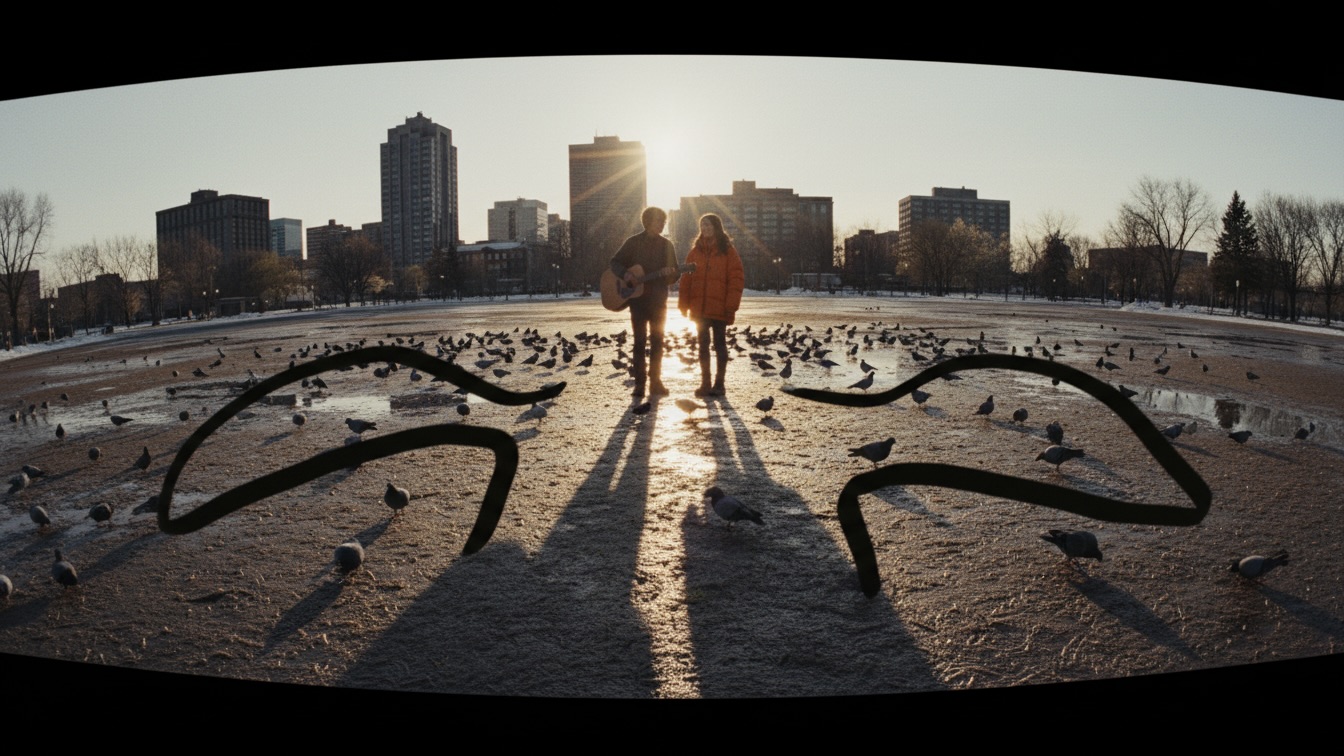
The narrative follows Lenny and Hanna, two young adults navigating the bleak, decaying landscape of Winnipeg in April. As Lenny attempts to play his out-of-tune guitar in a local park, he becomes acutely aware of an unsettling shift in the atmosphere. The natural world seems to stutter, with pigeons freezing in a high-frequency tremor and shadows detaching from the laws of physics. This "glitch" in reality culminates in a physical manifestation of darkness that nearly consumes their surroundings before a sudden car horn breaks the spell.
Following this brush with the inexplicable, the pair retreats to a coffee shop to regain their composure. While Hanna seeks comfort in the mundane act of ordering a drink, Lenny finds himself inspired by the terror and dissonance of the experience. He begins to translate the "shadow mass" and the heavy silence into a new form of musical expression. The story concludes with Lenny back in his apartment, embracing the imperfections of his life and his art, using his broken guitar to scream back at the encroaching void.
The central theme of "Slush and Shadow" is the tension between existential stagnation and the terrifying intrusion of the sublime. Winnipeg is depicted not just as a city, but as a "liminal space" where the characters feel stuck in a "mid-tier existence." This sense of being trapped in a loop—economic, social, and seasonal—creates a fertile ground for the "glitch" the characters witness. The story suggests that when life becomes too repetitive and devoid of meaning, the fabric of reality itself begins to thin and fray.
Another prominent theme is the role of art as a grounding force and a weapon against nihilism. Lenny struggles to find a melody that feels "real" until he encounters the "objective rancor" of the park’s silence. The snapping of his guitar string serves as a turning point, moving him from a state of passive observation to active creation. By choosing to keep the broken string, Lenny embraces dissonance and imperfection as the only honest responses to a broken world. Noise becomes his primary tool for asserting his existence against the silence of the void.
The narrative also explores the intersection of digital metaphors and physical reality. Hanna’s comments about "NPCs" and "patch updates" reflect a generation that interprets its alienation through the lens of simulation theory. This digital cynicism acts as a psychological defense mechanism, allowing the characters to distance themselves from their grim surroundings. However, when the shadow mass actually touches Hanna’s boot, the metaphor collapses into a frighteningly tangible reality. The "glitch" is no longer a joke about video games but a literal erosion of the world they inhabit.
Finally, the story examines the necessity of human connection in the face of cosmic indifference. Lenny and Hanna’s shared experience of the anomaly binds them together in a way that their usual cynical banter cannot. Their physical proximity—touching shoulders on the bus and holding hands in the park—provides the only warmth in an otherwise freezing and "rancid" environment. The shadow mass exists in the "gaps between us," suggesting that silence and emotional dishonesty are what allow the void to grow.
Lenny is a protagonist defined by high sensory acuity and a deep-seated artistic frustration. He possesses a psychological predisposition toward derealization, as evidenced by his intense focus on the "decay" of the snow and the "twitching" of pigeons. This sensitivity makes him the primary witness to the world’s "glitch," but it also leaves him vulnerable to the heavy weight of existential dread. He views his environment through a musical lens, constantly searching for a rhythm that matches the world’s inherent ugliness.
His internal conflict stems from his desire to create something "real" in a world that feels increasingly synthetic and looped. He is haunted by the songs he hasn't written and the time he has wasted in "digital slipstreams." When the shadow mass appears, his reaction is not just fear, but a desperate need to "provoke the world into making a sound." This indicates that his music is a survival mechanism, a way to anchor himself to a reality that he feels is slipping away.
By the end of the chapter, Lenny undergoes a subtle but significant transformation. He moves from being a victim of the "broken everything" to a deliberate orchestrator of its noise. His decision not to fix the broken string represents an acceptance of his own "broken frequency." He realizes that he does not need a perfect instrument to speak the truth; he only needs the courage to make a sound that the shadows cannot swallow.
Hanna serves as the pragmatic, cynical foil to Lenny’s more ethereal anxieties. Her psychological profile suggests a "defensive pessimist" who uses humor and pop-culture metaphors to navigate a harsh reality. She is the one who introduces the idea of the city as a "liminal space" and its inhabitants as "NPCs," using these concepts to shield herself from the bleakness of her surroundings. Her cracked phone screen and worn puffer jacket mirror the physical decay of the city she inhabits.
Despite her outward cynicism, Hanna is deeply attuned to Lenny’s emotional state and the subtle shifts in their environment. While she initially dismisses his concerns as an "artist phase," her fear becomes palpable when the shadows begin to move independently. Her vulnerability is revealed when her voice becomes "small" and she allows Lenny to lead her away from the danger. This suggests that her cynicism is a thin veil over a profound sense of fragility.
In the aftermath of the event, Hanna provides the necessary encouragement for Lenny to pursue his new, dissonant creative path. Her request for him not to fix the string is a sign of her validation of his experience. She recognizes that the "normal" world is a facade and that Lenny’s "ugly" music might be the only honest thing they have left. She remains his tether to the human world, ensuring that even as he explores the void, he does not do so alone.
The prose of "Slush and Shadow" is characterized by a gritty, tactile realism that borders on the grotesque. The author uses vivid, often repulsive imagery—such as the "synthetic tumor" of the jacket stuffing or the "sunburnt skin" of the guitar finish—to establish a tone of urban decay. This sensory detail grounds the supernatural elements of the story, making the "glitch" feel like a natural extension of a world that is already falling apart. The description of Winnipeg in April as "various shades of brown and gray" sets a melancholic and stagnant mood.
The pacing of the chapter is masterfully handled, transitioning from a slow, lethargic beginning to a frantic, high-tension climax. The "heavy" silence in the park is described with such physical density that it slows the narrative down, mimicking the characters' own feelings of being underwater. When the pigeons begin to vibrate and the shadow stretches, the sentences become shorter and more urgent. This rhythmic shift mirrors Lenny’s own pulse and the "jagged, syncopated riff" he plays to break the stillness.
Narrative voice plays a crucial role in blending the internal and external worlds. The first-person perspective allows the reader to experience Lenny’s hyper-fixations and his psychological descent into the "glitch." The use of modern, colloquial language—such as "vibes are objectively rancid" or "lo-fi beat to study/relax to"—contrasts sharply with the ancient, cosmic horror of the shadow mass. This juxtaposition highlights the absurdity of modern life when faced with the inexplicable.
The story’s conclusion utilizes a shift in lighting and sound to signal a return to "normalcy" that is nonetheless permanently altered. The "squealing, dissonant, beautiful note" of the bus brakes serves as a bridge between the terrifying silence of the park and the comforting noise of the city. The final focus on the "broken string" as a symbol of truth provides a poignant resolution. The style successfully captures the feeling of a world that is "losing its resolution," leaving the reader with a sense of lingering unease.


