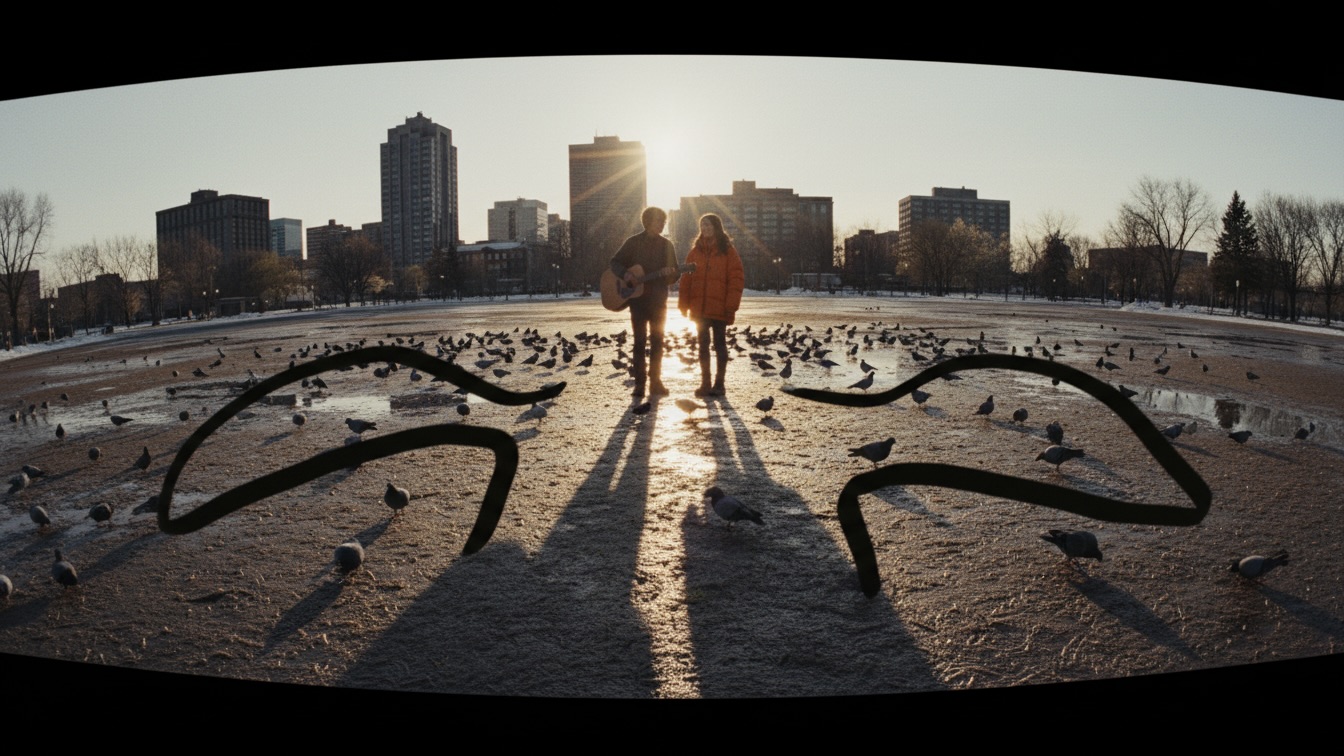
A musician navigates the melting brown slush of a Winnipeg spring while a strange silence haunts the pigeons.
"Your G-string is flat," Hanna said, not looking up from her phone. Her screen was a spiderweb of cracks, the backlight bleeding out in jagged white lines. She was wearing a puffer jacket that had definitely seen better winters, the stuffing leaking out of a small tear on the sleeve like a synthetic tumor.
"It’s not flat, it's 'character'," I said. I didn't stop playing. I was trying to find a rhythm that matched the way the pigeons were twitching on the pavement. There were hundreds of them. A gray, feathered carpet vibrating against the wet concrete. Winnipeg in April is just various shades of brown and gray. The snow doesn't melt so much as it decays, revealing all the cigarette butts and lost mittens from November.
"It’s characteristically out of tune," she countered. She finally looked up. Her eyes were tired, the kind of tired you get from staring at a flickering blue light for six hours straight. "Also, you’re scaring the birds. Look at them. They’re weirdly quiet today."
I stopped. She was right. The park was usually a riot of traffic noise from Carlton Street and the constant, stupid cooing of the birds. But today, the air felt thick. Like it had been replaced with something denser than oxygen. The sound of a bus braking two blocks away seemed to travel through water before it hit my ears. The silence wasn't empty; it was heavy. It felt like a physical weight on my shoulders, the kind of pressure you feel at the bottom of a deep pool.
"It’s the light," I muttered, adjusting the strap of my acoustic. It was an old Yamaha I’d found in a basement, the wood scarred and the finish peeling like sunburnt skin. "Look at the shadows under the trees. They aren't moving right."
Hanna squinted. The sun was a pale, weak disc hanging behind a thin veil of smog and clouds. It should have been bright, but the light was flat. In the middle of the park, near the fountain that hadn't been turned on since 2024, the shadows were deep. They didn't flicker with the wind. They just sat there, black puddles that seemed to absorb the surrounding gray.
"You're overthinking it," she said, but she pulled her jacket tighter. "It’s just Winnipeg. The city is a liminal space. We're all just NPCs waiting for the next patch update."
I hit a minor chord. The sound didn't ring out. It just sort of... died. It fell off the strings and vanished into the slush. My fingers were cold, the tips numb and red. I thought about the algorithm. I thought about the way everything now felt like a loop. My music, my rent, the way the snow melted and froze, melted and froze. We were stuck in a cycle of mid-tier existence. I wanted to write something that felt real, something that didn't sound like a lo-fi beat to study/relax to. But every time I tried to grab a melody, it felt like trying to catch a handful of smoke.
"Do you feel that?" I asked. My stomach did a slow roll.
"Feel what? The impending collapse of the housing market? Every day, Lenny."
"No. The silence. It's like... a shadow mass. Something is out of place."
I looked at the pigeons. They had all stopped moving. They weren't pecking at the ground. They were all facing the same direction, toward the cluster of elms near the back of the park. Their little bead eyes were fixed on nothing. The wind picked up, carrying the smell of wet dog and exhaust, but the trees didn't rustle. The branches stayed perfectly still, as if they were made of iron.
I started playing again, faster this time. I needed to break the quiet. I played a jagged, syncopated riff I’d been messing with—something aggressive. I wanted to provoke the world into making a sound. The friction of the strings against my calluses felt sharp, a grounding pain.
"Is this your 'I'm an artist' phase or are you actually losing it?" Hanna asked, though she wasn't smiling. She was watching the shadows now, too. One of the dark patches under a bench seemed to stretch, reaching out toward her boots even though the sun hadn't moved an inch.
"I'm not losing it. The vibes are objectively rancid," I said. I hit the strings harder. A string snapped—the high E. It whipped across my knuckle, leaving a thin red line that started to bead with blood. I didn't flinch. I just stared at the drop of red against the dull wood of the guitar. It was the only bright thing in the park.
"Lenny, let's go," Hanna said. Her voice was small. "The pigeons. Look at the pigeons."
I looked. The birds hadn't flown away. They were vibrating. Their bodies were shaking with a high-frequency tremor, but their feet stayed glued to the pavement. It looked like a glitch in a video game, a thousand models stuttering in place.
I stood up, my knees popping. The shadow under the bench was touching Hanna's shoe now. It wasn't a shadow; it was a hole. A lack of light so absolute it made my eyes ache. The silence reached a peak, a ringing in my ears that drowned out my own heartbeat. I reached out and grabbed Hanna’s hand. Her skin was ice cold, but she didn't pull away. We stood there in the center of the park, two kids in thrifted clothes, watching the world lose its resolution.
I thought about the songs I hadn't written. I thought about how much time I’d spent scrolling through feeds, looking at lives I didn't have, while the actual world was thinning out around me. The shadow mass wasn't just in the park; it was in the gaps between us. It was the silence we used to fill our days because being honest was too much work.
"Don't move," I whispered.
"I can't," she replied.
The light shifted again, turning a bruised purple, and for a second, the entire park vanished into a single, unblinking eye of darkness before the sound of a distant car horn shattered the stillness, and the pigeons suddenly took flight in a deafening explosion of wings.
We stood in the sudden vacuum of their departure. The shadows were back to normal. The trees swayed in the wind. The mud was just mud again. But my hand was still shaking, and the cut on my knuckle was stinging like fire.
"That was..." Hanna started, but she couldn't finish the sentence. She just looked at her boot where the shadow had touched it. There was a faint, gray smudge on the leather that wouldn't rub off.
I looked at my guitar. The broken string hung limp, a silver thread in the dying light. I didn't feel like playing anymore. The music felt small. The city felt fragile. We walked out of the park, stepping over the trash and the puddles, neither of us saying a word. The sun was finally setting, casting long, orange streaks across the skyline, but I kept looking back at the trees, waiting for the silence to return.
Winnipeg doesn't give you answers. It just gives you more winter, more potholes, and occasionally, a glimpse of the void. We headed toward the bus stop, our shoulders touching, two points of heat in a landscape that was still trying to figure out how to be alive again.
I thought about the rhythm again. Not the one I was playing, but the one the park had found. A slow, deliberate pulse that didn't care about my melodies. It was the sound of the earth shifting, of the shadows reclaiming their space. I gripped my guitar case tighter. My fingers were still numb, but the blood on my knuckle was drying, a small, dark crust of reality.
"Coffee?" I asked as the bus pulled up, its brakes squealing a dissonant, beautiful note.
"Yeah," Hanna said. "Something hot. Something that isn't this."
We stepped onto the bus, and as the doors hissed shut, I saw a single pigeon land on the bench we’d just left. It didn't peck. It didn't coo. It just sat there, staring into the dark, waiting for the next shift in the light.
The bus moved through the city, passing neon signs for payday loans and empty storefronts. Everything looked normal. Everything looked like it always did. But I knew the shadow was still there, tucked into the corners of the buildings, hiding in the silences between our words. I closed my eyes and tried to remember the chord I’d played right before the string snapped. It was a dissonant, ugly thing. It was the most honest sound I’d ever made.
I wondered if anyone else had noticed. If the people in the cars and the offices felt the heaviness, or if they were all too busy with their own loops to see the world glitching. Maybe it was just us. Maybe we were the only ones tuned to that specific, broken frequency.
"You're doing it again," Hanna said, leaning her head against the vibrating window of the bus.
"Doing what?"
"Thinking. Stop it. It makes your face look weird."
I laughed, a short, dry sound. "My face always looks weird."
"True. But this is a special kind of weird. Like you're trying to solve a math problem that doesn't have numbers."
"I'm just... I'm thinking about the song."
"The one with the broken string?"
"Yeah. The one with the broken everything."
She closed her eyes. "Write it then. Just don't make it depressing. I can't handle any more depressing stuff right now. The world is already doing that for us."
I looked out at the streetlights starting to flicker on. They were a sickly yellow, cutting through the dusk. I didn't know if I could write it. I didn't know if I had the words for the shadow mass or the way the silence felt like a physical blow. But I knew I had to try. Because if I didn't, the silence would win. And I wasn't ready to stop making noise just yet.
The bus hit a pothole, jarring us both. I felt the weight of the guitar in its case, a heavy, familiar presence against my leg. It was a tool. A weapon. A way to scream back at the void. I reached into my pocket and felt my phone, the screen still dark, the notifications waiting to pull me back into the digital slipstream. I left it there. For now, the real world—the muddy, broken, shadowy world—was enough.
We got off at the next stop. The air was colder now that the sun was gone. We walked toward the coffee shop, our boots splashing through the meltwater. The city was waking up its nighttime self, the sounds of sirens and shouting beginning to fill the gaps. It was loud and messy and perfect.
I looked up at the sky. The stars were starting to poke through the haze. They looked like pinpricks in a dark curtain. I wondered what was on the other side. I wondered if the shadows came from there. Or if they were just the parts of us we didn't know how to talk about yet.
"Hey, Lenny?" Hanna said, stopping at the door of the shop.
"Yeah?"
"Don't fix the string yet. I want to hear how it sounds without it."
I nodded. "Bet."
We went inside, the smell of roasted beans and steam hitting us like a warm blanket. The world was still there. It was still broken. But for a moment, the shadow felt a little further away.
I sat at a small, wobbly table and pulled out a notebook. The pages were dog-eared and stained with coffee. I picked up a pen and wrote one word: Silence.
Then I crossed it out and wrote: Noise.
That was a better start. The shadows couldn't survive in the noise. I looked at Hanna, who was ordering two large Americans with an extra shot. She looked tired, but she was talking to the barista, a kid with green hair and a bored expression. They were laughing about something. It was a small thing. A human thing.
I started to write. The words came fast, jagged and unpolished, just like the riff I’d been playing. I didn't care about the grammar or the flow. I just wanted to get it down before the feeling faded. I wrote about the pigeons and the slush and the way the light died in the park. I wrote about the gray smudge on Hanna's boot and the red line on my knuckle.
I wrote until my hand cramped. I wrote until the coffee was cold. I wrote until the shadow mass felt like something I could name, and once I could name it, it didn't feel so heavy anymore.
When we finally left the shop, the night was in full swing. The city was alive with the hum of a thousand different lives, all intersecting and overlapping. I felt a weird kind of peace. The kind you get when you realize that even if the world is glitching, you’re still here to see it.
We walked back toward my apartment, the guitar case swinging between us. The pigeons were gone, tucked away in whatever secret places they go at night. The park was empty, the shadows finally behaving themselves under the orange glow of the streetlights.
"You okay?" Hanna asked as we reached my door.
"Yeah," I said. "I think I found the melody."
"Good. Just don't play it too loud. Your neighbors already hate you."
"They hate my potential. It’s different."
She rolled her eyes and gave me a quick, awkward hug. "See you tomorrow, NPC."
"See you, Hanna."
I went upstairs, the stairs creaking under my feet. The apartment was cold and smelled like old laundry, but it was mine. I sat on my bed, pulled out the guitar, and looked at the broken string. I didn't replace it. I just tuned the other five and started to play.
The sound was thin and strange, but it was right. It matched the air in the park. It matched the feeling in my chest. I played until my fingers were sore again, until the room was filled with the dissonant, beautiful noise of a Winnipeg spring.
Outside, the wind howled against the glass, and for a second, I thought I saw a shadow move against the wall where there was no light to cast it. I didn't stop playing. I just turned up the volume and let the music fill the gaps.
The world might be thinning out, the resolution might be dropping, but as long as I could still break a string, I was still here. And that was enough for now.
I looked at the clock. 3:00 AM. The witching hour. Or just the time when the city finally stops pretending to be busy. I put the guitar down and walked to the window. The streets were wet, reflecting the traffic lights in long, distorted streaks of red and green.
I wondered where the shadows went when we weren't looking. If they were just waiting for us to get tired, to stop paying attention. Or if they were part of the architecture, the load-bearing walls of a reality that was older and weirder than we liked to admit.
I thought about the pigeons again. The way they had all faced the same way. It was like they were a compass, pointing toward a magnetic north that only they could feel. I wanted that kind of certainty. I wanted to know where the center was.
But maybe there wasn't a center. Maybe we were all just orbiting each other, trying not to collide, trying to make enough noise to prove we existed.
I went to the kitchen and poured a glass of water. The tap sputtered, the pipes groaning in the walls. The sound felt like a conversation. A slow, metallic dialogue between the building and the ground it sat on. I listened to it for a long time, the rhythm sinking into my bones.
I realized then that the silence in the park hadn't been an ending. It had been a pause. A breath before the next movement. And I was just one of the notes in the song.
I sat back down on the bed and picked up the notebook. I read over what I’d written. It was messy. It was raw. It was exactly what I needed.
I picked up the guitar one last time. I played the final chord of the new song. It was a cluster of notes that shouldn't have worked together, but they did. They rang out, filling the small, dark room, pushing back the shadows until there was nothing left but the sound.
And then, I let the silence come back. This time, it didn't feel heavy. It just felt like the end of a chapter.
I laid down and closed my eyes, the ghost of the melody still ringing in my ears. The city hummed outside, a constant, low-frequency reminder that life goes on, even when it glitches.
In the morning, the snow would be a little more melted. The puddles would be a little deeper. And maybe, if I was lucky, the shadows would stay where they belonged.
But even if they didn't, I had my guitar. I had my noise. And I had a broken string that sounded like the truth.
The light in the room shifted, a stray beam from a passing car swept across the ceiling, and for a heartbeat, I felt the shadow mass again, a cool breeze where the window was shut tight.
“I felt the shadow mass again, a cool breeze where the window was shut tight.”


