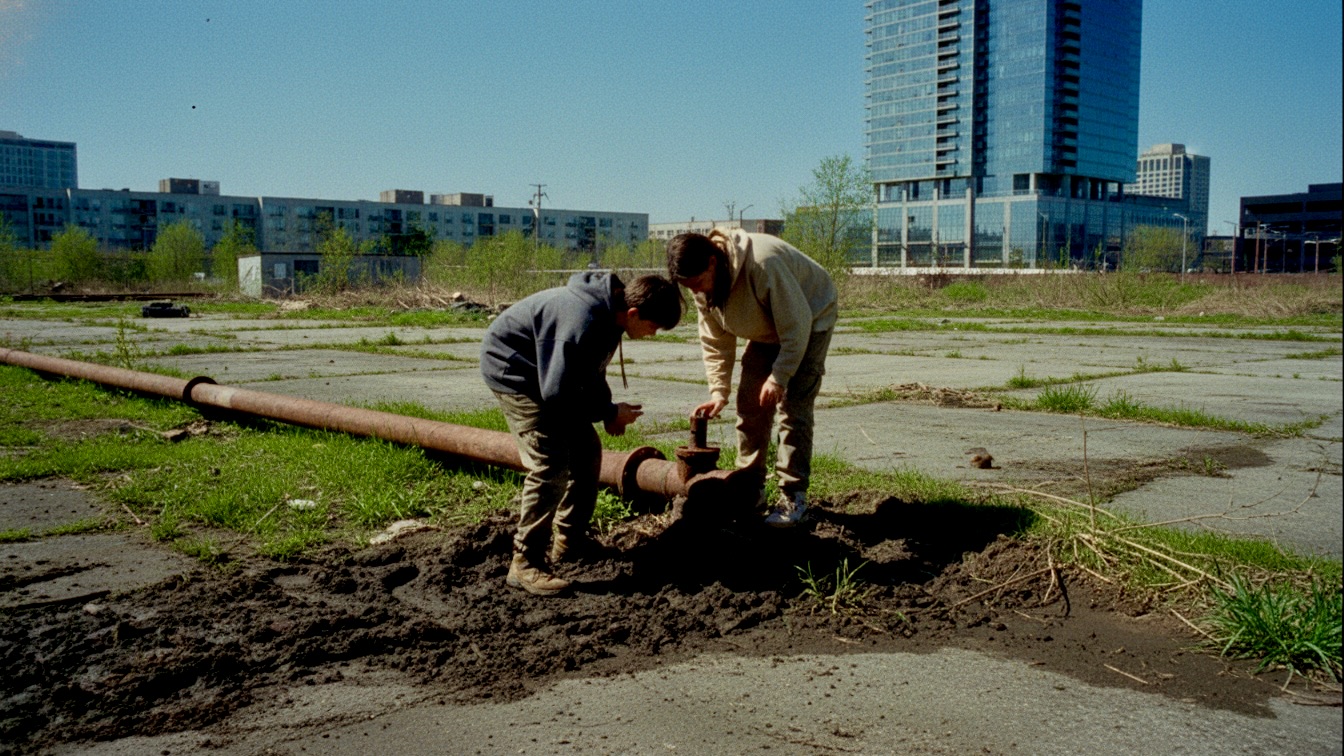
A condemned community garden becomes a battleground for two teens racing against a forty-eight-hour demolition deadline this spring.
The phone buzzes against my hip. It’s 5:02 AM. The notification is a red dot on a map. 'Site Clearing Scheduled: 48 Hours.' I stare at the screen until the light burns my retinas. My jaw is already locked. It’s been like that since I woke up. A solid block of bone and tension.
I try to breathe, but the air feels thin. It’s spring, but it’s not the kind of spring you see in movies. It’s damp. It’s gray. The smell of wet concrete is stronger than the smell of anything growing. I’m standing in the middle of Lot 42. To everyone else, it’s a dump. To me, it’s the only thing left of my grandfather.
I kick a rusted soda can. It clatters against a dead planter. The garden is frozen. Not literally—the frost is gone—but it’s stuck. The soil is hard-packed. The heirloom roses he spent forty years breeding look like skeletal fingers reaching out of the dirt. If I can’t prove the irrigation is functional and the 'historical botanical significance' is real by Thursday, the dozers come in. The city wants a parking garage. They always want a parking garage.
My leg starts to bounce. It’s a reflex. Fast, rhythmic tapping. I look at my hands. Dirt under the nails already. I haven’t even started.
A gate creaks. I don't turn around. I know the sound of those boots. Dr. Martens, worn down at the heel.
'You’re early,' Gina says.
'Couldn't sleep,' I mutter. My voice is gravel.
'Did you see the ping?'
'The forty-eight-hour one? Yeah. Hard to miss.'
Gina walks up beside me. She’s wearing a neon orange beanie and a puffer jacket that’s seen better days. She looks at the skeletal roses. She doesn't say it looks like a lost cause. She just drops a heavy canvas bag on the ground. Tools clink inside.
'The water main is under the shed,' she says. 'If we can’t get the pressure up, the city inspector won’t even step out of his car. He needs to see the 'automated ecological preservation system' in action.'
'It’s just a bunch of old pipes, Gina.'
'Not to the paperwork, it isn't.' She looks at me. Her eyes are tired. Digital burnout. We’re seventeen and we’re already exhausted by everything. 'Stop tapping your foot, Dan. You’re vibrating.'
I force my heel to the ground. It lasts three seconds. Then the vibration starts in my chest. We move to the shed. It’s a leaning wreck of cedar and moss. The door is swollen shut from the spring rains. I shoulder it. Once. Twice. The wood groans. On the third hit, it gives, and I stumble into the dark. It smells like damp earth and oil.
'Flashlight,' I say.
Gina clicks a button on her phone. The beam cuts through the gloom. There it is. The iron wheel. Rusted shut. It looks like it belongs on a submarine from the fifties.
'If we break it, we’re done,' Gina whispers.
'I know.'
I reach for the wheel. My palms are sweaty. I wipe them on my jeans. My breath is coming in short, shallow bursts. I can feel the clock in my head. 47 hours, 52 minutes.
'Grab the WD-40,' I say.
Gina hands me the blue and yellow can. I spray the joint. The smell is sharp and chemical. It cuts through the rot. I wait. My jaw hurts so bad I think a tooth might crack. I grip the wheel with both hands.
'On three?' Gina asks.
'No. Now.'
I pull. Nothing. I lean my entire weight into it. The metal bites into my skin. I can feel the grit of the rust grinding. My face is hot. My heart is a hammer in my ribs. Then—a snap. A sharp, metallic crack that echoes in the small shed.
'Did you break it?' Gina’s voice is tight.
I don't answer. I turn it again. It moves. Just an inch. Then another. There’s a gurgle deep in the ground. A sound like a giant swallowing.
'Water,' I breathe.
We run outside. The garden is quiet. We wait. Five seconds. Ten. Then, a hiss.
At the far end of the lot, a sprinkler head pops up through the weeds. It’s clogged. It spits out a brown, muddy sludge. Then, the sludge turns clear. A fan of water sprays out, catching the weak morning light. It hits the dead-looking roses.
'One down,' Gina says. She doesn't smile. She’s already looking at her tablet. 'We need the soil sensors to go green. They’re still reading as 'inactive.' If the data doesn't upload to the city portal, the inspector stays home.'
'I have to dig them out,' I say. 'They’re buried near the north fence.'
I grab a spade. The ground is heavy. Every scoop feels like I’m lifting lead. This is the 'revival.' It’s not poetic. It’s manual labor in the mud. I find the first sensor. It’s a small plastic cylinder. It’s covered in grime. I wipe it off with my sleeve. The LED is dark.
'Dead battery?' Gina asks, leaning over the fence.
'Hope not. These are proprietary. We can't just buy them at the store.'
I unscrew the cap. The seal is broken. Water got in. My stomach drops. This is it. This is the moment the parking garage wins. I look at the gray sky. A drone hums somewhere nearby. Probably the developer’s, checking the site progress.
'Dan. Look at me.' Gina’s voice is flat. 'Don't spiral. Give it to me.'
I hand it over. My hands are shaking. I hate that they’re shaking. I’m supposed to be the one who cares the most. My grandfather told me stories about these roses. How he brought the seeds from a place that doesn't exist anymore. How they only bloom once every three years. If they die, that history is erased. Deleted. Like a file nobody backed up.
Gina pulls a small kit from her bag. Tweezers. Alcohol wipes. A portable power bank. She works with surgical precision. She’s not looking at the plants. She’s looking at the circuitry.
'The corrosion isn't bad,' she says. 'I can bypass the primary cell.'
'Can you?'
'Shut up and dig the others.'
I dig. I find three more. Two are dry. One is crushed. I bring them back to her like offerings. The sun is higher now. People are starting to walk past the fence on their way to the train. They don't look at us. We’re just two kids in a trash lot. They don't see the 'botanical significance.' They see a shortcut that’s closed off.
I look at the roses again. The water is soaking into the earth. The dirt is turning from dusty gray to a rich, dark brown. It’s the color of life, maybe. Or just the color of mud. I can’t tell the difference anymore.
'Got one,' Gina says.
A tiny green light blinks on the sensor.
'Check the portal,' I say.
She taps her screen. 'Lot 42... Status: Monitoring. It’s live, Dan. One sensor is reporting.'
'We need all of them.'
'I’m working on it.'
I stand up and stretch. My back pops. I’m covered in filth. I look at the gate. There’s a notice taped to it. It’s yellow. 'Notice of Intent to Demolish.' I want to tear it down, but that’s a fine. I just stare at it.
'Why are we doing this?' I ask.
Gina stops working. She looks at the sensor, then at me. 'Because everything else is fake, Dan. The school, the apps, the 'career paths.' This is real. It’s dirt. It’s a plant. It’s something your grandad actually touched.'
I nod. My jaw loosens, just a fraction. 'He used to say these roses smelled like honey and old books.'
'We’ll see,' she says. 'If they bloom.'
'They have to bloom.'
We spend the next six hours in the dirt. We fix the sensors. We clear the trash. We prune the dead wood. My muscles ache. My fingernails are bleeding. But the portal is glowing green. Four sensors. 100% data transmission.
Around 3:00 PM, a black SUV pulls up. A man in a suit gets out. He doesn't look like an inspector. He looks like money. He looks at the fence. He looks at us. He holds up a phone, taking a photo of the lot.
'Hey!' I yell.
He doesn't respond. He just gets back in the car and drives away.
'That was the developer,' Gina says.
'He looks worried,' I say.
'He should be. We’re a legal headache now.'
By sunset, the garden looks... better. Not good. Just better. The water is still running. The sensors are blinking. The spring air is getting colder. We sit on the edge of a stone planter.
'40 hours left,' I say.
'We did what we could,' Gina says. She leans her head on my shoulder. She smells like dirt and WD-40.
I look down at the base of the rose bush. There’s a tiny bud. It’s tightly closed. It’s not red. It’s a pale, sickly green. But it’s there. It’s alive. It’s the first new growth in three years.
I reach out and touch it. It’s cold. It’s solid. It feels like a heartbeat.
'Do you think it’ll open in time?' I ask.
'Plants don't care about our schedules, Dan.'
'The inspector comes at 8:00 AM on Thursday.'
'Then we wait.'
We sit in the dark. The city hums around us. The sirens, the tires on the bridge, the distant bass from a car. But here, in the middle of the lot, I can hear the water dripping. I can hear the soil breathing.
My jaw finally unhooks. I take a full breath. It tastes like wet earth.
'My grandad used to say that spring is a fight,' I whisper.
'He was right,' Gina says.
We stay there until the stars try to poke through the light pollution. They’re faint, but they’re there. Just like the roses. Just like us.
The silence is heavy. It’s not the bad kind of silence. It’s the kind that comes after you’ve said everything you need to say. I look at the yellow notice on the gate. It looks smaller now.
'We’re not leaving,' I say.
'I know,' Gina says.
I close my eyes for a second. I see the parking garage. I see the concrete. Then I open them and see the mud. The beautiful, messy, freezing mud.
A truck rumbles past. The vibration makes the ground shake. My leg starts to bounce again.
'Dan,' Gina warns.
'I’m fine,' I say. 'I’m just ready.'
We have thirty-nine hours. The garden is waking up. It’s slow. It’s painful. It’s exactly what we needed.
I pick up the shovel. One more row to clear. One more chance to keep the world from getting flatter.
'Help me with the mulch?'
'Always,' she says.
We work into the night. The light from our phones is the only thing guiding us. It’s enough. For now, it’s enough.
The world is loud, but the dirt is quiet. And in the quiet, I can almost hear the roses growing. It’s a desperate sound. It’s the sound of not giving up.
We’re tired. We’re broke. We’re kids in a lot the world forgot. But we’re still here.
And tomorrow, the inspector has to look us in the eye.
I look at the bud one last time before we head to Gina’s car to sleep for a few hours. It looks a little bigger. Or maybe that’s just the shadows.
'See you at four?' Gina asks as she drops me at my door.
'Three-thirty,' I say.
'Deal.'
I walk into my house. My mom is asleep on the couch. The TV is on mute. I head to the bathroom and wash my hands. The dirt doesn't all come out. It’s stained into the creases of my palms.
I look in the mirror. My eyes are bloodshot. I look older.
I lie down on my bed, fully dressed. I don't set an alarm. I don't need to. The clock in my head is loud enough.
Forty-eight hours. Now less.
The spring is coming, whether the city likes it or not.
I fall asleep dreaming of iron pipes and green shoots.
When I wake up, the sun is just a gray line on the horizon. I’m out the door before my brain can tell me to stop.
The garden is waiting. The fight is just starting.
I reach the lot and stop. The gate is open. My heart stops.
'Gina?' I call out.
No answer.
I run to the shed. The door is swinging.
I turn the corner and see a man standing by the roses. He’s wearing a hi-vis vest. He has a clipboard.
He looks at me, then at the skeletal plants.
'You the one who filed the ecological stay?'
'Yeah,' I say, stepping forward. 'That’s me.'
He looks at the roses, then back at his clipboard. He sighs.
'You’re early. The inspection isn't until Thursday.'
'I wanted to make sure everything was ready.'
He walks over to the sprinkler. He kicks the dirt. It’s wet. He looks at the sensor blinking green.
'This system... it’s old.'
'But it works,' I say. 'And the roses are unique. They’re a heritage breed.'
He doesn't say anything for a long time. He just looks at the little green bud.
'The developer says this lot is a biohazard,' he says.
'The developer is lying,' I say.
The man looks at me. He has gray hair and tired eyes. He looks like someone who used to care about things.
'We’ll see,' he says. 'I’ll be back Thursday. Don't let the water stop.'
He walks away. I stand there, frozen.
He didn't say no.
I hear a car pull up. It’s Gina. She jumps out before the engine even stops.
'Was that him?'
'An early scout,' I say. 'He’s coming back.'
She looks at the roses. She looks at me.
'We have work to do.'
'Yeah,' I say. 'We do.'
We grab the shovels. The sun finally breaks through the clouds. It’s bright. It’s clear. It’s spring.
The dirt is under my nails, and for the first time in months, I don't want to wash it off.
“I looked back at the gate and saw a new, unofficial sign hanging there that we hadn't put up.”


