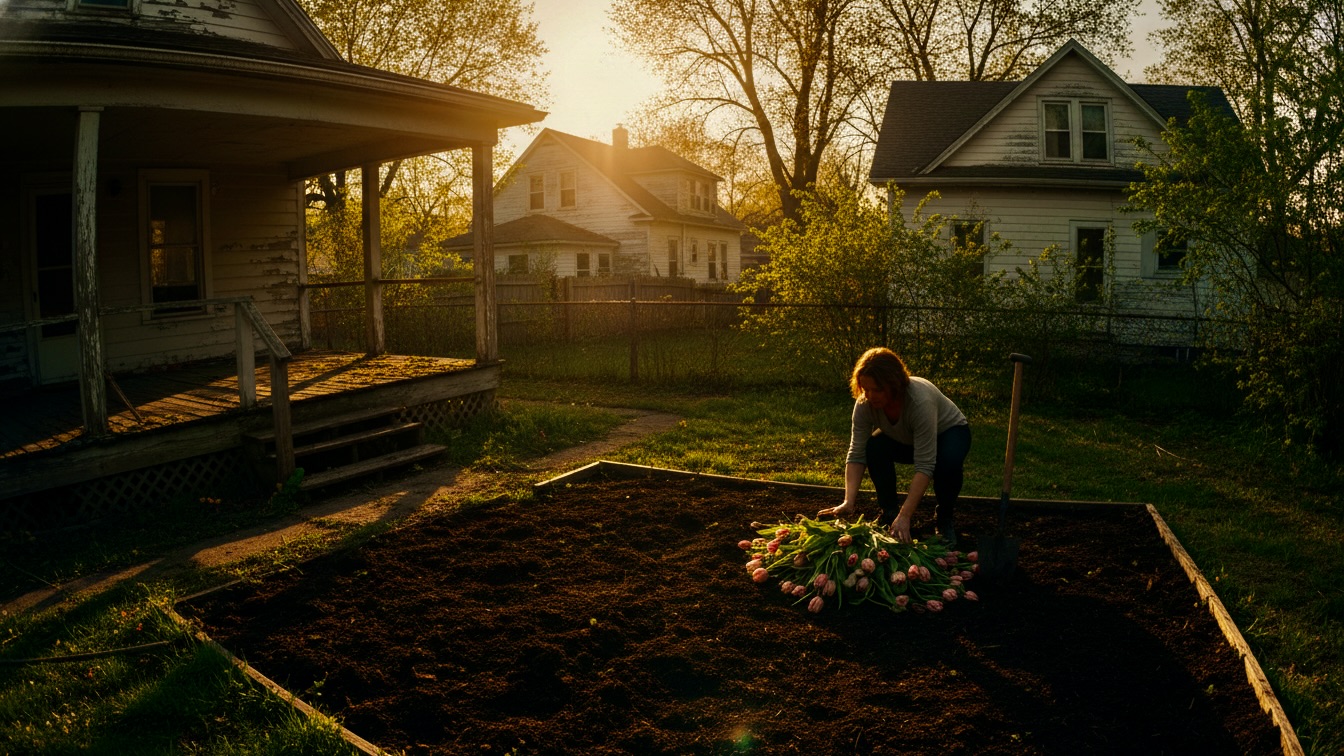
The narrative follows Martha, a woman navigating the suffocating pressures of extreme economic hardship. The story begins with her resentment of the tulips in her garden, which she views as a frivolous waste of space that should be occupied by life-sustaining crops like potatoes. This bitterness carries over into a grim trip to the grocery store, where she faces inflated prices, empty shelves, and a restrictive limit on basic produce.
Upon returning home, Martha finds her husband, Arnie, grappling with the literal decay of their house as he discovers extensive rot in the porch beams. Their son, Simon, soon arrives to reveal his own crisis, explaining that he is on the verge of eviction and desperately needs five hundred dollars. Martha is forced to tell him they have no money, a rejection that leads to a sharp emotional fracture between the family members.
The following night, Martha witnesses neighbors desperately raiding a community garden for seeds, a sight that triggers a cold, survivalist resolve within her. She decides to pawn her last valuable possession, a gold heirloom locket, to secure funds. Instead of fixing the house or giving the money to Simon, she invests the meager proceeds into fertilizer and seeds, leading Arnie in a desperate effort to transform their decorative flowerbeds into a vegetable garden for survival.
The central theme of the story is the brutal conflict between aesthetic beauty and the primal necessity of survival. Martha’s hatred for the tulips serves as the primary metaphor for this struggle. In her world, beauty has become an offensive luxury that offers no nourishment, and her decision to uproot the flowers represents a final surrender of her middle-class identity in favor of a hard-edged, agrarian survivalism.
Economic collapse and the erosion of human dignity also permeate the narrative. The characters are not just poor; they are being systematically erased by a world that has replaced human interaction with algorithms and corporate indifference. Simon’s inability to find work and the grocery store’s armed atmosphere suggest a society that has moved past the point of empathy, leaving the family to feel like "ghosts" in a house that is physically falling apart.
The story also explores the theme of generational failure and the death of the American Dream. Simon, at thirty years old, is unable to maintain his independence, while Arnie and Martha are unable to provide the safety net traditionally expected of parents. This breakdown of the familial role is mirrored by the physical rot of the porch and the literal "tearing of the earth" by neighbors, suggesting a total collapse of the social contract.
Finally, the narrative touches on the concept of sacrifice and its diminishing returns. Martha’s locket, a symbol of her history and marriage, is traded for a bag of fertilizer and some seeds. This exchange highlights the tragedy of their situation: she must destroy her past and her family's heritage just to buy a small, uncertain chance at a future. The "cold resolve" she feels is not a sign of hope, but a symptom of a soul that has been forced to harden against constant trauma.
Martha functions as the pragmatic core of the family, though her pragmatism is born out of deep psychological exhaustion. She is the first to recognize that their current way of life is unsustainable, as evidenced by her fixation on the "useless" tulips. Her internal state is characterized by a hyper-vigilance regarding resources, where even the sight of a bank app or a price tag is perceived as a physical threat, described as "teeth" or a "tightness" in her chest.
Her decision to pawn the locket reveals a character who has moved beyond sentimental attachment into a state of survival-driven detachment. While she feels the weight of the gold and remembers its history, she ultimately views it as a "ticket" rather than a treasure. This transition from a woman who appreciates heirlooms to a woman who views her own hands as "tools" marks a significant psychological shift from a domestic identity to a primal one.
By the end of the chapter, Martha has assumed a leadership role through sheer force of will. She rejects the role of the victim and the role of the grieving mother to become a laborer. Her refusal to help Simon with his rent, while painful, shows her recognition that they are all "sinking," and she chooses to invest in the soil because it is the only thing she can tangibly control in a world governed by invisible, hostile forces.
Arnie represents a man who is being broken by his inability to fulfill the traditional role of the provider and protector. His obsession with the rot in the porch is a psychological externalization of his own feelings of inadequacy and decay. He is unable to fix the house, just as he is unable to fix his son’s life or his wife’s poverty, and his flat, "dead" voice suggests a man who has retreated into a state of learned helplessness.
His reaction to Simon’s request for money is one of defensive aggression. When he laughs at the idea of having five hundred dollars, it is a "bark" intended to mask his own shame. He views himself and his family as "ghosts," indicating that he has already begun to disassociate from his own humanity as a way to cope with the indignity of their circumstances.
However, Arnie’s character shows a flicker of resilience when he joins Martha in the garden. He moves from staring at the rot to spreading fertilizer, signaling a shift from passive despair to active, albeit desperate, participation. His hands, described as feeling like "sandpaper," suggest that he is becoming as rugged and hardened as the environment he is trying to tame.
Simon embodies the plight of a younger generation that has been discarded by a shifting economic landscape. At thirty, he is trapped in a state of arrested development, forced to beg his impoverished parents for rent money. His description of the job market as a "black hole" and an "algorithm" highlights his profound sense of alienation; he no longer feels like a participant in society, but a data point that has been rejected.
His desperation is evident in his physical appearance, looking "twelve again" in the kitchen light, which suggests the regressive effect that poverty has on his psyche. He is not just looking for money; he is looking for the ability to "be a person." When Martha denies him the loan, the "hardening" of his face represents a definitive break in his trust, likely leading to further isolation or a descent into the same "hunger-driven" behavior Martha witnessed in the community garden.
The pacing of the chapter is deliberate and heavy, mirroring the "slow, heavy roll" of Martha’s stomach and the "thick silence" of the house. The author uses a rhythmic, almost repetitive sentence structure to emphasize the monotony and grinding nature of poverty. This creates a claustrophobic atmosphere where every small action, like tapping a credit card or cutting an apple, is imbued with immense tension and consequence.
The tone is unflinchingly bleak, characterized by a lack of sentimentality that borderlines on naturalism. The author avoids flowery language, opting instead for sharp, visceral descriptions. The metaphor of the bank numbers looking like "teeth" and the houses having "peeling skin" personifies the environment as a predatory, dying entity. This stylistic choice reinforces the idea that the characters are living in a world that is actively consuming them.
Sensory details are used effectively to ground the reader in the reality of the characters' deprivation. The smell of "old dishwater" and the "thin, brown stream" of the tap water provide a constant reminder of the physical decay surrounding the family. These details contrast sharply with the "bright" and "loud" tulips, making the flowers feel intrusive and wrong within the context of the story's grim sensory palette.
The narrative voice is closely aligned with Martha’s perspective, allowing for a deep exploration of her internal landscape. The use of "cold resolve" and the description of the apple tasting like a "secret" suggest a narrative shift from external observation to internal survivalism. The final image of the moon hitting the "grey weight" of the wilting tulips provides a haunting conclusion, leaving the reader with a sense of the characters' fragile, desperate endurance.


