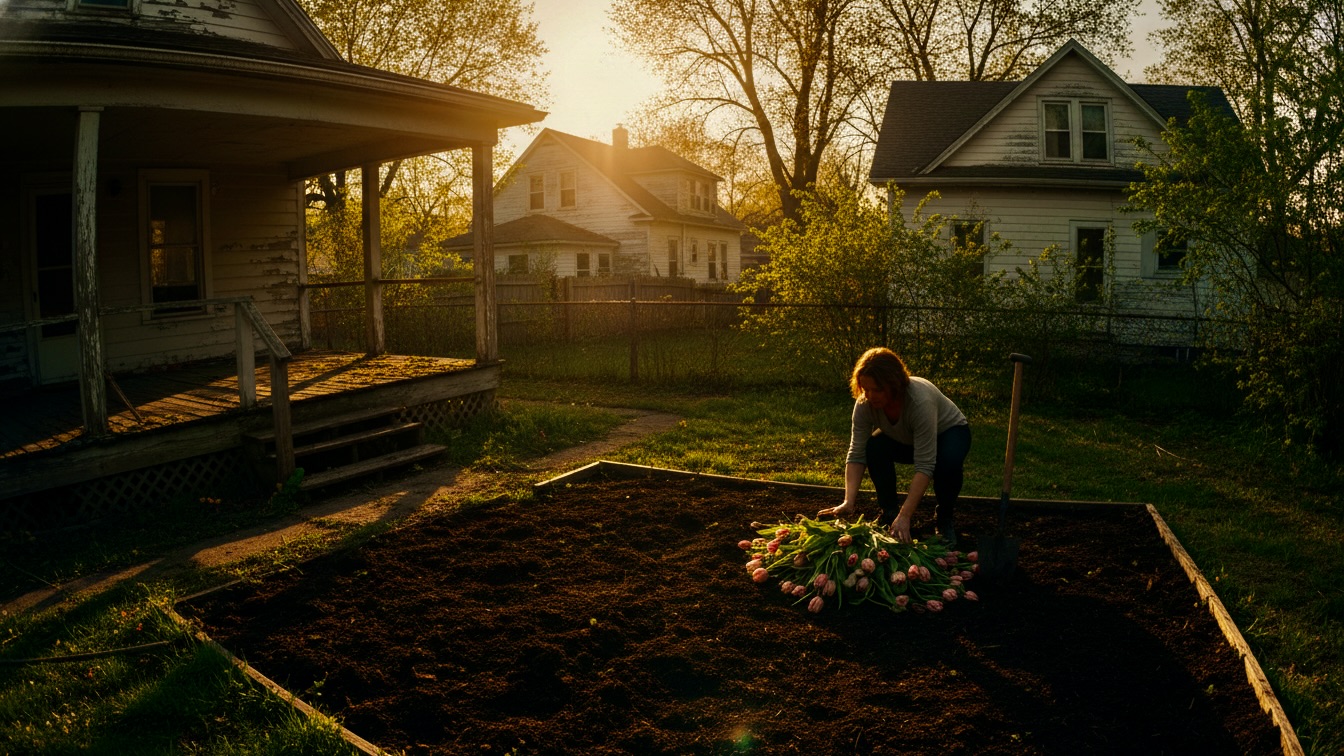
Martha stares at the tulips, wishing they were potatoes, while the world gets more expensive and the porch rots.
The tulips were too bright. They were loud. They stood in the flowerbed under the kitchen window like rows of tiny, pink lamps that wouldn't turn off. Martha watched them through the glass. The glass was greasy. It had a smudge where her forehead usually rested when she was tired. The tulips didn't care about the price of eggs. They didn't care that the stimulus check was a joke that nobody was laughing at. They just sat there, drinking the sun and eating the dirt. They were a waste. Every inch of that soil should have been a potato. A potato was a heavy thing. A potato was a quiet thing you could put in a pot and make into a meal. A tulip was just a pretty way to go hungry.
Martha turned away from the window. The kitchen smelled like old dishwater and the ghost of a chicken dinner they’d finished three days ago. She picked up her bag. It was a canvas bag with a frayed handle. She checked her phone. The bank app was a red sea. The numbers were small and sharp. They looked like teeth. She put the phone in her pocket and walked to the front door. The air outside was cool. It was the kind of spring that felt like it was pretending. The trees were getting their green back, but the houses on the street looked tired. The paint was peeling like sunburned skin. The grass was long because gas for the mower was a luxury now, like steak or air conditioning.
At the corner grocer, the fluorescent lights hummed. It was a low, angry sound that made the back of Martha’s neck itch. She walked past the cereal aisle. The boxes were half-empty, showing the metal shelves behind them. The prices were written in thick, black marker on scraps of cardboard. Bread was a number that made her chest feel tight. She went to the produce section. There were no oranges. There were no bananas. There was a pile of small, bruised apples. They looked like they had been through a fight. A sign was taped to the bin: LIMIT 2 PER CUSTOMER. PERSONNEL ARE AUTHORIZED TO ENFORCE.
Martha reached out. Her fingers felt thick and clumsy. She picked up one apple. It was cold. It was the size of a tennis ball. She picked up a second one. A man in a blue vest stood at the end of the aisle. He wasn't looking at her, but he was watching. He was holding a scanner like a weapon. Martha put the two apples in her bag. She wanted a third. She wanted to hide it under her sleeve. Her stomach did a slow, heavy roll. She looked at the man. He looked tired. His eyes were red. He probably wanted an apple too. She walked to the register. The total for two apples and a loaf of bread that felt like a brick was more than she’d spent on a full bag of groceries two years ago. She tapped her card. The machine took its time. It beeped. The sound was a small relief. She walked home with the bag hitting her thigh, the two apples knocking against each other like dice.
When she got back, Arnie was on the front porch. He was kneeling in the dirt. He had a crowbar in his hand. The wood of the porch was grey and soft. It looked like wet cardboard. He poked at a joist, and the metal went right through. He didn't say anything. He just looked at the hole. He looked like he was waiting for the hole to say sorry.
"It’s gone," Arnie said. He didn't look up. His voice was flat. It was the voice he used when he was talking about the car or the heater. "The whole beam. Rot went all the way to the house."
"Can you fix it?" Martha asked. She stood on the sidewalk. She didn't want to step on the porch. She was afraid the whole house would just fold up.
Arnie wiped his forehead with the back of his hand. He left a streak of grease. "I checked the site. A single treated four-by-four is forty bucks. The permit is another hundred. They want a drawing. They want a fee for the inspector. I don't have forty bucks, Marth. I don't even have the gas to go get the wood."
"We need the porch," she said.
"We need a lot of things," Arnie said. He stood up. His knees made a popping sound. He looked at the tulips. "Those things look stupid."
"I know," Martha said.
They went inside. The house felt small. It felt like the walls were leaning in to hear what they were saying. Simon was in the kitchen. He was thirty, but in this light, with his shoulders hunched, he looked like he was twelve again. He was staring at a pile of envelopes on the table. He didn't look happy. He looked like he’d been hit by something heavy and hadn't realized he was bleeding yet.
"Hey," Simon said. He didn't look at them.
"Hey," Arnie said. He went to the sink to wash the rot off his hands. The water was a thin, brown stream. "How’s the job hunt?"
"Dead," Simon said. "Everything’s an algorithm now. I don't even talk to people. I just upload my life into a black hole and wait for a bot to tell me I'm not good enough to stock shelves."
Martha put the apples on the counter. They looked even smaller in the kitchen. "You want some toast?"
Simon looked at the bread. Then he looked at Martha. His eyes were wide. They were the color of the sky before a storm. "Mom. I need to ask you something."
Martha felt her heart skip. It wasn't a good skip. It was a trip. "What is it?"
"I’m short," Simon said. "On the rent. The landlord... he’s not like the old guy. He’s a corporation. They don't take excuses. They just lock the door. I need five hundred. Just for this month. I’ll pay it back. I swear."
Arnie stopped scrubbing his hands. He turned around. The soap bubbles on his skin were popping. "Five hundred?" he said. He laughed, but it wasn't a laugh. It was a bark. "Simon, look at the counter. Two apples. That’s the grocery run. Two. We don't have five hundred cents."
"Dad, please," Simon said. His voice was thin. "If I lose the place, I’m back on the couch. I can't do that again. I’m thirty. I need to be a person."
"You think we're people?" Arnie asked. He stepped closer. He smelled like damp wood and frustration. "We’re just ghosts living in a house that’s falling down. I can't fix the porch. I can't buy a steak. And I definitely can't pay your rent."
"It’s just a loan," Simon said. He looked at Martha. "Mom?"
Martha felt the weight of the locket around her neck. It was under her shirt. It was gold. It was heavy. It was the last thing she had that wasn't a bill or a bruise. She looked at the floor. The linoleum was peeling in the corner. "We don't have it, honey," she whispered. "We really don't."
Simon’s face went hard. It was like watching a door close. "Right. Okay. Cool."
He walked out. The front door slammed. The house shook. A little bit of dust fell from the ceiling and landed on the two apples. Martha and Arnie stood in the silence. It was a thick silence. It felt like water. They were just standing at the bottom of a pool, waiting for the air to run out.
That night, the moon was bright. It was a cold, white eye looking down at the neighborhood. Martha couldn't sleep. She could hear Arnie’s breath. It was ragged. He was dreaming of rot. She got up and went to the window. She looked out at the community garden across the street. It was a small plot of land where people tried to grow things. It was supposed to be a symbol of hope. It was mostly just dirt.
She saw shadows moving. They weren't animals. They were too big. They were people. They were hunched over, moving through the rows. One of them had a flashlight. The beam was a tiny, yellow finger poking at the ground. They were digging. They weren't waiting for the plants to grow. They were looking for the seeds. They were looking for the early sprouts. They were tearing the earth apart with their bare hands.
Martha watched. She didn't call the police. The police didn't come for dirt. She just watched as the neighbors destroyed the only good thing on the block. They were hungry. Hunger was a monster that lived in your belly and ate your brain. It made you do things. It made you dig up a seed that wouldn't feed you for another three months just because you wanted to hold something that might be food.
In the morning, the garden was a wreck. The dirt was kicked everywhere. The little wooden signs that said 'Carrots' and 'Peas' were snapped in half. It looked like a battlefield where nobody had won. Martha stood on her porch. Arnie was beside her. He looked at the mess. He didn't say anything. He just gripped the railing. The railing creaked. A piece of it fell off and hit the dirt with a soft thud.
Martha felt a cold resolve. It wasn't bravery. It was a kind of death. She went back inside. She went to the bedroom and took off the locket. She held it in her hand. It felt warm from her skin. She remembered her grandmother putting it around her neck. She remembered the way the gold had shone at her wedding. Now, it was just a weight. It was just a ticket.
She walked to the pawn shop three blocks away. The shop was small and dark. It smelled like cigarettes and old metal. The man behind the glass had a face like a crumpled paper bag. He didn't look at the locket. He looked at the gold. He weighed it on a little scale. He tapped a calculator. The numbers were small. They were insulting.
"That’s all?" Martha asked.
"Gold is up," the man said. "But nobody’s buying jewelry. They’re buying bread. I’m taking a risk just holding onto it."
"It’s heirloom," she said.
"It’s metal," he said.
Martha took the cash. It was a small stack of twenties. They were wrinkled and dirty. She went to the hardware store. She didn't buy wood for the porch. She didn't buy a permit. She went to the back, where the garden supplies were kept. She found a large bag of fertilizer. It was a heavy, plastic bag with a picture of a giant green leaf on the front. It cost almost half of what she got for the locket.
She hauled it home. The bag was awkward. It kept slipping. The plastic dug into her fingers. By the time she got to the kitchen, she was sweating. The air was getting warmer. Spring was finally here, but it felt like a threat. It was the time for things to grow, but if they didn't grow fast enough, they would all starve.
Arnie was in the backyard. He was staring at the tulips. He had a shovel in his hand. He looked like he was about to kill them.
"Don't," Martha said. She dropped the bag of fertilizer on the grass. It made a heavy, muffled sound. "Help me with this."
Arnie looked at the bag. He looked at Martha. He saw her bare neck. He saw the space where the locket used to be. His face softened. It was a terrible thing to see. It was like watching a stone melt.
"Marth," he said.
"Don't say it," she said. "Just help me. We’re going to dig them up. All of them. The tulips, the grass, everything. We’re going to plant the potatoes. We’re going to plant the beans. We’re going to grow enough to fill the kitchen."
"It’s not enough soil," Arnie said. "We won't get enough."
"It has to be enough," Martha said. She grabbed the shovel from him. Her hands were shaking. "It has to be. I’m not going back to that store for two apples. I’m not doing it."
She pushed the shovel into the earth. The ground was hard. It fought her. She stepped on the blade with all her weight. The metal sank in. She turned over a clod of dirt. It was black and wet. It smelled like the beginning of the world. She threw it aside. She dug again. She was looking for something. She wasn't sure what. Maybe she was just looking for a way to stop the sinking feeling in her chest. Maybe she was just trying to bury the memory of the locket.
Arnie watched her for a moment. Then he knelt down. He reached into the bag of fertilizer. He took a handful of the grey, grainy dust. He spread it over the hole she’d made. He didn't say a word. They worked in silence as the sun moved across the sky. The tulips were piled in a heap by the fence. Their pink heads were wilting. They looked like discarded party decorations. They looked like a dream that had been thrown away.
By evening, the backyard was a dark, messy square of turned earth. Martha’s back ached. Her fingernails were black with dirt. She looked at her hands. They didn't look like her hands anymore. They looked like tools. She looked at Arnie. He was covered in sweat. He looked older. He looked like he was part of the ground.
"We need the seeds," Arnie said.
"I have enough left for the seeds," Martha said. "Tomorrow."
They went inside. The house was dark. They didn't turn on the lights. Electricity was another thing they were trying to forget. They sat at the kitchen table. The two apples were still there. They looked lonely. Martha picked one up. She took a knife and cut it into four pieces. She gave two to Arnie and kept two for herself.
They ate in the dark. The apple was sweet, but it was a sharp sweetness. It tasted like a secret. Martha thought about Simon. She thought about his apartment and the landlord who didn't take excuses. She thought about the people in the community garden, digging for seeds in the moonlight. She wondered if they were out there now. She wondered if they were looking at her backyard.
She looked out the window. The moon was rising again. It hit the pile of tulips. They were almost grey now. The grey weight was everywhere. It was in the air. It was in the dirt. It was in the way Arnie chewed his food. But they had the fertilizer. They had the dark earth. It was a start. It was a gamble. It was a way to keep from disappearing entirely.
Martha reached out and touched Arnie’s hand. His skin was rough. It felt like sandpaper. He didn't pull away. He gripped her fingers. They sat there, two people in a quiet house, holding onto each other while the world outside continued to grow more expensive and more dangerous. The spring was beautiful and cruel. It was a time of renewal that felt like a funeral. But they were still here. For now, that was the only thing that mattered.
“Martha looked out at the dark, freshly turned soil and wondered if the neighbors were watching from the shadows, waiting for her seeds to break the surface.”


