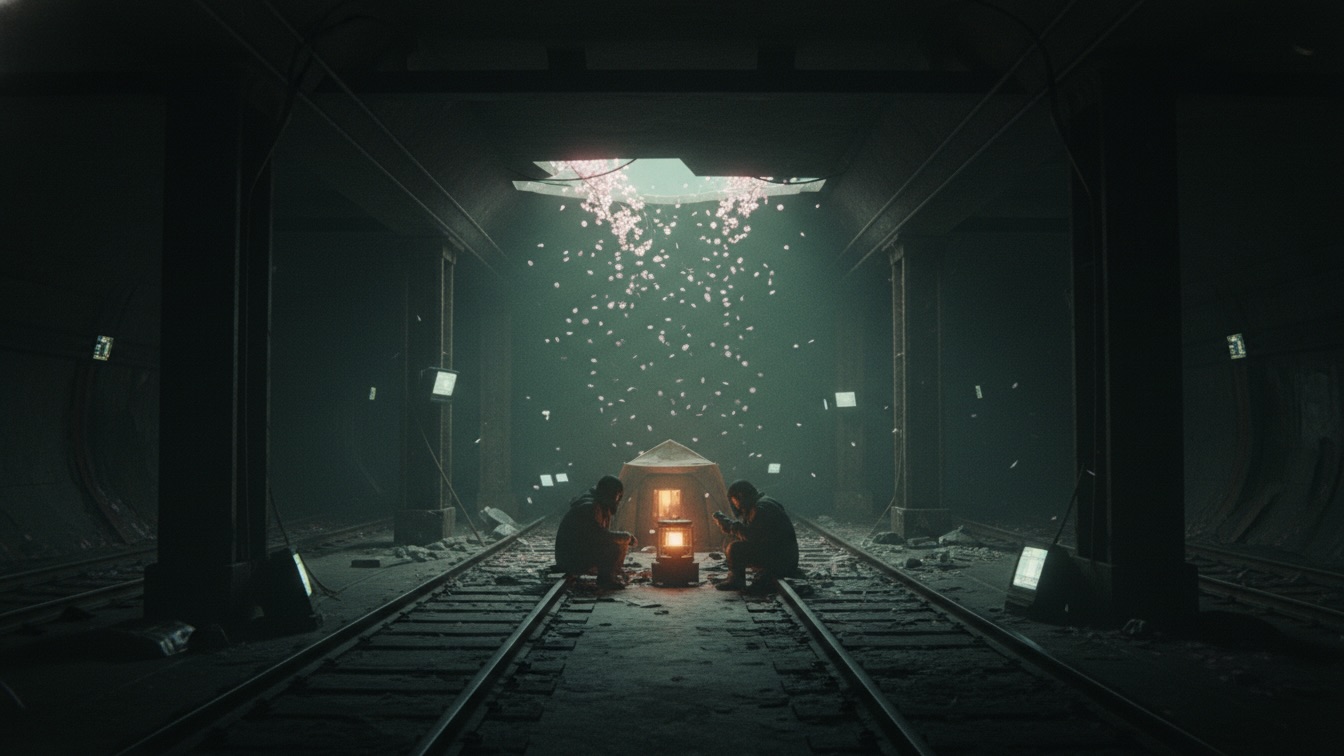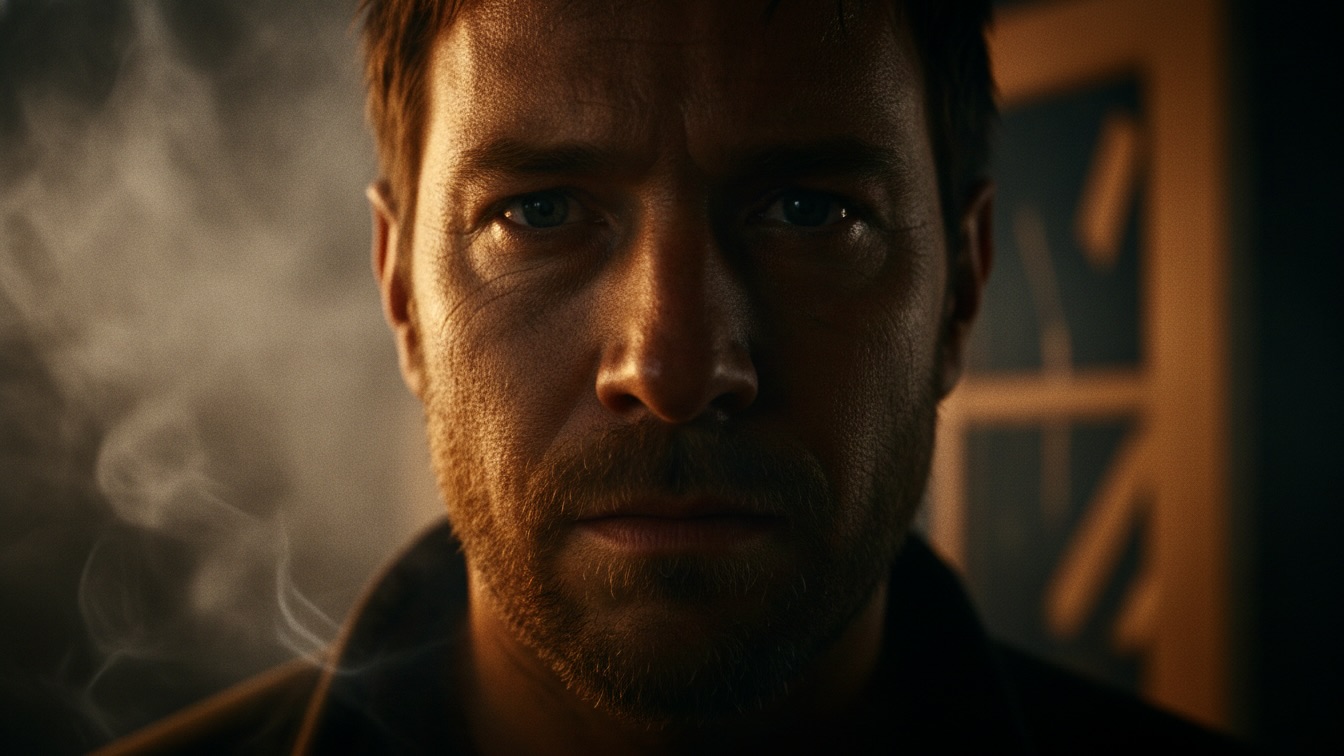
Mike opens his door to a dying kid, choosing between his own safety and a memory of mercy.
The wrench was heavy. It was real. In a world where everything was a projection, a credit, or a data point, the cold weight of the steel felt like an anchor. Mike gripped the handle until the ridges bit into his palm. Outside the door, the scraping sound stopped. It was replaced by a wet, bubbling hitch in someone's breathing. It sounded like a broken radiator. It sounded like Peter.
Mike didn't move. He counted his heartbeats. One. Two. Three. His internal clock was calibrated to the rhythm of the city's power grid, which was currently flickering. The silence in the apartment felt like a physical weight, pressing against his eardrums, filling the spaces where Chloe’s piano used to live. He looked at the floorboards. There was a faint smudge of grease near the door. He’d meant to clean it months ago. He never did. He didn't do much of anything anymore except wait for the water valves to hiss.
'Mike,' a voice whispered from the hallway. It was thin. It was a file compressed too many times until the high notes were gone. 'Please.'
Mike closed his eyes. He could picture it. The kid would be slumped against the doorframe, his cheap tactical vest cracked, his eyes blown out from the infrasound. Peter was a dead pixel in the city's display. If Mike opened that door, he was opting into the glitch. He was inviting the algorithm to find him. The Peacekeeper drones were probably already mapping the blood trails in the hallway. They had thermal sensors that could see through the cheap drywall of these pre-collapse tenements. Every second Peter sat there, Mike’s apartment glowed brighter on a heat map in some central hub.
He stood up. His knees felt like they were filled with crushed glass. He reached for the deadbolt. His hand hovered over the cold metal. If he did this, the isolation ended. The quiet, safe nothingness he had built over ten years would shatter. He thought about the empty hook by the door. He thought about the way the dust gathered in the shape of Chloe’s boots. He was already a ghost. What did it matter if he haunted a different room?
He turned the lock. The sound was a gunshot in the quiet. He pulled the door open six inches.
Peter fell inward. He didn't slide; he just collapsed like a stack of empty boxes. He hit the floor face-first, his breath leaving him in a sharp, metallic wheeze. Mike caught him by the shoulder and hauled him the rest of the way inside, kicking the door shut with his heel. He threw the bolt and engaged the chain. He didn't turn on the light. He didn't need to. The orange pulse from the street lamps was enough to see the damage.
Peter was vibrating. It wasn't a shiver. It was a high-frequency tremor that made his skin look blurry. The sonic cannons had done their job. The kid’s nose was bleeding, a thick, dark stream that looked black in the orange light. He’d lost a shoe. His sock was soaked in something that wasn't water.
'I... I told them,' Peter managed, his teeth chattering against each other. 'I told them to break... break the sightlines.'
'Shut up,' Mike said. His voice was a dry rasp. 'Don't talk. You’re leaking data.'
Mike dragged the kid toward the center of the room, away from the door. He needed to mask the heat signature. He grabbed a heavy, foil-lined emergency blanket from the closet—one of the few things he hadn't sold. It was crinkly and loud, the sound of a thousand crushed soda cans. He threw it over Peter, tucking the edges under the kid’s body to seal in the warmth. To the drones outside, Peter would now look like a cold patch on the floor. A glitch in the sensor.
Mike sat back on his heels, his breath coming in short, jagged bursts. His stomach was still churning from the infrasound hangover. He felt like he was floating two inches to the left of his own body. Cognitive static. He looked at Peter. The kid was staring at the ceiling, his pupils dilated to the edges of his irises.
'They didn't even... they didn't even use the mechs,' Peter whispered. 'Just the sound. It was just sound, Mike. Why did it hurt so much?'
'Because the system doesn't need to touch you to break you,' Mike said. He leaned his head against the scratched plastic table. 'It just needs to change the frequency.'
He looked at the window. A drone drifted past, its blue scanner light painting a line across the grimy glass. Mike froze. He didn't breathe. The light lingered on a smudge of dirt, then moved on, descending toward the plaza where the cleaning crews—the automated ones—would already be hosing the blood into the sewers. The state didn't like messes. Especially not in Spring. Spring was for renewal. Spring was for the new quotas.
'They're going to come for me,' Peter said. He tried to sit up, the foil blanket crackling. 'My phone. It’s still pinging.'
Mike’s heart skipped. 'Where is it?'
'Dropped it. In the hall.'
'You what?' Mike stood up, the adrenaline hitting him like a physical blow. A live phone in the hallway was a beacon. It was a digital flare. 'Peter, you idiot.'
'I couldn't hold it. My hands... they stopped working.' Peter held up his fingers. They were hooked like claws, locked in a permanent spasm.
Mike went to the door. He pressed his ear to the metal. Nothing. Just the distant, rhythmic hum of the city’s life support systems. He looked at the wrench on the floor. He picked it up. He had to go out there. If the phone was sitting in front of his door, the Peacekeepers wouldn't even bother knocking next time. They’d just vent the floor with sleep gas and harvest whatever was left.
He cracked the door. The hallway smelled like ozone and old sweat. The emergency LED at the end of the hall flickered, casting long, jerky shadows. He looked down. There, three feet from his threshold, was a rectangular glow. Peter’s phone. The screen was cracked, but it was still alive. A notification popped up, lighting up the dust motes in the air. Sector 4 Group: RUN. THEY HAVE THE LOGS.
Mike stepped out. The air felt thin, like it had been filtered through a dirty sock. He reached for the phone, his fingers inches from the glass.
A shadow fell over him.
He looked up. At the far end of the hallway, a silhouette stood framed against the flickering LED. It wasn't a drone. It was too tall, too heavy. It was a Peacekeeper in full riot gear, the matte black ceramic plates of his armor absorbing the light. The visor was a flat, featureless slab of polished glass.
Mike didn't think. He didn't have time for a plan. He grabbed the phone and lunged back into his apartment.
'ID check!' the Peacekeeper shouted. The voice was amplified, distorted by a vocoder until it sounded like a machine grinding rocks.
Mike slammed the door. He heard the heavy thud of boots hitting the floorboards. The Peacekeeper was running. Mike didn't bother with the deadbolt; he knew it wouldn't hold against a hydraulic breach. He grabbed Peter by the collar of his vest and hauled him toward the back of the apartment, toward the small, cramped bathroom that had no windows.
'Move!' Mike hissed.
'What’s happening?' Peter was dazed, the foil blanket trailing behind him like a metallic cape.
'The algorithm found us,' Mike said. He shoved Peter into the bathtub—a plastic basin that hadn't seen water in three days—and threw the foil over him again. 'Stay down. Don't breathe. If you make a sound, we’re both recycled.'
Mike stepped back into the main room. He looked at the phone in his hand. It was still vibrating. Another notification. User 'Chloe' has joined the chat.
Mike’s blood turned to ice. Chloe was dead. Chloe had been dead for a decade. It was a ghost. Or a trap. Or a sick joke played by the system’s AI to keep the engagement high even during a massacre. He stared at the name on the screen. The cognitive static in his head reached a screaming pitch.
BOOM.
The front door didn't just open; it disintegrated. The hinges screamed as they were sheared off the frame. A flashbang skittered across the floor, white light erupting in the dark room.
Mike squeezed his eyes shut, but the light burned through his eyelids. His ears rang with a high, sharp whine. He felt the floor vibrate. He swung the wrench blindly, a desperate arc of steel in the white void.
He felt it connect with something hard. A grunt. A metallic clang.
'Target active!' the voice boomed, closer now.
Mike opened his eyes, squinting through the spots. The Peacekeeper was in the room, his silhouette a dark tear in the white haze. He was holding a stun baton, the tip crackling with blue arcs of electricity.
'Down on the ground! Now!'
Mike didn't go down. He backed away, his heels hitting the edge of the mattress. He felt the empty space beside him. Chloe’s side. He looked at the Peacekeeper. He saw the way the light reflected off the black visor. He didn't see a man. He saw the Board. He saw the water cuts. He saw the ten years of silence he’d endured.
'You forgot to clear the cache,' Mike said. He felt a strange, cold calm wash over him. His heart stopped hammering. His hands stopped shaking.
'What?' the Peacekeeper hesitated, his baton lowering an inch.
'You think you own the grid,' Mike said, his voice level and hard. 'But you’re just part of the hardware. And hardware breaks.'
Mike reached into his pocket and pulled out the small, heavy battery bank he used to power his lights. He’d modded it months ago, stripping the limiters to give it a faster charge rate. It was unstable. It was a fire hazard. It was the only thing he had left.
He jammed the steel wrench into the charging port, shorting the cells.
The battery began to hiss. A sharp, chemical smell filled the room—sweet and toxic. The casing began to bloat, the plastic turning a dull, angry red.
'Drop it!' the Peacekeeper yelled, stepping forward.
Mike didn't drop it. He threw it.
The battery hit the Peacekeeper’s chest plate and bounced to the floor. It exploded in a fountain of white sparks and thick, acrid smoke. It wasn't a big explosion—not enough to level the room—but it was enough to fill the cramped space with a blinding, choking fog.
Mike lunged. He didn't use the wrench. He used his weight. He tackled the Peacekeeper, the two of them hitting the floorboards with a crash that shook the building. The armor was cold and hard, smelling of factory grease. Mike fumbled for the release latches on the helmet, his fingers searching for the pressure points he remembered from the old days.
He found the seal. He twisted.
The helmet popped with a hiss of pressurized air. Mike ripped it off.
Underneath was a face. A kid. No older than Peter. His hair was buzzed short, his skin pale and slick with sweat. He looked terrified. He didn't look like a monster. He looked like a bored Gen Zer who had taken a job with the Board because it was the only way to get a shower twice a week.
'Please,' the kid gasped, his eyes darting around the smoky room. 'I'm just... I'm just on shift. I have a sister.'
Mike froze. The wrench was raised above his head, ready to come down on the kid’s temple. He looked at the kid’s eyes. They were the same eyes as Peter’s. The same eyes as Chloe’s.
'Everyone has a sister,' Mike whispered.
He didn't swing. He grabbed the kid by the collar and slammed his head against the floor—just hard enough to knock the air out of him, not hard enough to kill. The Peacekeeper went limp, his eyes rolling back.
Mike stood up, coughing as the smoke thickened. He ran to the bathroom.
'Peter! Get up! We have to go!'
He hauled the kid out of the tub. Peter was barely conscious, his body still humming from the sonic trauma. Mike draped the kid’s arm over his shoulder and dragged him back into the main room. The hallway was silent. No more boots. Not yet. But the backup would be coming. The Peacekeeper’s HUD would have logged the location. The drones would be swarming the building in minutes.
Mike looked at his apartment one last time. The mattress. The folding chair. The empty rectangle where the piano used to be. It was all just trash now. It was a shell.
He saw Peter’s phone lying on the floor. The screen was still on.
User 'Chloe': Mike, are you there?
He picked it up. His thumb hovered over the screen. He wanted to type. He wanted to ask. But he knew. It was the algorithm. It was the system using his grief to track his engagement. It was a ghost in the machine, literally.
He smashed the phone against the corner of the table. The screen went black.
'Come on,' Mike said to Peter. 'We’re going to the roof.'
'The roof?' Peter mumbled. 'There’s nowhere to go on the roof.'
'There’s the sky,' Mike said. 'And the sky doesn't have a firewall.'
They staggered out of the apartment, leaving the door swinging on its one remaining hinge. The hallway was a tunnel of flickering shadows. Mike didn't look back. He didn't look at the unconscious kid in the armor. He just focused on the stairs.
They reached the roof access. Mike kicked the door open.
The night air was cool, but it carried the smell of the riot—tear gas and burnt rubber. The city stretched out below them, a grid of orange and blue lights that looked like a motherboard. The stars were invisible, drowned out by the glow of the Sector 4 hub.
'What now?' Peter asked, collapsing against a vent pipe. 'We’re trapped.'
Mike walked to the edge of the roof. He looked down at the plaza. The cleaning drones were almost finished. The concrete was wet and gleaming.
'We aren't trapped,' Mike said. He looked at the adjacent building, only six feet away across a narrow alley. 'We’re just moving to a different sector.'
He looked back at the door they’d just come through. He heard the sound of a heavy engine. A transport drone. It was hovering just below the roofline, its searchlight sweeping the brickwork.
Mike gripped Peter’s arm. 'Jump on three.'
'I can't jump! My legs—'
'You jump or you die, Peter. There is no middle ground. The patch is coming.'
Mike looked at the horizon. The sun was still hours away, but he could see the faint, dirty glow of the sunrise starting to compete with the city lights. It was Spring. The world was supposedly coming back to life.
He felt a sudden, sharp pain in his chest. Not a heart attack. A realization. He was alive. For the first time in ten years, he wasn't just a ghost in a room. He was a target. And being a target was better than being nothing.
'One,' Mike counted.
The searchlight hit them, blinding and white.
'Two.'
A voice boomed from the drone, commanding them to stay still.
'Three.'
Mike leaped into the dark, pulling the kid with him, leaving the ghost of his life behind in the smoke.
“As the drone's spotlight locked onto them, Mike stepped off the ledge into the abyss, clutching Peter's collar.”