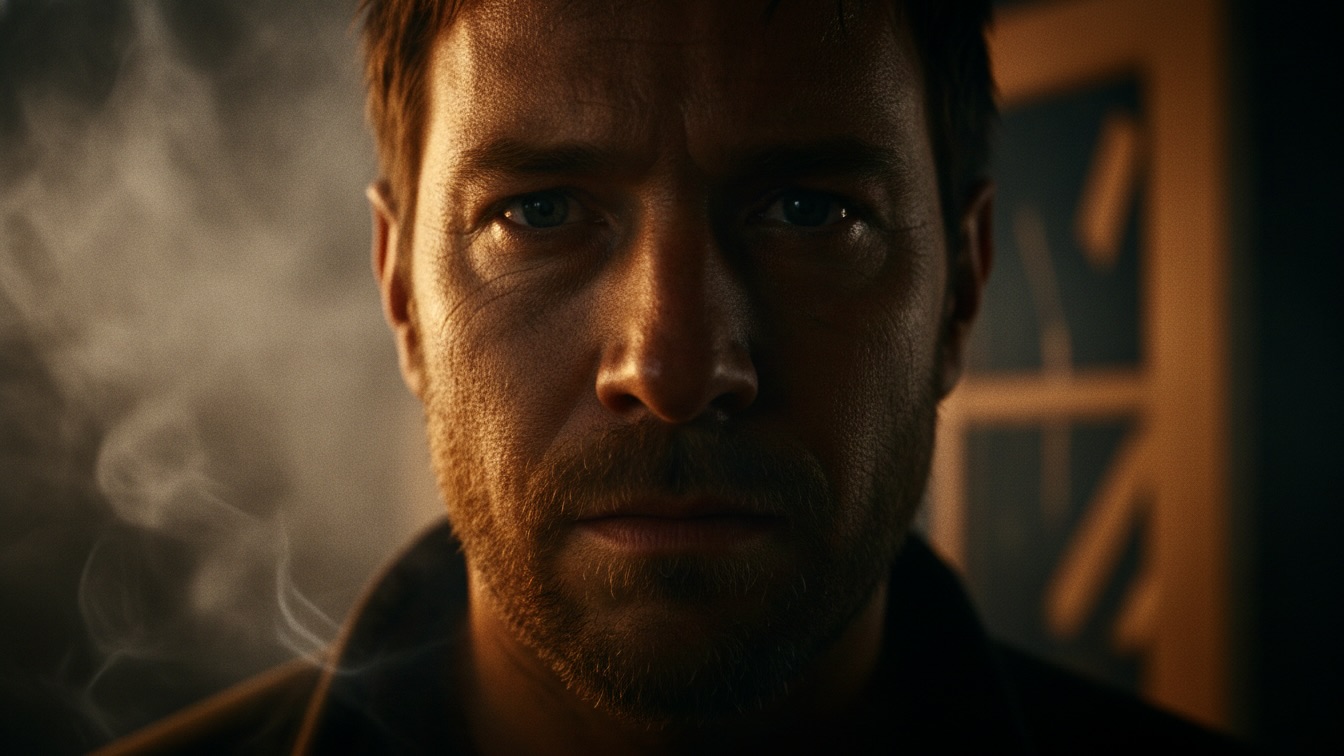
Mike watched the kids gather in the concrete plaza below. They were already dead. They just didn't know it yet.
The pink flare went up at exactly 4:12 PM.
Mike stood by the window. The glass was grimy, coated in a thin layer of spring dust that blew in from the dried-out reservoirs out east. Spring didn't mean flowers anymore. It just meant the air got hotter, the dust got thicker, and the Water Rationing Board tightened the valves. He watched the pink smoke arc through the hazy sky, leaving a chemical trail before it hit the concrete of the plaza below. It was too early. The sun was still up, casting long, hard shadows across the pavement.
He didn't move. He felt the familiar, dull thud of his heart against his ribs. The cognitive static started to build in the back of his neck, a white noise that hummed whenever he looked down at that square.
The apartment behind him was quiet. Too quiet. The light in the room was fading, shifting from a harsh yellow to a bruised, dirty orange. He kept the lights off to save the battery banks, but mostly he just preferred the dark. When the lights were on, he had to look at what was missing.
There was a rectangle of clean floorboard near the south wall where Chloe's upright piano used to sit. He sold it for water credits three years ago. There was a hook by the door that held nothing. Her boots were gone. Her jacket was gone. The only things left in the room were a mattress on the floor, a folding chair, a scratched plastic table, and Mike. He picked up his water cup. Scratched plastic. He took a sip. Tepid. It tasted like copper and old pipes.
He looked back out the window.
They were gathering. Teenagers. College kids. People who didn't remember the last time this happened. They were pouring into the plaza from the side streets, wearing cheap tactical gear bought off the gray market. Plastic shinguards meant for soccer. Skate helmets covered in stickers. Bandanas soaked in vinegar to ward off tear gas.
Stupid, Mike thought, his stomach turning over. You don't group up. You hug the walls.
He pressed his forehead against the warm glass. The physical ache in his knees flared up, a ghost pain from the baton strike he took ten years ago on that exact same pavement. He watched a girl with a megaphone climb onto the edge of the dry north fountain. The fountain was a concrete bowl filled with garbage. She was shouting, rallying them. He couldn't hear the words through the double-paned glass, but he knew the rhythm. He knew the cadence of desperate, angry youth.
He analyzed the plaza with the cold, detached eye of someone who had survived a slaughter.
They were massing near the fountain. A massive mistake. It was a perfect kill box. If the automated peacekeepers deployed from the main avenue—and they always deployed from the main avenue—they would form a phalanx. A moving wall of riot shields and sonic cannons. They would push the kids back into the fountain. The lip of the concrete bowl was three feet high. A tripping hazard. Once the front line hit that lip and fell backward into the bowl, the crowd crush would start. Ten seconds later, people would be suffocating under the weight of their own friends, trapped in a concrete depression while the drones dropped gas from above.
He knew this because he had watched it happen to his friends.
"Don't stand by the fountain," he whispered to the glass. His voice was raspy from disuse. "Move to the alleys. Break the sightlines."
Down below, a kid in a bulky plate carrier threw a rock at a passing patrol drone. The drone, a sleek black disc the size of a hubcap, didn't even flinch. The rock bounced off its casing. The drone paused, rotated, flashed a blue scanner light over the kid's face, and kept flying.
Logged, Mike thought. They have your face, kid. You're out of the system. No more rations for you.
He stepped away from the window. He couldn't watch this. He needed to sit down. The air in the apartment felt heavy, stripped of oxygen. He walked over to the mattress and sat on the edge. The foam dipped. It was the left side, the side he always sat on. The right side was perfectly flat. Chloe's side. It had been ten years, but he still couldn't bring himself to sleep in the middle.
He rubbed his face. His skin felt like sandpaper. Dehydration. He needed to drink more, but his daily allowance was down to three liters, and he had to save some for cooking the dry protein blocks.
The Water Rationing Board. That was what they were protesting. The Board had announced a permanent 40% cut to Sector 4's supply yesterday. It was a death sentence for half the block. The kids thought they could march on the Board's headquarters at the north end of the plaza, demand the valves be opened, and cancel the Board. They thought if they made enough noise, the system would break.
Mike closed his eyes. The white noise in his head got louder. He remembered the smell of the smoke. He remembered the way Chloe's hand felt as it slipped out of his grip in the panic. He remembered the mechanical, insect-like clicking of the crawler mechs as they marched over the barricades.
Three sharp knocks on his door.
Mike's eyes snapped open. The static vanished, replaced by a spike of pure adrenaline. His heart hammered against his ribs. He didn't breathe.
Knocking was weird. Peacekeepers didn't knock. If the State wanted you, they blew the hinges and flooded the room with flashbangs. Neighbors didn't knock either; nobody talked to anybody anymore.
Another three knocks. Urgent, but not aggressive.
Mike stood up. His knees popped in the quiet room. He walked silently to the door, his bare feet making no sound on the dusty floorboards. He reached out and grabbed the heavy steel pipe wrench he kept leaning against the doorframe. The metal was cold. It grounded him.
He pressed his eye to the peephole.
The hallway was dark, illuminated only by the flickering emergency LED at the far end. Standing outside his door was a kid. Nineteen, maybe twenty. He had a fresh scrape on his jaw, bleeding sluggishly. He was wearing a canvas plate carrier over a black hoodie. The stitching on the carrier was already fraying at the shoulder. It looked like it was stuffed with rubber floor mats, not ballistic plates.
Mike unlocked the deadbolt. He opened the door two inches, keeping his foot wedged against the bottom edge. He held the wrench low, out of sight.
"What," Mike said. It wasn't a question.
The kid blinked, startled by the sudden opening. He looked Mike up and down. "Mike?"
"Who's asking?"
"I'm Peter. From the Sector 4 channel." The kid shifted his weight, his eyes darting nervously down the empty hallway. "We know who you are. You're the Mike from the 2016 uprising. You led the push on the reservoir."
Mike stared at him. The kid's boots were tied wrong. Long, looping bows that would get caught on debris the second he started running.
"Go home, Peter," Mike said. He pushed the door to close it.
Peter shoved his hand into the gap. Mike stopped, not wanting to crush the kid's fingers, but kept his foot firmly planted.
"Wait, wait!" Peter hissed. "We're moving in twenty minutes. We're going to cancel the Board permanently. We're taking the main building."
"You're taking a concrete bunker with skateboards and rocks," Mike said, his voice flat. "You're dead. Go home."
"We have numbers!" Peter insisted, leaning closer to the gap. He smelled like nervous sweat and cheap energy drinks. "There's three thousand of us in the group chat. They can't stop all of us. But we need you. The older guys said you know the blind spots in the security grid. You know how to bypass the outer gates."
"The older guys are either dead or in prison," Mike said. "And the grid was updated six years ago. Whatever blind spots I knew are gone. You're marching into a meat grinder."
"You're just going to sit here?" Peter's voice cracked, a sudden spike of angry disbelief. "They cut the water to forty percent, Mike! My little sister is drinking out of the dehumidifier! We're dying anyway!"
Mike felt a tight, painful knot form in his throat. He swallowed it down. "Then die quiet. It hurts less."
"You're a coward."
The word hit Mike like a physical blow. He didn't react. He just looked at Peter. He looked at the naive, desperate fire in the kid's eyes. It was the exact same fire Chloe had.
"You think you're ready for this?" Mike said, his voice dropping to a harsh whisper. "You think this is a game? What's your plan for the sonic cannons?"
"We have earplugs," Peter said, pulling a pair of foam plugs from his pocket.
Mike let out a short, dry laugh. It sounded like a cough. "Foam earplugs. Jesus Christ. The peacekeepers don't use sound to hurt your ears, kid. They use infrasound. Low frequency. It bypasses the ears entirely. It vibrates the fluid in your eyeballs until you can't see. It liquefies your bowels. You're going to be blind, throwing up on yourself, and then the crawler mechs are going to step on your chest. Have you ever seen a mech step on a human being?"
Peter hesitated. His hand trembled slightly against the doorframe. "The mechs are offline. The grid is down in Sector 4."
"Who told you that?"
"The discord—"
"It's a honeypot!" Mike snapped, the anger finally breaking through his burnout. "Are you stupid? The State runs the servers. They let you organize. They want you in the plaza. It's cheaper to kill three thousand of you in one spot than to hunt you down one by one. They leaked the mech maintenance schedule to make you confident. It's a trap."
"You don't know that," Peter said, but his voice was thinner now.
"I do know that. Because they did the exact same thing to me ten years ago." Mike looked down at Peter's hand. "Move your hand."
"Mike, please. If you just show us the gate override—"
"There is no override. Move your hand or I'm shutting the door on it."
Peter stared at him. The kid's face twisted with a mix of betrayal and sheer terror. He was realizing, slowly, that the legend he came to find was just a broken man in a dark room.
"You gave up," Peter spat. "You're just a ghost."
Peter pulled his hand back.
Mike slammed the door shut. He threw the deadbolt. He engaged the chain lock. He leaned his back against the heavy metal door and slid down until he was sitting on the floor, his knees pulled up to his chest. He gripped the pipe wrench so hard his knuckles turned white.
He heard Peter stand outside for a few seconds. Then, the heavy, uncoordinated footsteps of the kid running down the hall.
Mike sat there. The apartment was nearly pitch black now. The sun had dipped below the skyline, leaving only the sickly orange glow of the streetlamps filtering through the dirty window. The silence in the room was absolute, pressing against his eardrums.
He looked at the empty rectangle where the piano used to be.
You should go down there, a voice in his head said. It sounded like Chloe. You could save him. You could pull him out of the kill box.
I can't, Mike thought back. I can't do it again.
He closed his eyes. He waited.
At exactly 6:00 PM, the sirens started.
It wasn't a wail. It was a digital shriek. A synthetic, dual-tone alarm that vibrated the floorboards. Mike opened his eyes. The orange light from the window was pulsing with the rhythm of the sirens.
He didn't get up. He stayed on the floor by the door.
Then came the sound of the crowd. It started as a roar, a collective shout of defiance. Three thousand voices yelling at the concrete walls of the Water Board. For a brief, agonizing second, it sounded like they were winning.
Then the pressure dropped.
Mike felt it in his sinuses. A sudden, sharp change in air pressure. The acoustic cannons were spooling up.
The roar of the crowd fractured. It turned into a scattered, panicked noise. Then, the screaming began.
Mike dropped the wrench. It clattered against the wood floor. He pressed the heels of his hands against his ears, pressing as hard as he could, but it didn't matter. The low-frequency hum of the cannons bypassed his hands entirely. He felt it vibrating in his teeth. He felt it in the water inside his stomach. His nausea spiked instantly.
Outside, the heavy mechanical thuds started.
Thump. Thump. Thump.
The crawler mechs. Eight-foot-tall automated riot control units. They moved with a jerky, unnatural rhythm.
He heard the popping sounds. Not gunfire. Not yet. Tear gas canisters launching from the drones. Dozens of them.
Mike curled into a tight ball on the floor. His breathing was rapid, shallow gasps. The screaming outside was no longer angry. It was the sound of pure, unadulterated terror. He could hear the distinct sound of the crowd crush happening. The desperate, animalistic shrieks of people being pushed over the lip of the fountain, trampled by the mass of bodies trying to escape the gas and the mechs.
Move to the alleys, Mike thought, tears streaming down his face. Break the sightlines. Break the sightlines.
He was crying. He didn't want to. It wasn't a quiet, cinematic cry. His nose was running, snot mixing with the dirt on the floor. He was dry heaving from the infrasound vibrations. His entire body shook.
He heard a sound that cut through the noise. A wet, heavy crunch. A mech stepping on something. Or someone.
"I'm sorry," Mike sobbed into his knees. "I'm sorry. I'm sorry."
He didn't know if he was apologizing to Peter, or to the kids in the fountain, or to Chloe. It all blurred together into one massive, crushing weight of guilt and survival.
The riot didn't last long. It never did. The State was efficient. By 6:15 PM, the screaming had died down to scattered moans and the harsh, robotic commands of the peacekeeper drones ordering dispersal. The low hum of the cannons faded, leaving a ringing silence in its wake.
Mike stayed on the floor. His muscles were locked, cramped from tension. The room was totally dark now.
He slowly pulled his hands away from his ears. The silence in the apartment was heavy. The air smelled faintly of chemical smoke that had seeped through the window cracks.
He forced himself to open his eyes. The room was empty. The piano was still gone. The boots were still gone.
Out in the hallway, beyond the heavy metal door, he heard a sound.
A soft, dragging scrape against the floorboards.
Mike froze. He held his breath.
Another scrape. Slower this time. Followed by a wet, ragged exhale. It was right outside his door.
He looked at the steel wrench lying an inch from his hand, the metal reflecting the faint, dying light from the window.
“He looked at the steel wrench lying an inch from his hand, the metal reflecting the faint, dying light from the window.”