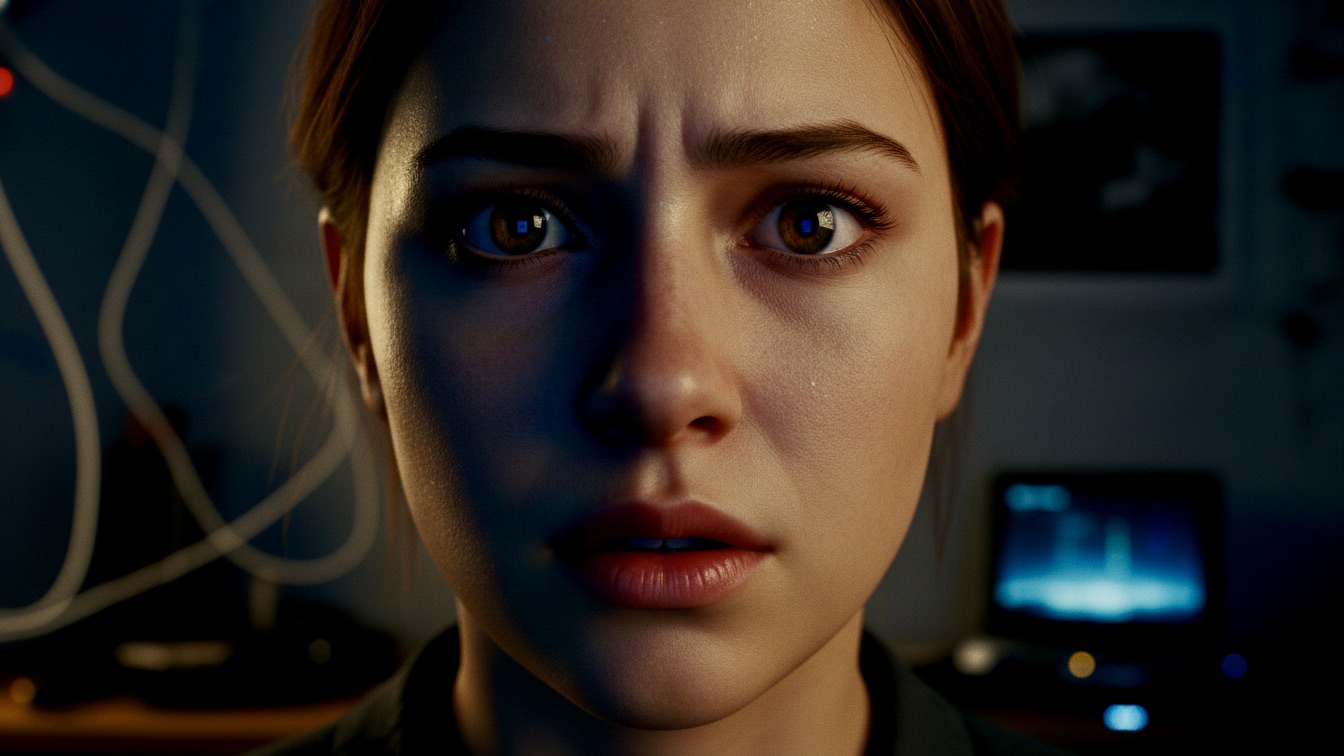
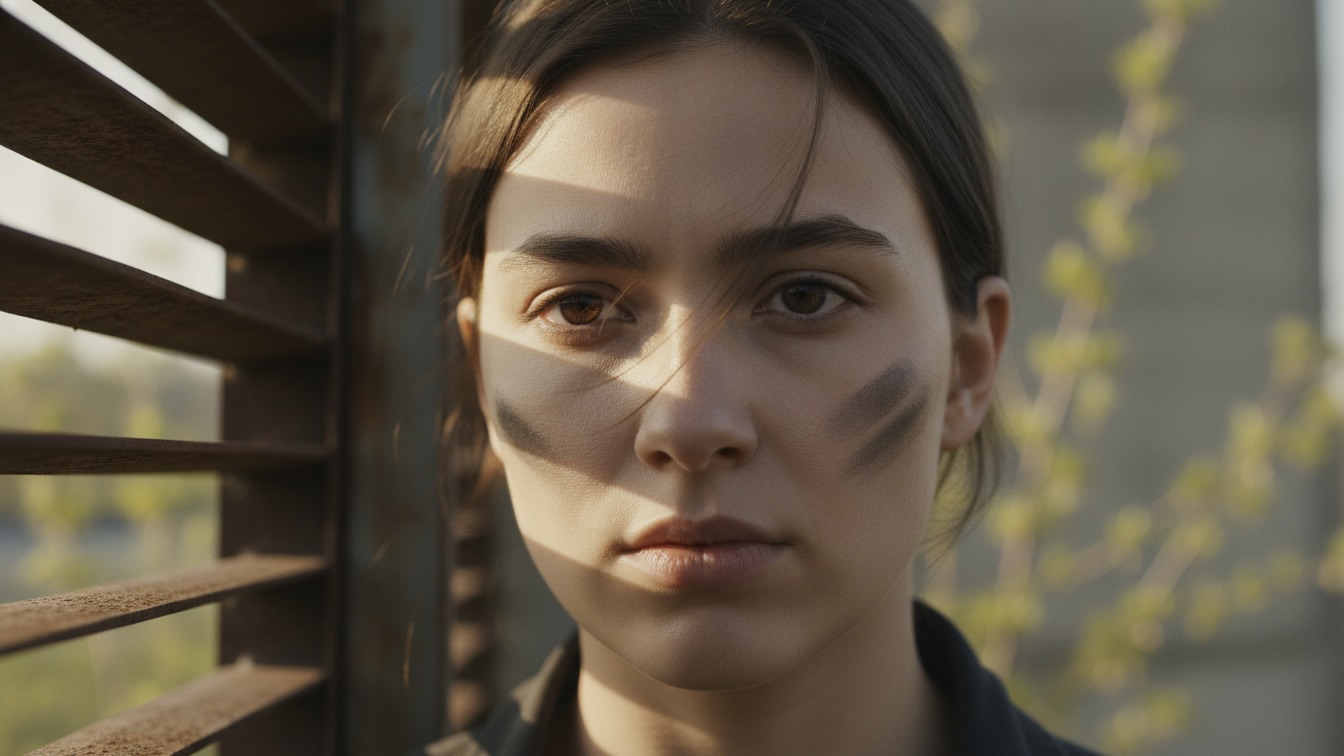
The sky was screaming with their names. Jenn ran until her lungs tasted like pennies and the city burned.
The silence in Arnie’s apartment was heavy. It wasn't the good kind of quiet. It was the kind that happened right before a bomb went off. Jenn stood by the window and watched the world break. On the street forty stories down, the tiny dots that were people had stopped moving. They were looking up.
They were looking at the giant screens that usually sold them happiness and synthetic protein.
Now, those screens were screaming. They showed names. They showed faces. They showed the truth about the farms. Maya’s face was still up there, ten stories tall, her bruised eye a dark smear against the night sky. Jenn felt a sudden, sharp rush of air in her lungs. It was like she’d been underwater for years and someone finally pulled her up. The claustrophobia of the cubicle, the weight of the delete key, the constant pressure to look away—it was all gone. She could breathe. It hurt, but it was real.
“Jenn, move!” Arnie’s voice cracked. He was shoving a mess of cables and black plastic boxes into a canvas bag. His hands were shaking so hard he dropped a hard drive. It hit the floor with a hollow thud. “They’re coming. The ping back. They know where we are. They’ve known since the second the upload hit fifty percent. Move!”
Jenn didn't move. She was watching a security drone hover in front of a billboard. The drone looked confused. Its red eye scanned the screen, trying to find a glitch to fix, but the whole world was a glitch now. The system was eating itself. “We did it, Arnie. Look at them.”
“I’m looking at our death warrants,” Arnie snapped. He grabbed her arm, his fingers digging into her jacket. He hauled her away from the window. “The Sector Police don't do trials for this. They do erasures. If we stay here, we’re just data points they need to scrub. Come on!”
They bolted into the hallway. The lighting was a flickering, sickly yellow. The air smelled like wet trash and old electricity. Jenn’s boots hit the concrete floor, the sound echoing up and down the hollow spine of the building. They didn't even try the elevator. It was a metal coffin. Arnie pushed open the door to the stairs. The stairwell was a concrete throat, dark and narrow. They started to run. Fourteen floors. Her knees clicked with every step. Her heart was a frantic drum in her ears. Somewhere below them, a heavy metal door slammed. Then another. The sound of boots. Not civilian boots. Heavy, synchronized, tactical.
“Down or up?” Jenn whispered, her voice catching in her throat.
“Down is where they’re coming from. Up is a dead end,” Arnie said. He was leaning over the railing, looking into the darkness. “Middle. We hit the sixth floor, take the sky-bridge to the parking garage. It’s unmonitored. Mostly.”
They took the stairs two at a time. Jenn’s vision was tunneling. The walls felt like they were leaning in, trying to catch her. She thought about Maya. Was Maya seeing this? Was there a screen in that concrete hellhole? Did she know her face was lighting up the city? The thought gave Jenn’s legs a second wind. She wasn't just running for herself. She was running because the secret was out, and secrets were the only thing that kept the State strong. Without the silence, the State was just a bunch of guys in armor with bad optics.
They reached the sixth floor. Arnie kicked the door open. The hallway here was even worse, the ceiling tiles sagging from some ancient leak. They ran past doors where people were shouting. Radios were blaring. The broadcast was everywhere. Jenn saw a glimpse of a family through a half-open door—a mother holding her kids, all of them staring at a tablet screen that was bleeding raw data. The mother looked at Jenn. Her eyes were wide, terrified, and awake. For the first time, people were awake.
“The bridge!” Arnie pointed.
It was a rusted cage of steel and plexiglass hanging between two buildings. The spring wind whistled through the gaps, carrying the scent of damp pavement and something burning. As they stepped onto the bridge, the city sky changed again. The State was trying to fight back. The screens flickered. For a second, a generic 'System Maintenance' graphic appeared, but then it shattered. Arnie’s code was a virus. It didn't just play a video; it rewrote the display drivers. The names came back. A list of ten thousand people who didn't exist anymore, scrolling like a digital waterfall.
“Arnie, look,” Jenn said, stopping in the middle of the bridge.
Below them, the street had turned into a riot. It wasn't organized. It was just a massive, collective 'no.' People were throwing things at the security drones. A police transport was stuck in the middle of a crowd, its sirens wailing, but nobody was moving. The fear was gone. It had been replaced by a raw, jagged energy.
“Don't stop!” Arnie yelled. He was already at the other end of the bridge, fumbling with a keycard. “The drones have facial recognition. If one of them pings you, it’s over.”
As if on cue, a high-pitched whine filled the air. A surveillance drone, smaller and faster than the ones on the street, banked around the corner of the building. Its red lens locked onto Jenn.
“Target identified,” a flat, synthetic voice chirped.
“Run!” Arnie screamed.
Jenn didn't think. She just moved. The drone dived. She felt the wind from its rotors as it zipped past her head. It was trying to get a clear angle for a stun-dart. She reached the end of the bridge and dove through the door Arnie was holding open. They slammed it shut, the metal booming in the empty parking garage. The drone hit the door a second later—a dull clink of carbon-fiber against steel.
“It’ll call for backup,” Arnie panted. He was slumped against a concrete pillar, his face white. “We need a car. Something old. Something without a GPS link.”
“In this neighborhood?” Jenn looked around. The garage was full of rusted-out husks and Tier 4 commuters. Most of them were electrics with hard-wired State trackers.
“There,” Arnie said, pointing to a corner. It was an old internal-combustion relic, a boxy thing covered in a decade of dust. “That’s Miller’s. He’s been rebuilding the engine for years. It’s purely mechanical.”
“Can you start it?”
Arnie grinned, a manic, terrified look. “I’ve been waiting for an excuse to steal this thing since I moved in.”
He smashed the window with a heavy wrench from his bag. The glass didn't shatter into pretty pieces; it crumbled into grit. He reached in, popped the hood, and started messing with the wires. Jenn stood guard, her eyes fixed on the door they’d just come through. Her heart was finally slowing down, settling into a hard, steady rhythm. The air in the garage was stale, but she could still feel that 'oxygen' sensation. The truth was out. The world was messy now. It was dangerous. But it wasn't a lie.
“Got it!” Arnie shouted.
The engine roared to life. It was a loud, coughing sound that spat blue smoke into the air. It sounded like a prehistoric beast waking up. It was the loudest thing Jenn had ever heard. Compared to the silent, hum-less electrics of the city, it felt like a revolution in itself.
“Get in!”
Jenn hopped into the passenger seat. The interior smelled like oil and old foam. Arnie slammed it into gear. The car lurched forward, tires screeching on the smooth concrete. They hit the exit ramp, the engine screaming as Arnie floored it. They burst out of the garage and into the chaos of the street.
It was a war zone. The spring rain had started to fall, a light drizzle that turned the neon lights into blurry smears. The air was thick with the smell of ozone and tear gas. Protesters were clashing with a line of riot police three blocks down. The police looked like robots in their black shells, but the people were more like a wave. They were flowing over the barriers, fueled by the faces on the screens.
Arnie steered the car onto a side street, his hands white on the steering wheel. “We need to get to the tunnels. If we can get to the Dead Zone, we can disappear. They haven't had active sensors there in years.”
“What about Maya?” Jenn asked. She was staring out the window. They were passing a small park. A group of teenagers were spray-painting a name on a statue. It was Maya’s name.
“We can't help her if we’re dead, Jenn,” Arnie said, his voice softening. “The leak is the help. People know now. The State can't just delete her anymore. She’s not a glitch. She’s a person. Everyone knows she’s a person.”
Jenn leaned her head against the cool glass. She felt a tear track down her cheek, but she didn't wipe it away. For the first time in her life, she didn't feel like a ghost. She felt heavy. She felt solid. She felt like she mattered.
They drove through the back-alleys, avoiding the main arteries where the fighting was thickest. Every time they passed a screen, Jenn looked. The data was still there. The State’s firewalls were failing. It was a total system collapse.
“Almost there,” Arnie muttered. He turned the car toward an old industrial district. The buildings here were skeletons, their windows broken like missing teeth. This was the edge of the Dead Zone—a place the city had forgotten during the last recession.
Suddenly, the car's radio crackled to life. It wasn't music. It wasn't news. It was a voice. Cold, calm, and terrifyingly familiar.
“This is an emergency broadcast from the Office of State Stability,” the voice said. It was Greg. Her supervisor. But he didn't sound like the guy who smelled like peppermint anymore. He sounded like a machine. “Citizens are advised to return to their homes immediately. A localized digital terrorist attack has compromised public safety feeds. The images you are seeing are AI-generated deepfakes designed to incite violence. Do not believe the lies. The State is your protector. The State is your truth.”
“They’re trying to gaslight the whole city,” Arnie said, gritting his teeth.
“It won't work,” Jenn said. “They saw the names, Arnie. They saw their own neighbors. You can't un-see that.”
They reached a rusted chain-link fence. Arnie didn't stop. He rammed the car through it, the metal screeching as it tore away. They bounced over a field of rubble and stopped in front of a low, nondescript concrete bunker. It was an old pumping station, half-buried in the earth.
“This is it,” Arnie said, cutting the engine. The silence that followed was deafening. No sirens. No shouting. Just the sound of the rain hitting the metal roof of the car.
They got out. The air was cold now, a sharp spring chill that bit through Jenn’s thin jacket. She looked back toward the city center. The skyline was a mess of flickering lights. The giant screens were still glitching, a chaotic strobe light of truth against the dark clouds.
“We go underground here,” Arnie said, pulling a heavy iron grate off the floor of the bunker. “There’s a network of maintenance tunnels that lead to a safehouse. It’s a bunker built by the old unions. It’s off the mesh. No signals in, no signals out.”
Jenn looked at the dark hole in the ground. It looked like another cage. But as she inhaled the damp, earthy air, she realized it wasn't. It was a hiding spot. A place to regroup.
“Arnie?”
“Yeah?”
“Thank you.”
Arnie looked at her, his face smudged with grease and exhaustion. He gave a small, tired nod. “Don't thank me yet. We’re officially the most wanted people in the sector. Tomorrow is going to be a lot worse than today.”
“I know,” Jenn said. She looked at her hands. They weren't shaking anymore. She felt a strange, quiet power. She was a data censor who had stopped censoring. She was a ghost who had found her voice.
They descended into the dark. The grate clanged shut above them, sealing them away from the world. But as they walked into the shadows, Jenn didn't feel afraid. She felt like she was finally moving in the right direction.
Hours passed in the tunnels. The air was thick with the smell of old stone and stagnant water. They walked in silence, guided only by the dim glow of Arnie’s flashlight. Every sound—a dripping pipe, a scurrying rat—made them jump. The adrenaline was wearing off, replaced by a bone-deep fatigue that made every step a struggle.
Finally, they reached a heavy steel door marked with a faded red star. Arnie entered a code on a mechanical keypad. The door groaned open, revealing a small, cramped room filled with bunk beds, canned food, and a wall of old-fashioned analog monitors.
“Welcome home,” Arnie said, dropping his bag on the floor. He collapsed onto one of the bunks, his eyes closing before his head even hit the pillow.
Jenn didn't lie down. She went to the monitors. Most of them were dead, but one was flickering with a grainy, black-and-white feed from a street camera near the apartment.
She watched the screen. The riot had moved on, leaving the street empty. The rain was coming down harder now, washing the soot and tear gas into the gutters. But the billboard across the street was still working. It wasn't showing Maya anymore. It was showing something else.
A list of names. New names.
Jenn felt her stomach drop. She leaned closer to the screen, her breath fogging the glass. At the top of the list, in bright, bold letters, were two names.
Jenn Carter. Arnie Victor.
Status: RELOCATED.
She stared at her own name. The State had already erased her. On paper, she was gone. She was at a farm. She was a ghost. But as she felt the cold metal of the monitor under her fingertips, she knew the truth. She was more alive than she had ever been. She looked at the list of names, the thousands of people the State had tried to hide. They weren't just names anymore. They were an army.
She turned away from the screen and looked at the small, dark room. It was a cell, but it was their cell. And outside, the city was still burning. The spring had finally come, not with flowers, but with fire and light.
She sat on the edge of her bunk and pulled Maya’s drive from her pocket. She held it tightly. It was the only evidence that any of this was real. She closed her eyes and listened to the silence of the bunker. It wasn't the silence of the office. It was the silence of a breath being held.
The city was waiting. And so was she.
She realized then that the upload wasn't the end. It was just the beginning. The State would hunt them. They would try to rewrite the story. They would try to turn the truth back into static. But you can't put the oxygen back in the bottle once it’s out.
Jenn laid back on the thin mattress. Her body ached, and her mind was a blur of faces and code. But for the first time in her life, when she closed her eyes, she didn't see the blur tool. She saw the sky.
It was a dark, messy, rain-soaked sky, but it was hers.
She drifted off to sleep, the sound of Arnie’s steady breathing the only thing keeping her grounded. In her dreams, she was back in the cubicle, but the monitor was a window. And when she reached out to click, the screen didn't delete. It opened.
She woke up a few hours later to the sound of a distant explosion. The floor of the bunker vibrated slightly. She sat up, her heart racing. Arnie was already awake, sitting at the desk, his face illuminated by the glow of the single working monitor.
“What was that?” she whispered.
Arnie didn't look back. He just pointed at the screen.
The feed was from the city center. The State Media Authority building—Jenn’s office—was on fire. A massive plume of black smoke was rising into the rainy morning air. The crowd wasn't just protesting anymore. They were taking back the tools of their own erasure.
Jenn watched the flames. She thought about her desk. Her coffee mug. The gray carpet. It was all burning. Everything she had been was ash.
“They’re doing it,” Arnie said, his voice hushed with awe. “They’re actually doing it.”
Jenn stood up and walked to his side. She watched the screen as the symbols of the State crumbled. It was violent, and it was terrifying, but it was the most beautiful thing she had ever seen.
“What now?” she asked.
Arnie turned to her. He looked older, the stress of the last twelve hours etched into his face. But he didn't look scared anymore.
“Now,” he said, reaching for his bag. “We find Maya.”
“She watched the State Media building burn on the grainy monitor, knowing their names were now the most dangerous data in the city.”