

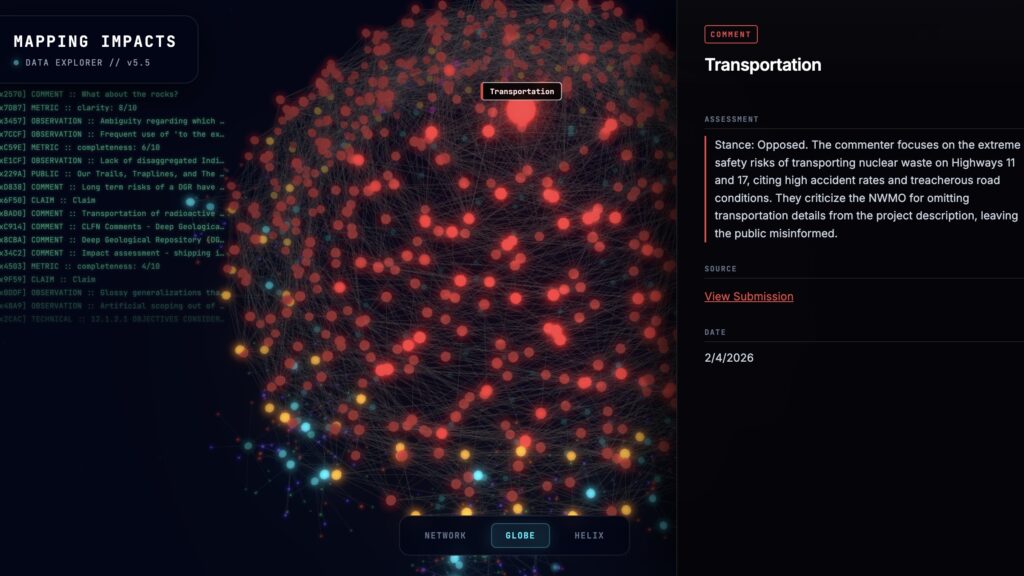
This is a visualization of all the comments and data we've been analyzing as part of our submissions to the Impact Assessment Agency of Canada regarding the NWMO Deep Geological Repository for Nuclear Waste Fuel.
Consolidated Overview from February 9, 2026
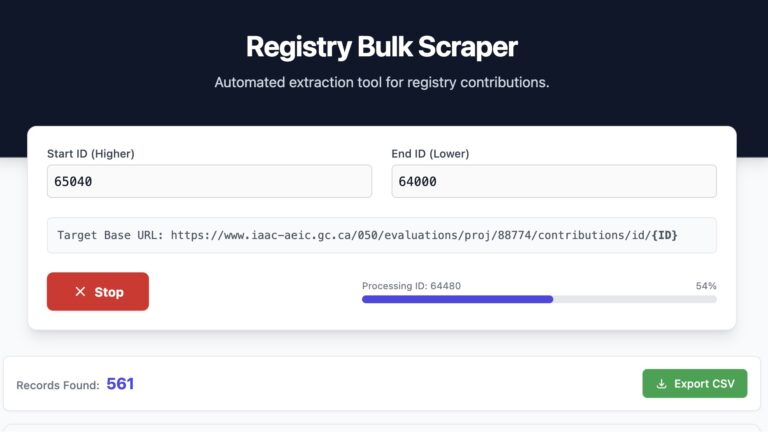
As part of our community programming, we’ve been looking through the hundreds of comments made to the Impact Assessment Agency of Canada’s public registry related to the NWMO Deep Geological Repository for Waste Nuclear Fuel. Here’s what our latest analysis from February 9, 2026 show. We still have some records to analyze, but here’s what today’s report shows:
Summary
The forensic review of public submissions regarding the Revell Site Deep Geological Repository (DGR) reveals a highly polarized landscape with a dominant trend of opposition.
While a minority of submissions, primarily from industry-adjacent individuals or local residents anticipating economic growth, support the project, the vast majority of comments express profound distrust in the regulatory process, the Nuclear Waste Management Organization (NWMO), and the safety of the proposed transportation logistics.
The sentiment is characterized by a rejection of the “willing host” model, with stakeholders arguing that the risks are regional and intergenerational, rather than localized to the municipality of Ignace. Our initial results show:
- Support: 10%
- Opposed: 76%
- Neutral/Undeclared: 14%
Language Analysis
A linguistic audit of the submissions highlights a distinct divergence in the framing of the project, reflecting fundamentally different value systems between the two groups.
Supporters use: Terminology focused on technocratic competence and economic pragmatism. Common descriptors include “science-based,” “highly regulated,” “clean energy,” “opportunity,” “economic boost,” “responsibility,” “solution,” and “misinformation” (often used to dismiss opposition). They frequently refer to the project as a “necessary step” for climate goals.
Opponents use: Terminology focused on existential risk, ethics, and systemic failure. Common descriptors include “unproven,” “abandonment,” “poison,” “mobile Chernobyl,” “catastrophic,” “bribe” (referring to financial incentives), “sham,” “unethical,” “sacrifice zone,” and “hubris.” There is a heavy reliance on terms related to time, such as “forever,” “eternity,” and “intergenerational.”
Procedural Fairness & The 30-Day Window
The audit identifies a critical procedural failure regarding the public consultation timeline, which multiple stakeholders have flagged as a functional barrier to democratic participation. A recurring and specific complaint cites the impossibility of reviewing the Initial Project Description (IPD) within the allotted 30-day comment window.
Submissions explicitly note that the IPD exceeds 1,200 to 1,300 pages of complex technical data (Ref: 21, 116, 140, 244). Stakeholders argue that expecting volunteer-run groups, Indigenous communities, and laypersons to digest, analyze, and respond to a document of this magnitude in four weeks is “patently unfair” (Ref: 21) and constitutes a “mockery” of the engagement process (Ref: 140). This compressed timeline is viewed not merely as an administrative oversight, but as a strategic exclusion of meaningful public scrutiny.
Furthermore, the audit reveals that this timeline disproportionately disenfranchises vulnerable populations and those in unorganized territories who lack the resources for rapid technical review.
Commenters emphasize that the 30-day window is “ludicrously short” (Ref: 164) for a project with a 160-year operational lifespan and millennial-scale hazards. Specific objections highlight that while a summary was available, the full 1,233-page document required for a “lengthier study” was difficult to access physically or digitally for those with limited internet connectivity (Ref: 207).
Consequently, the regulatory body must recognize that the brevity of this window has damaged the legitimacy of the assessment process, leading to accusations that the timeline was designed to prioritize industry schedules over public due diligence.
Governance, Transparency & Accountability
Transparency & Information Access
A significant volume of submissions identifies procedural barriers that stakeholders argue have impeded meaningful public scrutiny of the Initial Project Description. The regulatory comment period was established at 30 days, a timeframe that numerous commenters contend is functionally insufficient for reviewing over 1,200 pages of technical documentation.
For example, Comment #140 characterizes the timeline as a “mockery” of the assessment process, noting that the deadline for participant funding applications coincided with the review period, creating an overlapping burden that hindered effective participation. Further concerns regarding accessibility were raised in Comment #207, which reports that physical copies of the project description were scarce, restricted to on-site viewing at limited locations, and often consisted of summarized versions rather than the full technical text.
Digital accessibility issues were also cited as a barrier to transparency. Comment #116 asserts that digital portal glitches and the reliance on online documentation disenfranchise residents in unorganized territories who lack reliable internet access.
Similarly, Comment #85 reports technical failures within the Impact Assessment Agency’s web interface, specifically a lack of session timeout warnings that resulted in the loss of drafted submissions. Beyond logistical hurdles, there are specific allegations regarding the curation of public information.
Comment #238 alleges that the Nuclear Waste Management Organization (NWMO) removed research papers from their website after safety questions were raised by the public, while Comment #284 criticizes promotional materials for depicting a hand near a fuel rod without adequate radiation warnings, which the stakeholder views as a manipulation of the truth regarding waste safety.
The scope of data provided to the public has also been challenged. Comment #69 identifies a “transparency barrier” resulting from the confidentiality of the hosting agreement with the Wabigoon Lake Ojibway Nation, arguing that this prevents regulatory oversight of social and environmental safeguards.
This is compounded by claims in Comment #256 that the NWMO has admitted key baseline data regarding Indigenous social, cultural, and health factors remains uncharacterized. Consequently, stakeholders argue that the current information landscape prevents the “informed” component of informed consent, as critical socio-demographic data and contractual details remain shielded from public view.
Allegations of Secret Agreements & Conduct
Serious allegations regarding the financial and ethical conduct of the proponent and local officials appear frequently in the dataset. Multiple commenters characterize the financial incentives offered to host communities not as standard economic benefits, but as “bribery” or “economic coercion” designed to manufacture consent in economically vulnerable regions.
Comment #595 characterizes “learning funds” as bribery, while Comment #231 specifically points to the provision of a new fire truck to the community of Ignace as a suspicious inducement rather than a genuine safety measure. These financial flows are described in Comment #604 as “fraudulent” manipulation, with stakeholders in Comment #541 arguing that such incentives compromise the integrity of the site selection process.
Concerns regarding non-disclosure agreements (NDAs) and the suppression of dissent are prevalent. Comment #200 describes hosting agreements with municipalities as “virtual gag orders” that effectively suppress criticism and prevent transparent discourse.
This perception of secrecy is echoed in Comment #256, which describes the confidential nature of the Wabigoon Lake Ojibway Nation agreement as a “regulatory black box.” Furthermore, Comment #600 contains serious allegations that local leaders and the NWMO used bullying, harassment, and defamation to secure town approval, further claiming that online records of these unethical practices were subsequently deleted.
There are also allegations of inequitable financial negotiations that have fostered community division. Comment #183 describes the Host Community Agreement for Ignace as “unfair” and “disgusting” when compared to the significantly larger financial packages offered to other groups, such as an alleged $4 billion agreement mentioned in relation to the Wabigoon Lake Ojibway Nation.
Comment #89 supports this view, noting that the disparity in negotiated funds has led to resentment and a feeling that the community was taken advantage of by the proponent. These financial discrepancies are cited in Comment #116 as a cause of internal social fragmentation and a breakdown of trust within the region.
Democratic Integrity & Public Trust
The integrity of the democratic process used to determine “willingness” is a central point of contention. Comment #566 alleges that the vote in Ignace was illegitimate due to the inclusion of minors and out-of-province voters, while residents living in close proximity to the site but outside municipal boundaries were excluded.
This “willing host” model is criticized in Comment #148 as deeply flawed, allowing a single municipality to make decisions with broad regional implications without the input of neighboring First Nations or regional residents. Comment #303 reinforces this, arguing that the definition of a willing host arbitrarily excludes downstream and transportation corridor communities, thereby manufacturing a mandate that does not genuinely exist.
The dataset reflects a profound erosion of public trust in both the proponent and regulatory bodies. Comment #5 cites survey results indicating that 96% of respondents are uncomfortable with the nuclear industry managing the NWMO, and 92% believe the siting process was unfair.
This distrust extends to the municipal level, with Comment #187 describing a “toxic environment” within the town of Ignace characterized by staff firings, legal disputes, and internal arguments that have destroyed public confidence in local leadership. Furthermore, Comment #200 alleges collusion between the Impact Assessment Agency of Canada (IAAC), the Canadian Nuclear Safety Commission (CNSC), and the NWMO to “divide and conquer” the public by splitting transportation assessments from the main project scope.
Finally, there are concerns that the governance structure ignores established democratic opposition. Comment #266 argues that the decision-making process is undemocratic and calls for a public referendum. Comment #564, representing the Teme-Augama Anishnabai, and Comment #28, representing Eagle Lake First Nation, assert that the project is proceeding despite the lack of Free, Prior, and Informed Consent (FPIC) from impacted Indigenous Nations.
The perception that the process is designed to bypass opposition is summarized in Comment #426, which alleges that the community of Ignace has been manipulated through aggressive public relations campaigns, leaving the public to bear long-term risks while private entities profit.
Environment
Stakeholders have articulated significant apprehension regarding the hydrogeological and ecological integrity of the proposed Deep Geological Repository (DGR) site within the Revell Lake area. A primary area of contention involves the site’s location at the headwaters of the Wabigoon and Rainy/Turtle River watersheds, which flow into the Lake of the Woods, Lake Winnipeg, and ultimately Hudson Bay.
Commenters have alleged that the placement of high-level nuclear waste in this location poses an unacceptable risk of radionuclide leaching into interconnected freshwater systems. There are specific fears that any failure in the engineered barriers could result in the irreversible contamination of downstream aquifers and surface waters, potentially impacting drinking water sources and traditional harvesting areas for Indigenous communities and municipalities across Northwestern Ontario and Manitoba.
Technical concerns were also raised regarding the geological stability of the Canadian Shield, which proponents have cited as a stable medium for containment. Opposing submissions have challenged this assumption, citing the potential for seismic activity, “rock bursts,” and the formation of new fractures due to future glacial cycles or the “thermal pulse” generated by the decaying waste.
Critics argue that the heat emanating from the spent fuel could compromise the surrounding rock and degrade the bentonite clay buffers intended to seal the canisters. Consequently, there is a pervasive lack of confidence in the theoretical models used to predict rock integrity over the required timeframe of hundreds of thousands of years, with some stakeholders characterizing the project as an unproven experiment in a dynamic geological environment.
Furthermore, the potential impact on the boreal ecosystem and local wildlife has been highlighted as a critical environmental risk. Submissions have detailed concerns regarding the bioaccumulation of radioactive isotopes in the food chain, specifically threatening species such as moose, migratory birds, fish, and species at risk like the Black Ash.
Commenters have argued that the industrialization of this “pristine wilderness” through excavation and operation—and the alleged eventual “abandonment” of the waste—could lead to permanent ecological degradation. There are also ethical objections to the potential exposure of flora and fauna to ionizing radiation, with some stakeholders demanding non-lethal monitoring methods and a zero-discharge standard for effluents to protect the region’s biodiversity.
Transportation
The logistics of transporting high-level nuclear waste from Southern Ontario to the proposed site in Northwestern Ontario represent a dominant source of opposition in the submitted comments. Stakeholders have expressed grave alarm regarding the safety of utilizing the Trans-Canada Highway (Highway 17) and Highway 11 for the estimated 50-year duration of the project.
These routes are frequently described by residents as the “Highway of Death” due to their configuration as largely two-lane, undivided roads featuring sharp curves, rock cuts, and limited shoulders. Specific concerns were raised regarding the high frequency of transport truck accidents in the region, often exacerbated by severe winter conditions, ice, whiteouts, and wildlife collisions involving moose. Commenters allege that introducing thousands of shipments of radioactive material to this infrastructure creates a statistical inevitability of a catastrophic accident.
A significant procedural and regulatory objection involves the exclusion of transportation risks from the Initial Project Description (IPD). Many stakeholders view this omission as “project splitting,” arguing that the repository cannot function without the transport of waste and that the risks are therefore intrinsic to the project.
Critics contend that the current assessment fails to account for the cumulative radiation exposure to communities along the corridor, the potential for “mobile Chernobyl” scenarios, or the security risks associated with moving hazardous materials over 1,500 kilometers. There is a strong demand for the Impact Assessment to be expanded to include a comprehensive review of these logistical risks, rather than deferring them to separate regulatory processes.
Finally, serious concerns have been raised regarding the emergency response capabilities of the regions through which the waste would travel.
Submissions highlight that many areas along the route, particularly in Northern Ontario, rely on volunteer fire departments that allegedly lack the specialized training, equipment, and funding to manage a radiological spill or fire.
Commenters fear that a significant accident could not only cause environmental devastation but also sever the Trans-Canada Highway—the nation’s primary east-west artery—isolating communities and disrupting essential supply chains. The lack of detailed emergency evacuation plans for “corridor communities” has further fueled the perception that the transportation plan prioritizes industry timelines over public safety.
Indigenous Peoples
A predominant theme across the submissions is the assertion that the project may violate the United Nations Declaration on the Rights of Indigenous Peoples (UNDRIP), specifically regarding the principle of Free, Prior, and Informed Consent (FPIC). Numerous commenters, including representatives from Eagle Lake First Nation and Grassy Narrows, allege that the Nuclear Waste Management Organization (NWMO) has failed to secure broad consent across Treaty #3 territory.
Concerns were raised that the “willing host” model focuses too narrowly on the Wabigoon Lake Ojibway Nation, thereby marginalizing neighboring and downstream Indigenous communities who assert that their treaty rights and traditional territories will be irrevocably impacted by the repository and associated transportation activities.
Significant friction has been reported regarding the consultation process itself, with the Manitoba Métis Federation (MMF) and other groups arguing that the engagement has not been distinction-based or inclusive of all rights-holders.
Commenters have characterized the process as “pan-Indigenous,” alleging that it fails to account for the specific governance structures and territorial claims of the Red River Métis and other non-host nations.
Furthermore, there are allegations that the consultation process has been divisive; several submissions describe a “divide and conquer” strategy where financial incentives offered to host communities have reportedly created social fragmentation and conflict between Indigenous groups, rather than fostering genuine regional consensus.
Cultural and spiritual objections are also central to the opposition, with many commenters citing violations of Manito Aki Inakonigaawin (the Great Earth Law). Submissions emphasize a sacred, reciprocal responsibility to protect the land (“Mamma Aki”) and water for future generations, arguing that the burial of radioactive waste is fundamentally incompatible with Anishinaabe stewardship laws.
There are deep-seated fears that the project threatens traditional harvesting rights, including hunting, fishing, and the gathering of medicines, by introducing a risk of radiological contamination to the watershed. The exclusion of Indigenous Knowledge regarding the spiritual sentience of the land and the long-term protection of water systems was frequently cited as a critical flaw in the proponent’s methodology.
Socio-Economic Impacts
The submissions reveal a sharp divide regarding the economic implications of the project, with a significant focus on the potential for “boom and bust” cycles. While some supporters highlighted the promise of high-paying, long-term jobs and economic revitalization for Ignace, many opponents raised concerns about the stability of this growth.
There are fears that a rapid influx of transient workers could overwhelm local infrastructure, leading to housing shortages, inflated costs of living, and a strain on municipal services that small northern communities are ill-equipped to handle. Commenters noted that once the construction phase concludes, the region might be left with expanded infrastructure it cannot maintain, mirroring historical patterns of resource extraction industries in the north.
A major socio-economic concern involves the potential stigmatization of Northwestern Ontario. Business owners, particularly those in the tourism and outdoor recreation sectors, expressed fear that branding the region as a “nuclear waste dump” would deter visitors who come for the pristine wilderness.
Lodge owners and outfitters argued that the mere perception of radiological risk could devastate the local tourism economy, leading to a loss of livelihoods that outweighs the jobs created by the repository. Additionally, concerns were raised regarding property devaluation, with residents fearing that homes and camps along the transportation route or near the site would become unsellable due to radiation fears.
The capacity of local emergency services to handle the project’s risks was a recurring theme. Numerous submissions highlighted that the region relies heavily on volunteer fire departments and limited medical facilities, which are alleged to be insufficient for managing a radiological emergency.
Commenters argued that the introduction of thousands of nuclear waste shipments over decades would place an undue burden on these volunteer first responders. There is a pervasive concern that the costs of emergency preparedness, training, and potential accident remediation would fall on local municipalities rather than the proponent, creating a long-term fiscal liability for the region.
Finally, the issue of regional equity was frequently cited as a socio-economic injustice. Many commenters argued that Northwestern Ontario is being asked to bear the long-term risks of waste generated primarily for the benefit of Southern Ontario’s energy consumers.
This dynamic was described by some as a form of exploitation, where the economic benefits of nuclear power are concentrated in the south while the hazardous byproducts are exported to the north.
Conversely, supporters viewed the project as a unique opportunity for the north to lead in high-tech environmental management, though this view was often overshadowed by concerns regarding the equitable distribution of risk and reward.
Final Conclusion
The volume and intensity of the submissions indicate that the proposed Deep Geological Repository lacks a broad social license in Northwestern Ontario. This is a visualization of all the comments and data we’ve been analyzing as part of our submissions to the Impact Assessment Agency of Canada regarding the NWMO Deep Geological Repository for Nuclear Waste Fuel.The evidence provided by the public highlights critical gaps in the Initial Project Description, most notably the exclusion of transportation risks, which stakeholders view as an inseparable component of the project. Furthermore, the profound opposition from multiple Indigenous Nations, grounded in treaty rights and spiritual obligations, suggests that the current engagement process has not satisfied the requirements for Free, Prior, and Informed Consent. The allegations of economic coercion and the potential for irreversible socio-economic stigmatization of the region further complicate the project’s viability.
Given the unprecedented timescale of the hazard (millennia), the complexity of the technical challenges (geological stability, container integrity), and the depth of the ethical and legal objections raised, a standard assessment is insufficient. The concerns regarding the “boom/bust” socio-economic impacts, the strain on volunteer emergency services, and the transboundary risks to watersheds shared with Manitoba and the United States necessitate the highest level of scrutiny. Therefore, the evidence overwhelmingly supports the referral of this project to an independent Review Panel to ensure a transparent, comprehensive, and impartial examination of the long-term risks to current and future generations.
Learn More
You can read the full registry of public comments on the Impact Assessment Agency of Canada’s web site. You can learn more about our program here.
About the Author