Format: Short Film / Anthology Episode | Est. Length: 10-12 minutes
Imagine a contemporary anthology series, in the vein of Black Mirror or The Twilight Zone, that dissects the dark side of our hyper-connected, content-driven world. Each episode is a self-contained narrative exploring the unintended consequences of social media, influencer culture, and the relentless pursuit of online validation. "For The Content" serves as a chilling entry point into this world, a gritty cautionary tale where the line between observer and subject is violently erased.
A desperate influencer, Trista Roberts, struggles to get her livestream working at a chaotic street protest. As the connection finally stabilizes, her frustrated, authentic self vanishes, replaced by a curated persona of a brave "Truth-Seeker" ready to capture the "vibe" for her dwindling audience.
A clout-chasing influencer, whose livestream from a protest is failing, desperately provokes a group of mysterious armed men for viral content. The tables are turned when they seize her camera and make her the unwilling star of her own terrifying broadcast.
The episode is a sharp critique of performative authenticity and the commodification of human experience for online engagement. It explores the dangerous narcissism inherent in influencer culture, where real-world events, and the people within them, are reduced to backdrops and props for a personal brand. A central theme is the violent collision between curated online reality and the brutal, unpredictable nature of the physical world, asking a chilling question: when you live for the content, what happens when you become it?
Furthermore, the story delves into the loss of control and the illusion of power afforded by a phone camera. Trista wields her gimbal and phone like a weapon and a shield, believing it gives her authority and separates her from the events she covers. The final, horrifying reversal demonstrates the fragility of that power, transforming her tool of self-promotion into an instrument of her own imprisonment and terror.
Initially, the stakes for Trista are purely professional: her online relevance, her brand, and her income are all tied to the viewer count of her livestream. As she fails to generate compelling content, she risks fading into obscurity and algorithmic irrelevance. These stakes escalate dramatically and violently when she confronts the armed men; her physical safety, her autonomy, and ultimately her life are put on the line as she loses control of the narrative and becomes a captive in her own broadcast.
The primary conflict is Trista versus her own desperation, personified by the fluctuating viewer count—an unforgiving, algorithmic god she must appease. This internal pressure drives her into a series of external conflicts. The first is with the protest medic, who represents an authentic reality that is unimpressed by and hostile to Trista's performative intrusion. The ultimate antagonistic force is the group of armed men, led by a calm, observant leader who embodies a cold, dangerous reality that cannot be manipulated, baited, or filtered for an audience.
Trista Roberts, a struggling influencer known as "TristaTruth," is live-streaming from a city protest, but her viewer count is plummeting. Desperate to create a viral moment, she first tries to manufacture a story by intruding on a medic treating a wounded protester. When the medic dismisses her with contempt, causing her audience to drop further, Trista's panic drives her to a more extreme subject: a small, disciplined group of heavily armed men observing the protest from the periphery.
Seeing them as the perfect source of dangerous, clickable content, Trista confidently confronts their leader, shoving her phone in his face and asking a deliberately provocative question. Instead of the explosive reaction she hopes for, the leader calmly identifies her as a threat and his men silently and efficiently surround her. They take her phone, flip the camera around to face her, and continue her livestream, turning a horrified Trista into the unwilling subject of her own broadcast as her viewer count begins to skyrocket.
TRISTA ROBERTS ("TristaTruth"): A woman in her mid-20s whose identity is inextricably linked to her online persona. At the start, she is a master of manufactured sincerity, projecting an image of a brave, empathetic journalist while her internal monologue is consumed by metrics and engagement. Her psychological arc is a rapid, brutal descent from a position of perceived control to one of absolute powerlessness, as the filter through which she views the world is shattered, leaving her stripped of her persona and trapped as a terrified, silent object of spectacle.
THE LEADER: A man in his 40s, calm, disciplined, and exuding an aura of quiet, professional menace. He is the antithesis of Trista's chaotic, performative world. He serves as the story's unmovable object, a representation of a reality that does not care about being filmed. He is observant, analytical, and his actions are precise, making him a far more terrifying antagonist than any loud, aggressive figure Trista might have expected.
THE MEDIC: A tired, overworked woman who briefly serves as a foil to Trista. She represents the grounded, authentic reality of the protest—a world of genuine consequence and pain. Her curt dismissal of Trista is the first crack in the influencer's facade, a moment where the real world refuses to play along with the narrative.
BEAT 1 (The Performance): Trista fumbles with her phone, her real frustration visible before the stream goes live. She instantly transforms into her "TristaTruth" persona, feeding her small audience platitudes about the "historical energy" of the protest, but the pathetic viewer count reveals her desperation.
BEAT 2 (Manufacturing a Narrative): Searching for content, Trista spots a medic treating a wounded woman. Announcing to her viewers that she's "going in," she approaches the scene, holding her camera out like a scepter, ready to create a story of front-line heroism.
BEAT 3 (Rejection and Panic): Trista's intrusive questions are met with a flat, cold rejection from the medic, who tells her to get out of the way. The authentic moment is one of humiliation, and as her viewer count plummets, a sharp panic sets in; she is failing, and the algorithm knows it.
BEAT 4 (The Pivot): Her eyes scan the chaos for a new angle and lock onto a group of armed, disciplined men standing apart from the crowd. A jolt of fear and opportunity runs through her; they are mysterious, dangerous, and perfect for the algorithm. She announces a new direction to her stream, her voice a conspiratorial whisper as she begins moving toward them.
BEAT 5 (The Confrontation): Trista walks directly up to the leader and shoves her phone in his face, asking a monumentally stupid, provocative question designed to elicit a viral reaction. The leader, however, doesn't take the bait; he ignores the camera, looks directly at her, and calmly speaks to his subordinate.
BEAT 6 (The Reversal): Following their leader's quiet command, the men fluidly and silently box Trista in. The leader takes her phone and gimbal with absolute authority, flips the camera view to her face, and leans into the microphone.
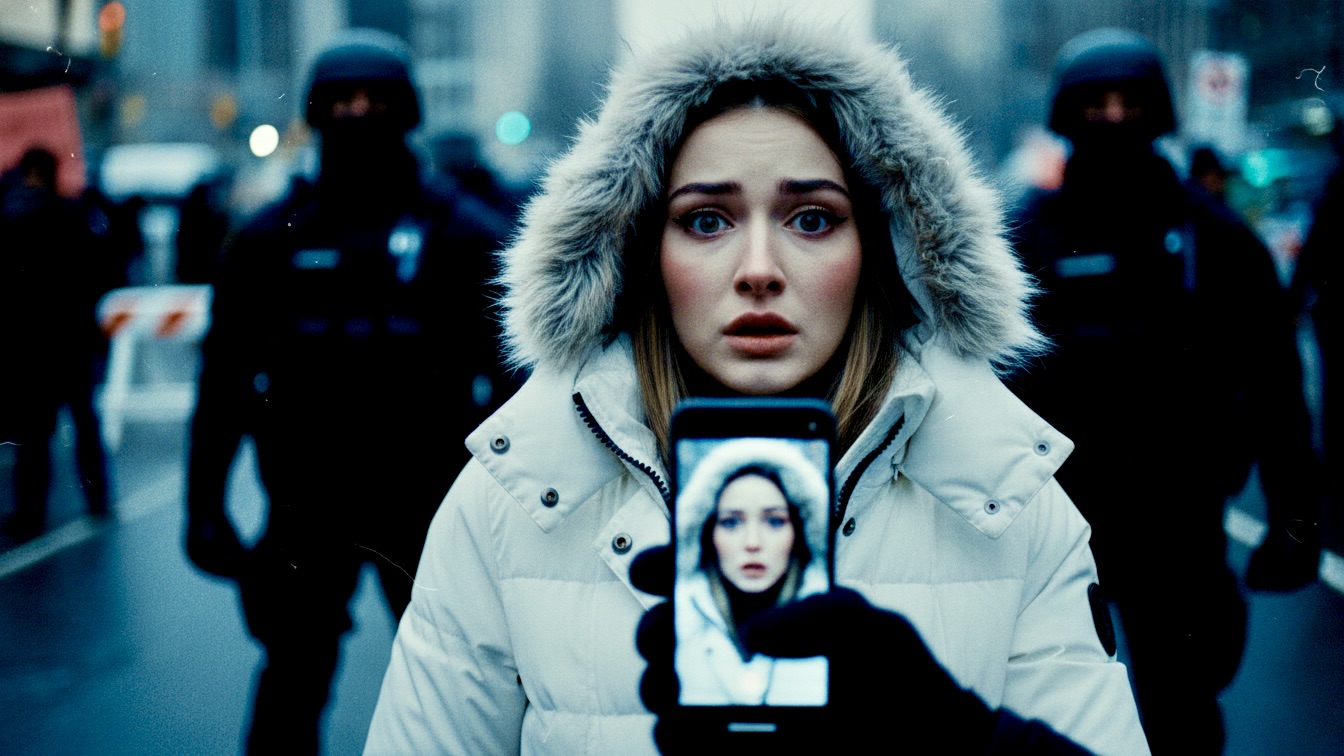
BEAT 7 (The Content): Trapped and terrified, Trista is forced to stare into her own phone as the leader tells her audience, "You wanted content. Now you're the content." The final shot is on her horrified face, framed by the on-screen graphics of her own livestream as the viewer count explodes upwards.
The episode's mood begins as biting social satire, inviting the audience to feel a sense of cringe and secondhand embarrassment at Trista's shallow performance. This emotional state shifts to rising tension and unease during her failed interaction with the medic. The moment she decides to approach the armed men, the mood turns sharply into one of suspense and dread, culminating in the final scenes with a feeling of claustrophobic, stark horror as the audience is forced to watch her become a victim of the very system she tried to manipulate.
As a standalone piece, this episode serves as a potent cautionary tale. If integrated into a larger season arc, the mysterious armed men could become a recurring, enigmatic presence. Their identity and purpose—are they private military, a government black ops team, or a political faction?—could form a central mystery. Subsequent episodes could feature other characters encountering this group from different perspectives, with each incident, captured on a different phone or security camera, revealing another piece of their agenda.
Trista's fate could also be a launching point. A following episode might focus on a true-crime vlogger analyzing Trista's final, viral stream, attempting to uncover what happened to her and who the men were. This would allow the season to explore the ripple effects of viral content and the digital ecosystems that spring up around real-world tragedies, escalating the theme from a personal horror story to a sprawling techno-thriller.
The primary visual style is cinéma vérité, shot to look like it is entirely from Trista's phone on a gimbal. This includes the shaky-cam motion, the slight fish-eye distortion of a phone lens, and a persistent on-screen graphic overlay of the livestream interface (viewer count, scrolling comments, likes). This grounds the audience firmly in her subjective, chaotic perspective. This "found footage" style should be jarringly contrasted by a few clean, stable, cinematic shots when the camera is not on her, subtly reminding the audience that another perspective exists.
The tone is a deliberate blend of the scathing social satire of Ingrid Goes West with the gritty, opportunistic tension of Nightcrawler. When the power dynamic shifts, the tone lands squarely in the territory of a tech-horror thriller like Black Mirror's "Shut Up and Dance," trapping the audience in a real-time nightmare. The final shot is cold, objective, and unflinching, holding on Trista's face as the numbers climb, cementing the film's bleak and cynical worldview.
The target audience is viewers aged 18-35, particularly those engaged with online culture and social media platforms. It is designed for fans of psychological thrillers, social horror, and satirical dramas that offer sharp commentary on contemporary society. The episode's format and themes will resonate strongly with audiences who enjoy the high-concept, tech-focused cautionary tales of series like Black Mirror and Severance.
The narrative unfolds in what feels like real-time, creating a sense of immediacy and escalating pressure. The first act, establishing Trista's character and desperation, is deliberately paced to build a foundation of cringe and pity. The pacing accelerates rapidly after the midpoint confrontation, moving from suspense to shock in the final two minutes. The compressed 10-12 minute runtime is crucial for maintaining this breathless, unrelenting tension, leaving the audience with no room to escape the inevitable, horrifying conclusion.
The authenticity of the livestream interface is critical. The on-screen graphics, including the viewer count, the like icons, and especially the scrolling live chat, must be meticulously designed and animated in post-production. The text of the live chat should be scripted to mirror the narrative arc, shifting from bored comments to mockery, then to alarm, and finally to a frenzy of emojis and panicked questions.
The protest setting requires a controlled environment that appears chaotic. A crowd of 50-75 extras, combined with practical smoke effects, sound design, and well-placed set dressing (barricades, signs, debris), can create the illusion of a much larger event. A technical advisor for the armed men is essential to ensure their gear, posture, and movements are precise and professional, providing a stark, menacing contrast to the disorganized protesters and Trista's amateurish vlogging.