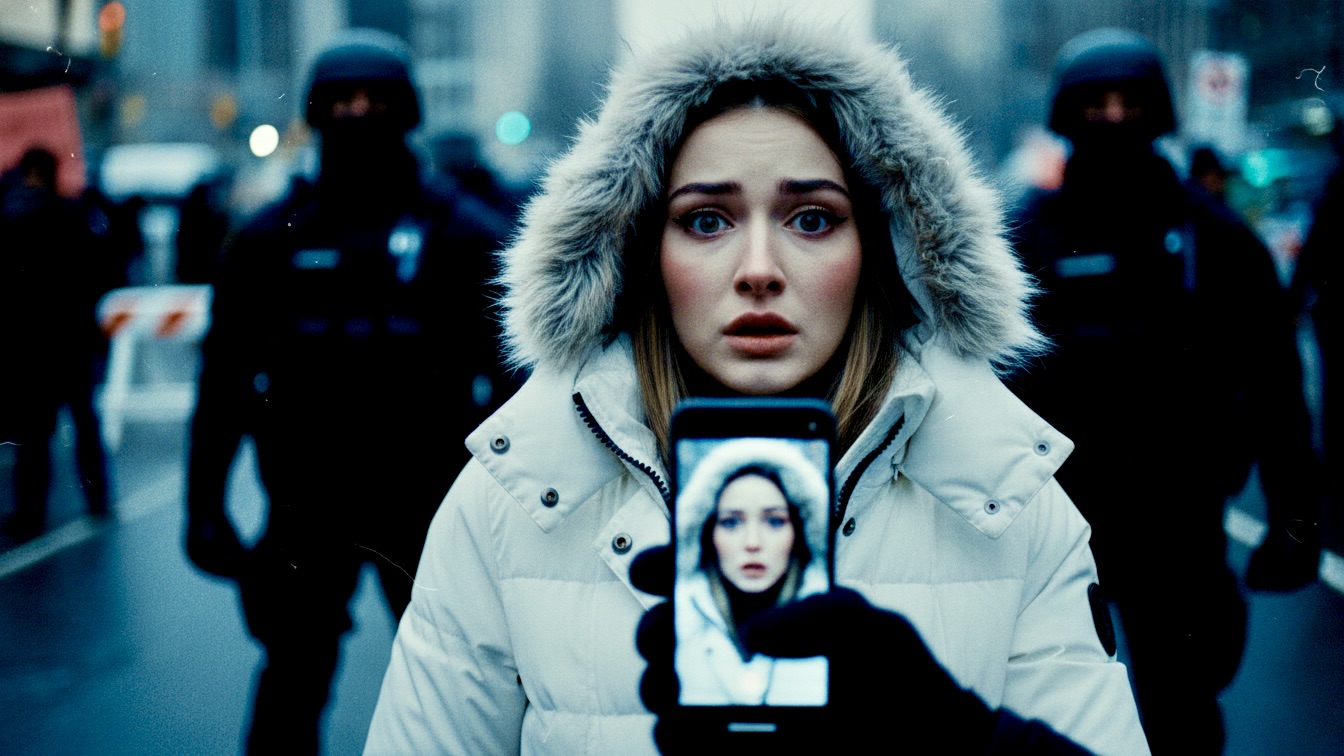
Trista Roberts, an influencer operating under the handle "TristaTruth," attempts to livestream from the center of a chaotic protest. Battling technical difficulties and a dwindling viewer count, she struggles to curate a narrative of "authentic truth" against a backdrop of civil unrest. Her initial attempts to engage with the environment fail; a combat medic rebuffs her intrusive questions, and her audience begins to lose interest. Desperate to appease the algorithmic demand for engagement and arrest the decline of her viewership, Trista seeks a more volatile subject.
She identifies a group of stoic, armed men standing on the periphery of the conflict who appear distinct from the protestors and police. Mistaking their menacing stillness for a content opportunity, she approaches them with a provocative, performative question intended to spark a viral moment. The interaction goes disastrously wrong when the men, rather than reacting with the expected outrage, quietly surround her. The leader of the group commandeers her phone and turns the camera back on her. As Trista succumbs to genuine terror, the man forces her to broadcast her own victimization, causing her viewer count to skyrocket in a grim irony of success.
The central theme of the narrative is the commodification of reality and the dissociation inherent in digital culture. The story critiques how social media platforms incentivize the transformation of genuine human struggle into entertainment. The protest, the smoke, and the injured woman are not treated as significant events in themselves but as set dressing for Trista’s personal brand. She reduces complex political and social upheaval to mere "vibes" and "energy," stripping the context of its weight to make it palatable for a digital audience that craves spectacle over substance.
Furthermore, the text explores the tyranny of the algorithm as a modern deity. Trista’s internal monologue reveals that her emotional state is entirely tethered to the fluctuating numbers on her screen. The "fickle god" of the algorithm dictates her actions, pushing her toward increasingly risky behavior. This external validation mechanism overrides her survival instincts. She fears the red downward-pointing arrow more than she fears the armed men, illustrating a psychological inversion where digital irrelevance is perceived as a form of death more terrifying than physical danger.
Finally, the story examines the concept of performative authenticity. Trista’s brand is built on being a "Truth-Seeker," yet every aspect of her presence is fabricated, from her "no-makeup" makeup look to her rehearsed breathless sincerity. The narrative exposes the paradox of modern content creation: the more one tries to project authenticity, the more artificial the behavior becomes. The only moment of genuine emotion—her terror at the end—is the only thing she did not script, yet it becomes the most successful piece of content she has ever produced. This underscores a dark truth about the voyeuristic nature of the audience; they do not want the curated truth, but rather the raw, unpolished spectacle of someone else's destruction.
Trista Roberts serves as a archetype of the pathologically online individual, suffering from a severe disconnect between her physical environment and her digital projection. Her psychology is defined by narcissism and a lack of empathy, though this narcissism appears driven by deep-seated insecurity rather than simple vanity. She views the world through a teleological lens where every object and person exists solely to provide content for her stream. When she sees an injured woman, she does not feel an impulse to help; she feels an impulse to frame the shot. This suggests a profound desensitization, where her capacity for human connection has been atrophied by her reliance on mediated interaction.
Her motivation is singular and desperate: validation through metrics. The physical sensation of "cold dread" she feels is not a response to the riot police or the smoke, but to the number "1.2k" dropping to "974." This reaction indicates that her self-worth is entirely externalized. She creates a cognitive barrier between herself and danger, believing that the camera acts as a shield. She operates under the delusion that she is the protagonist of reality, and therefore, the supporting characters—whether medics or militia members—will follow the script she implies.
Ultimately, Trista’s tragic flaw is her inability to read non-verbal, non-digital cues. She approaches the armed men with the confidence of someone who believes social consequences are limited to the comment section. When she confronts the leader, she expects a performative reaction that fits the grammar of social media conflict—shouting, drama, a "clipable" moment. She is psychologically unprepared for the quiet, indifference of real-world violence. Her breakdown occurs when the lens is turned on her, forcing her to see herself not as the curator of the scene, but as the subject of it. The terror she experiences is the shattering of her carefully constructed digital armor.
The leader of the armed group acts as a psychological foil to Trista. Where she is frantic, loud, and desperate for attention, he is still, quiet, and indifferent to observation. He represents a brutal, analog reality that refuses to be categorized by hashtags. His lack of reaction to her provocation signals a complete dismissal of the social contract Trista operates under. He does not care about her narrative or her audience until he realizes he can use them as a weapon against her.
His decision to turn the camera on Trista reveals a sadistic form of media literacy. He understands the medium well enough to know exactly what the audience wants. By forcing her to watch her own view count rise as she is terrorized, he strips her of her agency. He transforms her from the storyteller into the story, effectively trapping her in the very digital purgatory she sought to master. His dominance is established not just through physical force, but through his usurpation of her tool of power.
The narrative employs a tight, third-person limited perspective that immerses the reader in Trista’s distorted worldview. The prose mimics the frenetic, superficial energy of a livestream, utilizing influencer buzzwords like "vibe," "authentic," and "narrative." This linguistic choice highlights the absurdity of her presence in a combat zone. The author juxtaposes these vapid internal thoughts with the gritty, sensory details of the setting—the "glinting" shields, the "bloody bandage," and the "cold and still" eyes of the militia leader. This contrast creates a pervasive sense of irony and impending doom.
Pacing is used effectively to mirror Trista’s anxiety levels. The story begins with the slow, frustrating spinning wheel of the buffering screen, establishing a baseline of digital anxiety. As she moves through the crowd, the pacing accelerates, matching her desperation to find content. The encounter with the medic is quick and dismissive, prompting a frantic search for a new focal point. When she spots the armed men, the pacing slows down, becoming deliberate and tense. The "quiet, fluid convergence" of the men creates a suffocating atmosphere that contrasts sharply with the earlier chaotic noise of the protest.
The imagery of the phone and the gimbal is central to the story’s visual language. The device is described variously as a "scepter" and a tool of "digital purgatory." It acts as an extension of Trista’s body, the only organ through which she can process reality. The climax involves the physical reversal of this tool. When the leader flips the camera, the text emphasizes the visual of the screen itself—the red icon, the climbing numbers, and Trista’s own terrified reflection. This visual focus reinforces the theme that in this world, nothing is real until it is rendered in pixels, and the ultimate horror is to be consumed by the very interface one sought to control.