Format: Short Film / Anthology Episode | Est. Length: 10-12 minutes
Imagine this story as an episode within a grounded, noir-inspired anthology series titled The Bill Comes Due. Each standalone episode explores the catastrophic fallout from a single, morally compromising decision made by an ordinary person backed into a corner. The series weaves a tapestry of interconnected consequences across a shared, bleakly realistic setting, where one character's desperate act can unknowingly trigger another's downfall, illustrating that no bad deed ever truly happens in a vacuum.
Under a flat grey sky, a young man sits in his freezing, beat-up car, the engine off. He unwraps a heavy tire iron from a greasy rag, its cold, menacing weight a stark contrast to his shaking hands.
A desperate young man attempts to intimidate his guilt-ridden friend into silence over a past hit-and-run. His act of coercion inadvertently causes his friend's accidental death, framing him for murder in front of a sole, horrified witness.
The primary theme is the corrosive nature of guilt and the escalating cost of self-preservation. The story explores how a single past transgression poisons the present, forcing characters into impossible choices. It delves into the dark irony of fate, where the very act of trying to prevent one catastrophe directly precipitates a worse one. Tonally, this is a bleak, character-driven crime thriller, examining moral decay and the illusion of control when faced with inescapable consequences.
The narrative functions as a modern noir, stripping away romanticism to focus on the raw, unglamorous desperation of its protagonist. It questions the definition of "the right thing," contrasting Raph's need for moral cleansing with Jonah's pragmatic, survivalist worldview. The story suggests that sometimes, there is no right path, only different shades of ruin, and that the universe is indifferent to intent, judging only the final, damning tableau.
The stakes for Jonah are absolute: the loss of his entire future. He is on the verge of escaping a troubled past, with a new apprenticeship and the fragile hope of his mother resting on his success. Confession means guaranteed prison time, the destruction of his small, hard-won life, and the confirmation of his mother's worst fears. For Raph, the initial stakes are moral and psychological—his sanity and soul—but they tragically escalate to become his very life.
The central conflict is external: Jonah versus Raph. It is a battle of opposing philosophies—Jonah’s desperate pragmatism against Raph’s unbearable guilt. Raph’s conscience is the primary antagonistic force, an unstoppable drive toward confession that threatens to destroy them both. Internally, Jonah battles his own fear and buried morality, forcing himself to become the monster he believes the situation requires. The environment itself acts as a passive antagonist: the brutal cold, the desolate isolation, and the treacherous patch of ice become the final, indifferent arbiters of fate.
Jonah, a young man trying to build a stable life, is thrown into a panic when his old friend, Raph, threatens to confess to a fatal hit-and-run they covered up six months prior. Desperate to protect his future and his mother's hopes, Jonah agrees to meet Raph at a desolate, snow-covered park, secretly arming himself with a tire iron with the intent to intimidate his friend into silence. The meeting is fraught with tension as the guilt-wracked Raph confirms he can no longer live with the secret and is going to the police.
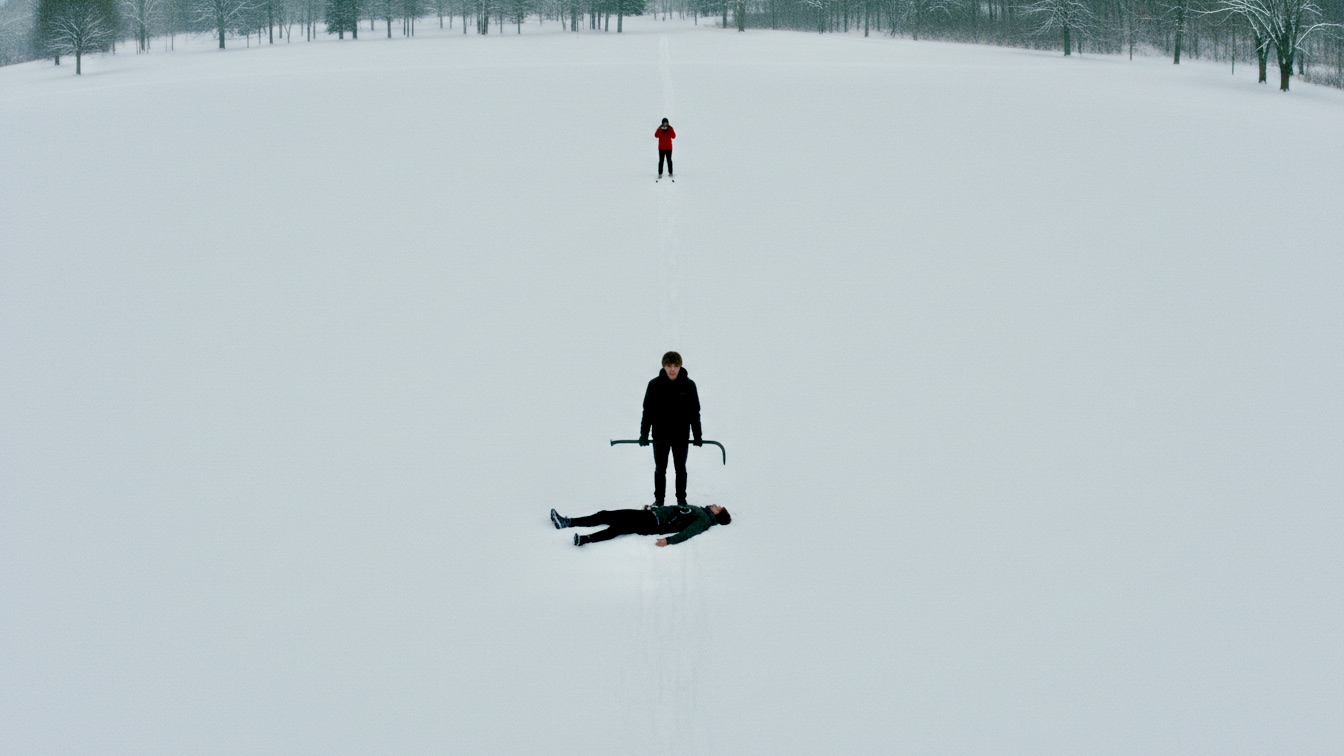
As Jonah's desperation mounts, he pulls the tire iron, hoping the threat will force Raph to back down. Terrified, Raph stumbles backward, slips on a patch of ice, and fatally cracks his head on a frozen tree root. Jonah stands frozen in shock over the accidental death he has caused, the tire iron still in his hand, when a skier emerges from the woods. The witness sees the perfect, damning picture: Jonah standing over a dead body with a weapon, and immediately pulls out their phone, sealing Jonah's fate.
JONAH: A young man clawing his way toward a better life, defined by a desperate, pragmatic survival instinct.
* Psychological Arc: Jonah begins in a state of controlled panic, willing to use threats and intimidation to preserve the fragile life he's building. He sees his actions as a necessary evil. He ends in a state of frozen, catatonic horror, having become the author of a far worse tragedy, his attempt to control the situation resulting in the ultimate loss of control. He is transformed from a conspirator into an apparent murderer, trapped by a cruel twist of fate he himself set in motion.
RAPH: A man being eaten alive by guilt, whose conscience has become a terminal illness.
* Psychological Arc: Raph starts as a ghost, haunted and hollowed out by the secret he carries, seeking redemption and peace through confession, regardless of the cost. His journey is a short, tragic path toward unburdening himself. He ends as a victim not of malice, but of the panicked situation his own moral crisis created, finding a final, violent end instead of the absolution he craved.
THE SKIER: A silent, objective observer who represents the intrusion of the outside world and inescapable consequence. They are the final judgment, the impartial eye that captures the damning evidence without context or understanding of intent, serving as the story's final, ironic twist.
BEAT 1: THE WEAPON. In his frigid car, Jonah wrestles with a panicked text message from his friend Raph, the source of a six-month-old dread. His shaking hands retrieve a tire iron from the passenger seat, the cold, heavy steel representing a desperate, half-formed plan to enforce silence. He tucks the weapon into his jacket sleeve, the weight a constant reminder of the line he is about to cross.
BEAT 2: THE CONFESSION. Jonah arrives at the desolate, snow-covered park to find a haunted, broken Raph waiting for him. The tension is immediate and thick as Raph, hollowed out by guilt, confirms Jonah’s worst fears: he can no longer live with their secret hit-and-run and is going to the police tomorrow. This confirmation transforms Jonah's fear into sharp, cornered-animal desperation.
BEAT 3: THE THREAT (MIDPOINT). The argument escalates, with Jonah’s pleas for pragmatism clashing against Raph’s unshakable need for absolution. Realizing he is losing, Jonah makes a fatal decision and pulls out the tire iron, the dark metal stark against the white snow. He holds it up not to strike, but to threaten—a final, desperate gambit to regain control and scare Raph into submission.
BEAT 4: THE FALL (CLIMAX). Raph’s despair turns to raw fear at the sight of the weapon, and he takes a panicked step backward onto a hidden, ice-sheathed tree root. His feet go out from under him, and he falls backward with a sickening, final crack as his head strikes the frozen ground. Jonah stands frozen, the tire iron still raised, having not laid a finger on him, yet having caused his death all the same.
BEAT 5: THE WITNESS. The vast silence is broken by the shushing sound of skis on snow. A figure in a bright red jacket emerges from the trail, stopping dead at the horrifying tableau: Jonah, weapon in hand, standing over Raph's broken body. Before Jonah can process what is happening, the skier fumbles for their phone, its lens becoming an unblinking eye that captures the scene and seals Jonah's fate.
The episode begins with a mood of cold, anxious dread, immersing the audience in Jonah's palpable fear and the oppressive winter atmosphere. This tension steadily builds during the drive and the initial confrontation, shifting into raw desperation as Jonah realizes he is losing control of the situation. The emotional peak is a sharp, shocking moment of accidental violence, followed immediately by a sudden, deafening silence and a feeling of profound, helpless horror. The arc concludes on a note of crushing irony and existential dread, leaving the audience with the chilling image of Jonah trapped by circumstance, his fate sealed by an impartial observer.
If expanded, this episode, "The Right Thing," could serve as the inciting incident for a season-long narrative. The investigation into Raph's "murder" could introduce a recurring, weary detective who becomes a central figure in the anthology, a connective tissue between seemingly unrelated cases. This detective, while investigating Jonah, could uncover details of the original hit-and-run, creating a complex legal and moral puzzle.
Subsequent episodes would focus on other characters on the periphery of this event: the skier, whose life is irrevocably altered by what they witnessed; a family member of the original hit-and-run victim, who gets a false sense of closure from the news; or even the mechanic at Jonah's new apprenticeship, who has his own secrets. The overarching story would explore the ripple effect of Jonah and Raph's original crime, showing how one dark secret, once disturbed, can poison an entire community, with the detective slowly piecing together a much larger, more tragic picture than any single case file suggests.
The visual style will be stark, naturalistic, and oppressive, reflecting the internal states of the characters. The color palette will be desaturated and cold, dominated by whites, greys, and muted blues of the winter landscape, with the only vibrant color being the shocking red of the skier's jacket at the climax. Cinematography will utilize a mix of tight, handheld shots inside the car to convey Jonah's anxiety, and wide, static shots in the park to emphasize the characters' isolation and insignificance against the vast, indifferent landscape.
The tone is grounded, bleak, and tense, drawing influence from the slow-burn pacing and grim realism of films like Winter's Bone and Blue Ruin. There is no stylized glamour; the violence is clumsy, shocking, and pathetic. The overall mood is one of impending doom, a modern-day tragedy where human flaws and cruel fate conspire to create a perfect, inescapable trap.
The target audience is adults aged 25-55 who appreciate sophisticated, character-driven psychological thrillers and modern noir. This includes viewers of premium cable dramas and streaming series like Fargo, True Detective, and Ozark. The episode is for an audience that prefers slow-burn tension, moral ambiguity, and impactful, thought-provoking storytelling over high-octane action.
For a 10-12 minute runtime, the pacing must be ruthlessly efficient. Act One (Jonah's decision and drive) will be a slow, deliberate build of dread, establishing stakes and atmosphere in the first 2-3 minutes. Act Two (the confrontation and escalation) will occupy the bulk of the runtime, a 5-6 minute stretch of escalating dialogue and tension. Act Three is brutally fast: the fall, the shock, and the arrival of the witness happen in a rapid, gut-punching sequence over the final 2 minutes, leaving no time for resolution and maximizing the final, horrifying impact.
The primary production consideration is the location. A genuinely isolated, snow-covered park or wooded area is essential to establishing the story's oppressive atmosphere. The weather is a key character; production must be prepared for shooting in cold conditions, and practical effects will be needed to manage snow continuity and the visual of breath in the frigid air.
The central stunt—Raph's fall—is the most critical technical element. It must be choreographed and executed with precision to look both accidental and brutally impactful. Sound design will be paramount: the crunch of snow, the sharp, cutting wind, the muffled dialogue, and the sickeningly sharp crack of the impact, followed by an absolute, ringing silence, will be crucial for conveying the scene's horror.