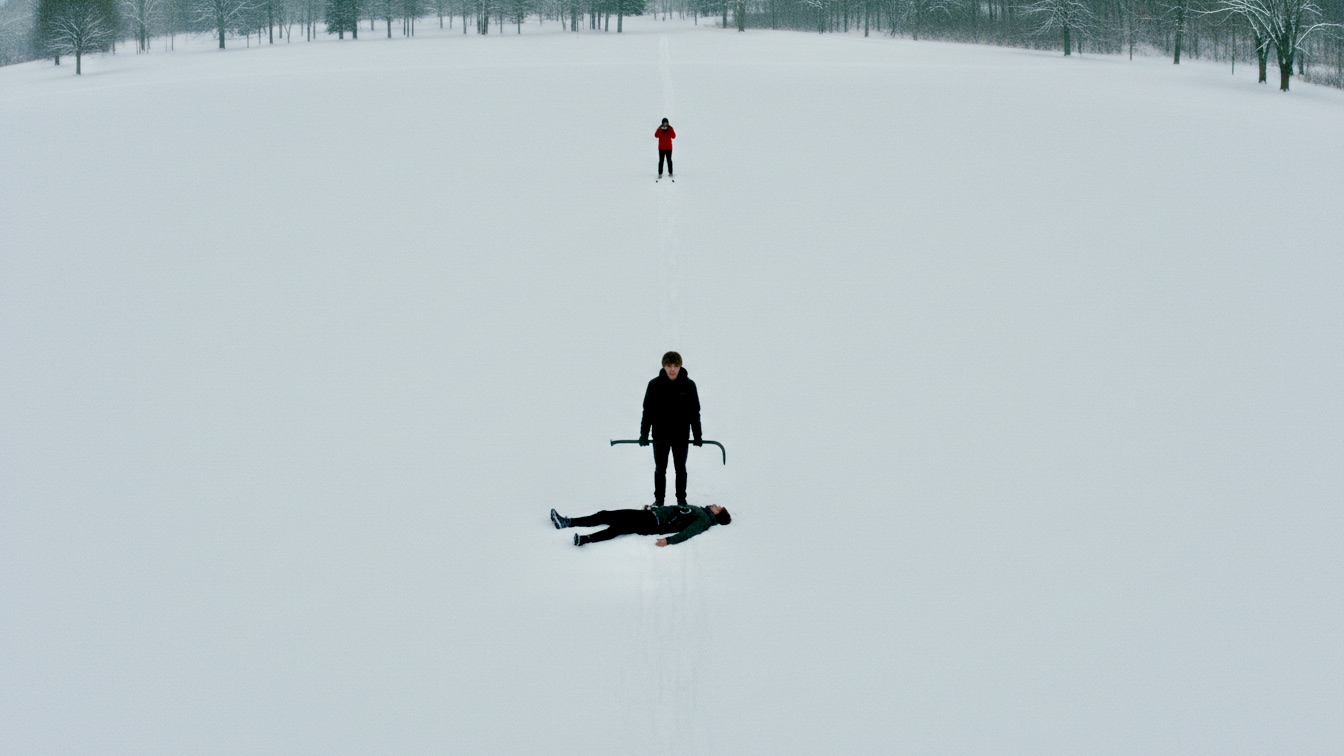
Jonah arrives at the frozen, desolate La Barrière Park to meet his estranged friend, Raph. The meeting is driven by a terrifying text message implying that Raph intends to confess to a hit-and-run accident the two committed six months prior. Jonah, desperate to protect the fragile stability of his new life and his mother’s hopes, arms himself with a tire iron, intending to intimidate Raph into silence. The atmosphere is heavy with the physical cold of winter and the psychological chill of their shared secret.
Upon meeting, Raph reveals his utter psychological deterioration, admitting that his guilt has made life unbearable. He declares his intention to go to the police the following morning. Panic seizes Jonah, and he brandishes the tire iron to assert control and force Raph into compliance. The confrontation escalates shouting, causing Raph to step back in fear.
In a twist of cruel fate, Raph trips over a hidden root and falls backward, striking his head on the frozen ground with fatal force. Jonah is left standing over his dead friend, weapon raised, having caused the death indirectly without striking a blow. The chapter concludes with a skier emerging from the woods. The witness sees the incriminating tableau—Jonah with the weapon and the fresh corpse—and takes a photo, sealing Jonah’s fate not as a tragic figure, but as an apparent murderer.
The narrative is deeply rooted in the theme of the inescapable nature of guilt and the futility of burying the past. The setting itself serves as a powerful metaphor for this theme; the "dead world" of the frozen park mirrors the moral decay festering between the two friends. Just as the snow covers the landscape but cannot hide the treacherous roots beneath, Jonah’s attempt to cover up their crime is superficial. The "bill coming due," as Raph phrases it, suggests a cosmic balancing of scales that Jonah cannot manipulate, no matter how hard he fights for self-preservation.
Parallel to the theme of guilt is the exploration of control versus fate. Jonah believes he can engineer a solution to a moral catastrophe through intimidation and willpower. He views the tire iron as a "problem solver," a physical manifestation of his desire to force the world into a shape that suits his survival. However, the story posits that control is an illusion. The very tool he brings to ensure his safety becomes the instrument of his destruction, not by its intended use, but by the optical implication it creates.
Furthermore, the story examines the corrosive power of secrecy on human connection. The bond between Jonah and Raph, once presumably strong, has been transmuted into a "poison" by their shared silence. The trauma of the hit-and-run has isolated them in different ways: Raph has imploded, consumed by his conscience, while Jonah has hardened, sacrificing his humanity to maintain a facade of normalcy. The tragedy lies in the fact that their divergent responses to the same event make their destruction inevitable.
Jonah acts as the protagonist, yet his psychological profile reveals a man operating under the influence of profound denial and self-interest. He is not motivated by malice, but by a desperate, almost feral need for self-preservation. His internal monologue reveals that he views Raph’s guilt not as a valid moral crisis, but as a "luxury" he cannot afford. This indicates a compartmentalization of trauma; Jonah has locked the memory of the accident away to function in his daily life, prioritizing his apprenticeship and his mother's approval over moral accountability.
Physically and mentally, Jonah is at a breaking point, though he masks it with aggression. The text notes his shaking hands and the "sour knot of acid and fear" in his stomach, betraying that his bravado is fragile. When he picks up the tire iron, he dissociates slightly, viewing the weapon as "foreign" and "obscene," yet he rationalizes its use as a necessary tool for survival. This cognitive dissonance allows him to threaten his friend while still convincing himself that he is merely "scaring him straight" rather than committing an act of violence.
Ultimately, Jonah is a victim of his own inability to surrender control. His tragic flaw is his refusal to accept consequences. By trying to forcefully suppress the truth, he creates a scenario far worse than the one he was trying to avoid. In the final moments, he becomes a "statue of guilt," paralyzed not just by the shock of Raph's death, but by the realization that his frantic attempts to save his life have ironically guaranteed its ruin. He stands condemned not by his actions, but by the appearance of them, trapped in a prison of his own making.
The narrative voice is third-person limited, closely adhering to Jonah’s perspective, which effectively immerses the reader in his rising panic. The pacing is deliberately structured to mirror a heart rate escalating into tachycardia. It begins with the slow, laborious struggle of the frozen car door, moves through the tense, claustrophobic drive, and culminates in the rapid, chaotic dialogue that leads to the accident. The sudden cessation of action after Raph’s death creates a jarring, breathless silence that emphasizes the finality of the event.
Sensory details are utilized aggressively to establish a tone of hostility and dread. The cold is not merely a weather condition but an antagonist; the car seat is "colder than a morgue slab," the wind is "merciless," and the snow sounds like "grinding glass." These descriptions create a visceral experience for the reader, reinforcing the idea that the environment itself is rejecting Jonah. The auditory imagery—the "sickening thud," the "wet crack"—brings a gruesome reality to the violence, grounding the psychological drama in physical horror.
The author also employs dramatic irony to devastating effect. The reader understands Jonah’s internal logic—that he never intended to strike Raph—but the external view provided by the skier reframes the narrative entirely. The "frozen photograph of murder" serves as a stylistic device that shifts the genre from a psychological drama to a crime thriller in a single paragraph. The final image of the phone’s camera lens as an "unblinking eye" symbolizes the objective, unforgiving judgment of the outside world crashing into Jonah’s subjective reality.