Melgund Township Winter Story Library
Variable Interest Rates on the Ice Road - Treatment
by Jamie F. Bell | Treatment
by Jamie F. Bell | Treatment
Format: Short Film / Anthology Episode | Est. Length: 10-12 minutes
Imagine this story as an episode in an anthology series titled NORTHERN EXPOSURE, a gritty, slice-of-life drama exploring the quiet desperation of individuals living on the economic margins in Canada's remote north. Each episode would be a self-contained narrative focusing on a different character navigating a world of precarious employment, failing infrastructure, and the dark humor required to survive a landscape that is both beautiful and brutal. The series would weave a tapestry of interconnected lives, where a background character in one story becomes the protagonist of the next, all set against the backdrop of a community slowly being crushed by forces far beyond its control.
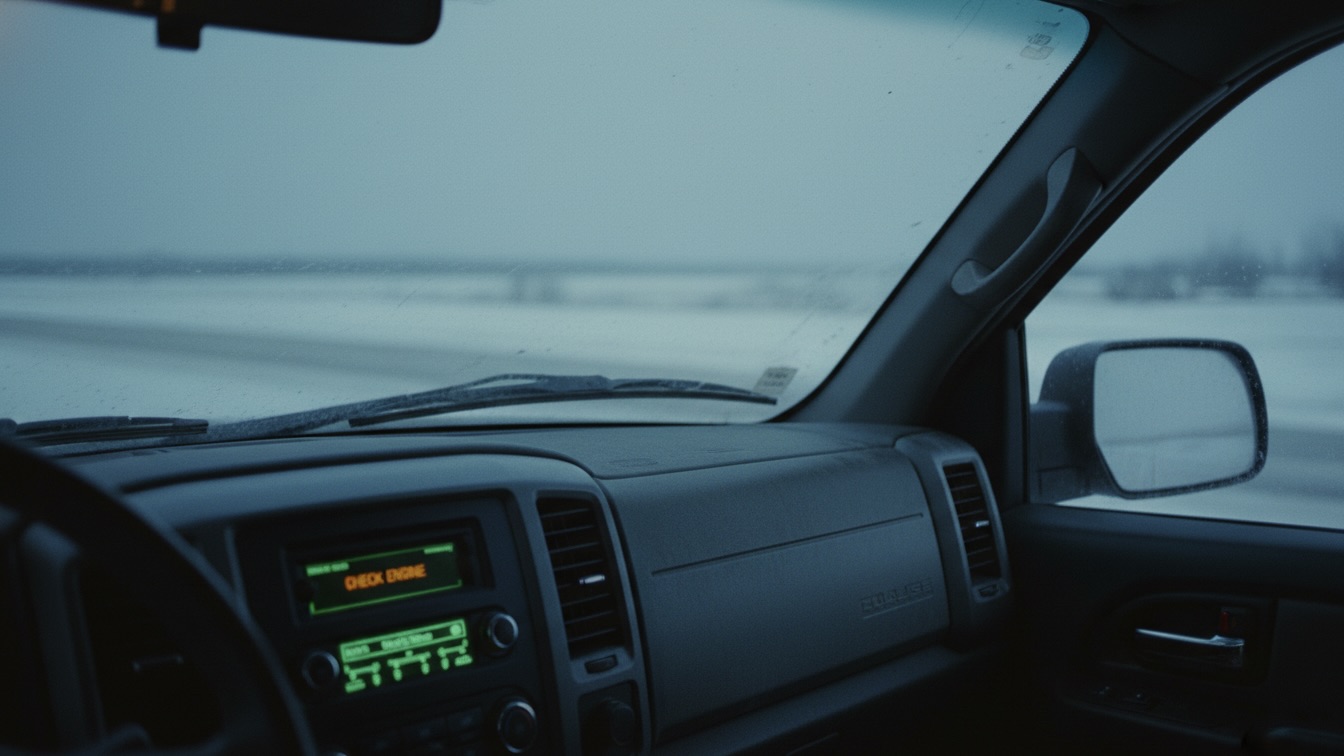
Two battered pickup trucks sit side-by-side on a vast, frozen lake, engines groaning in the minus-thirty-two-degree air. Inside one, a man grips his steering wheel, his dashboard a constellation of warning lights, as he prepares to risk his only asset in a pathetic drag race for fifty dollars.
In the frozen expanse of the Canadian north, a man with a dying truck must win a dangerous drag race on an ice road to afford groceries. He risks life, limb, and his only means of transportation for a pittance, battling a failing machine and the absurdities of modern poverty.
The primary theme is economic desperation, exploring the small, reckless decisions people are forced to make when trapped in a cycle of poverty. It examines how a seemingly insignificant amount of money ($50) can represent a lifeline, justifying enormous risks. The story is a poignant commentary on the decay of the working class, where personal assets like vehicles are not symbols of freedom but ticking time bombs of financial ruin, held together by hope and percussive maintenance.
A secondary theme is a specific brand of fragile, blue-collar masculinity, where pride is measured not in wealth but in the marginal superiority of one’s failing equipment over another’s. The "speed comparison" is less about the money and more about a desperate need for a 'win'—any win—in a life filled with losses. This is underscored by a tone of gallows humor and bleak absurdity, finding comedy in the pathetic symphony of mechanical failures and the pyrrhic nature of the protagonist’s victory.
The immediate stake is fifty dollars—enough for five dozen eggs or half a tank of gas, a tangible buffer against food and fuel insecurity. The greater stake is the protagonist’s truck itself; it is his sole asset, his transportation to work, and the only thing separating him from total immobility and financial ruin. If he wrecks it, he loses his livelihood and will be left "walking to work until July," a catastrophic outcome from which he has no financial safety net to recover.
The central conflict is Man vs. Environment, both natural and economic. The external antagonistic forces are the treacherous ice road, the extreme cold that freezes sensors and strains metal, and the protagonist’s own truck, which actively works against him with its litany of failures. His rival, Kevin, is less an antagonist and more a mirror—another man in the same desperate situation, making the race a shared struggle rather than a malicious competition. The primary internal conflict is the protagonist’s battle between his rational mind, which knows the race is suicidal, and his desperate need, which forces him to mash the pedal and pray.
In the frigid bleakness of a northern winter, our unnamed protagonist, beset by a failing truck and a dwindling bank account, agrees to a "speed comparison" against his friend Kevin on a treacherous ice road. The prize is fifty dollars—enough to make a meaningful difference in his weekly budget. The race begins as a pathetic display of spinning tires and screaming engines, a slow-motion battle against the slick, unforgiving ice.
As they gain speed, the protagonist's truck reveals a new, alarming issue: a violently wobbling front wheel. Forced to choose between pulling over and pushing his luck, he floors it, his desperation overriding his self-preservation. The climax arrives as he hits a pressure ridge at ninety kilometers an hour, launching the truck into the air and landing blind after his coffee freezes to the windshield. He roars past a shocked Kevin to win, only to discover his rival is short on cash, settling the debt with twenty-four dollars and a warm bag of beef jerky—a hollow, yet oddly satisfying, victory.
THE NARRATOR is a man in his late 30s or early 40s, worn down by circumstance but not yet broken. Psychological Arc: He begins in a state of weary, cynical resignation, using gallows humor to cope with the constant mechanical and financial failures that define his life. The race pushes him through a spike of adrenaline-fueled desperation where he makes a reckless, life-endangering choice, revealing a core of grit beneath the exhaustion. He ends not triumphant, but back in a state of quiet resignation, chewing on his meager, absurd winnings—a man who gambled everything and won just enough to survive another day.
KEVIN is the Narrator’s rival and friend, a reflection of the same struggles. He’s slightly more hapless, scraping his window with a credit card and driving a truck in similar disrepair. Psychological Arc: Kevin serves as a catalyst, proposing the race out of his own unseen desperation. He starts with a veneer of casual confidence but is quickly humbled by the conditions and the danger, his concern for the Narrator during the final moments of the race showing that their shared predicament outweighs their rivalry. He represents the community of people in the same sinking boat, trying to stay afloat with foolish wagers and camaraderie.
The Setup: In the biting cold, the Narrator sits in his dying truck, cataloging its many failures while observing his rival, Kevin, prepare for their fifty-dollar "speed comparison." The stakes are established not through dialogue, but through the Narrator’s internal monologue about the price of eggs and the precarious state of his finances. The world is bleak, the machinery is failing, and the wager is both pathetic and absolutely necessary.
The Start: The race begins with a comical lack of momentum, as both trucks scream uselessly, tires spinning on the polished ice in a slow, pathetic ballet of mechanical impotence. This initial failure establishes the true antagonist is not each other, but the brutal environment and their own unreliable equipment. The Narrator must finesse the gas pedal, fighting his own machine just to move forward, highlighting the immense effort required for even the smallest progress.
The Midpoint: As the trucks finally gain speed, the Narrator’s vehicle develops a terrifying wobble in the front wheel, transforming the race from a foolish competition into a genuine life-or-death situation. He is now actively fighting his own truck, which threatens to tear itself apart at high speed, forcing him to make a critical decision. This is the point of no return, where he must either forfeit the desperately needed money or risk a catastrophic wreck in the middle of a frozen lake.
The Climax: Confronted by a massive pressure ridge in the ice, the Narrator makes the split-second decision to hit it rather than brake and lose control. The truck launches into the air in a moment of surreal silence, then slams down, shattering the illusion of control and splashing frozen coffee across the windshield, blinding him completely. Driving blind at ninety kilometers an hour, he leans out the window into the punishing wind, a primal act of will that allows him to roar past a swerving Kevin and cross the finish line.
The Resolution: After winning, the Narrator confronts Kevin, only to receive a crumpled handful of cash and a bag of teriyaki beef jerky—the reality of his winnings falling short of the promise. The adrenaline fades, replaced by the familiar cold and the thrum of his damaged wheel, as he drives slowly back across the ice. The victory is pyrrhic, the prize absurd, but in the taste of the warm, salty jerky, there is a fleeting, tangible sense of survival.
The episode begins with a mood of bleak, deadpan humor and weary resignation, as the audience is immersed in the protagonist’s cynical worldview. As the race begins, the tone shifts to one of tense, low-stakes absurdity, which quickly escalates into genuine, heart-pounding anxiety as the mechanical failures become life-threatening. The climax is a moment of pure, terrifying chaos, followed by a brief, adrenaline-fueled euphoria that quickly dissolves into a bittersweet, almost melancholy resolution, leaving the audience with a poignant sense of the futility and cyclical nature of the protagonist's struggle.
If expanded into a series, this episode would serve as a thematic entry point. A season-long arc could follow the Narrator and Kevin as they are forced into increasingly risky "side hustles" to make ends meet after a local mill announces layoffs, putting the entire community on edge. The overarching story would be the town's collective struggle to survive a brutal winter, with the ice road becoming a central character—a lifeline for some, a final resting place for others.
Subplots could involve a local mechanic who acts as a community confessor, hearing the desperate stories behind every repair, or a single mother trying to keep a small diner afloat as her customers run out of money. The season would culminate in a major event on the ice road—perhaps a rescue operation during a blizzard or a conflict over a lucrative but dangerous hauling contract—that forces the characters to choose between self-preservation and community solidarity. The central theme would be an exploration of what holds a community together when the economic foundations crumble.
The visual style will be grounded in gritty realism, emphasizing the cold and the texture of decay. The color palette will be desaturated and stark—dominated by the whites, greys, and pale blues of the winter landscape, punctuated by the rust and grime of aging machinery. Cinematography will utilize a mix of static, wide shots to convey the immense, isolating emptiness of the frozen lake, and tight, handheld interior shots to capture the violent, bone-jarring rattle of the truck, making the viewer feel every bump and vibration.
The tone is a delicate balance of social realism and dark, Coen-esque comedy, finding humor in the bleakest of situations. It is observational and empathetic, never punching down at its characters but instead highlighting the absurdity of the systems that have failed them. Tonal comparables include the weary authenticity of Winter's Bone, the regional specificity and dark humor of Fargo, and the quiet, character-focused pacing of films by Kelly Reichardt like Wendy and Lucy.
The target audience consists of adults aged 25-55 who appreciate character-driven, independent cinema and prestige television dramas. They are viewers who gravitate towards authentic, slice-of-life stories with strong thematic depth and social commentary. This project would appeal to fans of anthology series like High Maintenance or grounded crime dramas like Mare of Easttown, as well as audiences for filmmakers who explore the American and North American working class, such as Chloé Zhao, the Coen Brothers, and Scott Cooper.
For a 10-12 minute runtime, the pacing will be deliberate yet tense. The first act (approx. 3 minutes) will be a slow burn, establishing the character, his failing truck, and the stakes with his internal monologue. The second act (approx. 6 minutes) will encompass the race itself, building from a comically slow start to a frantic, high-speed climax, with the tension escalating rapidly as new mechanical failures are introduced. The third act (approx. 2 minutes) will be a quiet, contemplative resolution, allowing the adrenaline to subside and the bittersweet reality of the outcome to settle in.
Authenticity of the environment is paramount. Production requires a location that can provide a genuine, expansive ice road and believable extreme cold conditions. The use of practical effects will be crucial to conveying the story's tactile reality; the truck's shuddering, the smoke, the sound design of the whining heater and thumping wheel bearing must feel visceral and real.
For the race sequence, particularly the jump over the pressure ridge, a combination of techniques will be necessary. Interior shots should be filmed on a gimbal rig to realistically simulate the violent motion and impact. Exterior shots may require a specialized camera vehicle and carefully planned stunt driving to capture the speed and danger on the ice safely and effectively, with minimal reliance on CGI to maintain the film's grounded, realistic aesthetic.