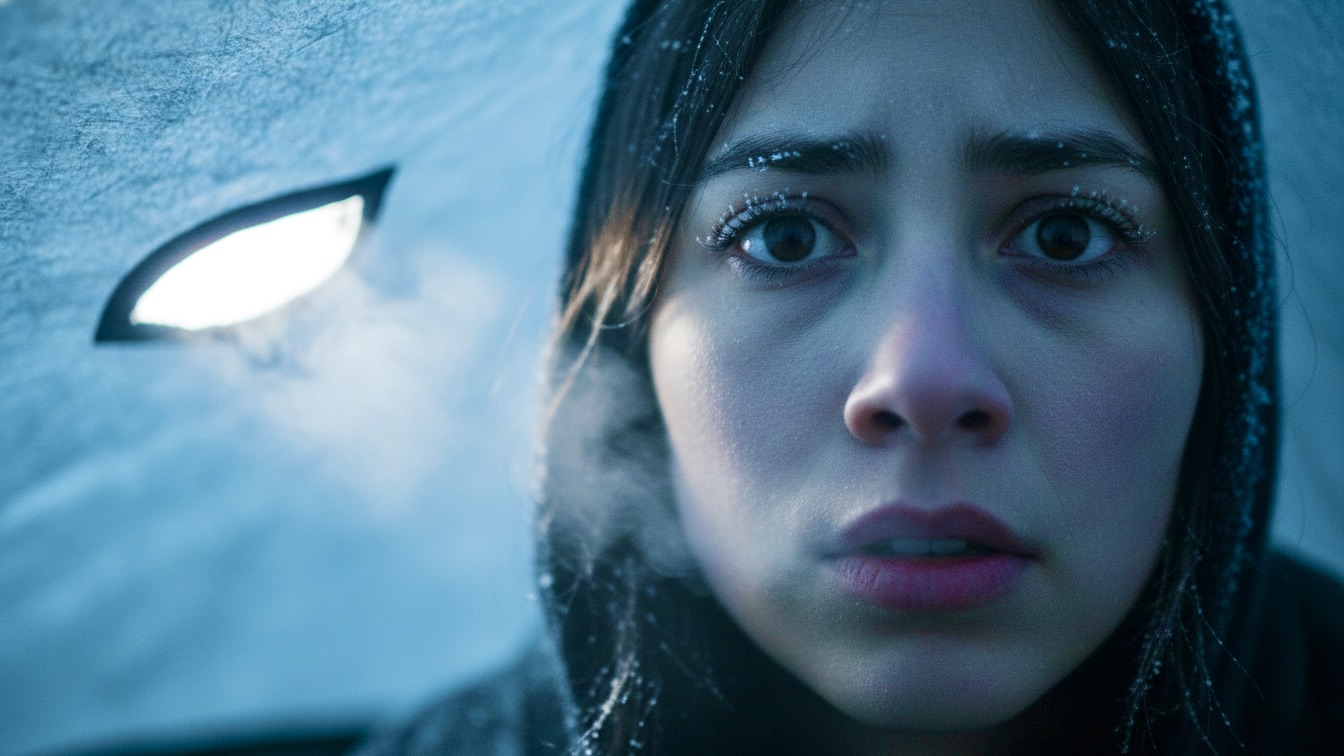
The interior of a cheap, snow-laden tent, filled with the stifling cold and the smell of stale breath and synthetic fabric. A harsh, unforgiving winter wind howls outside.
The black rectangle of her phone, now a tombstone for their curated existence, sat heavy in her palm. No faint glow, no buzzing vibration. Nothing. Maya tapped it once more, a ritualistic gesture she hadn't realized she’d adopted over the years. Like it might cough back to life, resurrected by sheer will or the ghost of a forgotten notification. It didn’t. It was dead. Truly dead. Not the kind of “low battery, charging soon” dead she usually experienced, but inert, gone, a plastic and glass brick.
The tent air, thick with the scent of cheap polyester and Liam’s sleep-heavy breath, pressed in on her. Outside, the wind made a low, insistent moan, a sound that had been a constant companion since the last signal bar flickered out, just after she’d uploaded the “sunrise over untouched snow” story. "#AuthenticWilderness #DeepWoods #SurvivalistLife." The irony tasted like ash in her mouth. Her body shivered, not the cute, performative shiver for the camera, but a deep, internal tremor that started in her frozen toes and vibrated up her spine.
Her fingers, stiff and clumsy, struggled to form a fist. The movement was sluggish, like trying to manipulate clay that had been left in the cold too long. The single-use heat packs, advertised for “12 hours of extreme warmth,” were now just solid, useless rectangles pressed against her numb palms. Another lie in a long chain of carefully constructed fictions they had bought into, both literally and figuratively. They’d reviewed them, of course. Given them five stars for “portability” and “initial warmth.” The review didn't mention they'd become paperweights after four hours.
Liam stirred beside her, a muffled grunt escaping his sleeping bag. His face was mostly obscured, buried deep within the synthetic folds. “Battery,” he mumbled, his voice thick with sleep and the cold, a faint puff of condensation hanging in the air with each word. “Check it.”
“It’s dead,” Maya said, her voice cracking slightly, dried out by the cold air. “I already told you.”
“No. Really dead?” The question was laced with a desperate hope that she recognized, a hope she’d just lost herself. He still wanted to believe the world functioned on their schedule, their terms. That a simple recharge would fix everything.
“Yes. Zero. Zilch. Gone.” She held up the phone, a dark, unresponsive slab, a monument to their disconnectedness. The screen, usually a vibrant window into a projected reality, was now a flat, empty mirror reflecting only her own pale, anxious face. A tiny crack, barely visible before, now seemed to spiderweb across the whole surface, a map of their crumbling situation.
He let out a long, drawn-out sigh, a sound that seemed to deflate the air inside the small tent. It was a sigh of utter defeat, a surrender to the physical world they had so carelessly disregarded. “My phone?”
“Yours went first. Remember? Like an hour after we lost the satellite connection. You were trying to live-stream the snow falling.” She remembered his frustration, his repeated attempts to find a sliver of signal, holding the phone up like a divining rod, cursing under his breath as the bars remained obstinately empty. It had seemed like a minor inconvenience then. A bad service provider. Not the end of their connection to everything.
A heavy silence descended, broken only by the persistent, mournful cry of the wind outside. It felt bigger now, louder, more intrusive without the constant hum of their devices to drown it out. The sound carried the weight of something ancient, something that didn't care about follower counts or engagement rates.
“The solar charger,” Liam finally said, his voice a little clearer now, edged with a dawning urgency. “Where is it?”
“In the pack. Outside.”
His eyes opened, just a sliver of white against his pale face, catching the dull, grey light that filtered through the tent. “Outside?” The single word was laced with disbelief, almost horror. The outside was a problem. A serious problem.
“Yeah. You said it needed sun. To get a good charge.” She remembered him carefully positioning it on a rock, getting the angle just right for the “eco-friendly charging solution” reel. It had looked good. Very green. Very “conscious traveler.” They’d even tagged the brand. She wondered if the brand still existed. If anything still existed outside this small, cold bubble.
He didn't move. Just lay there, staring at the unseen ceiling of the tent, the nylon bowing slightly under the accumulated weight of snow. A thin layer of frost had formed on the inside of the fabric, tiny, perfect crystals catching the weak light. Each one a miniature, indifferent diamond.
The cheap nylon fabric of their tent sagged visibly under a fresh layer of snow that had accumulated overnight. Every gust of wind pushed against it, creating a soft, thumping drumbeat that underscored their isolation. Her nose felt like a solid block of ice, the very tip of it aching with a dull, persistent throb. She wiggled her toes, a futile attempt to generate warmth. They felt like inert blocks, heavy and unresponsive, even encased in the expensive, thermal-lined boots that had been a “sponsored gift” for their “ultimate winter trek” review. The boots, like the heat packs, had clearly overstated their capabilities. The reviews, Maya knew, were mostly written on day one, when everything was new and functional, before the reality of the wild set in.
A real growl ripped through her stomach. Not the cute, little rumbling sound she sometimes added with sound effects to her food videos for authenticity, but a hollow, demanding roar that echoed the emptiness within her. They had granola bars, protein bites, and dried fruit—all packaged beautifully for content, all designed for aesthetics, not for actual sustenance. The “sustainable” protein bars were mostly air and oat fiber. The “organic” dried mango slices, colorful and photogenic, offered little in the way of real calories. The artisanal instant coffee, branded for “minimalist camping,” now seemed like a cruel joke, a distant, irrelevant luxury. They had even brought a small, branded enamel mug, white with a tasteful logo, specifically for the coffee shots. It was now just another cold object.
“This is so stupid,” she muttered, the words barely audible over the wind, laced with a venom she hadn't known she possessed.
Liam finally shifted, pushing himself up on one elbow. His hair was matted to his forehead, his face pale and drawn. He looked rough. Not the carefully curated, rugged “morning after” look they usually aimed for, complete with artfully tousled hair and a hint of stubble for that “authentic outdoorsman” vibe. This was genuinely disheveled and unwell. His eyes, usually bright with performative energy, were dull and bloodshot. “What’s stupid?” he asked, his voice raspy, a dryness in his throat.
“All of it. The gear. The trip. The no signal. This whole… performance.” The word performance hung in the air, heavy with unspoken accusation. They were actors in their own lives, and now the stage had collapsed.
“It was your idea. ‘Viral winter challenge,’” he retorted, rubbing his eyes with a stiff hand. He pulled his sleeping bag tighter around him, a futile gesture against the permeating cold. “Said it would be ‘epic content.’ ‘Unforgettable.’ ‘A deep dive into nature's raw beauty.’” His voice was mimicking hers, a flat, sarcastic drone.
“No, it was our idea. And it was supposed to be a challenge for views. For engagement. For brand deals. Not... this.” She waved a hand vaguely at the dark, unforgiving expanse beyond their flimsy tent, a gesture that encompassed the silent forest, the biting cold, the impossible distance from anything familiar. It felt like a hostile, alien planet, one they had foolishly ventured onto without proper preparation.
He sat up slowly, wincing as he moved, his joints aching. “What’s the temperature?”
“The app’s on my phone. Which is dead.” She pointed to the inert slab. “And even if it worked, the last reading was like, twenty degrees below freezing. That was hours ago. Before the sun went down. Before the real cold started.”
Another tired sigh from Liam. “Right.” He reached instinctively for his own phone, felt the cold, unresponsive glass, then remembered. His fingers fumbled, and he dropped it with a small, pathetic thud onto the sleeping bag. A dull sound, devoid of any digital chime or alert.
Maya picked at a loose thread on her sleeping bag, a tiny, almost imperceptible flaw in the “ultra-light, ultra-warm” fabric. It was light, she’d give it that. But the warmth was a debatable point. Her teeth began to chatter, a quiet, insistent rhythm that she tried, and failed, to control. It started as a faint tremor in her jaw, then spread, her whole body vibrating with the effort to retain heat.
“We should have done the sponsored review for the satellite phone,” Liam said, his voice low, almost a whisper, the regret palpable. “The one we turned down because it wasn’t ‘aesthetic’ enough. Too clunky.”
Maya blinked. A dull ache had started behind her eyes, pressing against her temples. “It was bulky. And honestly, who needs one? We just needed the look of being off-grid. The narrative. The ‘unplugged experience’ for the camera.” The irony was a physical weight, pressing down on her, as heavy and suffocating as the snow accumulating on the tent roof. They had prioritized optics over utility, every single time. Every decision made through the lens of potential content.
Her fingers were definitely numb now. She tried to rub them together, but it was like rubbing two pieces of wood. Useless. The friction generated no heat, only a dull, spreading discomfort that extended up her wrists. She couldn't feel the fine distinction of her fingernails anymore. Just a general, aching numbness.
“We need to start a fire,” Maya said, her voice sounding thin and small against the overwhelming silence, a desperate plea to the elements.
Liam looked at her, his expression a mixture of fatigue and incredulity. “With what? The damp wood? The stuff we collected for the ‘how-to’ video that was definitely not dry? The stuff we only touched with gloves on because it was ‘icky’?”
“The fire starter. The magnesium thing. We packed it. The one with the cool striker.”
“Yeah,” he said, a bitter edge to his tone, “for the ‘authentic fire-making tutorial.’ For the thumbnail. Not for actual warmth, Maya. We practiced once. For a reel. It took twenty minutes to get a flicker. And that was with dry tinder we brought from home. And a lighter. Which we don't have now, because ‘real survivalists use flint.’” He mimed striking the air with a theatrical flourish, but his hand shook.
He was right. It was a prop. All of it. The whole “survival kit” was a collection of photogenic items meant to convey capability, not to actually function in a real crisis. The expensive, lightweight axe they’d bought for felling small branches for the “campcraft” video was still wrapped in its protective sheath, perfectly pristine, never used. The emergency whistle, bright orange and loud, was clipped to Liam’s backpack, a decorative accessory. No one knew its purpose. No one had ever thought to blow it.
Her stomach rumbled again, louder this time. A visceral reminder of their unpreparedness. They had eaten the last of the “adventure snacks” yesterday, for a sunset post about “sustaining energy in the wild.” The small, perfectly portioned bags of trail mix, the dehydrated kale chips, the artisanal beef jerky – all consumed for the camera, not for survival. Now there was only the cold, hard reality of hunger, a gnawing emptiness that intensified with every shiver.
“We need to get out,” she said, though she had no idea where “out” was, or what it looked like, or how many miles of unforgiving wilderness lay between them and it.
“And go where? We don’t know where we are. GPS needs a signal.” His words were blunt, cutting through her increasingly desperate thoughts like shards of ice. “We chose this spot because it was ‘secluded’ for the content. ‘Off the beaten path.’ Remember? We told everyone we were going ‘deep into the unknown.’”
“The map. The paper map.” She remembered it, a crumpled, large-scale topographical map they’d bought for the visual of “planning our route.” It had looked great, spread out on a log, their fingers tracing imaginary paths.
Liam snorted, a humorless sound. “You put it under the stove. To keep it flat. So it wouldn't get wrinkled for the shot.”
The tiny, collapsible gas stove they'd used for boiling water for their artisanal instant coffee. The stove that was now out of fuel, its last few drops having been used to create a steaming mug for a “cozy morning in nature” photo. Another prop. Another layer of performance that had now stripped them bare, leaving them exposed and vulnerable. Their branded water bottles, sleek and colorful, sat empty. The portable water filter, another sponsored item, was still in its box. Untouched. They had assumed snow melt was enough. Now, even that seemed like a monumental task without a proper fire.
The silence pressed in. No chirping notifications. No music playing softly in the background from Liam's portable speaker. No podcasts to fill the void. Just the relentless moan of the wind, the soft thud of snow hitting the tent, and the blood rushing in her ears, a frantic, internal drumbeat. A hollow, echoing silence that felt vast and alive. And very, very cold.
Her breath plumed in front of her, a thick cloud in the dim, grey light filtering through the tent fabric. She watched it for a second, a small, ephemeral cloud of her own warmth dissolving into the biting air, a visible representation of her body losing the fight. Then she looked at Liam. His face was pale, shadowed, his eyes fixed on nothing in particular. The curated confidence, the practiced cheer, had vanished. He just looked lost. Empty.
“This isn’t content,” she whispered, the words thin and small, barely audible, the raw truth of it finally breaking through the layers of artifice. The performance was over. The stage lights were out. And they were still deep in the woods.
He didn't answer. He just stared at the tent flap, where the zipper was already showing a thin line of white frost, tracing the boundary between their meager shelter and the indifferent, lethal world outside. The cold was getting in. They were out of time for pretending.
“He didn't answer. He just stared at the tent flap, where the zipper was already showing a thin line of white frost, tracing the boundary between their meager shelter and the indifferent, lethal world outside. The cold was getting in. They were out of time for pretending.”