Melgund Township Winter Story Library
Hoarfrost on the Windows - Treatment
by Jamie F. Bell | Treatment
by Jamie F. Bell | Treatment
Format: Short Film / Anthology Episode | Est. Length: 10-12 minutes
Imagine this story as an episode within a psychological horror anthology series titled FRACTURED STATES. Each episode explores the terrifying fragility of the human mind, where memory, perception, and reality become indistinguishable. Set in isolated, atmospheric locations, the series examines how loneliness and psychological decline can manifest as tangible, external threats, leaving both the characters and the audience questioning what is real and what is a symptom of a breaking psyche.
In the pre-dawn gloom of an isolated winter cabin, an elderly man watches intricate frost patterns bloom across the window pane, only to see the impossible vision of his long-dead wife, dressed for summer, walking across the frozen lake outside.
An elderly man with dementia, hiding away in a remote winter cabin, finds his reality collapsing as his memories physically disintegrate and visions of his dead wife appear. He must survive a terrifying night, unsure if the threat is from a forgotten enemy, a phantom from his past, or his own unraveling mind.
The primary theme is the terrifying dissolution of self and reality that accompanies cognitive decline. The story externalizes the internal experience of dementia, where the past is not just forgotten but actively disintegrates, and the line between memory, hallucination, and perception is erased. The frost on the window serves as a central metaphor: a beautiful, complex, yet ultimately cold and obscuring barrier between the self and the world, where new, chaotic patterns constantly overwrite the old.
A secondary theme is the nature of fear in the absence of certainty. Arthur's terror is palpable, whether its source is a real snowmobile driven by a vengeful man or a paranoid delusion. The episode explores the idea that subjective experience is its own reality; the feeling of being hunted is real, even if the hunter is not. This culminates in a final, weary acceptance that fighting to distinguish the real from the unreal is a futile battle against one's own mind.
The central stake for Arthur is his sanity and his sense of self. He is not just at risk of forgetting his past, but of losing the very framework of reality that allows him to function, leaving him adrift in a sea of confusing patterns and terrifying phantoms. On a more tangible level, his physical safety is at stake; isolated and frail, he is vulnerable to the harsh environment, and the potential threat posed by the snowmobile suggests a risk of real, physical violence from an enemy he can no longer clearly remember.
The primary conflict is internal: Arthur versus his own disintegrating mind. This is a battle he cannot win, as his cognitive decline is an relentless, creeping force that erodes his memories, blurs his perception, and manufactures threats. The external conflicts are ambiguous and serve to heighten his internal struggle. The vision of his wife, Karen, acts as a beautiful but unsettling disruption of reality, while the approaching snowmobile manifests as a terrifying physical threat, personifying a forgotten grudge and forcing Arthur into a state of primal fear. The harsh, isolating winter landscape itself is a passive antagonist, amplifying his solitude and vulnerability.
Arthur, an elderly man suffering from memory loss, is holed up in a remote winter cabin. His quiet, confused existence is shattered when he sees a vivid hallucination of his wife Karen, dead for eleven years, walking across the frozen lake. This disturbing vision is compounded by a more terrifying discovery: the faces in his old family photographs are physically blurring and fading, a tangible manifestation of his mind's decay.
The psychological horror escalates when the sound of an approaching snowmobile pierces the silence, triggering a fragmented memory of a past enemy and a vow of revenge. Convinced he is being hunted, Arthur descends into a state of primal terror, hiding from the unseen visitor. The snowmobile eventually passes, leaving him in a state of exhausted uncertainty, unable to distinguish between a real threat, a paranoid delusion, and a trick of the mind. In the aftermath, he surrenders to the chaos, accepting the collapse of his reality, only for a final, ambiguous sound from within the cabin to suggest the horror may not be over.
ARTHUR (70s): A former academic, now frail and adrift in the fog of dementia.
* Psychological Arc: Arthur begins in a state of passive, melancholic confusion, observing the "patterns" of his disordered mind with a sense of weary detachment. The vision of his wife and the fading photos push him into active anxiety, and the snowmobile plunges him into raw, paranoid terror. He ends in a place beyond fear—a state of exhausted, almost peaceful resignation, accepting the loss of his own reality, only to have that fragile peace threatened by one final, inexplicable event.
KAREN (Appears 40s): Arthur’s deceased wife, who appears as a silent, smiling vision.
* Role: Karen is not a character but a manifestation of Arthur’s broken memory. She is both a symbol of the love and life he has lost and a deeply unsettling anomaly. Her impossible presence—a summer dress in a blizzard, bare feet on ice—represents the fundamental wrongness that has taken root in Arthur's world.
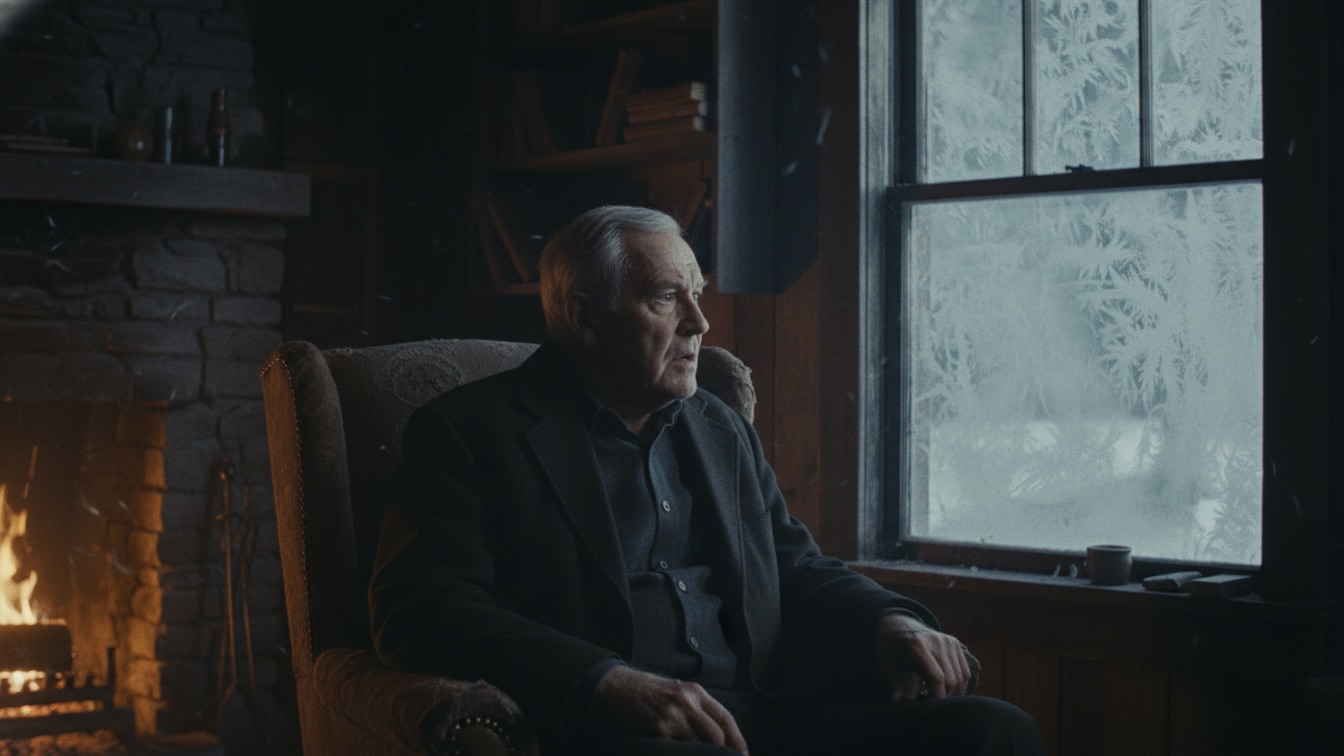
BEAT 1 - THE PATTERNS: In the cold pre-dawn, Arthur sits alone, watching the frost on the window. He is disconnected, his thoughts as fractured as the ice crystals, establishing his isolation and fragile mental state. The dying fire and dusty blanket underscore his neglect and solitude.
BEAT 2 - THE WOMAN ON THE ICE: Arthur’s quiet observation is broken by a flicker of movement. He sees his wife Karen, dead for years, walking on the frozen lake in a yellow sundress. This impossible, silent vision is the inciting incident, a profound crack in his already fragile reality.
BEAT 3 - THE FADING GHOSTS: Shaken, Arthur turns to the photographs on the mantel for grounding, but finds the opposite. The faces of his wife and son have become indistinct blurs, as if the memories themselves are physically dissolving from the paper. This externalizes his internal decay, sparking a low hum of deep, existential anxiety.
BEAT 4 - THE ENGINE IN THE WOODS (Midpoint): A low whine grows into the roar of a snowmobile, triggering a fragmented, paranoid memory of a man who once threatened him. The genre shifts from psychological drama to thriller as the sound becomes an imminent, terrifying threat. Arthur's internal confusion now has a sharp, external focus, and he is convinced he is being hunted.
BEAT 5 - THE SIEGE (Climax): The engine sound is deafening, seeming to shake the cabin itself. Arthur crawls behind a chair, his body rigid with terror, waiting for the inevitable confrontation. The sound peaks and then, instead of stopping, it fades away, leaving him in a profound, ringing silence, the threat having passed without ever materializing.
BEAT 6 - THE UNRAVELING: Arthur, drained and trembling, pulls himself back into his chair. He realizes he can no longer trust what he sees, hears, or remembers—the vision, the photos, the snowmobile are all just "patterns." He lets go of the fight, leaning his head back and accepting the quiet disintegration of his world.
BEAT 7 - THE FINAL SOUND: In the newfound, weary peace of his resignation, a single, sharp sound cuts through the silence. A floorboard creaks upstairs. His eyes snap open, the terror returning, as the source of the threat is now undeniably inside the house with him.
The episode begins with a mood of deep melancholy and quiet confusion, inviting the audience into Arthur's disoriented state. This shifts to unsettling wonder and grief with the appearance of Karen. The discovery of the fading photographs injects a rising dread and existential horror, which then explodes into sharp, visceral suspense and paranoia with the arrival of the snowmobile. The climax is a tense crescendo followed by an adrenaline-crash relief, which finally settles into a fragile, tragic peace as Arthur accepts his fate, only to be shattered by the final moment of stark, ambiguous terror.
If expanded, FRACTURED STATES could explore a recurring motif or entity that preys on those with weakened minds. Perhaps the "creak upstairs" is not random but the arrival of a presence drawn to Arthur's mental decay—a presence seen in other episodes, haunting different characters in their moments of extreme psychological vulnerability. This would transform the series from a simple anthology into a connected universe, where the true horror is not just mental illness, but a parasitic force that exploits it.
A season-long arc could follow an investigator or a family member (perhaps Arthur's son, Michael) trying to understand a series of strange events or disappearances linked to individuals in remote locations. Michael could uncover journals or evidence from other victims, slowly piecing together the nature of this predatory entity. The season would build a mythology around this force, culminating in a confrontation where the protagonist must not only face the creature but also question their own sanity, wondering if they are its next victim or simply succumbing to the same "fractured state."
The visual style will be one of stark contrasts and subjective reality. The world outside the cabin is desaturated and monochromatic—all whites, greys, and blacks—emphasizing the cold, dead emptiness of winter. The only flash of impossible color is Karen's yellow dress. Inside, the cabin is dark, claustrophobic, and lit almost entirely by the warm, flickering, and unreliable light of the fire, creating deep shadows and a sense of being trapped. Cinematography will utilize shallow depth of field and slow, deliberate camera movements to mirror Arthur's narrow, confused focus, with occasional jarring shifts or handheld shots to reflect his moments of panic.
The tone is a blend of melancholic character study and slow-burn psychological horror, reminiscent of The Father in its depiction of subjective reality and dementia, combined with the isolated, atmospheric dread of The Blackcoat's Daughter or A Dark Song. The sound design is paramount, creating a soundscape where the oppressive silence is as important as the howl of the wind, the crackle of the fire, and the terrifying intrusion of the snowmobile engine. The goal is to create an experience that is both heartbreakingly tragic and deeply unsettling.
The target audience is mature viewers (25-55) who appreciate character-driven psychological thrillers and elevated horror. This includes fans of A24-style films, anthology series like Black Mirror and The Twilight Zone, and viewers who prefer suspense and atmospheric dread over jump scares. The episode's thematic depth will also appeal to audiences interested in poignant dramas that explore complex human conditions like grief, memory, and aging.
The episode's pacing is deliberately slow and contemplative in the first act, building a deep sense of Arthur's isolation and internal state. The tempo accelerates sharply in the second act with the arrival of the snowmobile, creating a sustained sequence of high tension. The third act returns to a slower, more somber pace after the climax, allowing the weight of Arthur's realization to settle before the final, abrupt shock of the ending. Within a 10-12 minute runtime, Act 1 (Setup) would be ~3 minutes, Act 2 (Confrontation) ~6 minutes, and Act 3 (Resolution/Twist) ~2-3 minutes.
The key visual effect will be the "fading" photographs. This should be a subtle, practical-looking effect, achieved digitally in post-production, to make it feel unnervingly real, as if the emulsion is physically dissolving. The frost patterns on the window are another critical visual element; they should be intricately designed to appear both beautiful and labyrinthine, perhaps subtly changing or "growing" between shots to enhance the sense of an unstable environment.
Sound design is the most crucial technical element. The mix must create a clear distinction between the diegetic sounds of the cabin (fire, wind, creaks) and the intrusive, mechanical roar of the snowmobile, which should be mixed to feel overwhelmingly powerful and physically present. The final sound—the single creak of a floorboard—must be sharp, clear, and unnervingly close, cutting through the ambient noise to deliver the final jolt of terror. The production requires a single, isolated cabin location in a convincing winter landscape, which will be central to establishing the story's oppressive atmosphere.