Format: Short Film / Anthology Episode | Est. Length: 10-12 minutes
Imagine a near-future America fractured by civil conflict, where the authoritarian Bureau of Homeland Integrity (BHI) controls the secure zones and a desperate resistance fights for survival in the decaying urban peripheries. "Triage Politics" serves as a bottle episode within a larger series that explores this grim reality through the eyes of disparate characters—journalists, soldiers, medics, and civilians. Each story is a self-contained moral crucible, contributing to a mosaic of a society collapsing under the weight of its own security state, where the lines between right and wrong have been eroded by necessity.
A battered journalist awakens in agony on a hard wooden table, his world a blur of harsh light and pain. A shadowy figure looms over him with a metal tool, and in a surge of paranoid terror, he lashes out, convinced he’s in an enemy interrogation cell.
An idealistic journalist, trapped in a besieged library-turned-hospital, clashes with a pragmatic medic over her brutal, life-or-death triage decisions. He must confront the utter uselessness of his ideals in a world where survival is the only law that matters.
The episode is a stark examination of idealism versus pragmatism in a state of collapse. It questions the value of established moral codes—like journalistic ethics or the Geneva Conventions—when the foundational structures of society have crumbled. Theo represents a belief in rules, accountability, and the power of witness, while Mina embodies a new world order dictated by brutal necessity and resource scarcity. Her triage is not just medical; it's a political act, prioritizing a perceived future (the child) over a spent asset (the soldier), forcing the audience to grapple with the uncomfortable logic of survival.
Furthermore, the story explores the theme of identity and its fragility. Theo’s entire being is tied to his press badge and the principles it represents. When Mina dismisses it as a "useless object," she isn't just insulting him; she is nullifying his identity, his purpose, and his entire worldview. The episode dissects how, in extreme circumstances, we are stripped down to our biological function: a "contamination vector," a "drain on resources," or a body to be saved or discarded.
The stakes are immediate and absolute: life and death. For the young fighter, Mina's decision is a death sentence. For the dehydrated child, it is the only chance at life. For Theo, the physical stakes involve surviving his injuries and the hostile environment, but the psychological stakes are far higher. His core identity is on the line; if he cannot affect change or hold power accountable, his entire life's work and belief system are rendered meaningless, a truth that might be more devastating than any physical wound.
The central conflict is the ideological battle between Theo Garrick and Mina Kovic. It is a clash between the old world's morality and the new world's grim calculus. Mina is the primary antagonist from Theo's perspective, an immovable force of pure pragmatism whose authority is absolute within her domain. The external antagonistic force is the unseen BHI, whose presence is felt through the psychological warfare of the relentless K-Pop broadcast and the general state of siege that creates the scarcity driving the central conflict. Internally, Theo battles his own paranoia, his physical weakness, and the crushing shame and despair that come with the realization of his own impotence.
THEO GARRICK, a war journalist, awakens in excruciating pain inside what he believes is a BHI black site. Disoriented and terrified, he attacks a figure he perceives as a torturer, only to discover he has assaulted a medic in a makeshift hospital set up in a cavernous, decaying public library. Wracked with shame, he is restrained and forced to observe the grim reality of this sanctuary, run by the cold, efficient head medic, MINA KOVIC.
The true conflict ignites when a critically wounded militia fighter and a severely dehydrated child become the subjects of a brutal triage decision. With only one bag of saline left, Mina condemns the fighter to die by marking his forehead with an 'X', diverting the life-saving resource to the child. Horrified, Theo attempts to intervene, brandishing his press badge and invoking international law, only to be swiftly and humiliatingly overpowered by Mina, who dismisses his credentials as useless plastic. As the fighter dies, Theo is declared a "contamination vector" and exiled to the library's dark, freezing stacks, left to grapple with his shattered ideals and the final, maddening assault of a BHI propaganda broadcast echoing through the oppressive silence.
THEO GARRICK (30s-40s): An accomplished, idealistic, and currently terrified journalist.
* Psychological Arc: Theo begins in a state of heightened paranoia, viewing the world through the lens of his work—seeing BHI tactics everywhere. This paranoia gives way to shame, which is then replaced by a surge of righteous indignation as his core principles are violated. By the end, he is utterly broken, stripped of his professional identity and moral certainty, reduced from a "witness" to a "problem of biological order," left alone to face the psychological horror of his new reality.
MINA KOVIC (40s): The lead medic; exhausted, authoritative, and ruthlessly pragmatic.
* Psychological Arc: Mina is a static character within this episode, representing the unshakeable reality of the Zone. She has already undergone her transformation, shedding the sentimentality and ethics of the old world to become a brutally efficient gatekeeper of life and death. She operates not with malice, but with the detached logic of an engineer managing a failing system, viewing people and principles as mere variables in a survival equation.
SUPPORTING CHARACTERS: The Wounded Fighter (20s) serves as the catalyst for the central conflict, his death representing the expendability of those who fight. The Dehydrated Child (8) is the symbol of the future and the object of Mina's grim calculus. The First Medic represents the moral hesitation and empathy that Mina can no longer afford.
WAKING NIGHTMARE: Theo awakens to a grid of pain and sensory overload, his mind immediately classifying the harsh light and looming silhouette as a classic BHI interrogation. He is a subject, not a patient, and his training screams that he is in mortal danger. His body floods with adrenaline as he prepares to fight for his life.
PARANOID LASHING OUT: Mistaking a medic's approach for an act of torture, Theo’s survival instinct takes over and he violently swats away her hand, sending a tray of precious medical supplies crashing to the floor. Other figures converge to restrain him as he thrashes, his panic and pain erupting in a raw, animalistic scream. The chaos he creates is a direct result of the paranoia the war has instilled in him.
DAWNING REALITY: Strapped down and spent, Theo’s vision clears, revealing not a sterile cell but the grimy, ornate ceiling of a public library. The "interrogator" is a frustrated medic, and the shame of his violent mistake washes over him, momentarily eclipsing his pain. He realizes his honed survival instincts have betrayed him, making him a threat to the very people trying to help.
THE TRIAGE DECISION (MIDPOINT): Theo witnesses the arrival of a critically wounded fighter, his life rapidly draining away. He watches as the lead medic, Mina, assesses the boy, the last bag of saline, and a nearby dehydrated child. In a moment of cold, decisive action, Mina takes a marker and draws a large 'X' on the fighter's forehead, condemning him to die to save the child.
IDEALISTIC INTERVENTION: Unable to passively witness what he sees as a profound injustice, Theo fights his restraints and confronts Mina. He invokes his press badge, the Geneva Conventions, and the entire moral architecture of the world he represents. He believes his words and his status still hold power here, a desperate appeal to a law he thinks is universal.
THE HUMILIATION (CLIMAX): Mina turns from her patient and neutralizes Theo with shocking, efficient violence, twisting his wrist and forcing him to drop his badge. She calmly lectures him on the uselessness of his ideals and his identity in this place, defining him only by his biological cost as the fighter takes his last rattling breath beside them. The scene is a brutal deconstruction of Theo's entire being, executed with the clinical precision of a surgeon.
EXILE: Judged to be nothing more than a disruption, Theo is unceremoniously hauled away from the triage area, his body a dead weight. He is dragged through the main hall, a charnel house filled with the sick and dying, and dumped on the cold concrete floor of the library's dark, silent stacks. His expulsion from the group is swift and total.
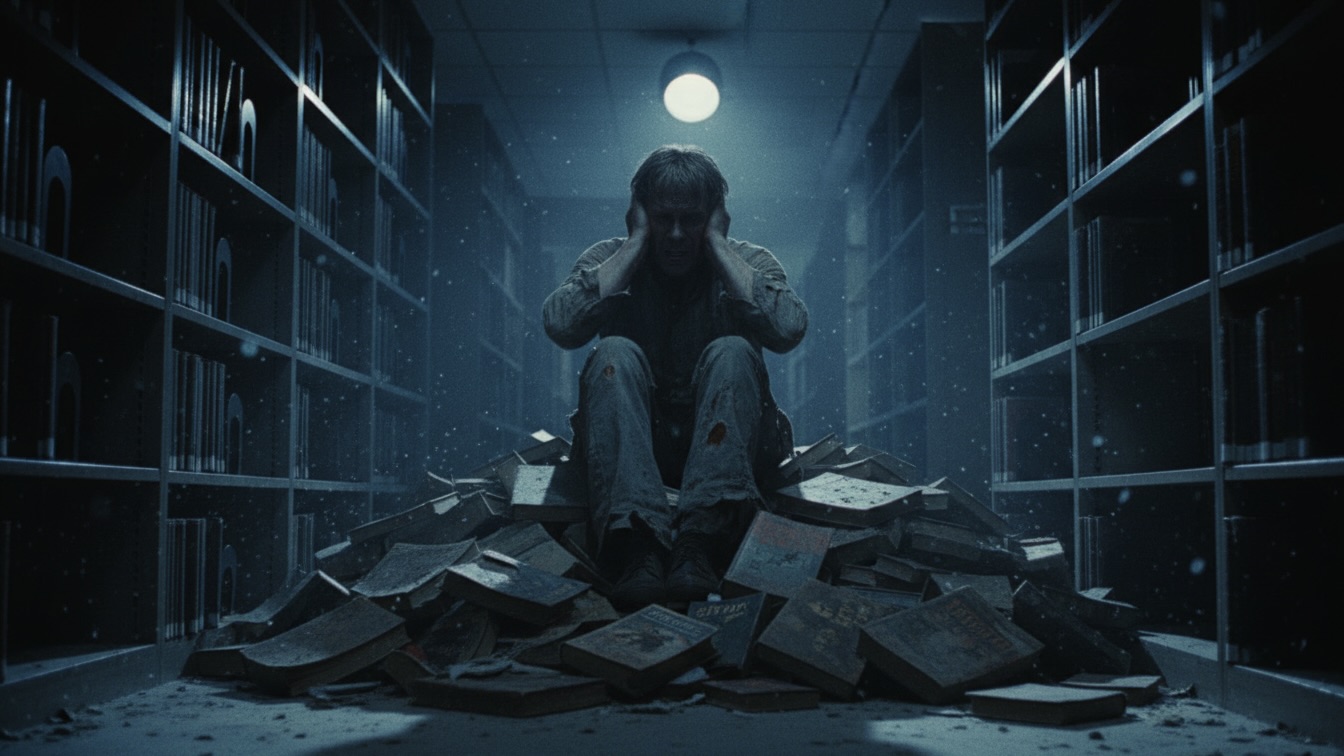
SONIC SIEGE: Lying alone and freezing on a makeshift bed of ruined books, Theo is assaulted by a new enemy: sound. A distorted, aggressively cheerful K-Pop song blasts from an old PA speaker, the BHI's psychological warfare. This final scene solidifies his despair, as the maddeningly upbeat music serves as a grotesque counterpoint to his suffering, confirming there is no sanctuary, only the front line.
The episode's emotional trajectory is a steep, downward spiral. It begins with visceral terror and paranoid confusion, which briefly morphs into shame and disorientation. A spark of righteous, idealistic anger provides a moment of agency for the protagonist, but this is immediately and brutally extinguished, leading to the episode's climax of humiliation and powerlessness. The final act plunges into a state of bleak, oppressive despair, leaving the audience in a lingering state of unease, trapped with Theo in the cold dark with the inescapable, maddeningly cheerful music.
If expanded, this episode serves as the crucible that forges a new Theo. The season would follow his journey after being cast out of the triage center. Having had his identity as a "witness" shattered, he must find a new purpose: does he attempt to escape the Zone, document the horrors from a new, more cynical perspective, or does he adopt Mina's brutal pragmatism to survive and fight back in a more direct way?
A season-long arc could see Theo reluctantly teaming up with other survivors in the library, using his investigative skills not to write stories, but to uncover BHI troop movements or find caches of supplies. His relationship with Mina could evolve from antagonistic to a grudging respect, as he is forced to understand the impossible choices she makes daily. The overarching story would explore whether it's possible to retain one's humanity in inhuman circumstances, with Theo's journey serving as the central, agonizing test case.
The visual style is grounded, gritty, and claustrophobic, employing a handheld camera to create a sense of immediacy and disorientation that mirrors Theo's perspective. Lighting will be stark and motivated by practical sources—a single, harsh floodlight in the triage area creates deep, menacing shadows and high-contrast, almost noir-like visuals. The color palette is severely desaturated, dominated by the cold blues of the unheated space, the sickly yellows of emergency lighting, and the grimy whites of plaster and bandages, punctuated only by the stark, visceral red of fresh blood.
The tone is relentlessly grim and tense, prioritizing psychological realism over action. The atmosphere is one of managed decay, a place where the quiet hum of suffering is the baseline. Tonal comparables include the raw, verité feel of Children of Men, the clinical horror of the medical scenes in Chernobyl, and the oppressive, hopeless atmosphere of The Road.
"Triage Politics" is aimed at a mature audience (18+) that appreciates intelligent, character-driven speculative fiction and psychological drama. It will appeal to viewers of thematically dense, dystopian series like Black Mirror, The Handmaid's Tale, and Station Eleven. The ideal viewer is looking for a challenging, thought-provoking experience that forgoes easy answers and focuses on the complex moral and ethical questions that arise at the edges of civilization.
For a 10-12 minute runtime, the pacing must be deliberate yet economical. The narrative follows a compressed three-act structure. Act One (Theo's awakening and disorientation) is slow and immersive, building tension through sensory detail and confusion. Act Two accelerates sharply with the arrival of the wounded fighter, forcing the central conflict to a head. Act Three is a swift, brutal resolution to the confrontation, followed by a lingering, oppressive final scene that allows the weight of Theo's defeat and the horror of his situation to settle on the audience.
As a contained "bottle episode," the production is feasible on a modest budget. The primary location, the library, is the most critical element. Production design must excel in creating a space that feels both grand and decayed, filled with the detritus of a refugee crisis—makeshift beds, scattered books, and evidence of long-term occupation.
The realism of the medical elements is paramount. Practical effects for the fighter's shrapnel wound must be visceral and convincing to sell the high stakes of Mina's decision. Sound design is a key narrative tool; the contrast between the tense, quiet desperation of the triage scenes and the sudden, tinny blast of the K-Pop broadcast in the finale is essential to the episode's psychological impact. The music itself should be carefully selected to be as incongruously cheerful and manufactured as possible.