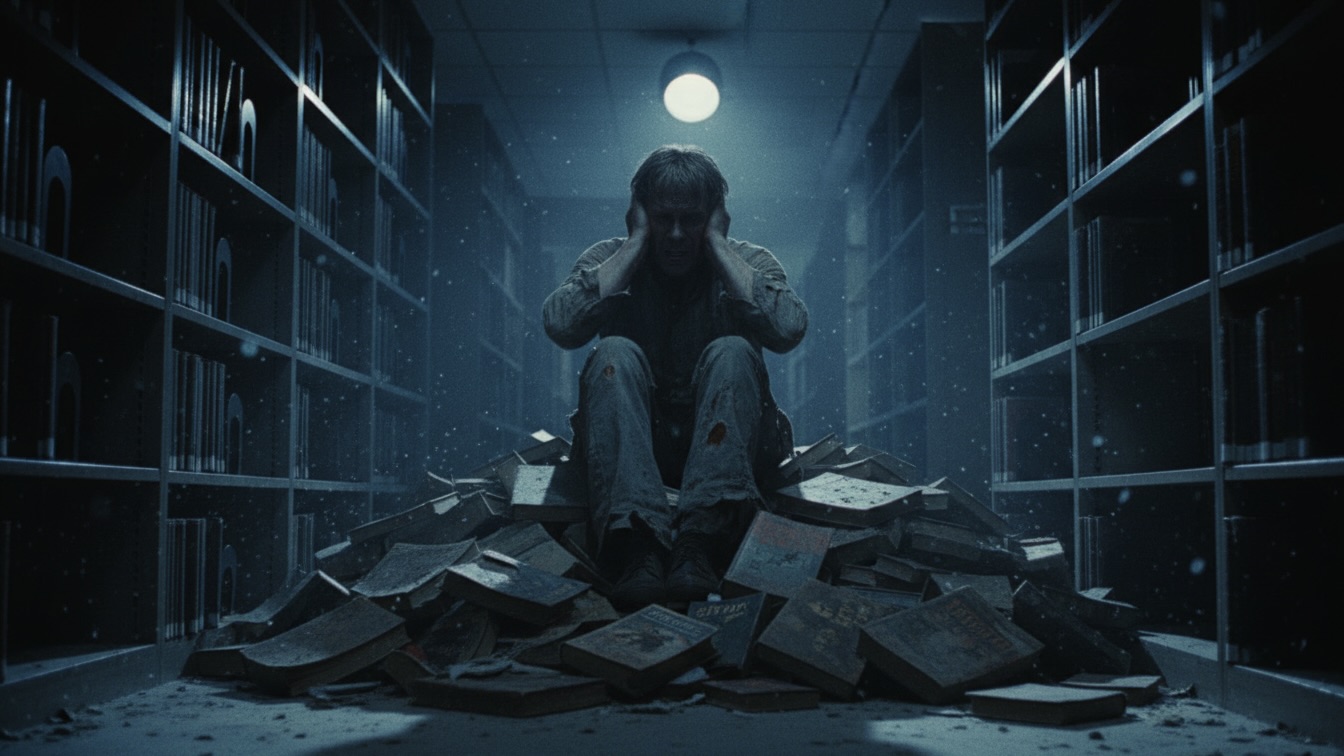
The narrative begins with Theo Garrick regaining consciousness in a state of severe physical distress, initially perceiving his surroundings through the lens of a prisoner anticipating interrogation. However, as his senses adjust, he realizes he is not in a detention cell but a makeshift triage center located within a dilapidated public library. His initial panic leads him to accidentally destroy valuable medical supplies, drawing the attention of Mina Kovic, a pragmatic and exhausted medic. Theo witnesses a brutal triage decision where Mina marks a critically wounded fighter as unsalvageable to save resources for a dehydrated child, a choice that shocks Theo’s moral sensibilities.
Attempting to intervene based on his status as a journalist and abstract concepts of international law, Theo physically collapses and contaminates more sterile equipment. Mina coldly dismantles his perceived authority, physically subduing him and dismissing his press badge as useless plastic in the face of biological reality. Following the death of the fighter, Theo is forcibly removed from the triage area and dumped in the library's fiction stacks. Alone and freezing, he attempts to insulate himself using damp romance novels. The chapter concludes with a psychological assault as the silence is broken by blaring, distorted K-Pop music, a weaponized cheerfulness that underscores the inescapability of the war.
The central theme of the text is the violent collision between abstract idealism and brutal materialism. Theo represents the world of symbols, laws, and narratives; he believes that his press badge, a piece of plastic, carries an intrinsic force field of moral authority and legal protection. He operates under the assumption that the "Geneva Convention" is a magic spell that can alter physical reality. In contrast, the environment of the library triage represents a world reduced to biological arithmetic. Values are measured in blood pressure, fluid ounces of saline, and core temperature. The narrative ruthlessly deconstructs Theo's idealism, showing that in a state of total collapse, symbols lose their signifier power and only the material utility remains.
Closely linked to this is the theme of the desecration of sanctuary. The setting, a public library, traditionally represents a bastion of order, culture, and quiet contemplation. In this story, that sanctity is inverted. The circulation desk becomes an operating table, the stacks become a freezing cell, and books are stripped of their intellectual content to serve as crude physical insulation. This transformation suggests that during extreme conflict, culture is not just ignored but actively metabolized for survival. The "Romance" section, usually a place of escapist fantasy, becomes a grim, damp tomb where the protagonist confronts his own physical vulnerability, highlighting the irrelevance of fiction when reality is this visceral.
Furthermore, the text explores the psychological concept of dehumanization as a survival mechanism. Mina Kovic practices "triage politics," a system where human beings are reduced to data points of viability. To function effectively, she must suppress empathy and view her patients—and Theo—strictly as biological components. Her reference to Theo as a "contamination vector" and a "problem of biological order" strips him of his humanity and identity. This is not done out of malice, but out of a desperate need to maintain efficiency in a resource-scarce environment. The story suggests that to save lives, one may have to sacrifice the very empathy that makes life valuable.
Finally, the ending introduces the theme of psychological warfare and the intrusion of the absurd. The use of upbeat K-Pop as a torture device creates a grotesque dissonance between the auditory environment and the physical reality of the dying refugees. It serves as a reminder that the "civilized" world outside the war zone continues to function with a manic cheerfulness that is utterly indifferent to the suffering within. This sonic siege denies the victims even the dignity of silence, emphasizing that modern warfare targets the mind just as aggressively as the body.
Theo is a man grappling with the sudden obsolescence of his identity. As a journalist, he defines himself through observation, documentation, and the belief that truth holds power. His internal monologue reveals a deep-seated reliance on narrative structures; he initially frames his situation as a "classic interrogation" because that is a story he understands and knows how to navigate. When the reality shifts to a chaotic medical emergency, he loses his footing both physically and psychologically. He is desperate to assert agency in a situation where he has none, leading to his disastrous attempt to intervene in the triage process.
His motivation is driven by a mix of righteous indignation and a frantic need to prove he is not merely "Subject 734" or a victim. He clings to his press badge as a talisman, unable to accept that his status holds no currency in this economy of survival. The narrative exposes his naivety; despite his experience in war zones, he has remained an observer rather than a participant. When he is finally forced to participate, he fails, becoming a burden rather than a savior. By the end of the chapter, stripped of his badge and exiled to the darkness, Theo is forced to confront the terrifying possibility that he is insignificant, leading to a breakdown of his psychological defenses.
Mina serves as the narrative's antagonist to Theo's ego, though she is not a villain. She is the embodiment of the "triage" mindset: cold, efficient, and ruthlessly utilitarian. Unlike Theo, who deals in words and ideals, Mina deals in fluids, pressure, and probability. Her psychology appears to be one of extreme compartmentalization. She does not allow herself the luxury of anger or pity; even her violence toward Theo is described as a "technical application of leverage" rather than an emotional outburst.
She represents a person who has accepted the horrors of her reality and adapted perfectly to them. Her dismissal of the fighter's life is not cruelty, but a calculated decision to save the child, showcasing a moral framework that prioritizes the future (the child) over the past (the doomed soldier). However, this adaptation has come at a cost. She views people as "components" or "vectors," suggesting a dissociation that protects her from the trauma of her daily decisions. To Mina, Theo is dangerous not because of his opinions, but because he introduces chaos into her carefully managed entropy.
The narrative employs a visceral, sensory-heavy style that grounds the reader immediately in the physical reality of the protagonist. The opening paragraph focuses intensely on pain, using metaphors of a "grid of agony" and an "occupying force" to externalize Theo's suffering. This establishes a tone that is gritty and claustrophobic. The author frequently juxtaposes clinical, sterile language with descriptions of decay and filth—"antiseptic" mixed with "musty books," "fluorescent light" against "peeling plasterwork." This contrast heightens the sense of dislocation and surrealism that permeates the chapter.
Pacing is used effectively to mirror Theo's internal state. The beginning is slow and disjointed, mimicking the confusion of waking up concussed. The pace accelerates rapidly during the confrontation with Mina, marked by shorter sentences and frantic action, reflecting Theo's panic and adrenaline. Following his expulsion to the stacks, the pacing slows down again to a heavy, oppressive rhythm, symbolized by the "Tap. Tap. Tap." of the condensation. This creates a lull that makes the sudden, jarring explosion of the K-Pop music at the end even more shocking and intrusive.
The author also utilizes irony as a key stylistic device. The setting of the library, a place of knowledge, is turned into a place of ignorance where books are used for warmth rather than reading. The "Romance" section becomes a lonely, freezing cell. The press badge, a symbol of communication, is rendered voiceless. Most poignantly, the "cheerful" music becomes an instrument of torture. These ironic inversions serve to dismantle the reader’s expectations of safety and order, reinforcing the theme that in the "Zone," nothing functions as it should.