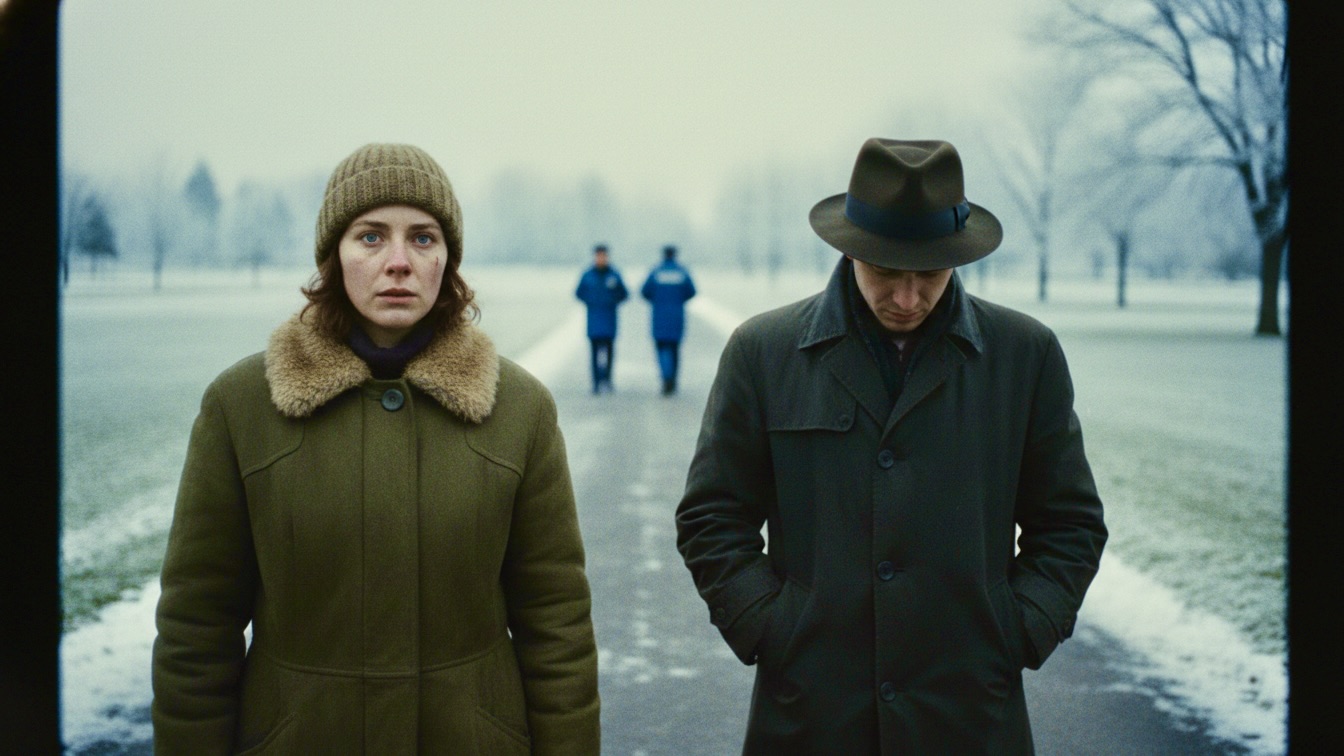
Format: Short Film / Anthology Episode | Est. Length: 10-12 minutes
Imagine a clandestine world operating in the quiet corners of our own, where trust is a liability and paranoia is a survival trait. "Trust Is Your Only Asset" serves as a standalone episode within a larger anthology series exploring the psychological toll of espionage on its operatives. Each episode functions as a taut, self-contained morality play, examining how the very skills that make these agents effective—deception, suspicion, emotional detachment—inevitably lead to their personal and professional ruin, often in ironic and devastating ways.
In the biting cold of a deserted winter park, a seasoned operative, RENA, finds a critical dead drop empty. The arrival of her distrusted rival, DAVE, confirms her worst fear: the mission is already compromised, and the person standing opposite her might be the reason why.
Two rival intelligence agents, forced to cooperate on a time-sensitive exchange, misidentify a civilian as an enemy operative. Their mutual paranoia fuels a disastrous plan that not only fails the mission but exposes them both, proving they are their own worst enemies.
The episode is a taut exploration of paranoia and professional self-destruction. It posits that in the world of espionage, the greatest threat is not the external enemy but the internal corrosion of trust. The characters' inability to trust each other, or even their own judgment, creates a feedback loop of suspicion that leads them to misinterpret reality, turning an innocent bystander into a phantom menace while ignoring the real threat in plain sight.
Secondly, the story delves into the theme of hubris in methodology. Rena’s intellectual arrogance and her need for a complex, clever solution clashes with Dave’s blunt, brute-force simplicity. The narrative demonstrates that neither approach is superior; in fact, their rigid adherence to their respective "styles" makes them predictable and vulnerable, ultimately proving that their greatest weakness is their inability to adapt or collaborate.
The primary stake is the retrieval of a high-value asset—mission-critical data contained within a book. Failure to secure this asset means a significant intelligence loss for their organization and a major victory for an opposing power. On a personal level, the stakes are the agents' careers; being "burned" on a public stage by park security renders them useless for future fieldwork. Their cover identities, their professional standing, and their freedom are all on the line, and their failure is not just a mission loss but a permanent black mark that could end their careers or worse.
The central conflict is the man-vs-self struggle playing out between the two protagonists. Rena and Dave are their own antagonists; their deep-seated rivalry and mutual suspicion is the primary force driving the plot toward disaster. This internal conflict is externalized in their constant jockeying for control and their inability to form a cohesive strategy. The perceived antagonist, the man in the green parka, is a red herring—a projection of their paranoia. The true, passive antagonistic force is the Woman in the Grey Coat, the real contact who observes their incompetence and acts decisively to mitigate her own exposure by destroying the asset, representing the cold, unforgiving reality of a world that punishes mistakes without mercy.
Two rival intelligence operatives, Rena and Dave, meet at a dead drop in a frigid city park to retrieve a sensitive asset, only to find the drop empty. Their immediate suspicion of one another poisons any chance of effective collaboration. Their paranoia quickly latches onto a plausible threat: a middle-aged man with binoculars on the riverbank, whom they conclude is enemy surveillance who has already lifted the package.
Forced into a tense, impromptu partnership, Rena devises a risky plan to create a diversion, intending to fake a fall on an icy path to draw the "birdwatcher" in as a Good Samaritan, allowing Dave to lift the asset from him. However, the plan backfires spectacularly. Rena’s fall attracts a crowd of genuine civilians and, eventually, park security. The commotion spooks their target—who was, in fact, just a birdwatcher—and forces the real, unnoticed contact to abort the mission, destroying the data and quietly disappearing. Rena and Dave are left exposed, their identities logged, their mission an utter failure caused entirely by their own inability to trust anyone, especially each other.
RENA (30s): A sharp, analytical field agent who prides herself on her intellect and ability to out-think her opponents. Psychological Arc: Rena begins the story in a state of controlled, professional paranoia, confident in her ability to read any situation. She ends in a state of shattered humiliation, forced to confront the devastating reality that her own "cleverness" and inability to trust her partner directly led to a catastrophic, career-ending failure.
DAVE (30s): A pragmatic, physically imposing agent who defaults to direct action and views Rena’s methods as needlessly complicated. Psychological Arc: Dave starts with an arrogant confidence, believing his straightforward approach is superior and that Rena is the weak link. He ends in a state of cold, flat certainty, sharing the blame for a failure born of their mutual dysfunction, the reflection of his own professional flaws staring back at him in Rena’s eyes.
SUPPORTING CHARACTERS: The MAN IN THE GREEN PARKA serves as a red herring, the blank screen onto which the agents project their paranoia. The WOMAN IN THE GREY COAT is the real contact, a ghost of professional competence whose quiet, decisive actions highlight the protagonists' chaotic failure.
THE EMPTY DROP: Rena confirms the dead drop is empty in the frigid, isolating cold of a winter park, her anxiety palpable. Her rival, Dave, arrives, and their terse dialogue immediately establishes their deep-seated distrust and opposing methodologies. The central problem is established: the asset is gone, and they are each other's prime suspect.
THE RED HERRING: Their shared paranoia finds a target in a man with binoculars, a plausible but ultimately innocent birdwatcher. They debate his identity from a distance, their professional instincts warped by their suspicion, turning a random civilian into a hostile operative. This critical misidentification sets them on a collision course with failure.
THE FLAWED ALLIANCE (Midpoint): Rena concocts a theatrical plan to feign an accident, forcing a reluctant collaboration with Dave where he must act as the pickpocket while she plays the victim. This moment represents their only attempt at teamwork, but it's a strategy built on a foundation of flawed assumptions and mutual contempt. The tension skyrockets as they commit to their plan, walking knowingly into a trap of their own making.
THE BACKFIRE (Climax): Rena executes the fall perfectly, but the plan immediately unravels as real Good Samaritans and park security rush to her aid, not their target. From the ground, she watches in horror as the birdwatcher retreats and, across the park, she finally notices the real contact—a woman in a grey coat—calmly abort the mission and destroy the asset. The mission doesn't just fail; it implodes into a public incident, burning them completely.
THE RECKONING: After being logged by security, Rena and Dave stand in the aftermath, the park now a quiet monument to their failure. The fury and suspicion are replaced by a hollow, shared humiliation as the truth settles in. Dave’s final, deadpan observation, "He was just watching birds," serves as the epitaph for the mission, confirming their paranoia was the only real enemy they faced.
The episode begins with a mood of cold, tense suspicion, which builds into a sharp spike of adrenaline and high-stakes anxiety as Rena and Dave commit to their flawed plan. The emotional peak is the climax, a chaotic mix of physical pain for Rena, rising panic as the plan backfires, and a sudden, gut-wrenching moment of dawning horror as she realizes their true mistake. The arc then plummets into a prolonged, quiet denouement of profound humiliation, bitterness, and the cold, empty weight of shared failure, leaving the audience with a chilling sense of dramatic irony.
This episode's failure could serve as the inciting incident for a season-long arc. "Control" could place Rena and Dave on a mandatory, low-stakes detail together as punishment, forcing them to confront their toxic dynamic or be permanently removed from field duty. Their shared failure would make them a liability, and they would have to learn to trust each other to uncover why they were paired for a mission so perfectly designed to exploit their weaknesses, leading them to suspect a mole within their own agency is setting them up.
Alternatively, the consequences of the lost data could become the season's central plot. The information contained in the destroyed book could pertain to a threat that their agency is now blind to. Throughout the season, the fallout from this unseen threat would manifest in escalating ways, with each new crisis serving as a painful reminder of Rena and Dave's initial failure, forcing them to work outside the system to clean up a mess only they understand the true origins of.
The visual style will be grounded and naturalistic, with a cold, desaturated color palette dominated by whites, greys, and muted earth tones to emphasize the bleak, unforgiving winter landscape. Cinematography will favor static, observational shots and slow, deliberate pans, creating a sense of voyeurism and trapping the characters within the frame. The tone is inspired by the grounded, melancholic espionage of Tinker Tailor Soldier Spy and the stark, character-driven tension of Michael Clayton, focusing on psychological realism over action spectacle.
The mood is one of pervasive, low-grade paranoia. The sound design will be minimalist and crucial, amplifying the crunch of snow underfoot, the sharp chirp of a bird, and the brittle whisper of the wind to create an atmosphere of intense, almost unbearable quiet. The overall effect should be a slow-burn thriller that feels both intimate and chillingly detached, where the most significant conflicts happen in the loaded glances and unspoken accusations between the characters.
The primary audience is adults aged 25-55 who are fans of intelligent, slow-burn psychological thrillers and espionage dramas. This includes viewers who appreciate character-driven narratives over action-heavy plots, such as followers of series like The Americans, Slow Horses, and Homeland. The episode's self-contained, high-concept nature would also appeal to fans of anthology series like Black Mirror or Inside No. 9, who enjoy concise, impactful storytelling with a twist.
With an estimated runtime of 10-12 minutes, the pacing must be deliberate yet tight, with no wasted motion. The narrative follows a clear three-act structure compressed for maximum impact. Act One (3-4 minutes) establishes the characters, setting, and inciting incident at the dead drop. Act Two (4-5 minutes) covers the formulation of the plan, the build-up of tension, and its disastrous execution. Act Three (2-3 minutes) is the swift, brutal fallout and the final, damning realization, allowing the weight of the failure to settle in before the cut to black.
The primary production consideration is securing a location that can convincingly portray a stark, snow-covered urban park in winter. The authenticity of the cold is paramount to the story's atmosphere; practical breath effects and the actors' physical response to the environment are crucial visual elements. The production design should be minimalist, focusing on the texture of the environment and the characters' winter clothing, which serves as a form of social and professional armor.
Sound design will be a key post-production focus. Capturing crisp, high-fidelity location sound—the crunch of snow, the distant city hum, the wind—is essential for building the world's oppressive quiet. The use of sound should be subtle, designed to heighten the audience's sense of paranoia and isolation, making every small noise feel like a potential threat. No special effects are required, as the drama is entirely psychological and performance-driven.