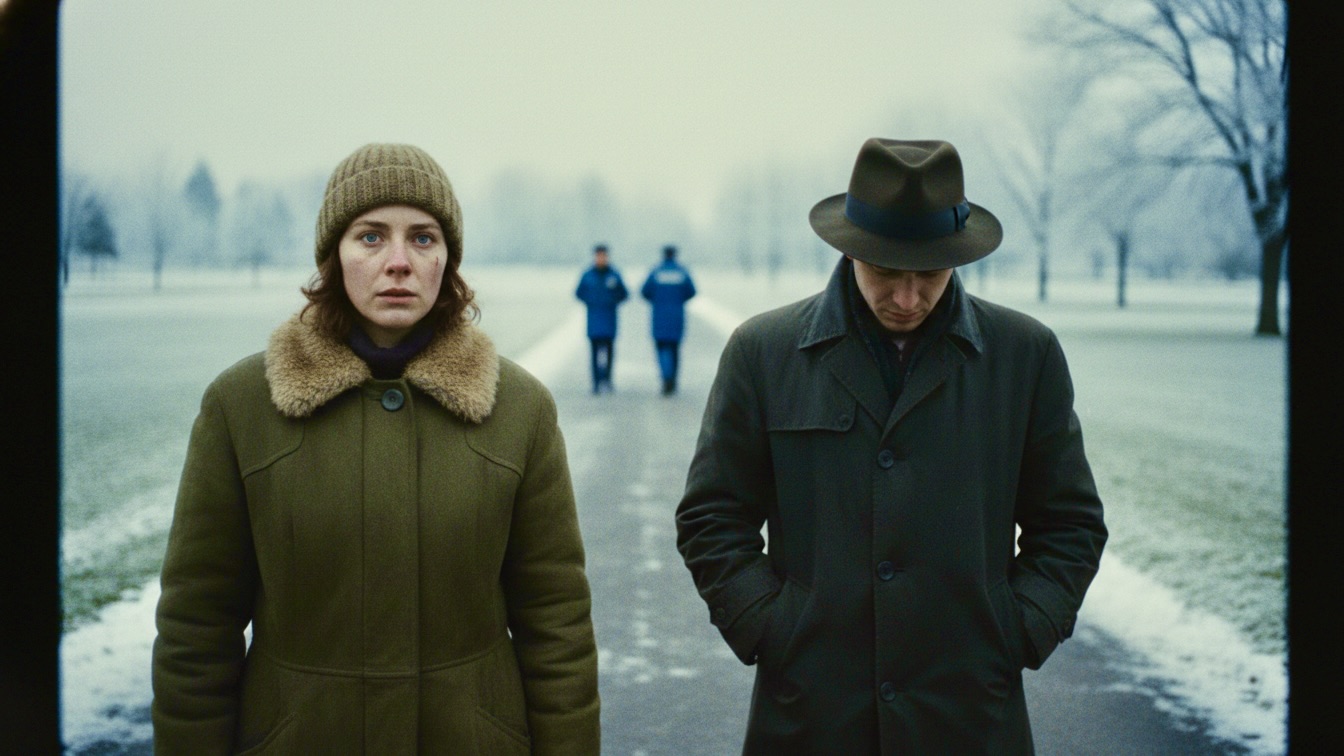
The narrative opens in a stark, frozen park where Rena, an intelligence operative, discovers a dead drop is empty. She is soon joined by her partner and rival, Dave, whose arrival is marked by tension and mutual distrust. Their suspicion quickly fixates on a nearby birdwatcher, whom they misidentify as an enemy agent conducting surveillance. Driven by professional paranoia and the pressure to retrieve the missing asset, Rena orchestrates a diversionary tactic involving a staged fall on the ice to allow Dave to intercept the target.
The plan, however, unravels catastrophically. The birdwatcher reveals himself to be a genuine civilian, frightened away by the commotion rather than drawn in. The staged accident attracts unwanted attention from park security and bystanders, creating a chaotic scene. Amidst this distraction, the true contact—a woman unnoticed on a nearby bench—discards the intelligence data and departs, signaling the mission's total failure. The chapter concludes with Rena and Dave standing in the cold, forced to confront the reality that their hyper-vigilance and lack of genuine insight were the architects of their own defeat.
The central theme of the text is the corrosive nature of professional paranoia and how it distorts reality. The story posits that in a world built on deception, the capacity to discern truth from fiction creates a dangerous blind spot. Rena and Dave are so conditioned to see threats and conspiracies that they project agency onto an innocent bystander. This projection is not merely a mistake; it is a psychological necessity for them, validating their worldview that everything is a game of espionage. The irony lies in the title, "Trust Is Your Only Asset," as the characters possess neither trust in each other nor the ability to trust the simplicity of their environment.
Complementing this is the theme of isolation, mirrored perfectly by the setting. The physical coldness of the winter park serves as a potent metaphor for the emotional distance between the two operatives. The environment is described as "dead," "hollow," and "frozen," adjectives that apply equally to the relationship between Rena and Dave. They are isolated not only from the civilians around them, whom they view with disdain or suspicion, but also from one another. Their partnership is defined by calculation and rivalry rather than cooperation, turning them into solitary islands even when standing side by side.
Furthermore, the narrative explores the concept of performance and authenticity. Rena’s life is a series of calculated acts, culminating in her theatrical fall on the ice. She views the world as a stage where everyone is playing a part, which leads to her critical error: assuming the birdwatcher is also performing. When reality intrudes—in the form of the birdwatcher’s genuine fear and the helpfulness of the bystanders—the artifice of her world shatters. The true professional, the woman in grey, succeeds because she does not perform; she blends into the banality of the setting, exploiting the very "emptiness" Rena scorned.
Rena serves as the primary focal point of the narrative, embodying the high-functioning anxiety of a career spy. Her internal monologue reveals a mind that is constantly processing, calculating, and categorizing. She does not merely observe her surroundings; she dissects them, looking for seams and false bottoms in reality just as she does in the hollow log. This hyper-analytical state, while intended to be her greatest strength, is revealed to be her tragic flaw. Her intelligence is a closed loop, feeding on its own assumptions until it constructs a false narrative that leads to disaster.
Psychologically, Rena is defined by a desperate need for control. Faced with an empty drop—a variable she cannot control—she seeks to impose order on the chaos by inventing a villain in the form of the birdwatcher. This fabrication provides her with a solvable problem, a target she can outmaneuver. It is a defense mechanism against the helplessness of the situation. Her interactions with Dave further highlight this need for dominance; she refuses to be "baited" by him and rejects his brute-force suggestions in favor of a more complex, intellectual plan. She needs to be the smartest person in the room, a desire that ultimately blinds her to the obvious.
The climax of the chapter exposes the fragility of her self-image. When she is on the ground, feigning injury, the physical humiliation mirrors her professional degradation. The realization that she has been outsmarted not by an enemy, but by her own over-complication, delivers a crushing blow to her ego. In the final moments, the "flat, dead certainty" she sees in Dave’s eyes is a reflection of her own emptiness. She is forced to recognize that her greatest enemy was not the surveillance she imagined, but the projection of her own fears onto the world.
Dave functions as the id to Rena’s superego, representing the physical and aggressive aspects of their trade. While Rena intellectualizes the threat, Dave seeks to confront it physically. His character is marked by an "arrogant patience" and a predisposition toward violence, evidenced by his eagerness to "take" the birdwatcher. However, despite his contrasting methods, he is equally complicit in the shared delusion. He validates Rena’s paranoia because it suits his desire for action; he wants the birdwatcher to be a spy so that he has something to fight.
His psychological role is that of an enabler. He challenges Rena, but only in terms of methodology, not in her fundamental assessment of reality. His skepticism is performative; beneath it, he is just as desperate as she is to find a culprit. When the plan fails, his transition from aggression to a "flat, dead certainty" signifies a total collapse of his purpose. Stripped of a physical enemy to fight, Dave is left with nothing, exposing the shallowness of his approach to the world.
The narrative voice is third-person limited, closely adhering to Rena’s perspective, which effectively traps the reader inside her paranoid worldview. This stylistic choice is crucial; by filtering all sensory information through Rena’s suspicious mind, the author forces the reader to participate in the misinterpretation of the scene. We see the birdwatcher’s movements as "deliberate" and "hostile" because Rena describes them that way. The prose is sharp and clipped, mimicking the staccato rhythm of anxious thought and the biting cold of the setting.
Atmosphere is established through a relentless use of sensory details related to temperature and texture. Words like "hollow," "dead," "sucked," "sharp-edged," and "brittle" create a tactile experience of discomfort. The cold is not just a weather condition; it is an active, hostile force that "feels solid" in the lungs. This sensory assault heightens the tension, creating a backdrop of physical distress that mirrors the psychological stress of the characters. The setting of the park, a "stark watercolour of white snow and black, skeletal trees," reinforces the binary, black-and-white thinking that dooms the operatives.
Pacing is managed with surgical precision to maximize the irony of the conclusion. The chapter begins with a slow, agonizing wait, building tension through silence and internal deliberation. As the plan is hatched, the pace accelerates, driven by the adrenaline of the execution. However, the climax is deliberately anti-climactic; instead of a dramatic confrontation, the energy dissipates into embarrassment and bureaucratic banality. This structural deflation reflects the hollowness of the operatives' victory. The final image of the trash can as a "tombstone" provides a static, heavy resolution, grounding the story in the weight of permanent failure.