Melgund Township Winter Story Library
The Thaw in Sarah's Eyes - Treatment
by Tony Eetak | Treatment
by Tony Eetak | Treatment
Format: Short Film / Anthology Episode | Est. Length: 10-12 minutes
Imagine an anthology series, "THE ELEMENTAL TEST," where each episode thrusts a relationship into the crucible of an extreme environment. From the crushing pressure of the deep sea to the isolating silence of the arctic, the series explores how the raw, unforgiving forces of nature strip away social pretense, forcing characters to confront the true foundations of their connection. "The Thaw in Sarah's Eyes" serves as a quintessential episode, using the brutal beauty of a blizzard to test the bond between a romantic and a pragmatist, questioning whether love is a shared ideal or a shared will to survive.
A couple lies in a tent during a snowstorm, their intimate conversation a bubble of warmth against the howling wind. In an instant, a roar of white noise and a crushing weight obliterates their shelter, plunging them into suffocating darkness beneath tons of snow.
A romantic poet, seeking to share the beauty of winter with his pragmatic girlfriend, finds their idyllic camping trip turned into a desperate fight for survival when an avalanche buries them alive. Trapped by the storm, they must reconcile their dangerously different worldviews before the cold claims them both.
The central theme is the collision of Romanticism and Pragmatism. John sees the world through a lens of metaphor and beauty, while Sarah sees it as a series of physical challenges and meteorological facts. The episode explores whether these two philosophies can coexist or if one must yield to the other in the face of a life-or-death struggle. It posits that true understanding isn't found in convincing someone to see the world your way, but in the shared, wordless effort of survival.
A secondary theme is the nature of perception and love. The story questions what it means to truly "see" another person. John wants Sarah to see the poetry in the storm, but the real journey is for him to see the poetry in her pragmatism—the fierce, beautiful efficiency of her will to live. Their survival, and the ultimate "thaw" in their relationship, comes not from a shared aesthetic, but from a shared vulnerability and the profound intimacy of mutual dependence.
The primary stakes are life and death. John and Sarah face immediate, tangible threats: suffocation under the snow, the brutal force of the blizzard, and the insidious, creeping danger of hypothermia. Every decision, from finding a shovel to digging a shelter, directly impacts their chances of surviving the next few hours. The secondary, emotional stake is their relationship. If they cannot bridge the chasm between their opposing worldviews, they risk not only dying, but dying as strangers, their final moments defined by frustration and misunderstanding rather than connection.
The primary antagonistic force is Nature itself, personified by the blizzard. It is an impersonal, overwhelming, and relentless opponent that attacks them with crushing weight, blinding snow, and lethal cold. It cannot be reasoned with or romanticized; it can only be endured and outsmarted. The secondary conflict is internal and interpersonal. John's internal conflict is his struggle to shed his useless poetic notions in the face of a reality that demands action, not words. The interpersonal conflict is the friction between his idealism and Sarah's stark pragmatism, a clash that becomes a direct threat to their survival when his paralysis endangers them both.
John, a poet, and Sarah, a pragmatist, are on a winter camping trip when their tent is suddenly buried by an avalanche. Plunged into darkness, John's romantic view of nature's power is instantly challenged by Sarah's sharp, survival-focused commands. After a frantic escape from the crushed tent into a raging blizzard, their opposing philosophies create immediate friction: John is struck by the "sublime and terrible beauty," while Sarah is already focused on the practical necessity of finding their shovel and building a shelter.
Their survival hinges on their ability to work together. Guided by Sarah's clear-headed instructions, they battle the storm to dig a life-saving snow cave. Huddled inside, trapped in the cold and dark, the physical struggle gives way to an emotional one. A raw, intimate conversation reveals the deep-seated origins of their worldviews, culminating in Sarah's confession that she came on the trip not to see the winter, but to understand the man who could see a "love letter" in a blizzard. When the storm finally breaks, they emerge into a world of profound, silent beauty, and for the first time, they see it—and each other—with the same eyes.
JOHN: A romantic intellectual who experiences the world through a literary filter. At the start, he is a "poet," treating the dangerous wilderness as a source of aesthetic inspiration and metaphor, frustratingly detached from the physical reality of their situation. His psychological arc is a forced disillusionment; the storm strips him of his abstract notions, forcing him to engage with the world on its own brutal terms. By the end, he discovers a deeper, more profound poetry not in words, but in the simple, practical act of survival and the quiet, shared understanding with Sarah.
SARAH: A hardened pragmatist whose past has taught her that nature, particularly winter, is not a thing of beauty but a series of problems to be solved. At the start, she is the "cynic," her voice a blade of pure practicality, frustrated by John's inability to grasp the severity of their danger. Her psychological arc is a subtle "thaw." While her pragmatism is what saves them, the shared ordeal and John's unwavering (if foolish) perspective allows her, in the final, silent dawn, to drop her guard and experience a moment of pure, unadulterated awe, finally seeing the beauty he always talked about.
THE BURIAL: John murmurs poetic thoughts about the snow on the tent just as a colossal weight collapses it, plunging them into a dark, heavy, and suffocating silence. Sarah's sharp, pragmatic voice cuts through John's daze, establishing her as the leader in this new, terrifying reality. The immediate threat is suffocation and the crushing weight of the snow.
THE ESCAPE: Paralyzed by the romantic notion of his own demise, John struggles until Sarah's insults galvanize him into action. He cuts them free of the tent and sleeping bag, emerging from their tomb into the roaring, monochromatic chaos of a full-blown blizzard. The world is a formless void of white, and the cold is a physical assault.
THE PLAN: Faced with the overwhelming storm, John is awestruck while Sarah immediately identifies their only chance: using a nearby rock outcropping to dig a snow cave. She directs John to find the shovel, her efficiency a stark contrast to his disorientation. This beat establishes the core dynamic: she provides the strategy, he must provide the labor.
THE SHELTER (Midpoint): Following Sarah's precise instructions, they work in a desperate rhythm against the freezing wind, carving a hole into a massive snowdrift. The grueling, repetitive work forces John out of his head and into his body, focusing his mind on the simple, brutal task of digging. They successfully create a cramped but life-saving shelter just as the last of the light fades.
THE CONFESSION: Sealed inside the absolute dark and quiet of the snow cave, the adrenaline fades, replaced by the deep, patient cold and the reality of their entrapment. Their philosophical conflict comes to a head in a raw, whispered conversation, where Sarah reveals her past with winter and admits she came not for the scenery, but to understand John's unique, baffling love for it. This moment of vulnerability bridges the gap between them, a transfer of emotional warmth that is as vital as their shared body heat.
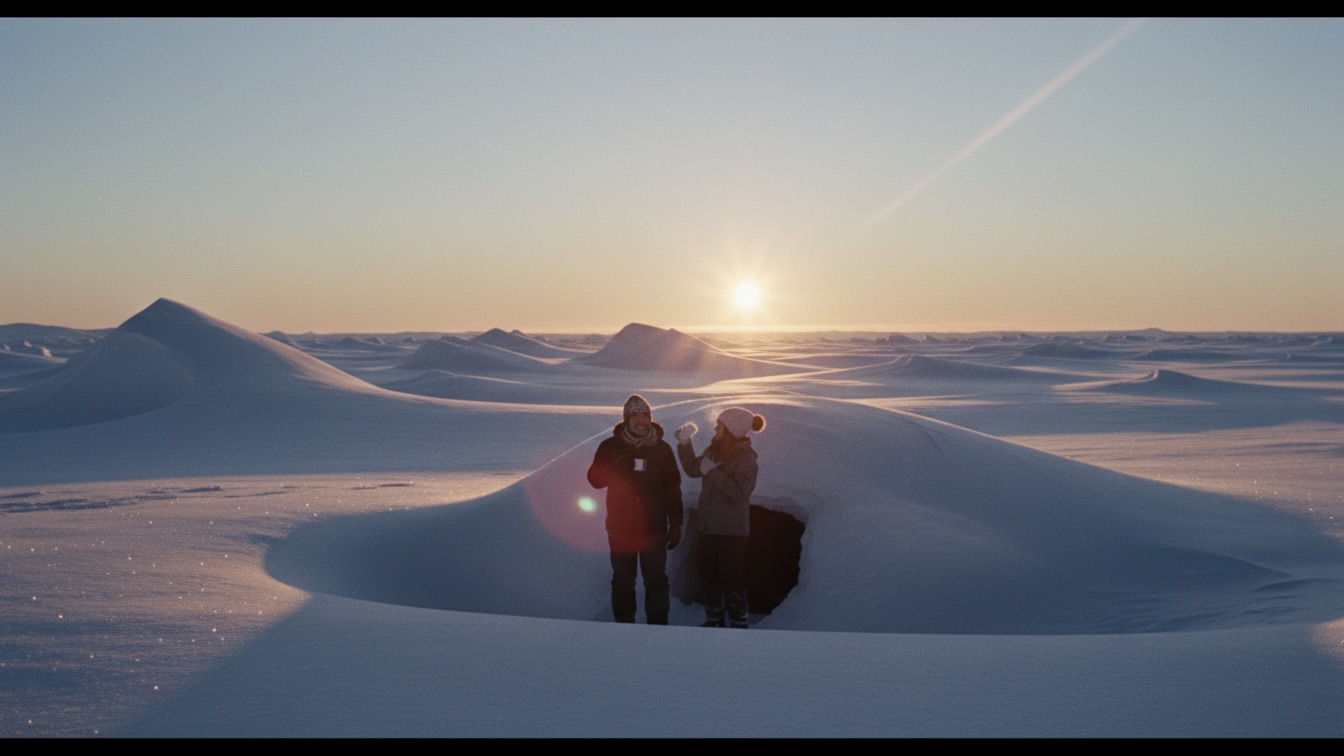
THE THAW (Climax): They awaken to a profound silence—the storm has passed. Pushing open the entrance, they are flooded with the brilliant blue light of a post-blizzard dawn. They emerge into a transformed world of sculpted white under a cloudless sky, a sight of such pure, silent beauty that it transcends words.
THE RESOLUTION: John opens his mouth to speak, but stops, seeing the weary awe on Sarah's face. For the first time, they are seeing the exact same thing, a shared moment of profound beauty that needs no commentary. Her small, tired smile confirms the thaw in her eyes, and when she directs him back to the practical work of survival, he nods, finally understanding the unspoken poetry of action.
The episode's mood begins as cozy and intimate before being violently shattered by the avalanche, plunging the audience into claustrophobic terror and disorientation. This gives way to a desperate, high-tension struggle for survival against the roaring blizzard, characterized by frantic action and sensory overload. The mood shifts dramatically upon entering the snow cave, becoming quiet, tense, and deeply intimate, where the fear of the storm is replaced by the creeping dread of the cold and the emotional weight of their confessions. The final act is one of catharsis and awe, as the chaos gives way to a vast, silent, and breathtakingly beautiful landscape, leaving the audience with a sense of hard-won peace and quiet hope.
If expanded into a series, "The Thaw in Sarah's Eyes" would establish the core premise: relationships tested to their breaking point by the indifferent power of nature. A full season could explore this theme through different dynamics and environments. One episode might follow two estranged brothers on a diving trip where equipment failure forces them to confront a shared trauma; another could feature a scientist and a skeptic at a remote arctic research station during a polar night, debating faith and evidence as strange phenomena escalate.
The overarching story of the season would not be plot-driven, but thematic, creating a mosaic of human resilience and fragility. It could explore a recurring motif of "signal vs. noise"—how in moments of extreme crisis, the "noise" of modern life, social roles, and intellectualism is stripped away, leaving only the "signal" of one's true character and the core of a relationship. A season arc could subtly build a larger picture of humanity's precarious place in a world that is becoming increasingly wild and unpredictable, with each episode serving as a deeply personal case study.
The visual style will be one of stark contrasts, mirroring the central thematic conflict. The opening inside the tent is warm, intimate, and tightly framed. The avalanche sequence will be chaotic and visceral, using handheld cameras, extreme close-ups on fabric and snow, and a sound design that shifts from roaring chaos to muffled, claustrophobic silence. The blizzard itself will be a near-monochromatic assault of white, using wide shots to emphasize the characters' insignificance and disorienting close-ups to capture the stinging detail of the snow.
Inside the snow cave, the lighting will be minimal and practical (a single headlamp beam), creating deep shadows and an intensely intimate, almost womb-like atmosphere. The final sequence will be a dramatic departure: majestic, static, wide-angle shots of the pristine, sunlit landscape. The tone is a blend of a high-stakes survival thriller and an intimate character drama. Tonal comparables include the raw, elemental struggle of The Revenant, the tense, contained character dynamics of Gravity, and the philosophical undertones of a Terrence Malick film, grounded in a visceral, life-or-death scenario.
The target audience is adults aged 25-55 who appreciate character-driven, cinematic dramas and survival thrillers. This includes viewers of premium cable and streaming content like HBO's Chernobyl or Netflix's The Crown, who are drawn to high production values and nuanced storytelling. It will also appeal to fans of films like Into the Wild, The Grey, and 127 Hours, who enjoy stories that pit human psychology against the raw power of the natural world.
For a 10-12 minute runtime, the pacing will be swift and relentless. Act One (The Avalanche and Escape) will be incredibly fast, taking up the first 2-3 minutes to immediately establish the stakes and terror. Act Two (The Plan and The Shelter) will be a tense, grueling montage of their struggle, slowing slightly to emphasize the exhausting labor. The midpoint turn—sealing themselves in the cave—will mark a dramatic shift in pace, leading to the quiet, dialogue-heavy intimacy of the confession. The final act (The Thaw and Resolution) will be deliberately slow and visually driven, allowing the emotional impact of the climax and the beauty of the landscape to land with full force.
The primary production challenge is realistically and safely depicting the avalanche and blizzard. The initial burial sequence could be achieved on a controlled set, using a collapsible tent structure and lightweight, artificial snow to ensure actor safety. The interior of the snow cave would also be a set piece, allowing for control over lighting, camera placement, and atmosphere, while exterior shots of the entrance can be blended with location footage.
The blizzard scenes will require a combination of location shooting in a snowy environment and significant practical effects, including powerful wind and snow machines. Sound design is paramount; it will be the key to conveying the oppressive force of the storm and the profound, deafening silence that follows. The contrast between the muffled, interior world of the tent/cave and the roaring exterior is a critical storytelling tool.