The blade is a cold, unyielding sliver of reality, pressing against the hip with the weight of a dormant threat. It exists not as an ornament of adventure or a brutalist accessory, but as a violent necessity waiting to sever the thin, fabricated membrane that separates comfort from oblivion. In the suffocating dark, this sharp edge becomes the only stanza that matters, slicing through the suffocating layers of romantic delusion to reveal the raw, freezing air of survival. It represents the precise moment where the abstract appreciation of danger collapses into the tangible, steel-hard requirement to cut one's way out of a grave.
The narrative operates within the survival thriller genre but subverts its typical adrenaline-fueled pacing by filtering the experience through a deeply introspective, literary lens. The primary thematic conflict is not merely between humanity and nature, but between the Romantic sublime and Naturalistic indifference. The protagonist, John, attempts to frame a life-threatening avalanche through the aesthetics of Edmund Burke or the poetry of Rilke, seeking a transcendent experience of "terrible beauty." However, the narrative ruthlessly deconstructs this intellectualization. The storm does not care for his metaphors; it is a physical force of crushing weight and suffocating cold. The story posits that the "sublime" is a luxury of the observer, whereas the participant experiences only the brutal mechanics of physics and biology.
The narrative voice is strictly first-person, confined to John’s perspective, which creates a fascinating layer of unreliability and irony. He is self-aware enough to recognize his own foolishness, yet he cannot stop his mind from converting terror into prose. This cognitive dissonance serves as a defense mechanism; by narrating his own potential death as an "epic poem," he distances himself from the visceral horror of suffocation. His perception is limited by his urban privilege, which views winter as a novelty or a canvas for spiritual renewal. Consequently, the narrative is filled with gaps where Sarah’s competence fills the void of his helplessness. We see Sarah only through his eyes—first as a "blade" of pragmatism, then as a savior—but the text implies a depth of fear and frustration in her that John only fully grasps when the danger has passed.
Existentially, the chapter grapples with the ethics of imposing one's romantic worldview onto reality. John’s desire to "share" his vision of winter nearly kills them, raising questions about the responsibility of love and the arrogance of the uninitiated. The snow cave becomes a crucible where these pretenses are stripped away. In the darkness, the existential dread is not just about the cessation of life, but the realization of one's own triviality against the "monstrous" indifference of the storm. The transition from the noisy chaos of the avalanche to the "monastic silence" of the cave mirrors a shift from performative heroism to the quiet, desperate work of enduring. Meaning is found not in the grand gesture, but in the transfer of body heat and the rhythmic, unglamorous act of digging.
Psychological State:
John enters the narrative in a state of cognitive dissonance, oscillating between genuine terror and a dissociative tendency to literary intellectualization. The shock of the avalanche triggers a regression where he becomes physically clumsy and dependent, masking his panic with internal monologues about poetry. As the chapter progresses, the physical labor of digging grounds him, shifting his state from abstract panic to focused, rhythmic exertion. By the end, the "thaw" in him is the breaking of his ego; he moves from a man observing the world to a man simply existing within it.
Mental Health Assessment:
He exhibits a high degree of trait openness but a dangerous lack of situational awareness, bordering on delusion regarding the natural world. His coping mechanism is intellectualization; he uses language to build a buffer between his psyche and the raw trauma of the event. While this protects him from a total breakdown, it initially hinders his survival reflexes. His mental health appears robust enough to integrate the trauma, as evidenced by his ability to eventually find the "unspoken poetry" in work, suggesting a capacity for growth and adaptation.
Motivations & Drivers:
His primary motivation shifts from the pursuit of an aesthetic ideal—the "crystalline chaos"—to the primal need for survival. However, a secondary, deeply relational driver underpins his actions: the desperate need for Sarah to validate his worldview. He wants her to see the beauty he sees, to bridge the gap between his romanticism and her pragmatism. This desire for connection drives him into the storm, and ironically, it is only by abandoning his vision and adopting hers that he achieves the intimacy he sought.
Hopes & Fears:
John fears incompetence and the exposure of his own uselessness more than he admits. The "domestic squabble" with the zipper highlights a deep-seated anxiety about failing in his masculine role as a protector or adventurer. Conversely, his hope is anchored in the transformative power of nature. He hopes that the ordeal will be a "symbolic death and rebirth," a narrative arc he clings to even as Sarah tells him to shut up. He fears that his poetry is ultimately "kindling that wouldn't catch," useless against the cold reality.
Psychological State:
Sarah operates in a state of hyper-arousal and acute focus, characteristic of someone with deep experiential knowledge of danger. Her "pragmatism" is not merely an attitude but a survival physiology; she bypasses emotional processing to access muscle memory and problem-solving skills. The "blade" of her voice suggests she is suppressing immense fear and anger to maintain command. The eventual "thaw" in her eyes indicates a release of this sustained vigilance, allowing her to finally process the beauty she had previously been too busy surviving to see.
Mental Health Assessment:
Sarah demonstrates high resilience and emotional regulation. Her background—where winter is a "nine-month-long shift"—has conditioned her to view adversity as a series of tasks rather than a personal tragedy. This utilitarian view protects her from panic but perhaps alienates her from the aesthetic enjoyment of her environment. Her mental health is stable, grounded in reality, though she carries the burden of being the "adult" in the relationship, which likely causes chronic stress in high-stakes situations.
Motivations & Drivers:
Her driving force is the preservation of life—both hers and John’s. Every action she takes, from the command to cut the tent to the architecture of the snow cave, is calculated for thermal efficiency and survival. Beneath this, there is a motivation of loyalty. She is driven by a commitment to John that supersedes her better judgment. She is not there for the snow; she is there for the man who loves the snow, driven by a need to understand the "foolish" heart of her partner.
Hopes & Fears:
Sarah fears the "cold stone" of loss. Her anger is a manifestation of her fear that John’s naivety will result in their deaths. She fears the indifference of the elements, knowing intimately that nature does not negotiate. Her hope is modest and concrete: to survive the night. However, the ending reveals a latent hope to understand John’s perspective—to see the "love letter" he spoke of, suggesting she desires a shared emotional language just as much as he does.
The emotional trajectory of the text follows a bell curve of tension, beginning with the chaotic, high-decibel shock of the avalanche and descending into a claustrophobic, intimate silence. Initially, the emotion is defined by discord. The "blade" of Sarah's voice clashes with John's internal poetic monologue, creating a friction that mirrors the physical struggle against the snow. This dissonance generates anxiety in the reader, as the misalignment between the characters feels as dangerous as the storm itself. The stuck zipper and the argument over the shovel serve as microcosms of their relationship, ratcheting up the tension through frustration and helplessness.
As they begin to dig, the emotional tenor shifts from panic to a grim, rhythmic solidarity. The shared physical exertion acts as an emotional equalizer. The "deep, resonant hum" inside the snow cave provides a sonic backdrop for a new kind of intimacy. The cold forces them together physically, which necessitates an emotional vulnerability. The pivotal moment occurs in the dark, when Sarah confesses she came because of his enthusiasm, not the landscape. Here, the tension breaks, replaced by a warmth that creates a protective bubble against the freezing reality outside. The architecture of the snow cave—cramped, dark, and quiet—forces a stripping away of pretenses, allowing their emotional connection to become the primary source of heat.
The final emotional movement is one of transcendent awe. The "blue light" of dawn brings a release of the accumulated dread. The shift from the "color of death" to the "incandescent blue" signals a survival not just of the body, but of the spirit. The silence of the morning is no longer terrifying but profound. The "thaw" in Sarah's eyes resolves the central conflict; the fear has evaporated, leaving behind a shared, silent reverence. The reader is left with a sense of catharsis, derived not from a heroic conquest of nature, but from the quiet reconciliation of two disparate souls witnessing the same beauty.
The environment in this chapter is an active antagonist that dictates the psychological state of the characters. The transition from the tent—a "membrane of civilization"—to the "formless, roaring void" represents a complete loss of psychological safety. The whiteout conditions erase spatial orientation ("no up, no down"), mirroring John's internal confusion and loss of control. The cold is described as "cellular," penetrating the physical boundaries of the self and turning the body into "glass." This environmental hostility forces the characters to retreat inward, shrinking their world to the immediate radius of their own warmth.
The construction of the snow cave represents a reclamation of space and agency. By carving a "womb of ice" out of the hostile drift, they transform the instrument of their potential death into a shelter. This space is liminal; it is described as a "grave with an exit," highlighting the proximity of death. Psychologically, the cave functions as a confessional booth. The darkness and confinement strip away the visual cues of the outside world, forcing the characters to rely on touch and voice. The environment here acts as a pressure cooker for truth, squeezing out the honest admission of why they are there.
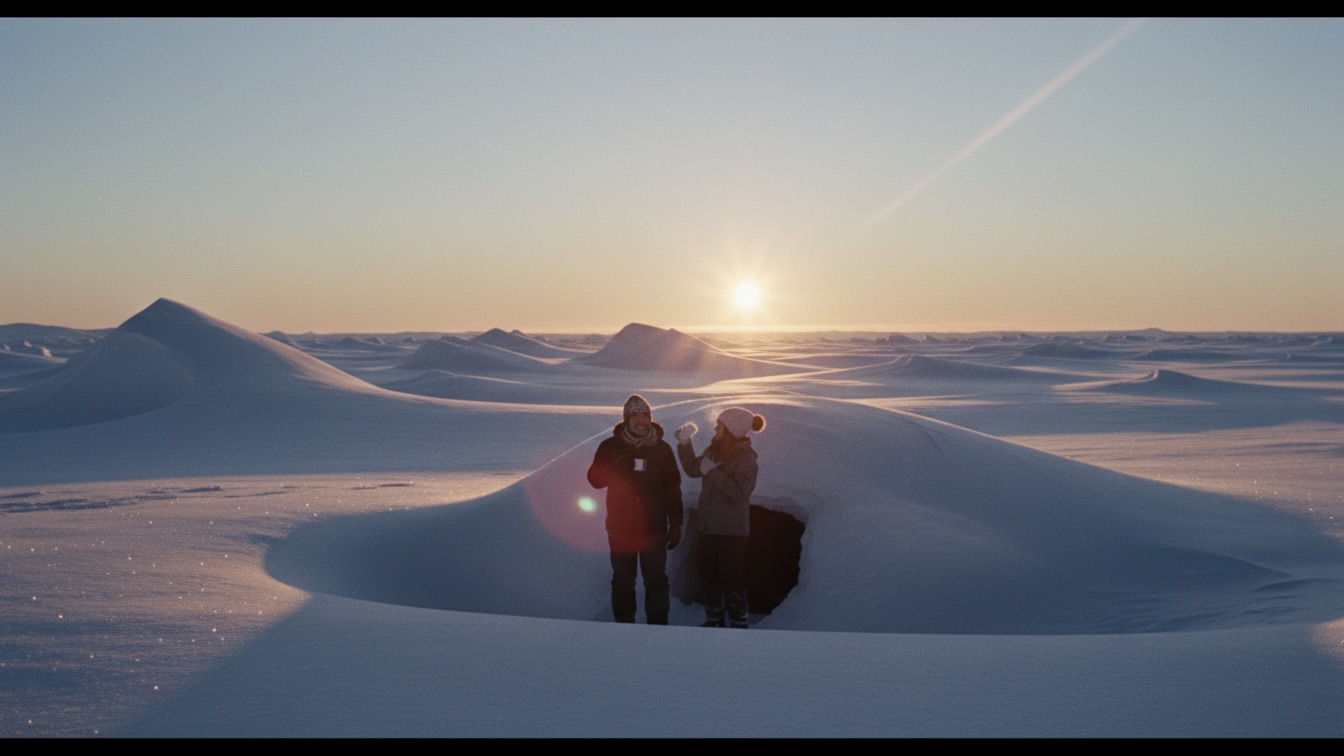
The final scene utilizes the vastness of the post-storm landscape to mirror the expanded consciousness of the characters. The "sculpted white" and the "painful blue" sky represent a clarity that stands in stark contrast to the chaotic "gray" of the storm. The environment is no longer a crushing weight but a pristine, open expanse. This spatial expansion reflects the opening of Sarah’s perception to the beauty John described, and John’s grounding in the reality Sarah knows. The landscape has ceased to be a backdrop and has become the shared ground upon which their relationship is rebuilt.
The prose relies heavily on the juxtaposition of high-flown, poetic diction with sharp, utilitarian language. John’s internal monologue is dense with metaphors—"frantic iambic pentameter," "weekend Wordsworth," "crystalline chaos." This stylistic choice characterizes his worldview as one that filters reality through art. In contrast, Sarah’s dialogue is monosyllabic and imperative: "Cut," "Dig," "Find it." The rhythm of the sentences mimics the action; long, breathless sentences describe the confusion of the storm, while short, punchy sentences describe the labor of survival. This rhythmic variance underscores the clash between the chaotic sublime and the orderly pragmatic.
Symbolism is woven tightly into the narrative objects. The "oversized survival knife" transforms from a "brutalist accessory" (an aesthetic object) to a tool of salvation (a functional object), mirroring John’s own journey. The book of Rilke, saved while essential gear is lost, symbolizes the persistence of the human spirit and art even in the face of oblivion, yet it is acknowledged as a "useless anchor," highlighting its lack of utility in immediate survival. The "thaw" is the central symbolic motif, operating on three levels: the physical melting of snow, the warming of their bodies, and the emotional softening of Sarah’s resistance to the beauty of the wild.
The imagery of "white" evolves throughout the text. Initially, it is the "color of nothing," a terrifying void that erases identity. Later, inside the cave, the light filtering through the snow is "ethereal blue," suggesting a shift from danger to sanctuary. Finally, the morning sun turns the peaks "fiery rose gold," reclaiming the landscape from the cold neutrality of the storm. This color progression tracks the emotional arc from terror to sanctuary to awe. The recurring motif of "silence" also shifts from the "muffled" silence of burial to the "monastic" silence of the cave, and finally to the "profound" silence of the dawn, each variation carrying a different psychological weight.
The story situates itself firmly within the tradition of the "Man vs. Nature" narrative, echoing the naturalistic determinism of Jack London’s "To Build a Fire," where the cold is an indifferent judge of human competence. However, it subverts the solitary nature of London’s work by introducing the relational dynamic. It also draws upon the Romantic tradition of the Sublime, as defined by Burke and Kant—the experience of awe mixed with terror. John serves as a modern, somewhat ironic stand-in for the Romantic poet, attempting to impose a Wordsworthian reverence onto a landscape that demands a Darwinian response.
The text engages with the cultural archetype of the katabasis, the hero's journey into the underworld. The burial in the snow and the subsequent descent into the "grave with an exit" (the snow cave) mimic the mythological descent into the land of the dead. John explicitly references this ("symbolic death and rebirth"), showing his awareness of the trope, yet the story insists that the true transformation comes not from the mythical structure, but from the mundane endurance of the cold. The cave becomes a womb, facilitating a rebirth that is relational rather than purely heroic.
Furthermore, the story highlights the cultural friction between the "tourist gaze" and the "local gaze." John represents the urban visitor who consumes the landscape as scenery or spiritual commodity, while Sarah represents the local inhabitant for whom the landscape is a workplace and a hazard. This dynamic reflects broader cultural conversations about how we interact with wilderness—whether we view it as a playground for self-actualization or a sovereign entity that commands respect. The resolution suggests a synthesis of these views is necessary: one must respect the lethality of the cold to survive it, but one must also perceive its beauty to find meaning in the endurance.
What persists after the reading is the sensation of temperature as an emotional state. The story effectively transmits the "cellular cold" to the reader, making the warmth of the final scene feel physically earned. The contrast between the noise of the storm and the absolute silence of the aftermath leaves a ringing in the ears, a sonic afterimage that underscores the fragility of human existence. The reader is left contemplating the thinness of the "membrane" that separates a cozy camping trip from a fight for life, provoking a re-evaluation of one's own preparedness for the sudden shifts in reality.
The narrative also leaves a lingering question about the nature of beauty. By validating John’s vision only after a near-death experience, the story suggests that true beauty is not a passive picture on a postcard, but a terrible, overwhelming force that must be survived to be truly seen. The "thaw" in Sarah’s eyes implies that she has seen something beyond the chores of winter, something that justifies the risk. This complicates the reader’s understanding of the sublime, framing it as a reward for endurance rather than a gift of observation.
Finally, the dynamic between the characters resonates as a meditation on intimacy. The image of the two of them huddled in the "womb of ice," sharing body heat, serves as a powerful metaphor for the function of relationships in a hostile world. The story suggests that the ultimate survival tool is not the knife or the shovel, but the ability to communicate and connect across the chasm of differing worldviews. The lingering thought is that we are all, in some sense, digging caves in the snow, hoping our combined warmth is enough to last the night.
The silence of the morning is not merely the absence of wind; it is the presence of a new, terrifying clarity. The storm has scoured the world clean of John’s metaphors and Sarah’s cynicism, leaving behind a landscape that refuses to be reduced to either poetry or a chore. In this stillness, the blue light does not offer comfort, but rather a cold, indifferent witness to their survival, reflecting the truth that they were spared not by fate, but by the friction of their own desperate, clumsy humanity against the ice.
As they emerge from the snow cave, the "thaw" is less a melting of ice and more a fracture in the armor of their separate realities. The cold remains a sharpening stone, honing their perception until they can finally see the same world: one where the beauty is indistinguishable from the danger, and where the only stanza that truly holds heat is the synchronized rhythm of two people breathing in the dark.