Format: Short Film / Anthology Episode | Est. Length: 10-12 minutes
Imagine a series, THE LONG DARK, an anthology of modern folk horror where isolated, forgotten towns across North America become breeding grounds for supernatural entities that manifest from the landscape and the local psyche. Each episode explores a unique piece of folklore, a creature or presence that preys on a specific human emotion—grief, jealousy, regret—testing the bonds of communities already strained by hardship and seclusion. "The Solstice Light" serves as a quintessential episode, establishing the series' core theme: the greatest monsters are not those in the woods, but the ones we feed in silence, and the only defense is the fragile, flickering light of human connection.
Haunted by guilt over her brother's death, Clara steps off a bus into her hometown of Pine Hollow, a place swallowed by a relentless, three-day blizzard. She finds a town suffocating under an unnatural silence, where the few remaining residents, including her own father, seem like ghosts, staring blankly into space as a palpable dread hangs in the frozen air.
A guilt-ridden woman returns to her snowbound hometown for the winter solstice and discovers a terrifying supernatural entity that feeds on the residents' isolated grief. She must confront the tragic memory of her brother's death to convince the broken community to fight the encroaching darkness together before it consumes them all.
The primary theme is the duality of grief as both a private burden and a communal experience. The story explores how unprocessed sorrow and guilt, when left to fester in isolation, can become monstrous and destructive, not just to an individual but to an entire community. It posits that connection, shared storytelling, and the vocalization of pain are the antidotes to this psychological poison, transforming grief from a weapon used against us into a source of collective strength and light.
Genre-wise, this is a piece of atmospheric folk horror blended with psychological drama. It eschews jump scares for a slow-burn, creeping dread that emanates from the oppressive landscape and the internal landscapes of its characters. The horror is rooted in the relatable fear of being consumed by one's own worst memories and the chilling idea that our deepest pain can attract predators from the shadows.
The stakes are existential for the entire town of Pine Hollow. If the Sorrow-Eater is not stopped, it will continue to feed on the residents one by one, draining them of their life force, memories, and spirit until they are nothing but empty, breathing shells, lost forever in a loop of their worst moments. For Clara, the stakes are deeply personal: she risks being consumed by the immense guilt she carries over her brother Leo's death, a fate she feels she might deserve. Her fight is not just for the town's survival, but for her own redemption and the chance to finally process her grief in a healthy way.
The primary antagonistic force is the Sorrow-Eater, an ancient, non-corporeal entity that embodies the oppressive cold and silence of the deep winter. It is a psychic predator that isolates individuals and feeds on the energy of their rawest grief and guilt, growing stronger as the nights lengthen. The secondary conflict is internal and societal: Clara's own crippling guilt, which makes her a beacon for the entity, is a major obstacle. Furthermore, the town's culture of stoic individualism and emotional suppression acts as the entity's greatest ally, as each resident's refusal to connect or share their pain makes them a vulnerable and solitary target.
Clara returns to her remote, snow-choked hometown of Pine Hollow, summoned by a strange call from her mother. She finds the town in a state of unnatural paralysis, with residents, including her own father, trapped in a silent, depressive stupor. Her investigation into the town's malaise leads her to Thomas, the fearful shopkeeper, and finally to Marianne, a wise elder who explains the horrifying truth: the town is being preyed upon by a "Sorrow-Eater," a supernatural entity that feeds on isolated grief, and its power is peaking with the approaching winter solstice.
Marianne warns Clara that her own profound guilt over her brother Leo’s death makes her a powerful lure for the creature. After experiencing the entity's psychic assault firsthand—a vivid, waking nightmare of her last, bitter argument with Leo—Clara realizes she cannot run from her past. In a desperate act of defiance, she formulates a plan to fight the darkness not with weapons, but with light and sound, proposing a gathering on the solstice where the townsfolk will share stories of their lost loved ones, creating a collective fire of memory and community to drive the creature back into the cold.
CLARA (20s): A sharp, pragmatic young woman burdened by five years of unresolved guilt.
* Psychological Arc: She begins the story returning home not to heal, but to serve a self-imposed sentence for her perceived role in her brother's death. She is avoidant, isolated, and believes her pain is a private punishment. Through her confrontation with the Sorrow-Eater and her connection with Marianne and Thomas, she transforms from a passive victim of her grief into a proactive leader, realizing that sharing her sorrow is not a weakness but the only way to save herself and her community.
MARIANNE (70s): The town's elder and keeper of its forgotten lore, with a calm, knowing presence.
* Psychological Arc: Marianne is the story's anchor and source of wisdom. Her role is not to change, but to act as the catalyst for Clara's change. She understands the ancient threat and provides Clara with the crucial knowledge and emotional support needed to formulate a plan, representing the power of tradition and communal memory.
THOMAS (50s): The general store owner, a kind man hollowed out by the loss of his wife, Helen.
* Psychological Arc: Thomas embodies the town's condition—a good person locked away by grief, too afraid to speak of his loss. He starts as a wall of denial and fear, resistant to Clara's attempts to connect. He represents the story's central challenge: convincing the grieving to open up. His eventual, tentative agreement to help Clara is the story's crucial turning point, signifying the first crack in the town's icy facade of isolation.
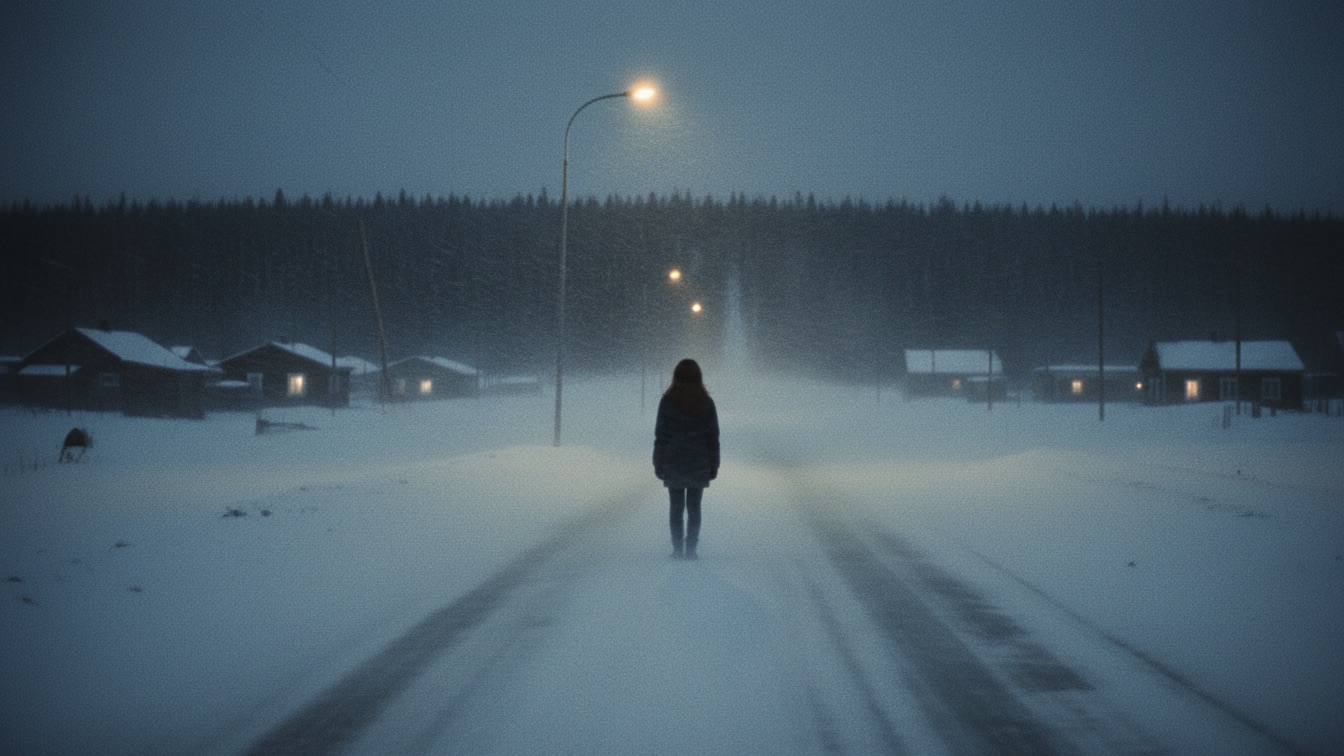
BEAT 1: THE ARRIVAL. Clara steps off a bus into the crushing silence and oppressive white of Pine Hollow, a town buried in snow and sorrow. She finds her family home cold and dark, with her father a near-catatonic figure lost in front of a silent television, confirming the chilling dread from her mother's phone call. The silence is not peaceful; it is a heavy, watchful presence.
BEAT 2: THE WARNING. Seeking supplies and answers, Clara visits the general store, where the haunted owner, Thomas, deflects her questions about the town's strange malaise. He is a portrait of contained grief, his fear palpable beneath a veneer of small-town stoicism. As she leaves, he gives her a cryptic and urgent warning—"Don't sit in the dark"—transforming the oppressive atmosphere into a tangible threat.
BEAT 3: THE REVELATION (MIDPOINT). Clara seeks out the town elder, Marianne, who reveals the horrifying truth about the "Sorrow-Eater," an ancient entity that feeds on isolated grief. Marianne explains that the creature traps its victims in loops of their worst memories, and warns a guilt-ridden Clara that she is a beacon for the creature, which has been waiting for her return. The threat is now named, and Clara understands she is not an observer but the intended prey.
BEAT 4: THE ATTACK & THE PLAN. That night, Clara is psychically assaulted by the entity, forced to relive the vicious final argument with her brother Leo with terrifying clarity, feeling the creature's cold presence feeding on her despair. Shaken but defiant, she realizes the entity's power lies in isolation and formulates a radical plan: to gather the townsfolk on the solstice, the longest night, to create a "fire" of shared stories and memories to combat the darkness.
BEAT 5: THE CLIMAX. Clara confronts Thomas in his darkened store, pleading with him to help rally the town for her solstice gathering. When he resists, trapped by his own fear and grief, she breaks through his defenses by sharing a warm, specific memory of his late wife, then confesses her own raw guilt about Leo. This act of profound vulnerability cracks his shell, and in his tearful, hesitant agreement, Clara secures the crucial first follower needed to light a fire against the encroaching night.
The episode begins with a mood of oppressive, melancholic dread, immersing the audience in the cold, silent world of Pine Hollow. This evolves into a creeping psychological horror as the supernatural threat is hinted at and then revealed, creating tension and a sense of claustrophobia. The midpoint shifts the emotional trajectory from passive fear to active struggle, and as Clara formulates her plan, a fragile, defiant spark of hope is introduced, culminating in a tense but ultimately cathartic and emotionally resonant climax that champions connection over despair.
If expanded, the season could follow two potential paths. The first is a "monster-of-the-week" format where each episode is a self-contained story like "The Solstice Light," exploring different towns and their unique emotional predators, unified by the overarching theme of community versus isolation. This allows for a rich exploration of American folklore and the diverse ways communities process trauma.
A second, more serialized arc could emerge, with a recurring character—perhaps a folklorist, a journalist, or a survivor like Clara—who begins to connect the incidents. This character could discover that the entities are all part of a larger, interconnected phenomenon, perhaps awakening due to a specific cosmic event or a societal shift towards isolation. The season's goal would then become understanding the entities' origins and finding a way to sever their connection to our world, culminating in a confrontation with a more powerful, source entity.
The visual style will be grounded in a stark, naturalistic realism that emphasizes the brutal beauty and oppressive nature of the winter landscape. The color palette will be heavily desaturated, dominated by whites, cool blues, and deep grays, with the only warmth coming from artificial interior lights, which should feel fragile and lonely. Cinematography will utilize slow, deliberate camera movements, long takes, and wide shots that dwarf the characters against the vast, indifferent snowscape to create a sense of isolation, contrasted with tight, claustrophobic framing indoors to heighten psychological tension.
The tone is one of elevated, atmospheric horror, drawing inspiration from the patient dread of The Lodge and the community-centric supernaturalism of Midnight Mass, while avoiding overt gore or jump scares. The horror is psychological and emotional, conveyed through performance, sound design that emphasizes the terrifying weight of silence, and subtle visual cues that suggest a watching presence just at the edge of the frame. The overall mood should be melancholic and tense, but with an undercurrent of defiant hope.
The target audience is mature viewers aged 18-49 who are fans of elevated, character-driven horror and psychological thrillers. This includes followers of modern folk horror (e.g., The Witch, Midsommar) and supernatural dramas that prioritize atmosphere and thematic depth over cheap thrills (e.g., The Haunting of Hill House, Black Mirror). It will appeal to an audience that appreciates slow-burn storytelling and is willing to engage with complex themes of grief, trauma, and mental health.
For a 10-12 minute runtime, the pacing must be concise and impactful. The first act (2-3 minutes) will rapidly establish the oppressive atmosphere and Clara's emotional state. The second act (5-6 minutes) will be the core of the film, dedicated to the investigation, the chilling revelation from Marianne, and Clara's internal struggle, building dread deliberately. The third act (2-3 minutes) will focus entirely on the climactic confrontation with Thomas, ending on a note of fragile, hard-won hope rather than a definitive resolution, leaving the audience to imagine the solstice gathering to come.
The most significant production consideration is the location and environment. Securing a location that can provide a convincing, deeply snowbound small town is critical to establishing the story's oppressive atmosphere. This may require shooting in a northern climate during winter or relying on extensive, high-quality practical and digital snow effects, which will be a key budgetary factor.
The antagonist, the Sorrow-Eater, is an atmospheric presence rather than a physical creature, which is a key creative and budgetary advantage. Its presence will be conveyed primarily through sound design (the unnerving depth of silence, subtle shifts in ambient noise, distorted whispers), lighting (deepening shadows, a cold quality to the light), and the actors' performances. The psychic attack on Clara can be achieved through stylized editing, sound distortion, and a focused performance, requiring minimal VFX and placing the emphasis on psychological horror.