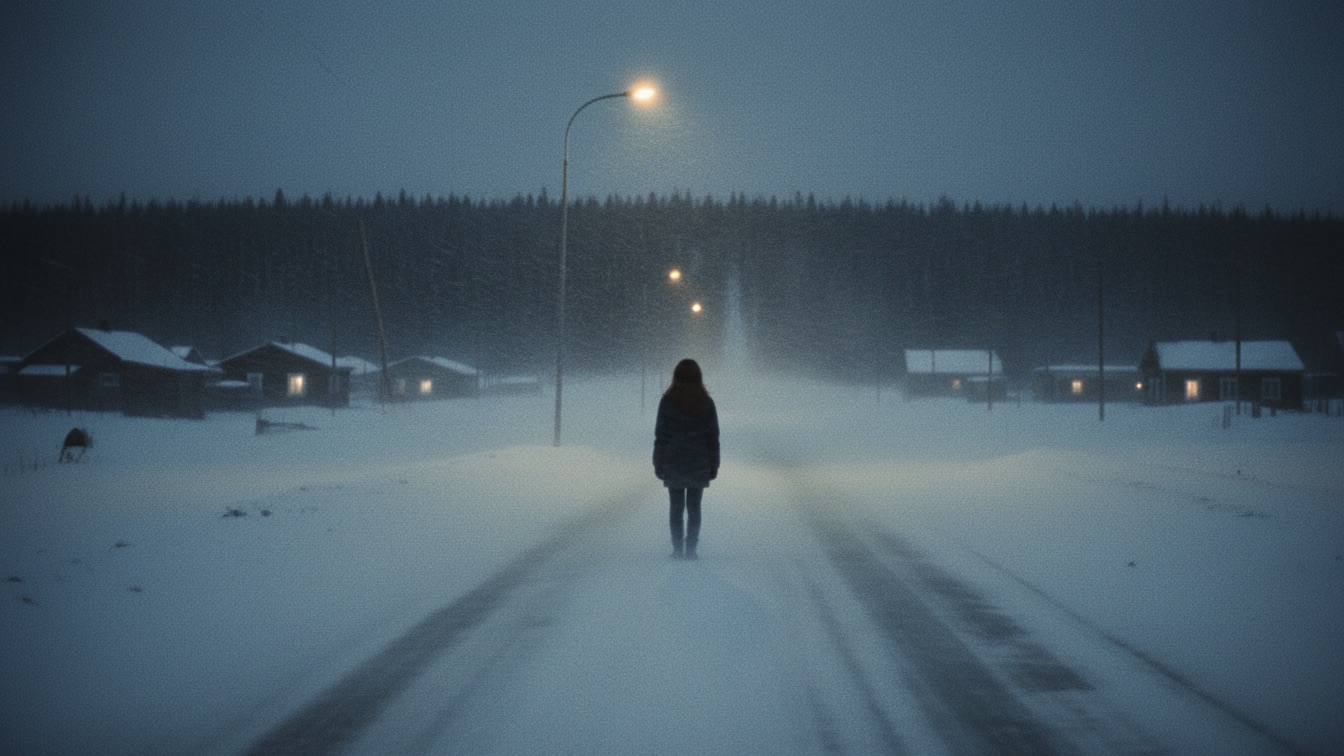
A single log, sodden with the heavy moisture of a relentless storm, cannot burn; it merely smokes, choking on its own inability to generate heat. This physical reality serves as the central metaphor for the spiritual asphyxiation occurring within the narrative, where isolation transforms individual grief into a cold, incombustible substance. The dampness is not merely atmospheric but internal, a saturation of the soul that prevents the spark of connection from taking hold. In this environment, the failure to ignite becomes a death sentence, leaving the isolated elements to rot in a pile of scattered, useless kindling, waiting for a predator that feeds on the absence of warmth.
The narrative operates firmly within the bounds of atmospheric folk horror, utilizing the trope of the isolated, snowbound community to explore the topography of grief. The central conceit of the "Sorrow-Eater" functions as an externalized manifestation of severe depression and collective trauma. By giving the psychological weight of mourning a predatory form, the story validates the physical sensation of grief—the heaviness, the cold, the paralysis—treating it not as a mood but as an entity. The winter setting is not passive scenery; it is an active antagonist, a "siege" that enforces the isolation necessary for the entity to feed. This aligns with the genre's tendency to use landscape as a mirror for internal decay, suggesting that the environment itself has turned against the inhabitants because they have violated the fundamental human law of communal support.
Clara’s first-person perspective offers a lens that is both intimate and necessarily distorted by her own unresolved history. Her narration is colored by a specific brand of survivor’s guilt, which initially frames her return as a penance rather than a rescue mission. She perceives the town through the filter of her own self-loathing, interpreting the silence of Pine Hollow as a judgment upon her past actions before she understands it as a supernatural symptom. This perceptual limit is crucial; it allows the reader to experience the shift from personal neurosis to external horror alongside her. The cold imagery serves to numb the narrative voice, stripping away flowery language in favor of stark, brittle observations that mimic the sensory deprivation of the setting.
Ethically, the story posits a stark existential choice between the safety of isolation and the vulnerability of connection. The townspeople have retreated into their homes under the false belief that hiding protects them, a defensive mechanism that ironically serves the predator’s needs. The narrative interrogates the morality of suffering, challenging the romanticized notion of the solitary mourner. It suggests that while grief is personal, the act of healing must be communal. The "Sorrow-Eater" thrives on the privacy of pain, making the argument that the refusal to share one's burden is not an act of strength, but a capitulation to the void. The struggle is not just for survival, but for the preservation of meaning in a world that has been stripped of its color and voice.
Psychological State:
Clara enters the narrative in a state of suspended animation, her life seemingly paused since the moment of her brother’s death. She carries a heavy, calcified guilt that she mistakes for a moral compass, believing that her suffering is a necessary payment for her perceived role in the tragedy. The return to Pine Hollow acts as a trigger, stripping away the numbness she likely cultivated in the city and exposing raw, unhealed wounds. Her perception of the cold is masochistic; she welcomes the harshness of the weather because it aligns with her internal landscape of self-punishment.
Mental Health Assessment:
She exhibits signs of prolonged, complex grief disorder, characterized by obsessive rumination and an inability to envision a future disconnected from her past trauma. Her "survivor's guilt" drives a compulsion to revisit the site of the trauma, not to heal, but to "serve a sentence." However, her resilience is evident in her reaction to Marianne’s revelation. Unlike her parents, who have succumbed to catatonia, Clara converts her fear into action. This suggests that while she is damaged, her survival instinct—and her protective love for her community—remains intact, allowing her to pivot from victimhood to leadership.
Motivations & Drivers:
Initially, her motivation is purely penitential; she seeks to immerse herself in the discomfort of home to appease her conscience. This shifts dramatically upon understanding the nature of the threat. Her drive transforms into a desperate need to save the remnants of her family and town, essentially trying to save Leo retroactively by saving those who remember him. The winter environment acts as a crucible, forcing her to abandon her passive acceptance of punishment in favor of active rebellion against the cold.
Hopes & Fears:
Her deepest fear is not the monster itself, but the possibility that her guilt is justified and that she deserves to be consumed. She fears that her abandonment of the town contributed to its decay. Conversely, her rising hope is tied to the concept of redemption through connection. She hopes that by igniting a metaphorical fire in the town, she can finally thaw the frozen guilt within herself, trading the "cold weight" of Leo’s absence for the warmth of shared memory.
Psychological State:
Thomas exists in a state of defensive withdrawal, his world shrunk to the confines of his store and the loop of his memories. He is characterized by a "weary sadness" and a hyper-vigilance that borders on paranoia. The loss of his wife, Helen, has left him without a buffer against the encroaching darkness, and he has constructed a routine of mechanical efficiency to keep the grief at bay. The winter exacerbates his condition, reinforcing the physical and emotional walls he has built.
Mental Health Assessment:
He displays symptoms of severe depressive withdrawal and avoidance coping. His refusal to engage in non-transactional conversation and his fixation on the security monitor indicate a man under siege, battling intrusive thoughts and anxiety. He is aware of the deterioration of his mental state ("When it gets too quiet, you start to hear things") but feels powerless to stop it. His isolation is a maladaptive safety behavior; he believes avoiding emotional triggers keeps him safe, unaware that it is slowly killing him.
Motivations & Drivers:
His primary driver is self-preservation through minimization. He seeks to make himself small and unnoticeable to the "quiet." He wants to endure the winter without confronting the void left by Helen. However, Clara’s intervention sparks a dormant motivation: the desire to honor his wife properly. The conflict between his fear of the "Sorrow-Eater" and his love for Helen’s memory becomes the engine of his character arc in this chapter.
Hopes & Fears:
Thomas fears the total erasure of self that the "Sorrow-Eater" promises. He is terrified of facing the full magnitude of his loss without the anesthesia of routine. Yet, buried beneath the fear is a fragile hope that he is not alone in his suffering. He hopes for permission to remember the joy of his past (the "silly hat") rather than just the pain of its end, a permission Clara grants him.
Psychological State:
Marianne possesses a grounded, ancient stability that contrasts sharply with the frantic fear of the rest of the town. She is the keeper of the "old tongue" and the town’s collective memory, functioning as a psychological anchor. She is not immune to the cold or the darkness, but she understands its taxonomy. Her state is one of alert acceptance; she acknowledges the predator without succumbing to the panic it induces.
Mental Health Assessment:
She appears to be the most mentally robust character, having integrated loss into her worldview ("Loss is the price of living"). Her coping mechanisms are proactive and ritualistic—tea, fire, storytelling—which allow her to maintain a sense of agency. She does not repress her knowledge of the threat but contextualizes it within a broader mythic framework, which preserves her sanity.
Motivations & Drivers:
Her motivation is the preservation of the community’s spirit. She acts as the catalyst for Clara, providing the necessary context to turn vague dread into actionable strategy. She is driven by a duty to pass on the knowledge of survival, recognizing that she cannot fight the battle alone but can arm the warrior who will.
Hopes & Fears:
Marianne fears the complete extinguishment of the town’s "fire," the loss of human connection that would turn Pine Hollow into a graveyard. Her hope lies in the younger generation, specifically Clara. She hopes that the "scattered kindling" can be gathered in time, trusting in the resilience of human connection to outlast the supernatural winter.
The narrative constructs its emotional arc through a deliberate manipulation of atmospheric pressure. It begins with a suffocating sense of entrapment, established immediately by the bus ride into the "relentless, swallowing white." This creates a baseline of claustrophobia and dread. The emotion here is heavy and static, mirroring the physical sensation of the snowdrifts. The reader is made to feel the weight of the silence, which is not an absence of sound but a "dense, textured thing." This pressure builds as Clara encounters the catatonic state of her parents and the terrified evasion of the townspeople, creating a rising tension born of helplessness.
As the story progresses to the encounter with Marianne, the emotional architecture shifts from vague dread to sharp, specific horror. The naming of the "Sorrow-Eater" crystallizes the fear, transforming the atmospheric depression into a tangible threat. This transition is crucial; it moves the emotional needle from passive suffering to active realization. The horror is intimate, rooted in the violation of private memories, which creates a deep sense of empathy for the characters. The reader understands that the monster is not under the bed, but inside the mind, feeding on the most painful moments of their lives.
Finally, the narrative pivots toward a fragile, desperate defiance. The interaction between Clara and Thomas in the store serves as the emotional fulcrum. The release of Thomas’s suppressed memory—the chili, the antlers—cracks the facade of the text’s grimness. This moment introduces a warmth that contrasts violently with the preceding cold, generating a surge of hope that is all the more powerful for its precariousness. The emotional trajectory ends not on a note of triumph, but on a resonant chord of determination, leaving the reader with the feeling of a held breath released into the cold air.
Pine Hollow is depicted not merely as a location but as a psychological containment zone. The town is described as a "narrow canyon carved between high banks of plowed snow," a spatial arrangement that suggests entrapment and burial. The verticality of the snow and the encroaching forest creates a "tunnel vision" effect, mirroring the cognitive narrowing experienced in deep depression. The environment actively conspires to separate the inhabitants; houses are "islands in a sea of encroaching darkness," and the lack of footprints reinforces the physical reality of their emotional estrangement. The setting enforces the theme that isolation is a physical state before it becomes a spiritual one.
The interiors of the buildings reflect the mental states of their occupants. The family home is dark, stale, and illuminated only by the "blue-gray glow" of the television—a cold, artificial light that offers no warmth, symbolizing the family's disconnection from reality and each other. In contrast, Marianne’s cottage is a "pocket of warmth," smelling of life (herbs, woodsmoke), representing a preserved sanity. Thomas’s store, a "museum of survival," is packed with physical goods but devoid of emotional sustenance, highlighting the futility of material preparation against a psychological threat. The cold is a pervasive, invasive force that "seeps through" walls and clothes, symbolizing the inability of physical barriers to keep out the trauma.
The prose utilizes a stark, sensory-driven lexicon to build the atmosphere of the "Sorrow-Eater’s" domain. Words like "shards," "bruise," "rust," and "skeletal" create a texture of decay and violence. The sentence rhythm often mimics the labored breathing of someone in the cold—short, clipped phrases that land with a thud. "One step. Then another." This stylistic choice emphasizes the effort required simply to exist in this environment. The silence is personified throughout, treated as a character with agency, a "void" that rushes in to steal space, further enhancing the sense of active malice in the atmosphere.
Symbolism is woven tightly into the narrative fabric. The Solstice, the "longest night," serves as the temporal ticking clock, representing the nadir of hope and the peak of the predator's power. It is the ultimate test of endurance. The "damp wood" metaphor introduced by Marianne is the central symbolic image, perfectly encapsulating the condition of the townspeople: potential fuel rendered inert by the environment. The recurring motif of the "flickering light"—the TV, the store lamp, the streetlights—represents the fragility of human consciousness against the overwhelming dark.
The imagery of the wolf and the hunt is pervasive, linking the natural predation of the winter wilderness with the supernatural predation of the entity. The television documentary about wolves acts as a meta-textual foreshadowing, blurring the line between the natural order and the supernatural threat. The "Sorrow-Eater" is described not as a monster of tooth and claw, but of "stillness," subverting the typical horror trope and aligning the monster more closely with the quiet lethality of hypothermia or despair.
The narrative draws heavily from the well of Algonquian folklore, specifically the legend of the Wendigo. While not explicitly named as such, the "Sorrow-Eater" shares the Wendigo’s association with winter, starvation, and the consumption of the human spirit. However, the story reinterprets this myth through a modern psychological lens. Instead of physical cannibalism driven by famine, the entity engages in emotional cannibalism driven by grief. This aligns the story with contemporary "elevated horror" trends where supernatural monsters serve as direct allegories for mental illness and trauma (similar to The Babadook or Hereditary).
The story also echoes the literary tradition of the "winter count" or the survival narrative, found in works like Jack London’s "To Build a Fire." The existential struggle against a cold that seeks to extinguish the spark of life is a primal human story. Here, the "fire" is metaphorical—community and memory—but the stakes are the same. The town of Pine Hollow functions as a classic "hamlet of the damned," a trope found in everything from Stephen King’s Salem’s Lot to Shirley Jackson’s The Lottery, where an isolated community becomes a petri dish for a specific societal or spiritual rot.
Furthermore, the concept of the Solstice acts as a bridge to pagan and pre-Christian traditions regarding the death and rebirth of the sun. The proposed gathering at the town hall mirrors ancient Yule rituals designed to call back the light through sympathetic magic (lighting fires to encourage the sun). By invoking this ritual, Clara is attempting to bypass the modern, isolated way of living and tap into an older, communal form of survival, suggesting that the solution to the "Sorrow-Eater" lies in returning to ancient roots of shared existence.
What remains after the final line is not the image of the snow or the monster, but the chilling familiarity of the "Sorrow-Eater’s" methodology. The story leaves the reader with the uncomfortable recognition of how easily grief can mimic a haunting. The coldness described in the text lingers as a sensory afterimage, making the warmth of one's own reality feel suddenly precious and precarious. The narrative forces a confrontation with the idea that isolation is not a sanctuary but a hunting ground, prompting a reflection on the reader's own "closed doors."
The ambiguity of the ending serves to heighten the impact. We do not see the victory; we only see the preparation for battle. This leaves the reader suspended in the same "damp wood" state as the characters, holding onto the fragile hope that the fire will catch. The question of whether the town can actually overcome the supernatural weight of their sorrow remains unanswered, echoing the real-world uncertainty of recovery from deep depression. The "Sorrow-Eater" feels less like a fictional monster and more like a permanent, lurking aspect of the human condition that waits for the winter of the soul.
Ultimately, the story evokes a profound sense of the necessity of witnessing. The horror stems from the characters suffering unseen, their pain unacknowledged. The proposed remedy—simply telling stories and saying names—suggests that the antidote to cosmic horror is human intimacy. The lingering thought is that we are all potential kindling, and that our survival depends entirely on our willingness to lean against one another to dry out the dampness of our individual storms.
The narrative closes not with the roar of a fire, but with the precarious scratching of a match against a rough surface. The wind is still howling, the snow is still burying the world in white silence, and the predator is still circling in the dark. There is no guarantee that the spark Clara holds will survive the gale; the physics of the "damp wood" remain a formidable reality. The ending does not offer the comfort of a dawn already arrived, but rather the terrifying, beautiful tension of the moment just before ignition, where the potential for light battles the overwhelming probability of darkness.
In this suspended moment, the winter itself seems to pause, holding its breath to see if the human spirit can alter the temperature of the void. The cold is absolute, a heavy, indifferent blanket that has smothered the town for years, yet the heat of a single shared memory—a silly hat, a caught fish—vibrates against it. The story leaves us shivering, not just from the phantom frost it has conjured, but from the realization that the only thing standing between us and the long, hungry night is the courage to speak into the silence.