Format: Short Film / Anthology Episode | Est. Length: 10-12 minutes
Imagine an anthology series, The Fault Line, where each episode follows a different high-level professional—a lawyer, an engineer, a risk analyst—sent to the front lines where corporate ambition collides with human reality. These are stories of moral reckoning, where characters who thrive in the sterile logic of boardrooms are forced to confront the messy, often devastating, consequences of their work on real communities and environments. Permafrost and Precedent serves as a quintessential episode, establishing the series' core theme: the moment a carefully constructed professional identity shatters against an undeniable truth.
A high-powered corporate lawyer, insulated by Italian leather and a six-figure coat, descends in a rattling prop plane into a vast, hostile wilderness. Her mission: to dismantle a lawsuit and protect a client's bottom line.
A detached corporate lawyer travels to a remote First Nation community to disprove their claim against her client, a luxury resort developer. Confronted by the raw scale of the environmental and cultural devastation, she is forced to choose between her career and her conscience.
The primary theme is the clash between two irreconcilable worldviews: the sterile, quantitative logic of corporate law versus the holistic, ancestral wisdom of an Indigenous culture. The story critiques a system that quantifies nature as an "asset" and cultural heritage as a "liability," exploring how legal frameworks can be used to legitimize profound injustice. It is a story about the limits of data and documents in the face of physical reality and deep-seated grief.
A secondary, more personal theme is that of transformation and moral awakening. Anna Hayes embodies a modern professional archetype whose identity is fused with her career. The episode charts the painful disintegration of this identity when confronted with a truth that her professional tools—logic, precedent, and intimidation—cannot conquer. It examines the idea that true understanding requires not intellectual dominance, but humble observation and empathy.
For ANNA HAYES, the stakes are initially professional: winning a high-profile case, maintaining her reputation as a formidable litigator, and upholding her fiduciary duty to her client. As the story progresses, the stakes become deeply personal: her entire moral framework and sense of self are on the line. For MARK DAVID and the AANISHENU COMMUNITY, the stakes are existential: the preservation of their culture, the sanctity of their ancestral land, and justice for a wound that cannot be measured in monetary terms. A loss in court would not only deny them compensation but would legally validate the erasure of their heritage.
The central conflict is Anna vs. the Aanishenu Community, personified by their counsel, Mark David. This external conflict is not a battle of legal wits but a fundamental clash of values. Mark and the elders represent an antagonistic force to Anna's objective, using narrative, history, and moral weight as weapons against her legal maneuvering. Internally, Anna is in conflict with herself, as her ingrained professional cynicism battles an emerging, undeniable sense of empathy and guilt. The environment itself acts as a primary antagonistic force; the brutal, indifferent cold is a constant physical and psychological pressure that strips away her urban armor and forces a raw vulnerability.
Anna Hayes, a sharp corporate lawyer, flies to the remote subarctic community of Fort Albany Creek to manage a lawsuit filed by the Aanishenu First Nation against her client, Sterling Resorts. Armed with a geotechnical report that blames a catastrophic landslide on an "act of God," she intends to quickly and efficiently neutralize the claim. Her initial meeting with the community's counsel, Mark David, and the tribal elders immediately challenges her control, as they reject her legalistic approach in favor of a holistic, community-centered discussion about the true cost of the disaster.
The turning point occurs when Mark takes Anna to the site of the landslide, revealing a visceral wound in the earth far more horrific than any report could convey. There, confronted by the raw devastation and the profound, sung grief of the elders mourning their destroyed sacred site—the "Ridge of Whispers"—Anna's professional certainty collapses. The community's testimony is not a document but a heartbreaking song of loss, forcing Anna to see the human cost behind her client's balance sheet. The episode closes with Anna alone in the vast, frozen landscape, her worldview shattered, facing a profound moral crossroads that will redefine her life and career.
ANNA HAYES (30s): A brilliant, sharp, and emotionally detached corporate litigator.
* Psychological Arc: Anna begins as the embodiment of corporate amorality, viewing the world as a series of manageable risks and liabilities, her confidence rooted in legal structures and data. By the end, she is stripped of this certainty, humbled and haunted by the human and environmental reality she has witnessed. She transforms from a confident agent of a powerful system to a disillusioned individual questioning the very foundation of her profession and morality.
MARK DAVID (40s): Counsel for the Aanishenu First Nation; a man of the land.
* Psychological Arc: Mark is the story's anchor. He begins and ends as a calm, resolute guardian of his community, possessing a deep, quiet strength rooted in his connection to his culture and land. He is not fighting a case; he is defending his home. His role is not to change, but to be the catalyst for Anna's transformation, forcing her to see the world through his eyes.
THE ELDERS (JOSEPH & SARAH, 70s+): Respected members of the Aanishenu community.
* They function as the living embodiment of the community's claim. They represent generations of ancestral knowledge and the profound spiritual loss caused by the landslide. Their testimony is not spoken in legal terms but through story, song, and silent, powerful presence, serving as the story's moral and emotional core.
Beat 1: The Descent. Anna's jarring flight into the hostile, monotonous northern landscape establishes her isolation and anxiety. The plane's shuddering mirrors her internal discomfort, contrasting her expensive, orderly world with the raw chaos of the North. Her focus on the case file is a desperate attempt to impose logic on an overwhelming environment.
Beat 2: The Confrontation. Arriving in Fort Albany Creek, Anna is immediately disarmed by the predatory cold and the quiet authority of Mark David. Her attempts to control the meeting according to corporate protocol are rebuffed by Mark and the silent, powerful presence of the elders. The clash is established not as legal vs. legal, but as a sterile, document-based worldview versus a holistic, ancestral one.
Beat 3: The Reckoning (Midpoint). Mark takes Anna to the landslide site, the former "Ridge of Whispers." The sheer physical scale of the devastation—a raw, violent scar on the landscape—shatters her abstract, report-based understanding of the case. This is the point of no return where the legal argument becomes secondary to the visceral reality of the wound in the earth.
Beat 4: The Testimony (Climax). At the site, the elders arrive and Sarah sings a song of mourning, a profound expression of grief that transcends language. This non-verbal, emotional testimony becomes the most powerful evidence presented, directly challenging Anna's legal framework. Joseph’s analogy of tracking an animal crystallizes her failure: she has only been looking at the footprints, missing the entire story.
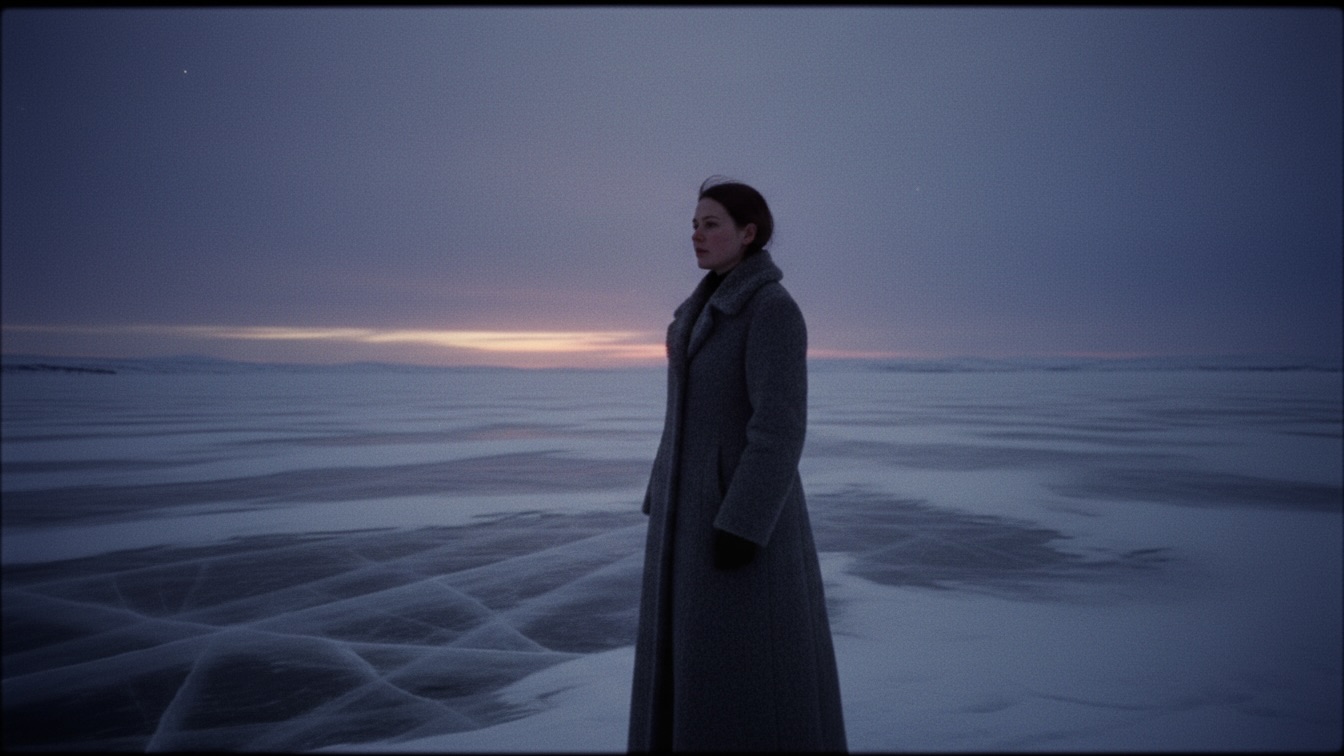
Beat 5: The Thaw (Resolution). Alone by a vast frozen lake at twilight, Anna experiences a profound internal shift. The cold and silence are no longer adversaries but fundamental truths, and she recognizes the living, breathing nature of the land. She understands the case is not about winning but about justice, accepting the collapse of her old worldview and facing an uncertain professional and moral future.
The episode begins with a mood of high-strung anxiety and professional detachment, defined by the rattling plane and Anna's clinical focus. This transitions into frustration and intellectual conflict during her initial meeting with the community, where her control is systematically dismantled. The emotional midpoint is a sharp pivot into shock and awe at the landslide site, followed by the climax, which is deeply melancholic, somber, and moving. The final mood is one of quiet, profound introspection, leaving the audience with the weight of Anna's moral crisis and the haunting beauty of the landscape.
If expanded, Season One would follow Anna's return to Toronto. Haunted by what she saw, she attempts to force a meaningful settlement from Sterling Resorts, putting her in direct conflict with her own firm and the partners who mentored her. This would force her to leak information or work with Mark covertly, risking her career to pursue a form of justice that the legal system is designed to prevent. Her ultimate failure to win within the system would lead to her leaving corporate law at the end of the season.
A multi-season arc would see Anna establishing a small, independent practice dedicated to environmental and Indigenous rights cases. Each season would focus on a single, complex case, pitting her against a new corporate giant and forcing her to confront different facets of the systemic conflict between industry and community. Her overarching story would be a journey from a cog in the machine to one of its most determined opponents, constantly challenged by the immense power and resources of her former world.
The visual language will be built on a stark contrast between two worlds. Anna's life in Toronto is shown through cold, clinical cinematography: controlled, gliding camera movements, sharp architectural lines, and a desaturated, blue-grey color palette. The world is sterile, ordered, and reflected in glass and steel. In contrast, the North is captured with vast, static wide shots that emphasize scale, human insignificance, and the raw, unforgiving beauty of the landscape. Handheld cameras will be used for moments of emotional intimacy or tension, such as the confrontation in the community hall or Anna's reaction at the landslide, to create a sense of immediacy and instability.
The tone is a slow-burn, atmospheric drama with the tension of a legal thriller. It is grounded, naturalistic, and deeply empathetic to the Aanishenu perspective. The mood is somber and introspective, prioritizing character psychology and sense of place over plot mechanics. Tonal comparables include the stark, place-as-character storytelling of Wind River and the sharp, intelligent critique of corporate amorality found in Michael Clayton.
The target audience is mature viewers who appreciate character-driven, socially conscious drama. This includes fans of prestige television series from networks like HBO and streamers like Apple TV+, as well as independent cinema. The ideal viewer is interested in legal and environmental themes, enjoys slow-burn narratives that build to a powerful emotional climax, and is seeking thought-provoking content that explores complex moral questions.
Given the 10-12 minute runtime, the pacing must be deliberate yet efficient. The first act will be atmospheric, using the journey and arrival to establish Anna's character and the oppressive environment. The second act will accelerate the conflict in the community hall before slowing dramatically for the midpoint reveal at the landslide site. The climax—the elders' song—will be a moment of near-stillness, allowing the emotional weight to land before a quiet, contemplative resolution.
Authenticity of location is paramount. Production should take place in a remote, northern environment during winter to capture the genuine, palpable cold and the unique quality of the light. The landscape is not a backdrop but a central character, and its scale and harshness must be felt by the audience.
The landslide site is the key visual set piece. This could be achieved through a combination of a carefully chosen location (such as a quarry or existing logging scar) augmented with VFX and practical set dressing (uprooted trees, debris) to create the necessary scale of devastation. Sound design will be critical, contrasting the overwhelming, textured silence of the wilderness with the intrusive, mechanical sounds of Anna's world (the plane, the clicking of her briefcase) to heighten the thematic conflict.