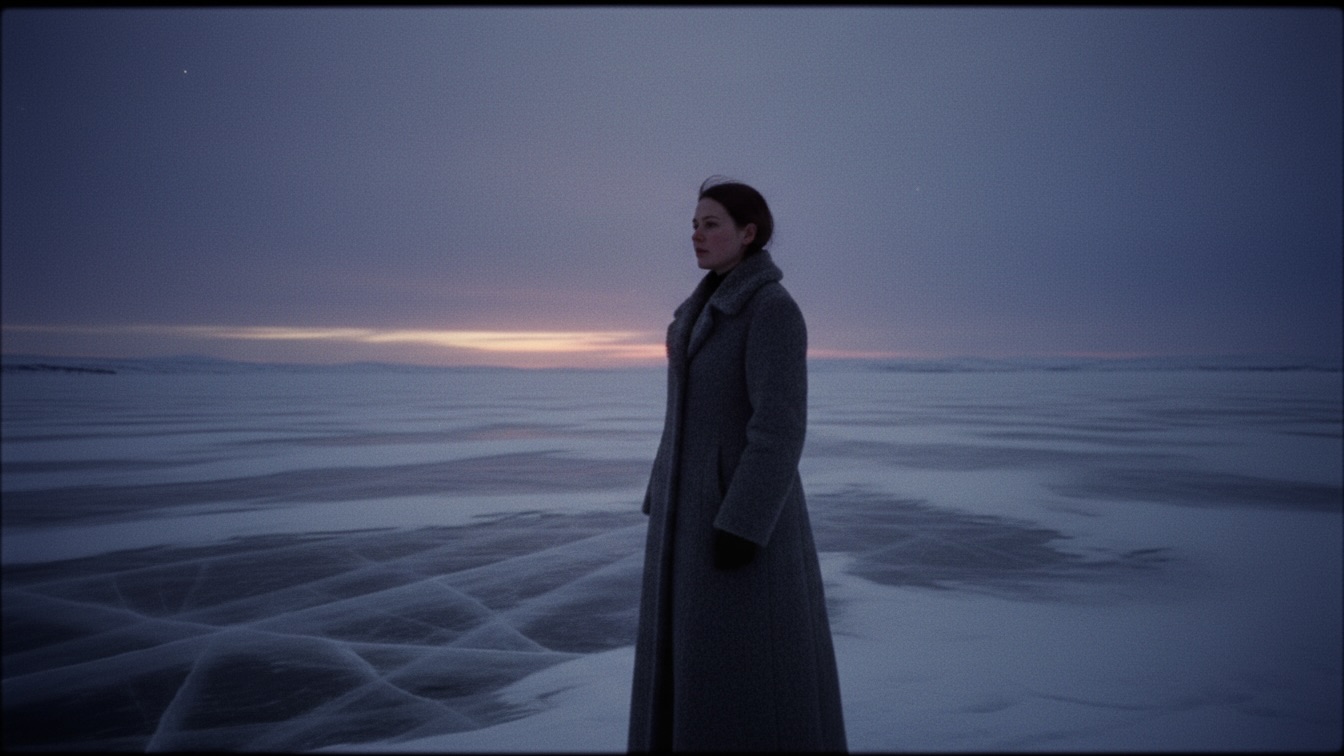
The thin, expensive leather of a luxury boot sole acts as a precarious membrane between a cultivated identity and the brutal indifference of the earth. It is a barrier designed for pavement and polished floors, a symbol of a life constructed on the premise that the environment is something to be paved over or ignored. When that fragile layer meets the unyielding reality of the frozen north, the cold does not merely penetrate the foot; it shatters the illusion of separation between the observer and the world. The chill rising through that inadequate leather becomes an indictment, a physical dismantling of the protagonist’s carefully curated armor, proving that no amount of wealth or status can insulate a human soul from the fundamental, biting truth of the ground beneath them.
The narrative operates within the framework of a legal drama but quickly subverts the genre’s expectations, transforming into an ecological and psychological character study. At its heart, the story explores the collision between two incompatible epistemologies: the Western, corporate worldview that reduces the land to data points, assets, and liabilities, and the Indigenous perspective that views the land as a living relation, a repository of memory, and a moral agent. Anna Hayes enters the narrative as the embodiment of the former, armed with the "clean, sterile" logic of geotechnical reports and legal precedents. Her journey is not one of conquering the opposition through argument, but of having her own perceptual framework dismantled by the sheer, undeniable reality of the environment. The "winter" here is not merely a setting; it is the antagonist to her apathy, an active force that freezes the flow of corporate rhetoric and demands a reckoning with the physical consequences of abstraction.
The narrative voice is strictly first-person, filtered through Anna’s cynical and highly structured mind. Initially, her perception is limited by her profession; she sees the landscape as a "print defect" and the Aanishenu claims as "emotional manipulation." However, the reliability of her narration fractures as the cold permeates her defenses. The text utilizes the imagery of winter to expose the limitations of her "objective" reality. Where she sees "white and grey" and "emptiness," the Indigenous characters see a text written in "broken twigs" and "warmth left on the ground." The narrative arc tracks the disintegration of Anna’s professional certainty, revealing that her reliance on documents and connectivity is a form of blindness. By the end, the silence she feared becomes a source of instruction, suggesting that true understanding requires the cessation of the relentless internal noise of modern life.
Ethically, the story interrogates the concept of "force majeure" or "acts of God" within a legal context. Anna’s initial defense rests on the idea that the landslide was a geological inevitability, absolving her client of responsibility. The narrative challenges this by positing that the separation of human action from environmental reaction is a fallacy. The story suggests a moral universe where the land keeps a distinct kind of score, one that cannot be settled with settlement checks. The existential weight of the chapter lies in the realization that technical correctness does not equate to moral rightness. The "precedent" of the title shifts from legal case law to the ancient, geological precedent of the earth itself—a law of cause and effect that predates and supersedes human jurisprudence.
Psychological State
Anna operates in a state of high-functioning dissociation, maintaining a rigid separation between her professional persona and her physical environment. Her anxiety is somatic, manifesting as a hum in her molars and a frantic need for digital connectivity. The cold acts as a shock to her system, forcibly grounding her in her body and stripping away the dissociation. As the chapter progresses, her psychological state shifts from defensive arrogance to a vulnerable disorientation, and finally to a somber clarity. The winter environment breaks down the compartmentalization she relies on to function as a corporate litigator.
Mental Health Assessment
Her mental health appears precarious, sustained only by the momentum of her work and the validation of "winning." She exhibits signs of burnout—chronic fatigue, cynicism, and a sense of detachment from meaning. Her reliance on her phone as a "phantom limb" indicates a deep-seated fear of isolation and a compulsive need for external validation. The "hairline crack" in her certainty suggests that her resilience is brittle; she is not bending under pressure, she is in danger of shattering. The encounter with the sublime horror of the landslide serves as a traumatic but potentially therapeutic intervention, forcing a reintegration of her values.
Motivations & Drivers
Initially, Anna is driven by the desire to impose order on chaos and to secure a victory for Sterling Resorts, viewing the world as a series of risks to be mitigated. She seeks to validate her own identity through professional competence and the accumulation of status symbols, like her coat and boots. However, the environment and Mark David’s guidance disrupt these drivers. By the end of the chapter, her motivation shifts from winning a legal argument to understanding the "truth" of the landscape. She is driven by a nascent need to align herself with the moral reality she has witnessed, rather than the legal fiction she was hired to construct.
Hopes & Fears
Anna fears irrelevance and the loss of control. The silence of the north terrifies her because it strips away the noise she uses to distract herself from existential emptiness. She fears being "wrong," not just legally, but ontologically—that her entire worldview might be insufficient. Conversely, her hope evolves from a desire for a quick settlement to a yearning for something more profound: a connection to something real, enduring, and "right." She begins to hope for a form of justice that transcends the courtroom, even if it means the dismantling of her previous self.
Psychological State
Mark possesses a grounded, enduring calm that contrasts sharply with Anna’s frantic energy. His psychological state is defined by a deep, integrated grief that does not paralyze him but rather fuels his purpose. He is fully present in his environment, moving with an economy of motion and emotion. The cold does not assault him; he exists in symbiosis with it. His patience with Anna is not born of politeness but of a strategic understanding that she must "see" for herself to understand; he is playing a long game.
Mental Health Assessment
Mark appears psychologically robust, drawing strength from his community and his connection to the land. While he carries the trauma of his people—the loss of the river, the destruction of the sacred site—he processes this through action and ritual (the meeting, the trek to the ridge). He does not exhibit the fragmentation or anxiety that plagues Anna. His mental health is anchored in a collective identity rather than an individualistic one, giving him a resilience that withstands the "winter" of colonial encroachment.
Motivations & Drivers
His primary driver is the protection and restoration of his community and their territory. He is motivated by a duty to the elders and to future generations. Unlike Anna, whose goals are abstract and financial, Mark’s goals are tangible and existential. He seeks to force the legal system to acknowledge the spiritual and physical reality of the Aanishenu lifeworld. He drives Anna to the ridge not to intimidate her, but to bear witness, driven by the belief that the land itself is the most powerful testimony.
Hopes & Fears
Mark fears the total erasure of his culture’s memory and the permanent severance of the bond between his people and the land. The loss of the Ridge of Whispers represents a terrifying break in the continuity of his people's history. His hope is that the truth of the land will prevail over the fiction of the corporation. He hopes that by exposing Anna to the raw wound of the earth, he can spark a recognition of shared humanity and responsibility, turning an adversary into, if not an ally, at least a witness.
The emotional trajectory of the chapter follows a curve of deconstruction. It begins with the high-frequency tension of urban anxiety—the "frantic, rattling shudder" of the plane and Anna’s nervous tic regarding her phone. This initial state is characterized by a defensive superiority; Anna uses her intellect and professional status to distance herself from the discomfort of the environment and the moral weight of the opposition. The cold serves as the primary mechanism of transfer, bridging the gap between the external world and internal feeling. As the physical cold penetrates her "expensive wool," the emotional barrier of professional detachment also begins to freeze and crack, allowing dread and vulnerability to seep in.
As the narrative moves to the community hall and then the ridge, the dominant emotion shifts from anxiety to a profound, heavy silence. The interaction with the elders introduces a weight of grief that cannot be parried with legal arguments. The transition is marked by the failure of language; Anna’s "corporate-speak" withers in the face of Sarah’s song. The architecture of the scene relies on the contrast between the smallness of human maneuvering and the immense, crushing reality of the loss. The emotional climax occurs at the ridge, where the visual shock of the landslide transmutes Anna’s defensive skepticism into horror and, finally, a somber awe.
In the aftermath, the emotional tone settles into a meditative melancholy. The frantic energy of the beginning is replaced by a vast, quiet spaciousness. The "humming" anxiety is gone, replaced by the "sound of the world breathing." This shift indicates a fundamental alteration in the protagonist’s emotional landscape. The fear of the cold transforms into a respect for its honesty. The chapter concludes not with the triumph of resolving the conflict, but with the heavy, resonant peace of accepting a difficult truth. The emotional architecture is built on the realization that some debts are spiritual and cannot be paid, only acknowledged.
The setting of Fort Albany Creek and the surrounding wilderness acts as a psychological mirror that distorts and then clarifies the protagonist's self-perception. In Toronto, Anna’s environment is controlled, heated, and predictable, mirroring her desire for a manageable, billable life. The North, however, represents the uncontrollable unconscious. The "white and grey" geometry is not empty; it is a canvas that refuses to accept her projections. The extreme cold functions as a truth serum, stripping away the artifices of fashion, status, and professional jargon. The physical pain of the cold forces a hyper-awareness of the body and the immediate moment, making it impossible for Anna to retreat into the abstract safety of her case files.
The spatial progression from the claustrophobic aircraft and truck cab to the immense, open expanse of the frozen lake mirrors Anna’s internal expansion. The "scraped gash" of the airstrip and the "raw scar" of the landslide are violent intrusions of the industrial world into the natural one, paralleling the intrusion of the lawsuit into the community's life. The destruction of the Ridge of Whispers is a spatial representation of cultural amputation. By physically traversing this space—struggling in snowshoes, sinking into the powder—Anna is forced to participate in the landscape rather than observe it from a distance. The environment ceases to be a passive backdrop and becomes an active moral agent that dwarfs her human concerns, reorienting her sense of scale and significance.
The prose employs a stark, sensory-driven aesthetic that mirrors the harshness of the environment. The diction shifts from the polysyllabic, Latinate vocabulary of the legal world ("liability," "parameters," "negligence") to the monosyllabic, Anglo-Saxon roots of the natural world ("cold," "snow," "bone," "scar"). This linguistic shift underscores the thematic move from the abstract to the concrete. The imagery is tactile and visceral; the cold is described as "needles," a "predator," and a "physical force." This personification of the elements elevates the setting to the status of a character, one that is indifferent to human status but deeply reactive to human action.
Symbolism is woven tightly into the narrative fabric. Anna’s Italian leather boots serve as a recurring motif of her inadequacy and her misplaced values. They are beautiful but useless, much like her legal arguments in the face of the community's loss. The "file" represents the sanitized version of reality that Anna clings to, while the "snow" and "mud" represent the messy, undeniable truth. The landslide itself is the central symbol: a "wound" in the earth that exposes the violence inherent in the corporate "equation." The contrast between the "noise" of the plane and the "song" of the elders highlights the difference between the chaotic distraction of modern progress and the harmonious, albeit sorrowful, resonance of tradition.
The sentence rhythm mimics the protagonist’s psychological state. The opening paragraphs feature choppy, fragmented sentences that convey anxiety and the jarring motion of the plane. As Anna spends more time in the silence of the North, the sentences lengthen and become more fluid, adopting a contemplative cadence. The final section, where she stands by the frozen lake, utilizes lyrical, expansive phrasing ("The sound of the world breathing in its sleep"), reflecting her internal deceleration and the opening of her mind to the sublime. This stylistic evolution reinforces the narrative arc of a woman moving from a frantic, closed system to an open, receptive state of being.
The story resonates deeply with the genre of Canadian Gothic and Northern eco-fiction, where the landscape is often portrayed as a sublime, terrifying force that exposes the fragility of human civilization. It draws upon the trope of the "outsider" or the "city lawyer" entering a rural or Indigenous community, a narrative structure common in post-colonial literature. However, it subverts the "white savior" archetype; Anna does not come to save the community, nor does she succeed in "saving" her client in a moral sense. Instead, she undergoes a katabasis—a descent into the underworld—represented here by the frozen, death-like landscape, to retrieve knowledge.
The narrative explicitly engages with the cultural and legal tensions surrounding Indigenous land rights and the concept of "oral history" as evidence. This reflects real-world legal battles, such as the landmark Delgamuukw case in Canada, which established the admissibility of oral history in land claims. The clash between Anna’s "Nordic Engineering" report and the elders’ "memory of the riverbank" dramatizes the conflict between Western positivism and Indigenous epistemologies. The story posits that the land itself is a text—a "precedent"—that holds a higher authority than written law. The "Ridge of Whispers" evokes the significance of songlines and sacred geography, where the physical landscape is inextricably linked to cultural identity and spiritual practice.
Furthermore, the story echoes the mythic theme of the "Wounded King" or the "Wasteland," where the health of the land is tied to the moral conduct of its rulers (or in this case, its exploiters). The landslide is not just a geological event but a manifestation of spiritual rot caused by greed and negligence. The "song of mourning" functions as a Greek chorus, articulating the tragedy that the protagonist is complicit in. By framing the environmental damage as the silencing of a voice (the wind in the ridge), the text connects ecological destruction directly to cultural genocide, placing the story within the broader discourse of reconciliation and environmental justice.
What remains most potently after the narrative concludes is the haunting juxtaposition of the sterile legal file against the visceral reality of the "raw scar" on the hillside. The story forces the reader to confront the inadequacy of bureaucratic language to contain or explain human suffering and environmental violence. The image of the landslide, described as a "visceral wound in the white flesh of the landscape," lingers as a testament to the permanent consequences of temporary profit. It challenges the reader to look beyond the "footprints"—the superficial evidence—and consider the "broken twigs," the subtle, systemic impacts of their own society's consumption.
The silence of the ending is heavy with unresolved tension. There is no triumphant courtroom victory, no magical reversal of the damage. Instead, there is a profound sense of loss and a quiet, uncomfortable awakening. The reader is left with the sensation of the cold—not just as a temperature, but as a clarifying agent that freezes away the superfluous and leaves only what is essential. The "song" of the elders echoes in this silence, a reminder that some things, once broken, cannot be fixed, only mourned. This refusal to offer a tidy resolution gives the story its lasting power, placing the burden of the moral question squarely on the reader.
Ultimately, the story evokes a sense of humility. It dismantles the arrogance of the modern belief that the world is an "equation" to be solved or an asset to be managed. It suggests that the earth is a "provider" and a "teacher" that demands reciprocity. The lingering question is not whether Sterling Resorts will win the lawsuit, but whether Anna—and by extension, the reader—can integrate this new way of seeing into a life built on the denial of it. The "tectonic shift" within the protagonist invites the reader to examine their own "fault lines," the places where their constructed lives might fracture under the weight of a greater truth.
The narrative does not end with a gavel banging or a contract being signed, but with the groaning of the ice, a sound that bridges the gap between the geological and the vocal. This auditory hallucination—or perhaps, realization—suggests that the landscape has successfully colonized Anna’s consciousness, replacing her internal monologue of billable hours with the deep, resonant time of the earth. The winter has ceased to be an adversary to be defeated by central heating and court orders; it has become a confidant, whispering a terrifying but necessary wisdom that will likely render her return to the glass towers of Toronto an impossible exile.
There is a distinct melancholy in this transformation, a recognition that to see the world clearly is to lose the comfort of ignorance. The stars that look like "chips of ice" offer no warmth, only a piercing illumination that reveals the smallness of human endeavors. Anna stands on the precipice of a new life, shivering not from the temperature, but from the shedding of her old skin. The frost has done its work, biting through the leather, the wool, and the pride, leaving behind a raw, exposed humanity that is finally, painfully, awake.