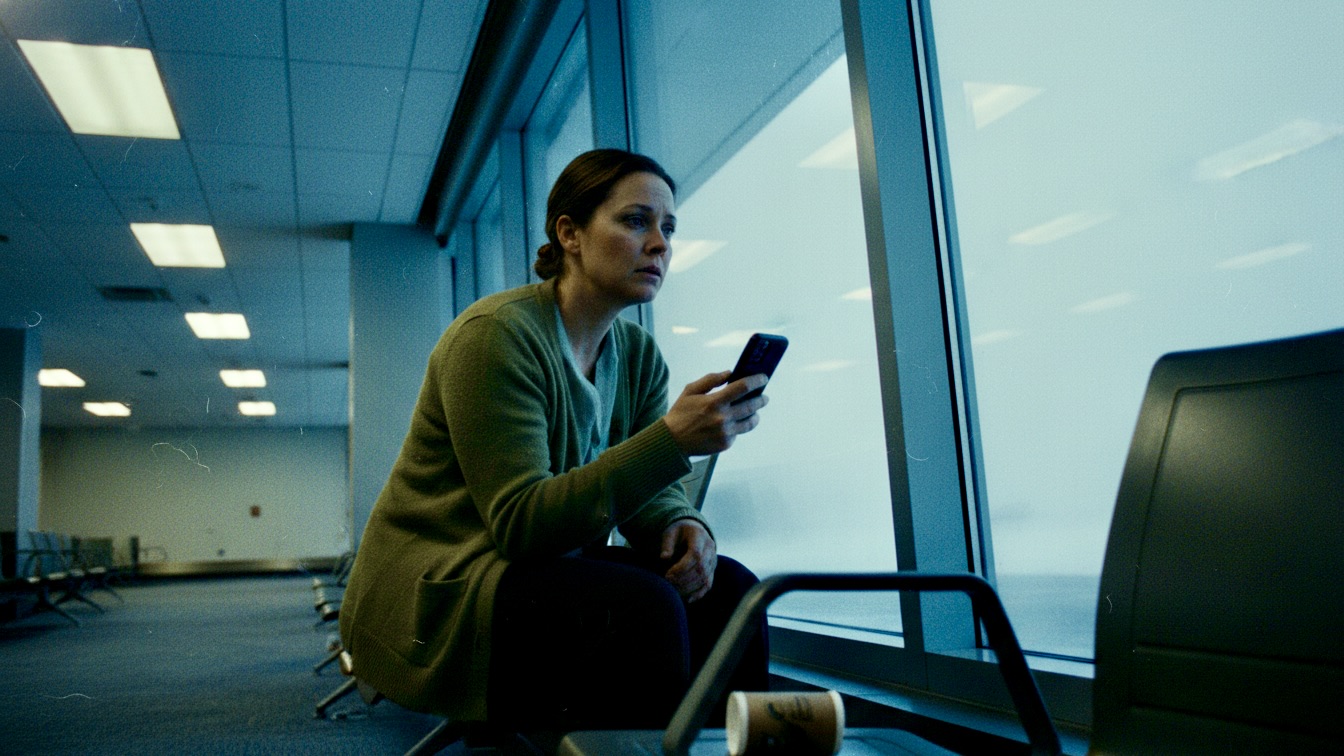
Format: Short Film / Anthology Episode | Est. Length: 10-12 minutes
Imagine a grounded, dramatic anthology series titled GRIDLOCK, where each episode serves as a bottle episode, trapping a different protagonist within a failing system. From a stalled elevator during a city-wide blackout to a family stuck in a bureaucratic nightmare at a border crossing, the series explores how ordinary people confront their breaking points when the infrastructures—physical, social, and economic—we rely on collapse. "The Stalled Ascent" would be a key episode, using the microcosm of a snowed-in airport terminal to examine the erosion of public services, economic anxiety, and the desperate, personal choices that arise from systemic failure.
An exhausted ICU nurse, stranded in a desolate airport terminal by a blizzard, stares at her dead phone. The mechanical groan of a jammed boarding gate is the only sound that breaks the oppressive silence, each grind a reminder that the distance to her critically ill mother is now insurmountable.
Trapped in an airport by a brutal snowstorm and a broken gate, an exhausted nurse must choose between surrendering to her fate or attempting a suicidal cross-country drive to reach her ailing mother. Her decision becomes a desperate battle between professional pragmatism and primal love.
The primary theme is Powerlessness vs. Agency in the face of Systemic Decay. The protagonist is a capable, professional caregiver rendered utterly helpless by a confluence of failing infrastructure (the gate), natural forces (the storm), and personal limitations (a dead phone, exhaustion). The episode explores whether true agency is found in a reckless act of defiance or in the quiet endurance of an impossible situation. It is a microcosm of a society where individuals are increasingly at the mercy of systems beyond their control.
A secondary theme is Duty vs. Self-Preservation. As a nurse, the protagonist's life is defined by a duty to care for others, often at great personal cost. This professional ethos is now locked in a brutal conflict with her most basic survival instincts. The potential drive is not just a physical journey but a moral and psychological one, forcing her to question how much of herself she is willing to sacrifice for the person she loves most, and whether that sacrifice is an act of love or a fool's errand.
The stakes are life and death, both literally and emotionally. The most immediate risk is to the protagonist's mother, whose ambiguous illness could worsen catastrophically while she is unreachable; the protagonist is haunted by the fear of her mother dying alone. Simultaneously, the protagonist’s own life is on the line if she chooses to drive into the blizzard, risking a fatal accident or freezing to death. Beyond this, the stakes include financial ruin from the cancelled trip and lost work, and the profound psychological toll of guilt, helplessness, and making an impossible choice that will define her for the rest of her life.
The conflict is a multi-layered assault on the protagonist. The primary external antagonist is the Environment: a biblical snowstorm that has shut down the world, mirrored by the malfunctioning technology of the jammed boarding gate. These forces represent an indifferent, insurmountable obstacle. A secondary external conflict is the Systemic Apathy of the airport and the broader socioeconomic decay, personified by the resigned factory worker, which underscores her isolation. The core conflict, however, is Internal: The Nurse's ingrained sense of duty and overwhelming guilt are at war with her rational fear and crippling exhaustion. Her own body and mind become a battleground as she fights the impulse to take a suicidal risk against the unbearable weight of inaction.
ANNA, an ICU nurse physically and emotionally depleted from a seventeen-hour shift, is stranded at an airport gate, trying to get home to her sick mother. A severe blizzard has grounded all flights, and to make matters worse, the boarding gate mechanism has jammed, trapping the last remaining passengers in a cold, isolated waiting area. With her phone dead and her charger broken, Anna is cut off, her anxiety for her mother—whose cough sounded serious over their last call—spiraling into a quiet panic.
As the hours drag on, the terminal becomes a purgatory of shared misery. Anna's internal torment is amplified by her surroundings: the incessant hum of fluorescent lights, the garbled, useless announcements, and the presence of other stranded souls, including a laid-off factory worker whose quiet despair reflects the region's economic collapse. The thought of driving the treacherous, multi-day route to Halifax becomes a desperate, terrifying obsession. The choice crystallizes into an impossible dilemma: risk her life on icy roads in a whiteout, or remain a helpless prisoner, consumed by the guilt of abandoning her mother in her time of need.
ANNA (30s): An ICU nurse, professionally competent and compassionate but personally running on fumes.
* Psychological Arc: Anna begins in a state of passive, exhausted despair, a victim of circumstance. Her journey is entirely internal, moving from a state of anxious paralysis to the precipice of a life-altering decision. By the end, she is no longer just a victim; she is an agent, forced to choose between two potentially tragic outcomes, and in making that choice—whichever it is—she reclaims a sliver of control, accepting the immense weight and consequence of her own agency.
FRANK (50s): A factory worker, weathered and cynical, who acts as a foil and a mirror for Anna.
* Psychological Arc: Frank is largely static, representing a man who has already been broken by the system and has settled into a state of grim resignation. He serves as a voice for the broader societal malaise, grounding Anna's personal crisis in a larger context of collective struggle. His final, matter-of-fact reveal that the roads are closed acts as the final catalyst, forcing Anna's hand by transforming her choice from merely dangerous to seemingly impossible.
Opening: The story opens in the cold, sterile purgatory of Gate 42. We establish Anna's bone-deep exhaustion, her dead phone, and the grinding, broken sound of the gate, immediately trapping her and the audience in a state of anxious limbo. Her internal monologue reveals the urgent stakes: her mother's worsening cough and her desperate need to get home.
Inciting Incident: A garbled announcement confirms the "indefinite delay," and the sight of the thick, swirling snow pressing against the windows solidifies the reality that there is no easy way out. This moment crushes any lingering hope of a quick resolution, forcing Anna to confront the full, terrifying scope of her predicament and the powerlessness that comes with it.
Rising Action: Anna's internal state deteriorates as the physical and financial pressures mount, each minor discomfort a fresh torment. Her brief, bleak interaction with Frank, the factory man, externalizes the theme of systemic decay, connecting her personal crisis to a wider societal collapse. The claustrophobia of the terminal intensifies, pushing her mind toward more desperate, irrational solutions.
Midpoint: The idea of driving, once a fleeting, insane thought, solidifies into a tangible, albeit terrifying, option. This marks a shift in Anna's internal state from passive suffering to active, agonizing deliberation. She visualizes the horrors of the drive—the ice, the whiteout, the isolation—pitting her primal fear against the crushing guilt of inaction.
Climax: Frank, having overheard a fragment of news, delivers the final blow: the roads are closed east of Truro, hours from her destination. This news doesn't resolve Anna's dilemma but sharpens it to a razor's edge, transforming the drive from a dangerous gamble into an act of pure, desperate faith against impossible odds. The choice is now absolute: surrender completely, or commit to a potentially futile, suicidal gesture of love.
Resolution: In the final moments, Anna stands up, her expression a mask of grim resolve. She looks from the jammed gate to the terminal exit, the path to the blizzard. The film ends before she takes a definitive step, leaving the audience with the colossal, suffocating weight of her choice, focusing not on the outcome, but on the harrowing moment of decision itself.
The episode begins with a tone of Weary Anxiety, immersing the audience in Anna's physical and mental exhaustion. This slowly builds into a sense of Claustrophobic Desperation as the reality of her entrapment sinks in, with the terminal feeling less like a waiting area and more like a prison. The emotional midpoint is a spike of Agonizing Indecision, a frantic, internal battle between terror and guilt. The climax delivers a feeling of Crushing Futility, before resolving into a final, somber mood of Grim Resolve, leaving the audience in a state of profound tension and empathy, haunted by the ambiguity of Anna's choice.
If expanded, GRIDLOCK would connect these standalone stories through subtle narrative threads and escalating thematic resonance. A recurring news report on the radio or a TV in the background of each episode could detail the cascading effects of the blizzard from "The Stalled Ascent," showing how one system's failure triggers others. For instance, a later episode might feature a paramedic dealing with the fallout of highway accidents caused by the storm, or a family trying to keep their heat on during the subsequent power outages.
The season's arc would not be about a single plot, but about the progressive decay of a society's connective tissue. Characters could have fleeting, "sliding doors" moments, unknowingly passing each other in different episodes—Anna might be the nurse who briefly treats a character from a future episode. This would build a powerful mosaic of a world quietly coming apart at the seams, culminating in a finale where a city-wide event, like a blackout, brings all these disparate struggles into a single, terrifying focus.
The visual style will be grounded, naturalistic, and deeply subjective, locking the audience into Anna's perspective. The cinematography will utilize a shallow depth of field and tight, often handheld, shots to enhance the sense of claustrophobia and internal turmoil. The color palette will be cold and desaturated, dominated by the sterile blues and greys of the terminal, punctuated by the sickly yellow of the fluorescent lights, reflecting Anna's physical and emotional state. The overall tone is one of quiet dread and social realism, emphasizing the weight of the ordinary.
Tonal influences include the stark, character-focused realism of films like Winter's Bone and the oppressive, atmospheric tension of Lynne Ramsay's You Were Never Really Here. The episode should feel less like a constructed drama and more like a captured moment of authentic crisis. The soundscape will be a critical element, contrasting the oppressive, low hum of the airport with the visceral, internal sounds of Anna's strained breathing and pounding heart.
The target audience is mature viewers (25-55) who gravitate towards character-driven psychological dramas and social thrillers. This includes fans of premium cable and streaming series like Chernobyl, Black Mirror, or films from directors like the Dardenne brothers or Kelly Reichardt. The episode is for an audience that appreciates slow-burn tension, thematic depth, and stories that reflect contemporary anxieties about societal fragility and economic precarity, preferring nuanced emotional exploration over plot-driven spectacle.
With an estimated runtime of 10-12 minutes, the pacing must be deliberate and immersive. The narrative will feel as though it unfolds in near-real-time to trap the audience in the agonizingly slow passage of time with Anna. The traditional three-act structure will be compressed: Act One establishes the stasis and stakes; Act Two is the long, internal struggle and rising desperation; Act Three is the sharp, climactic delivery of new information and the final, unresolved decision. There will be no wasted scenes, with every shot and moment designed to deepen the sense of entrapment and heighten the internal conflict.
The production hinges on securing a single, convincing location that can be dressed to look like a slightly dated, forgotten corner of a regional airport. The sense of isolation is key, so the set should feel vast yet empty, populated by only a handful of background actors to heighten the feeling of shared but unspoken misery. The exterior blizzard will be the primary visual effect, achieved through a combination of practical elements (wind machines, snow dressing on windows) and subtle VFX enhancement to create a sense of overwhelming, elemental fury visible through the large terminal windows.
Sound design is paramount. The score should be minimal to non-existent, allowing the diegetic sounds of the terminal—the hum of the lights, the distant, muffled announcements, the groan of the gate, the howl of the wind—to create the oppressive atmosphere. Foley will be crucial for capturing the intimate, visceral sounds of Anna's experience: the rustle of her clothes, the tremor in her hand, the hitch in her breath. These sonic details will be the primary vehicle for conveying her internal state of escalating panic and exhaustion.