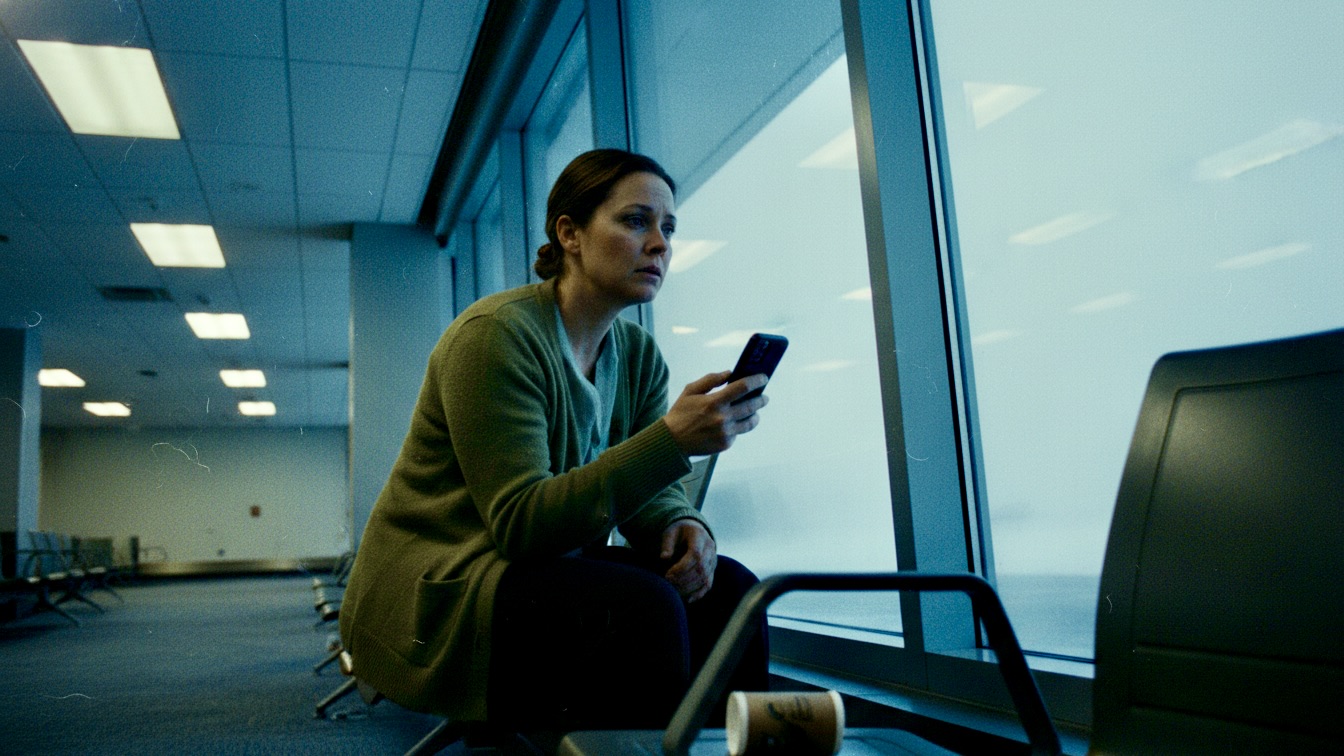
The airport terminal, usually a conduit of kinetic energy, now sits in an enforced stasis, a purgatorial space where the stale air is thick with the metallic tang of recycled oxygen and the faint, persistent hum of unseen machinery.
The automatic gate, Gate 42, was jammed. A dull, grinding sound, like molar on bedrock, had announced its sudden demise an hour ago, trapping us, the last stragglers for the red-eye to Halifax, in a no-man's land between the main concourse and the promised boarding ramp. My own breath, each exhalation a cloud of visible despair in the chill of the unheated waiting area, snagged in my throat.
My head, a persistent knot of pressure behind my eyes, throbbed with the insistent rhythm of inadequate sleep and a caffeine deficit. Another day bled into another night, each moment a dull erosion of my already fraying resolve.
My phone, clutched in a hand that trembled almost imperceptibly, was a dead weight. The charger, a flimsy white cord I’d carelessly tossed into my carry-on, had snapped clean at the connector sometime during the third flight delay announcement. A small, insignificant thing, perhaps, to anyone else, but to me, it felt like the final, deliberate snip of an umbilical cord. No updates. No calls. Just the cold, blank screen reflecting the sickly yellow glow of the overhead fluorescents. I needed to call Mom. Needed to hear her voice, thin and reedy as it was, to confirm she was alright. Her cough, that rasping, wet sound, had haunted my last shift, echoing through the sterile halls of the ICU, overriding the beeps and alarms of the machines.
The ache in my feet had settled into a dull, persistent thrum, a constant reminder of the seventeen-hour shift I’d pulled before this ill-fated escape. My Skechers, usually my allies against the unforgiving linoleum of the hospital, felt like leaden weights. The fabric of my jeans, stiff and unforgiving, chafed against my skin. I could feel the grit under my fingernails, a consequence of absentmindedly picking at my cuticles, a nervous habit that had flared with renewed intensity since the first "indefinite delay" pronouncement. Every muscle in my body felt strung taut, a symphony of minor complaints.
The carry-on, a battered navy blue bag that had seen more emergency room floors than vacation resorts, dug into my shoulder. Its weight, familiar and unwelcome, was a constant drag. I shifted it, trying to distribute the strain, but the dull protest in my trapezius persisted. It wasn't just the physical weight; it was the metaphorical one, the accumulation of all the cancelled plans, the lost money, the escalating worry. Each metallic tang of the recycled coffee I'd forced down hours ago seemed to linger on my tongue, a bitter counterpoint to the sweetness of the vacation I wouldn't have.
The insistent hum of the fluorescent lights above was a low, insidious drone, a constant companion to the growing cacophony of frustrated sighs and low mutters. It felt like the air itself was thick, a miasma of stale coffee, unwashed desperation, and the faint, sweet-sickly scent of disinfectant that always seemed to cling to me, a ghost of my profession. Every now and then, a garbled announcement, muffled by poor speakers, would echo through the vast, impersonal space, only to be met with a collective groan or a dismissive wave of a hand. No one believed them anymore.
Mom. Her last call had been short, clipped, punctuated by that unsettling cough. "Just a bit of a chill, dear," she'd insisted, but her voice had been too thin, too easily winded. As a nurse, I'd cataloged the symptoms instantly: persistent dry cough, lethargy, a slight fever she'd tried to downplay. Bronchitis at best, pneumonia at worst. The thought had lodged itself in my chest, a cold, hard stone. My mind replayed the last doctor’s assessment, a hurried, inconclusive consultation that had ended with a prescription and a dismissive wave. But Mom was stubborn. She'd hate the hospital. She'd rather suffer in silence than be a burden. This trip, this rare, precious weekend, was meant to assuage that gnawing guilt, to finally be there, to see with my own eyes. Now, I was stuck here, powerless, a continent away, a prisoner of a failing machine and an unyielding sky.
Seventeen hours. That was how long my last shift had stretched, a blur of blinking monitors and hushed code calls. The smell of disinfectant, a heavy, cloying presence, still felt embedded in my nostrils. The alarms, urgent and demanding, still echoed in my ears. The understaffed wards, the frantic scramble for supplies, the sheer, crushing exhaustion that pressed down on my chest like a physical weight. Flu season had been a relentless beast, gorging itself on the elderly and the immunocompromised, leaving us nurses drained, hollowed out. Every bed taken, every hallway overflowing. The faces, desperate and weary, of patients and their families, etched themselves into my memory. The moral compromises: which patient got the last available ventilator, which one could wait just a little longer. The raw, chafed skin on my hands from constant washing, the persistent ache in my lower back, the metallic taste of adrenaline that seemed to coat my tongue permanently. I’d barely slept, grabbing a few hours of fitful rest before dragging myself back to the airport, fueled by a desperate hope for escape, a brief respite from the relentless tide of suffering.
The storm outside was a monstrous entity. I could feel the terminal itself shuddering, a low groan reverberating through the concrete and steel as gusts of wind, invisible but immense, buffeted the massive plate-glass windows. Snow pressed against the panes, a thick, swirling curtain that turned the outside world into a blurred, grey expanse, erasing any discernible landmarks, any hint of the city beyond. Sometimes, I thought I could hear a distant thunder, a low rumble that vibrated in my chest, or perhaps it was just the structural groan of the building itself, straining against the elemental fury. A thin, insidious drip of melting snow marked a slow, steady track down the inside of one window, proof of an ill-fitting frame, a minor flaw in the vast, imposing structure, but to me, it felt like a symbol of everything that was failing, everything that was falling apart.
A man, his face a roadmap of hard living, cleared his throat beside me. He'd been pacing for an hour, a caged animal, his worn jacket slung over a shoulder that seemed to slump under an invisible burden. He didn't look at me, but spoke into the stale air, his voice rough, gravelly. "Another bloody delay. My brother lost his pension last month. Factory shut down. Trade deal, they said." His words hung heavy, a bitter, functional truth, not a plea for sympathy, but a statement of shared, inarticulate rage. I just nodded, a slight, almost imperceptible movement, my own throat too tight to offer any platitude. What could I say? I knew the stories. The local paper, when I had time to skim it between shifts, was full of them. Communities gutted, livelihoods dismantled. Another layer of worry, another strata of despair, added to the already crumbling edifice of our shared existence.
The financial pinch was a sharp, persistent ache. The cancelled hotel room in Halifax, non-refundable. The extra night here, at an overpriced airport hotel, if I could even secure one. The endless, exorbitant airport food – a watery coffee for seven dollars, a limp sandwich for fifteen. Each swipe of my debit card felt like a deeper cut, a draining of the precious few savings I had painstakingly accumulated. My mind, exhausted as it was, became a meticulous, agonizing ledger, tallying the losses. The lost shifts at work, the sick days I couldn't afford to take. The rising cost of Mom's medications, her home care. It wasn't just a trip; it was an investment, a desperate attempt to bridge the ever-widening chasm between my life here and her fading one there. And now, the investment was hemorrhaging, bleeding out into the indifferent machinery of delay and disruption.
My gaze drifted to the other stranded passengers, a mosaic of misery. A young couple, their faces pale with exhaustion, huddled together, an unspoken fear palpable between them. An elderly woman, her hands gnarled with age, meticulously rearranging the contents of her oversized purse, a nervous tic of order in the encroaching chaos. And then there was him, the man who’d spoken, now leaning against a pillar, his eyes fixed on the snow-lashed windows. He was a factory man, I knew it from the way he carried himself, the slight stoop of his shoulders, the calloused hands. His brother’s pension, the factory closure – these weren’t just anecdotes. They were the raw, bleeding wounds of a system devouring its own. I imagined the hollowed-out towns, the empty storefronts, the silent machinery, symbols of a prosperity that had somehow, inexplicably, slipped through our collective fingers.
The thought of driving, of getting behind the wheel of my beat-up Civic and pointing it east, clawed at the edges of my sanity. Halifax was a long haul, even in ideal conditions. In this, in a blizzard that felt biblical in its ferocity, it was madness. I pictured the icy roads, a black sheen beneath a fresh dusting of snow, treacherous and unforgiving. Whiteout conditions, the world reduced to a swirling vortex of white, no horizon, no distinction between earth and sky. The sheer physical toll of driving cross-country, the bone-deep fatigue battling against the adrenaline of fear. My hands, cramping on the steering wheel, knuckles white. The hazards, my nursing brain cataloged them almost automatically: hypothermia if I broke down, traffic accidents, head injuries, internal bleeding. The desperate, overwhelming hope of reaching my mother, warring with the cold, rational fear of not making it at all. The crushing feeling of being utterly alone on a frozen, hostile road, the only company the roar of the wind and the whisper of my own escalating panic.
Then, the alternative: another night in this purgatory. The claustrophobia of the airport, the cold seeping into my bones, chilling me to the marrow. The gnawing loneliness, a hollow ache in my gut that no amount of stale airport food could fill. The repetitive drone of the announcements, a broken record of disappointment. The thought of sleeping on a hard, unforgiving bench, my neck cricked at an impossible angle, my body protesting every contact point. The stale, recycled air, thick with invisible particles and the ghosts of a thousand anxious breaths. The profound feeling of helplessness, of being utterly at the mercy of forces beyond my control. And with it, the insidious tendrils of guilt, weaving themselves around my heart. Guilt for choosing comfort, for choosing survival, over the desperate, unquantifiable need to be with my mother. The idea of waking up in this desolate space, the artificial light a cruel mockery of dawn, knowing another day had passed without me reaching her, was almost unbearable.
The knot in my chest tightened, a physical manifestation of the impossible choice. My breath hitched, a small, choked sound that no one else seemed to notice. The man by the pillar had pulled out a tattered photograph, staring at it with an expression I couldn't quite decipher, a mixture of tenderness and profound sorrow. The elderly woman had finally given up on her purse, her hands now clasped tightly in her lap, her gaze vacant. Each person, a silent testament to their own particular brand of quiet desperation, their own individual battles fought in the public space of the terminal. We were all shipwrecked, tossed onto this sterile shore, waiting for a rescue that might never come. My mind, usually so sharp, so focused on the immediate, tangible needs of my patients, felt fractured, pulled in a hundred different directions by fear, exhaustion, and an overwhelming sense of futility. The image of Mom's face, pale and drawn, superimposed itself over the swirling snow outside, a silent plea. Could I risk everything for her? Could I live with myself if I didn't even try? The weight of it, the colossal, crushing weight of that question, pressed down on me, threatening to suffocate me in the stale, recycled air of the terminal.
The decision felt like an amputation. Whichever path I chose, a part of me would be lost, irrevocably severed. The reckless impulsivity of the drive, the sheer audacious defiance of nature's wrath, was appealing in a dark, desperate way. To do something, anything, rather than simply exist in this agonizing limbo. But the image of my car skidding, uncontrolled, into an unseen ditch, played on a loop behind my eyes. The metallic crunch of twisted metal, the searing pain, the dark oblivion. And then what? Would I even reach her? Or would I become another burden, another tragedy for my family to bear? The thought sickened me, a cold wave washing over my already churning stomach. My professional training screamed caution, roared warnings. Survival was paramount. But what was survival without purpose? What was survival if it meant abandoning the one person who had always been my anchor?
The hours bled into a viscous, formless mass. The garbled announcements became indistinguishable, a meaningless drone. My sense of time, always precise in the hospital, where every minute could mean the difference between life and death, had utterly dissolved. My eyelids felt weighted with lead, dragging themselves down, only to snap open again, forced awake by the sharp spike of anxiety whenever a new, frantic thought surfaced. My vision blurred around the edges, the fluorescent lights creating halos of sickly yellow. The air grew colder, or perhaps it was just the chill that had settled deep within my bones, a cold that no amount of shivering could dislodge. My hands, still clutching the dead phone, felt numb, like blocks of ice. A slight tremor ran through my arm, a nervous tic. Was it fatigue, or something more? The vague aches in my joints, the persistent low thrum behind my eyes, they could be anything. Stress. The onset of the flu, perhaps, an occupational hazard I had so far miraculously avoided. The thought made my stomach clench. If I got sick, if I brought the virus home to Mom, what then?
The man by the pillar coughed, a dry, hacking sound that startled me. He looked up, catching my eye for a fraction of a second, his expression unreadable, a mixture of resignation and something akin to defiance. His lips, cracked and dry, parted. "They say the roads are closed east of Truro," he rasped, his voice rough, as if unused to speech. Truro. That was still hours from Halifax. Even if I somehow managed to get out of this airport, managed to find a car rental, managed to fight my way through the initial layers of the storm, I would hit an insurmountable wall. The news, delivered without inflection, without a hint of pity, was another heavy stone dropped into the already murky waters of my dilemma. It didn't solve my problem; it merely reshaped it, traded one impossible choice for another. Now, the drive was not just risky; it was potentially impossible. A fool's errand. A suicidal gesture.
But the thought of surrendering, of simply giving in to the overwhelming force of the storm and the bureaucratic inertia of the airport, felt like a betrayal. A surrender to the impersonal forces that seemed determined to keep me from her. My mother, alone in that old house, her breath rattling in her chest, waiting. Had she eaten? Had she taken her medications? Who was there to check on her? The neighbour, Mrs. Henderson, a sweet woman but frail herself. She wouldn't be able to do much. The image of Mom, huddled under a blanket, her eyes wide with fear, brought a fresh wave of nausea. I had to get to her. I had to.
My gaze fell upon a small group of travellers near a boarded-up kiosk, their faces etched with similar lines of fatigue and worry. They weren't speaking, just existing in a shared space of quiet despair. A woman, her hair streaked with grey, clutched a small, worn teddy bear. A young man, barely older than a teenager, stared fixedly at a laptop screen, its glow painting his face in ethereal blues and greens. Were they also trying to reach ailing family? Were they also trapped by the relentless machinery of modern life and the capricious whims of nature? The shared suffering, however unspoken, felt like a fragile thread, a faint connection in the vast, isolating expanse of the terminal.
The floor of the waiting area was littered with discarded boarding passes, empty coffee cups, and crumpled snack wrappers, a testament to the passage of many miserable hours. Each piece of debris, a small monument to a broken journey. The cleaning crew, usually so meticulous, had clearly given up, overwhelmed by the sheer volume of human detritus. A half-eaten bagel, abandoned on a plastic seat, was already hardening, its crust growing brittle. A discarded newspaper, dated yesterday, proclaimed an optimistic weather forecast, a cruel joke in retrospect. The irony was a bitter pill. Hope, it seemed, was as perishable as day-old bread.
My reflection in the dark glass of the jammed gate showed a woman I barely recognized. Eyes shadowed, hair dishevelled, mouth set in a grim, unyielding line. My nurse's uniform, usually crisp and comforting, now felt like a costume, a faded memory of a life of purposeful action. Here, I was nothing more than a number, a statistic, another cog in the grinding machine of delay. The thought of my patients, the ones I'd left behind, brought a pang of guilt. Who was caring for Mr. Davis, the one who always asked for extra pudding? Or Mrs. Petrov, who only slept if I hummed her lullabies? My absence, however temporary, was a gap in their care, a tiny fracture in the delicate ecosystem of the hospital ward. But my mother… my mother was different. She was my first patient, my longest, my most cherished.
The dull ache in my feet intensified, now spreading up my calves, a slow, creeping burn. I closed my eyes, trying to conjure the image of her face, clear and bright, but it was obscured by the swirling snow, by the hospital lights, by the image of her frail hand, the skin thin as parchment, resting on the white sheet.
I remembered the last time I’d been home, just a few months ago. The smell of her kitchen, warm with cinnamon and something else, something uniquely her. The way she would gently chastise me for working too much, her eyes twinkling with a love so profound it always brought a lump to my throat. That love was a tether, a fragile, invisible cord pulling me eastward, pulling me through the storm, through the exhaustion, through the despair.
A child, perhaps three years old, toddled past, his bright red rain boots squeaking on the linoleum. He clutched a crumpled drawing, a vibrant explosion of crayon colours that seemed impossibly cheerful in this somber setting. His mother, her face drawn, scooped him up, murmuring soft reassurances. The innocence of the child, oblivious to the existential dread that permeated the air, was a stark contrast to the hardened despair of the adults. It was a fleeting, poignant moment, a reminder of the other lives entwined in this disruption, the other reasons people were desperate to get home. Family. The primal pull. It was an instinct, a biological imperative, stronger than logic, stronger than fear, stronger than the most brutal of storms.
My eyes opened, refocusing on the jammed gate. The metal groaned again, a slight, almost imperceptible shift, but it didn't open. It mocked us, a sealed portal to a destination that remained stubbornly out of reach. The man by the pillar had now put away his photograph and was staring at the gate, his jaw clenched, a muscle twitching in his cheek. He was older than me, perhaps in his late fifties, his face weathered by years of sun and hard work. I wondered what he had lost, beyond his brother’s pension. What hopes, what dreams had been sacrificed on the altar of progress and trade deals? His silence, heavy and profound, was more eloquent than any speech. It spoke of a lifetime of small defeats, culminating in this one, larger, more crushing disappointment.
The air conditioning, or heating, or whatever system was struggling to maintain a semblance of comfort, wheezed intermittently, blowing gusts of indifferent, stale air. I shivered, pulling my thin cardigan tighter around me, though I knew it was futile. The cold was an internal beast, a predator gnawing at my resolve. Every tremor that ran through me felt like a concession to the elements, a surrender to the inevitable. My body, usually a finely tuned instrument in the demanding symphony of the hospital, felt clumsy, unresponsive, almost alien. The dry taste in my mouth persisted, a chalky film that no amount of water could dislodge.
My tongue felt rough, sandpapery. I needed to sleep. A real sleep. Not the fitful, anxious dozing I’d managed on the plastic seats, but a deep, restorative plunge into oblivion. But oblivion felt like a luxury I couldn't afford, not with Mom’s face still superimposed over the swirling snow, not with the agonizing choice still hanging, heavy and unresolved, in the stale air.
Another garbled announcement, this one with a slightly more urgent tone. People stirred, a ripple of strained hope passing through the small crowd. But it was just another update on a different flight, a technical glitch rectified for a destination far, far from Halifax. The collective sigh was audible, a sound like deflating bellows. The man by the pillar let out a short, sharp bark of laughter, devoid of humor, a bitter, cynical sound that grated on my already frayed nerves. "They'll send a man to Mars before they get us to the Maritimes," he muttered, loud enough for a few nearby people to hear. A few nodded in grim agreement, a shared moment of gallows humor in the face of insurmountable absurdity. But it didn't ease the tension. It only underscored the pervasive sense of powerlessness.
My heart pounded a frantic rhythm against my ribs. The decision still hung, a sword of Damocles, above my head. The raw, visceral fear of the drive, the absolute terror of being alone on those treacherous roads, vied with the crushing, unbearable guilt of abandoning my mother, of letting her face whatever was coming, alone. My professional self, the nurse, the healer, the protector, demanded action, demanded intervention. But my human self, exhausted and terrified, yearned for safety, for warmth, for the solace of simply giving up. The image of the storm, a white, howling vortex, was seared into my mind. The endless road, stretching into a featureless abyss. The helplessness of being stuck, watching the clock tick, knowing that with every passing minute, her condition might worsen, her breathing become more labored, her eyes more vacant.
I looked at my dead phone, then back at the jammed gate, then out at the relentless snow. The world, it seemed, was determined to keep me here, to keep me from her. But what if the world was wrong? What if the only way was to defy it, to rage against the dying of the light? The words of my mother, always pragmatic, always resilient, echoed in my mind: "Sometimes, dear, you just have to make your own way." But at what cost? At what terrible, irreversible cost? The choice, sharp and agonizing, lingered, a shard of ice in my chest. The very air in the terminal seemed to thicken, pressing in on me, suffocating me with its unspoken demands.
The lights, the distant announcements, the collective weight of silent despair – it all coalesced into a single, overwhelming question. Was I brave enough to risk everything, or was I too afraid to fail? The answer, elusive and terrifying, remained just out of reach, swirling like the snow outside, obscuring the path ahead.
Was I to stay, a prisoner of this sterile, indifferent hub, or was I to brave the tempest, throwing myself against the relentless fury of the world, hoping to find my way through the chaos to her side, or simply to break upon its merciless shores?
The gate remained stubbornly shut.
“Was I to stay, a prisoner of this sterile, indifferent hub, or was I to brave the tempest, throwing myself against the relentless fury of the world, hoping to find my way through the chaos to her side, or simply to break upon its merciless shores? The gate remained stubbornly shut.”